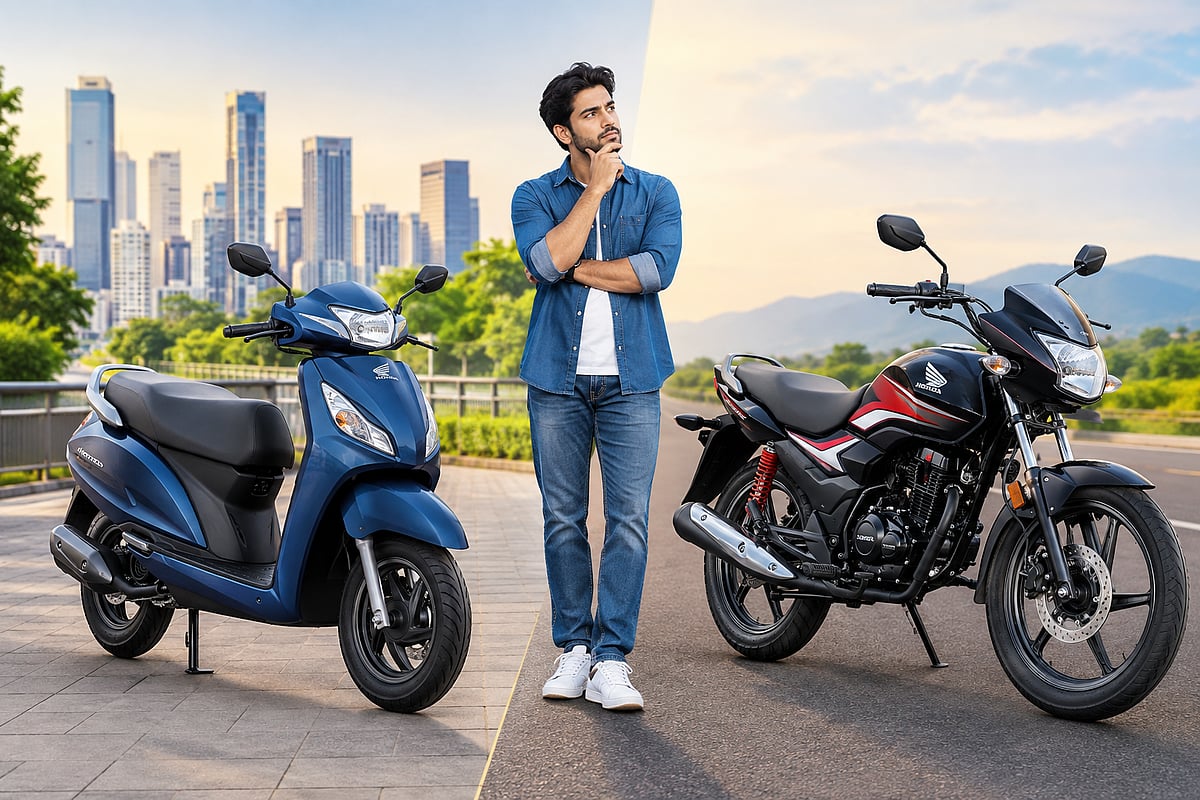
Choosing between Honda scooters and Honda bikes depends on your daily travel habits. Scooters prioritize automatic convenience, storage, and easy city maneuvering. Motorcycles offer more control, broader performance options, and greater flexibility for longer journeys.
Honda’s current portfolio gives buyers options on both sides. Its scooters include models such as the Activa110, Activa125, Dio110, Dio125, Activa e:, and QC1. Honda bikes range from commuter models like the Shine125 and SP125 to the Unicorn, SP160, Hornet2.0, and larger BigWing motorcycles.
Where Honda Scooters and Honda Bikes Fit Differently
Honda scooters generally suit riders who value convenience and short urban journeys, while Honda bikes offer more choice for commuting, performance, and longer-distance riding. Use this as a starting point. Your regular distance, traffic, pillion needs, comfort, and parking conditions should decide the final choice.
When Do Honda Scooters Make More Sense?
Honda scooters make more sense when ease of operation, frequent stops, and practical carrying ability matter most. Popular models differ in engine size, storage, and style:
- Activa 110/125: Classic daily commuter with ample under-seat storage and smooth automatic transmission.
- Dio 110/125: Sportier styling but same practical scooter layout.
- Activa e: Electric variant with swappable batteries via Honda’s network.
- QC1: Electric scooter with home charging and 26-litre storage.
For everyday use, also consider: ease of U-turns and parking, seat and pillion comfort, storage space, suspension over rough roads, braking confidence, and features you will actually use. More features are not automatically better; the useful ones remove friction from your regular journeys.
When Can Honda Bikes Be the Better Fit?
Honda bikes become the stronger option when you want manual control, spend more time on faster roads, or prefer traditional motorcycle ergonomics. The wider range gives you scope to move from basic commuting to sportier or leisure-focused riding.
Choose a bike if you value: greater control over acceleration, longer-distance comfort, more engine-performance options, traditional motorcycle ergonomics, and more flexibility for highway use.
How Does Going Electric Change the Decision?
Electric Honda scooters add two important questions: how far you travel and how you prefer to recharge. The QC1 suits riders who can charge at home, while the Activa e: uses battery swapping. Before choosing an electric scooter, check your average daily distance, home-charging access, battery-swap availability, battery warranty, service support, and pillion/storage needs. Range matters, but charging convenience can matter just as much.
What Should a Test Ride Tell You?
A test ride should show which Honda two-wheeler feels easier to live with every day. For scooters, check low-speed balance, seat comfort, pillion space, storage usability, suspension response, braking feel, and ease of parking. For bikes, also assess clutch effort, gearshift quality, handlebar reach, footpeg position, U-turn confidence, and stability at higher speeds. Specifications tell you what a model has; a test ride tells you whether those specs work for you.
What to Check for Long-Term Ownership
Long-term ownership should include service access, warranty, and recurring costs. Before booking, review distance to the nearest authorized service center, service intervals, warranty coverage, insurance renewal, tire and brake replacement, fuel or electricity costs, battery warranty for EVs, and charging or swapping convenience. A product feature matters most when you understand what it changes after months or years of use.
(Note: The original article also mentions Bajaj Finance Two-wheeler Loan options for financing. While this is a practical consideration for buyers, the final choice should remain comfortable both on the road and in your monthly budget.)
Summary: Which Should You Choose?
Choose Honda scooters if your priorities are automatic convenience, easy city riding, storage, frequent short journeys, and family-friendly usability. The Activa range offers familiar everyday practicality, the Dio range adds a sportier character, while the QC1 and Activa e: provide two different approaches to electric mobility.
Choose Honda bikes if you value greater riding control, more performance options, longer-distance usability, and wider choices from commuter to premium. The Shine125 and SP125 focus on commuting, the Unicorn adds a relaxed 160 cc experience, while the Hornet2.0 moves toward sportier riding.
The right Honda two-wheeler is not the one with the longest specification sheet. It is the one whose engine or battery, comfort, features, and ownership requirements fit the journeys you make most often.