
Overview
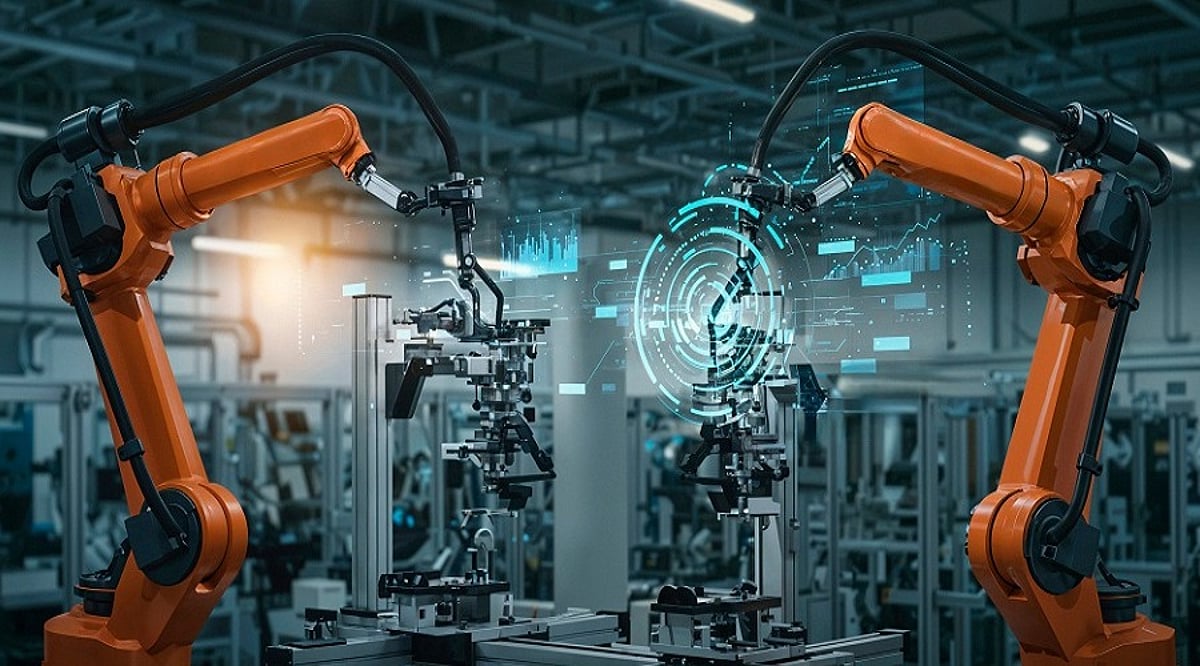
AI-powered machine vision enables robots to perceive, interpret, and respond to real-world environments using advanced sensors, deep learning, and real-time decision-making. Modern vision systems improve robotic capabilities such as adaptive object handling, quality inspection, autonomous navigation, and safe human-robot collaboration across industries. Advances in vision-language-action models, edge AI, and intelligent automation are making robots more flexible, efficient, and capable while addressing increasingly complex tasks.
From Blind Automation to Visual Intelligence
Traditional robotic cells depend on precision fixtures, fixed trajectories, and tightly structured environments. A part out of place stops the line cold. Modern systems replace that rigidity with cameras, depth sensors, and trained models that estimate an object’s position and orientation in real time. Machine vision has evolved from an optional sensing layer into a core component that directly shapes perception, planning, and control.
Inside the AI Vision Stack
Perception in a modern robotic system moves through several layers. Sensors, ranging from 2D cameras to time-of-flight units and lidar, capture raw visual and spatial data. Many systems now push early processing directly into the sensor itself and onto edge devices near the robot. This cuts latency and bandwidth before data ever reaches the main compute unit. Deep learning models handle detection, segmentation, and pose estimation. Most run on convolutional networks or transformer architectures. Robots often mix input types too, pairing RGB cameras with depth sensors and force feedback, so one missed signal does not stop the whole task.
What sets current systems apart from older automation is the tight link between what a robot sees and what it does next. The system reads what it sees and acts on it right away. It adjusts grip or movement mid-task instead of waiting for a person to check the work first.
New Capabilities This Unlocks
- Adaptive pick-and-place: A robot estimates the pose of a randomly oriented part directly from a mixed bin, work that once demanded a custom fixture for every product variant.
- Inline inspection systems: Built on convolutional networks and vision transformers, they catch scratches, weld defects, and misaligned assemblies that rule-based image checks routinely miss.
- Safe human-robot collaboration: Cobots track a person’s position and proximity closely enough to slow down before a collision rather than after one, letting them work near people without a safety cage.
- Autonomous mobile robots: Use vision-based mapping to reroute around a spilled pallet or a parked cart without needing the warehouse floor plan reprogrammed.
- Vision-language-action models: Such as Figure AI’s Helix and NVIDIA’s GR00T N1, these pair a vision-language backbone with a fast motor-control policy, letting a robot act on an instruction like ‘pick the damaged blue container’ instead of only flagging objects it was separately trained to detect.
Together, these shifts underpin Industry 4.0, where flexible, data-driven automation replaces fixed programming across a plant floor.
Where This Shows Up Today
- Manufacturing: Plants use vision-guided bin picking and defect classification to shorten quality checks and catch problems earlier in the line.
- Warehousing: Barcodes are read visually, and routes are adjusted around clutter without fixed paths, letting operators redesign storage layouts without reprogramming every route.
- Agriculture: Robots and drones scan crop rows for early signs of disease.
- Healthcare and retail: Service robots identify people, signage, and obstacles well enough to navigate spaces never built with a machine in mind.
Limits and Open Problems
A model trained on one factory floor or one lighting setup often struggles on another. Closing that gap remains active engineering work, not a solved problem. Creating the labeled datasets needed to train these systems is expensive, so manufacturers increasingly use synthetic images generated from digital twins to reduce data collection costs. Dust, reflections, and sensor failure still test the limits of what a camera-based system can handle reliably. Safety certification for vision-driven decisions has not kept pace with the technology itself, and operators still need clear evidence of what a robot ‘saw’ before trusting its judgment call.
Final Thoughts
Vision-language-action models point toward robots that take a spoken instruction and work out the steps themselves—without a specialist rewriting detection rules for every new task. That shift, from programming behavior to describing intent, is the next real test for factories deciding how much autonomy to hand a machine.