Tag: intellectual property

  • Tetris Company Disavows White House ‘Build the Wall’ Game, Cites Copyright Infringement

    Tetris Company Disavows White House ‘Build the Wall’ Game, Cites Copyright Infringement

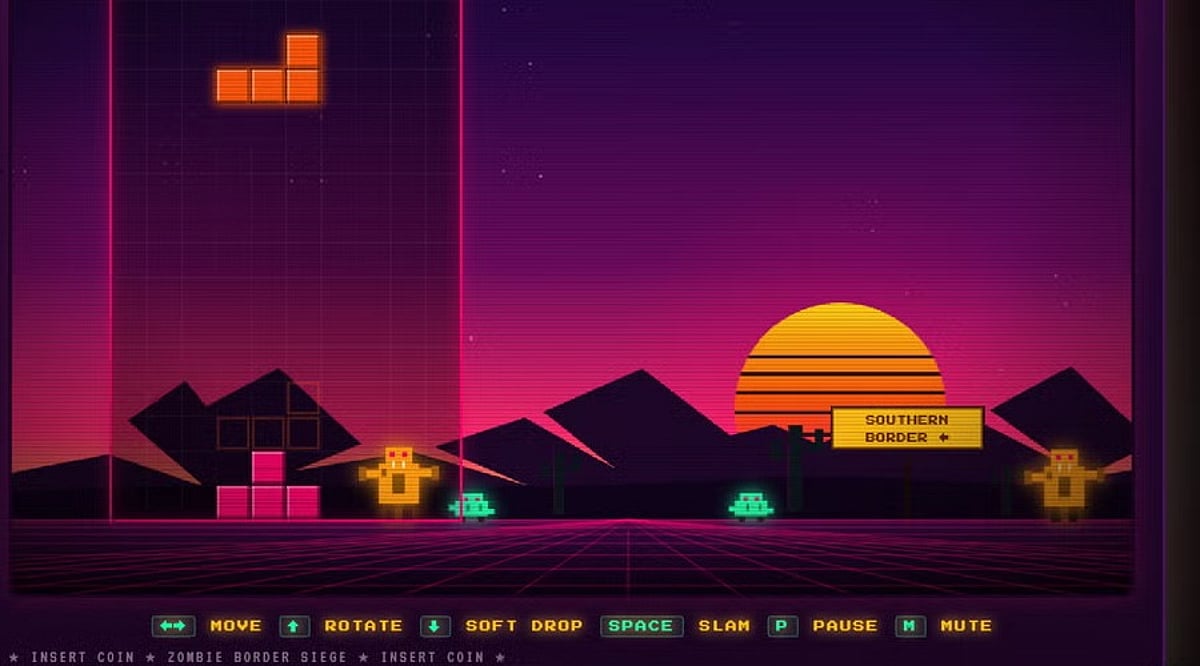
    The Tetris Company has publicly disavowed a Tetris-style game launched by the White House, stating it did not create or authorize the use of its brand or intellectual property for the politically themed ‘Build the Wall’ game.

    The controversy began when the Trump administration added ‘Build the Wall’ to its new White House Arcade. The browser game uses falling blocks and stacking mechanics that closely resemble the classic Tetris format, but with a border-security theme. Despite the Tetris Company’s statement, reports indicate the game has not been removed from the White House website.

    Tetris Raises Copyright Concerns

    On September 4, 2026, The Tetris Company issued a statement via social media, criticizing the game. The company stated, “At Tetris we believe in the power of connection and bringing people together, not dividing them. To our fans everywhere: we love you, we see you, and we’re grateful to have you in our community.”

    The caption of the image also read, “P.S. The Tetris Company was not involved in the creation of ‘Build the Wall’. P.P.S. We take copyright infringement very seriously.”

    Future Strategies

    The response could potentially lead to a wider intellectual-property dispute if the company chooses to pursue formal action. However, no lawsuit or court ruling has been reported in the latest coverage. The company also said it was reviewing the matter, stressing its serious stance on copyright infringement.

    The response further highlighted the contrast between Tetris’ message of bringing people together and the political purpose attached to the White House game.

  • AI Copyright Showdown in 2026: Key Lawsuits, Fair Use Questions, and What’s Next for Creators

    AI Copyright Showdown in 2026: Key Lawsuits, Fair Use Questions, and What’s Next for Creators

    Generative AI has revolutionized digital content creation, but it has also sparked one of the biggest copyright debates in technology. Courts across the US and Europe are determining whether AI companies can legally use copyrighted artworks without creators’ consent to train image-generating models. The outcomes of these cases could reshape AI development, licensing, and digital creation for years to come.

    The legal issues extend beyond ownership of AI-generated images. They also cover fair use of copyrighted material for AI training, whether AI-generated content infringes existing IP rights, and how creators can be compensated when their work benefits AI models.

    Major Lawsuits Defining the Future of AI Copyright

    Several landmark court cases are underway. Artists Sarah Andersen, Kelly McKernan, and Karla Ortiz are testifying in the closely watched Andersen v. Stability AI case. They argue that their copyrighted work was illegally used to train AI image models from Stability AI, Midjourney, and DeviantArt. This case is expected to become a pivotal development in copyright law and a major influence on AI technology’s future.

    Stability AI also faces lawsuits from Getty Images, which claims the company’s AI tool was trained on millions of its licensed photos without permission. Litigation continues in the US, while a UK court previously ruled against Getty’s copyright claims, allowing only a limited trademark ruling.

    Meanwhile, Disney, Universal, and Warner Bros have filed lawsuits against Midjourney for allegedly using their characters—including those from Star Wars, Marvel, and Shrek—without permission in its image generator. Midjourney argues its AI training falls under the “fair use” doctrine, making this one of the most important tests of AI copyright law to date.

    Why These Cases Matter

    These landmark decisions will determine whether training AI models on copyrighted art without permission constitutes fair use. The rulings will redefine future technology development, dataset licensing requirements, and fair compensation for digital creators.

    Copyright Rules Continue to Evolve

    Another major issue is whether AI-generated images themselves qualify for copyright protection. The US Copyright Office has long held that works produced solely by AI are not eligible for copyright, reflecting the traditional need for human creativity.

    By late 2025, industry estimates placed the number of generative AI copyright lawsuits—covering training data, generated graphics, and intellectual property rights—at over 50. As AI image generators grow more powerful and popular in advertising, design, entertainment, and marketing, the debate has become more urgent.

    AI companies say they need massive datasets to train innovative models, but artists, photographers, and media companies argue their copyrighted works should not be used without consent or compensation. As governments and courts interpret existing copyright laws for the AI era, 2026 is emerging as a pivotal year. The decisions made now will likely set the course for training AI models, safeguarding creators, and introducing new copyright laws or alternative licensing systems for datasets.

  • China Accuses US AI Firms of Illegally Distilling Chinese Models, Escalating Tech War

    China Accuses US AI Firms of Illegally Distilling Chinese Models, Escalating Tech War

    China has formally accused American artificial intelligence companies of using AI models developed by Chinese firms to train their own platforms, intensifying the technology rivalry between the world’s two largest economies. The accusation, delivered by the Chinese Ministry of Commerce on Monday, claims that “many American artificial intelligence enterprises have distilled Chinese models during their research, development and training processes.” The statement comes just days after the United States accused Chinese companies of copying proprietary American AI technology.

    Distillation at the Heart of the Dispute

    The conflict revolves around AI model distillation, a common technique where a smaller model learns to replicate the performance of a larger, more capable one. This process reduces computational costs while preserving most of the original model’s capabilities, making it widely used across the industry. However, U.S. officials allege that some Chinese firms have used distillation to reproduce advanced U.S. AI systems without authorization. Beijing has denied these allegations, calling them “lacking factual basis and legal grounds,” and accusing the U.S. of “double standards” and “artificial intelligence hegemonism.”

    AI Race Heats Up

    The latest exchange follows reports that a senior White House official accused Chinese startup Moonshot AI of illegally copying Anthropic’s advanced AI model to create its highly anticipated Kimi K3. The release of Kimi K3 garnered significant attention in the tech world as it competed strongly with top global AI models. According to IDC, global AI spending—encompassing AI-powered applications, infrastructure, and related services—is expected to surpass $631 billion by 2028, underscoring the strategic importance of AI across industries. Intellectual property, model development, and governance disputes are becoming increasingly common amid this surge in investment.

    China Signals Potential Countermeasures

    China maintains that model distillation is standard industry practice and that American AI firms have also benefited from Chinese-generated models. The ministry added, “China will take all necessary measures to firmly safeguard its legitimate and lawful rights and interests.” The charges follow a warning by U.S. Treasury Secretary Scott Bessent that Washington could impose restrictions on Chinese entities, and reports suggest the U.S. is considering restrictions on some foreign-developed open-source AI models. These developments highlight the growing importance of AI as a major flashpoint in the broader technological and geopolitical rivalry between the U.S. and China.

  • Silicon Valley Divided: US Tech Giants Disagree Over Access to Chinese AI Models

    Silicon Valley Divided: US Tech Giants Disagree Over Access to Chinese AI Models

    Chinese AI models are creating a policy split across Silicon Valley as their cost, access, and technical ability improve. OpenAI and Anthropic want tighter controls on some Chinese systems, while Nvidia, Microsoft, Meta, and other companies support continued access to open models.

    The dispute has grown after Z.ai and Moonshot AI released new systems that compete with leading American products. The debate now covers national security, intellectual property, software access, and competition within the US technology sector.

    Chinese AI Models Raise Security Concerns

    Anthropic has accused DeepSeek, Moonshot AI, and MiniMax of using Claude outputs to improve competing systems. The company said the firms created about 24,000 false accounts and generated more than 16 million exchanges with Claude. Anthropic described the activity as “industrial-scale” extraction. The Chinese companies have not publicly accepted those claims, and the allegations have not been independently proven. Beijing has also rejected similar accusations as “groundless.”

    OpenAI and Anthropic have reportedly urged US officials to consider tighter controls on Chinese open-weight models. Their position treats advanced model files and training methods as valuable technology that needs stronger protection.

    Treasury Secretary Scott Bessent has said the administration may consider sanctions against companies that steal American AI property. White House technology adviser Michael Kratsios has also raised concerns about large-scale copying from US models. Officials have not announced a broad ban.

    Tech Leaders Defend Open Model Access

    Nvidia chief executive Jensen Huang has called for both closed and open frontier models. Microsoft chief executive Satya Nadella has also said open software supports a healthy AI market. Executives from Meta, IBM, and Palantir joined a letter backing open access.

    Their companies benefit when developers can test and deploy many models. Cloud providers gain more computing demand, while chipmakers sell hardware used to run the systems. Startups also use lower-cost models to avoid high fees from closed platforms.

    Supporters say open-weight systems allow developers to inspect, adapt, and host software on their own servers. They also argue that broad restrictions could reduce competition and give large closed-model companies more control over the market.

    Nearly 200 companies linked to the Little Tech Association reportedly asked Washington to avoid blanket restrictions. They supported action against proven intellectual property theft but opposed blocking models already available across global platforms.

    OpenAI appears to support open-weight AI in general while seeking targeted controls on Chinese systems. That position separates wider software access from concerns linked to specific companies and alleged data misuse.

    Chinese Providers Expand Through Lower Costs

    Chinese AI models have gained users through lower prices and open access. Developers can download some models, adjust them, and run them without relying on a single provider. That approach can reduce costs for coding, research, and automated tasks.

    Moonshot AI’s Kimi K3 and Z.ai’s GLM-5.2 have drawn attention after strong benchmark results. Users have also adopted DeepSeek and other Chinese systems for business tasks. Some American companies are testing them to cut operating expenses.

    The models still face limits, as independent evaluators say leading US systems offer stronger performance across a wider range of tasks. Chinese providers also face capacity pressure, financial losses, and export controls on advanced chips.

    Washington now appears to be considering targeted measures instead of a full ban. Such action could focus on companies accused of data theft or security risks. Meanwhile, open-model supporters want the government to protect US technology without limiting lawful access.

  • Midjourney Demands Disney, Universal, and Warner Bros Disclose Internal AI Projects in Copyright Battle

    Midjourney Demands Disney, Universal, and Warner Bros Disclose Internal AI Projects in Copyright Battle

    In a significant escalation of the ongoing copyright dispute, the AI image generator Midjourney has asked a federal court to compel Disney, Universal, and Warner Bros. Discovery to hand over detailed records of their own internal use of generative AI technology. The demand represents an aggressive tactical shift that could reshape how the courts evaluate evidence in AI-related copyright litigation.

    How the Lawsuit Reached This Point

    Disney and Universal originally filed suit against Midjourney in June 2025, alleging its models could produce unauthorized renditions of iconic copyrighted characters such as Bart Simpson and Darth Vader. Warner Bros. Discovery followed in September 2025, adding its own stable of characters including Batman and Superman. The studios sought an injunction and statutory damages of up to $150,000 per infringing work. Midjourney has consistently argued that its use of publicly available images for training constitutes fair use.

    What Midjourney Is Now Demanding

    The case has moved into the discovery phase, the stage where both parties exchange evidence. Midjourney is now seeking far broader disclosure than initially granted by a court order in June 2026, which limited the studios’ obligations to AI use in consumer products only. The company is asking the court to remove that restriction entirely and require the studios to produce internal documents covering AI business strategies, training datasets, model weights, board-level presentations, and every prompt that studio employees have entered into Midjourney’s platform — not just the specific prompts linked to the allegedly infringing images at the heart of the case.

    The Legal Theory Behind the Request

    Midjourney’s motion relies on the legal doctrine of “unclean hands”: if the studios themselves use generative AI internally for storyboarding or early-stage concept work without properly licensing every image, that could indicate the industry treats such AI training as standard, unlicensed practice. In its court filings, Midjourney contends that this evidence could show the studios are engaging in the very conduct they are suing over. The studios’ lead attorney, David Singer, has dismissed the request as a “fishing expedition,” maintaining that the case is narrowly about stopping unauthorized copying and distribution of copyrighted characters, not about halting AI development or shutting down Midjourney.

    Why This Discovery Fight Matters Beyond This Case

    Legal observers are closely watching the outcome, as the court’s ruling on what evidence is admissible could set a precedent for numerous other AI copyright cases moving through the judiciary. If Midjourney succeeds in obtaining the studios’ internal AI records, it could fundamentally alter how courts weigh fair use arguments and industry-custom defenses in future disputes between AI companies and content owners. For now, the case stands as a pointed illustration of a central tension in the generative AI industry: media companies suing over unauthorized AI training while facing questions about their own internal AI practices.

    This article is based on reporting originally published by Analytics Insight on July 7, 2026.

  • Taylor Swift Files Trademarks to Shield Her Voice and Image from AI Deepfakes

    Taylor Swift Files Trademarks to Shield Her Voice and Image from AI Deepfakes

    Pop superstar Taylor Swift has submitted trademark applications for two audio clips and one photograph of herself, marking a strategic move to protect her identity from unauthorized artificial intelligence-generated deepfakes, according to a trademark attorney.

    Swift’s company, TAS Rights Management, is listed as the owner of the image and audio snippets in filings made with the US Patent and Trademark Office on Friday. The applications come amid a surge of AI-generated content that has misappropriated Swift’s voice and likeness, including explicit imagery, fake political endorsements, and deceptive advertisements.

    One of the audio samples features Swift saying, “Hey, it’s Taylor Swift, and you can listen to my new album, ‘The Life of a Showgirl,’ on demand on Amazon Music Unlimited.” The photograph she is seeking to trademark shows her performing live in a sequined costume while holding a pink guitar.

    Trademark attorney Josh Gerben, who first reported the filings on his blog, explained that these applications “are specifically designed to protect Taylor from threats posed by artificial intelligence.” He noted that while existing ‘Right of Publicity’ laws offer some protection against unauthorized use of a famous person’s likeness, “trademark filings can offer an additional layer of protection.”

    Gerben highlighted that registering a celebrity’s voice as a trademark is a novel legal strategy that has not yet been tested in court. Traditionally, vocalists have relied on copyright laws to safeguard their recorded songs. However, AI technologies now allow users to generate entirely original content that mimics an artist’s voice without copying an existing recording, creating a legal gap that trademarks might help fill.

    Similarly, the image Swift is attempting to trademark serves a comparable purpose. “Swift’s team may gain additional grounds to pursue claims against manipulated or AI-generated images that evoke her likeness by protecting a distinctive visual, down to Swift’s frequently worn jumpsuit and pose,” Gerben wrote.

    Actor Matthew McConaughey has already secured similar trademark protections. “We want to create a clear perimeter around ownership with consent and attribution the norm in an AI world,” McConaughey told the Wall Street Journal in January.

    If successful, Swift’s approach could establish a new legal standard for how public figures protect their likenesses in the age of AI, potentially shaping the future legal framework for combating AI impersonation in the entertainment industry.