
Tag: interview questions

  • Top CSE and IT Interview Questions Every Fresher Should Master

    Top CSE and IT Interview Questions Every Fresher Should Master

    Recruiters evaluate far more than technical knowledge in a first CSE or IT interview. They assess problem-solving, communication, coding fundamentals, and project understanding across every interview stage. A structured preparation plan focused on concepts, practical scenarios, and consistent practice helps candidates build confidence and perform better.

    The Question Behind Every Question

    Most freshers walk into their first technical interview expecting a quiz. What they actually face is closer to an audit of how they think. A recruiter asking about linked lists rarely cares whether the definition is memorized. They want to see reasoning happen in real time: how a problem gets broken down, where the logic might fail, and how clearly that thinking gets explained out loud.

    A first CSE or IT interview, whether for a campus placement drive or an entry-level software developer role, usually spans programming, data structures, object-oriented concepts, databases, operating systems, networks, and behavioral rounds. The exact mix shifts with the role. A developer position leans heavily on coding and algorithms, while IT support or infrastructure roles lean more on troubleshooting and systems knowledge.

    Programming: Where Code Quality Gets Tested

    Programming questions reveal how a candidate writes and reasons about code, not just whether syntax gets remembered correctly. Common ground includes the difference between a compiler and an interpreter, how loops and conditionals behave, and how a broken program gets debugged. Interviewers watch closely for whether a candidate clarifies the problem first, writes readable code, and checks edge cases before calling a solution finished. Estimating the time and space complexity of a solution matters here too, even for problems that look simple on the surface.

    Data Structures and Algorithms: Where Efficiency Gets Tested

    DSA questions move the focus from writing code to choosing the right approach. Expect arrays, linked lists, stacks, queues, hash tables, trees, and graphs to come up regularly. A candidate might be asked to detect a cycle in a linked list or compare breadth-first and depth-first search. These questions judge algorithmic thinking and awareness of trade-offs between time and space. Recognizing patterns across problems matters more than memorizing solutions.

    Object-Oriented Programming: Where Design Thinking Gets Tested

    Object-oriented questions assess how a candidate structures software rather than how many terms they can define. Encapsulation, inheritance, polymorphism, abstraction, and the difference between overloading and overriding come up often. A simple example, such as a payment system supporting multiple payment methods, tends to surface how abstraction works in practice. Freshers also face basic version control questions, including the difference between Git and GitHub or how a merge conflict gets resolved. Since most entry-level roles involve collaborative codebases.

    DBMS and SQL: Where Data Modeling Gets Tested

    Database questions check whether a candidate understands how applications store and protect information. Primary and foreign keys, normalization, joins, indexes, and ACID properties form the core of this section. Recruiters ask about normalization to assess scalable database design, not a textbook definition. Writing a basic query or explaining how an index speeds up lookups while adding storage overhead signals genuine practical readiness.

    Operating Systems and Networks: Where Resource Management Gets Tested

    Operating system questions cover processes versus threads, deadlock, virtual memory, and context switching, testing how well a candidate understands resource management. Networking questions typically include TCP versus UDP, DNS, and how to troubleshoot a system that cannot connect to the internet. These areas carry extra weight for infrastructure and cybersecurity roles.

    Real Scenarios: Where Problem Ownership Gets Tested

    Scenario questions reveal how a candidate responds when something breaks. A recruiter might ask what gets checked first when a user cannot log in or how a slow website gets investigated. Developers face similar scenarios framed differently: debugging a failing API or tracing a slow database query. A strong answer follows a clear sequence: identify the issue, gather information, isolate the cause, test a fix, and communicate the result. Many interviewers care more about how a candidate explains an imperfect solution than how fast they reach the optimal one. Online assessments and recorded video screenings now appear before many technical rounds, so coding tests, aptitude sections, and SQL exercises are worth expecting alongside live interviews.

    Coding Round vs Technical Round

    Not every company tests the same way. Service-based companies such as TCS, Infosys, and Wipro emphasize core CS fundamentals, aptitude, and basic coding over advanced algorithms. Product-based companies place far more weight on DSA and multiple rounds of coding interviews. Startups often focus on projects and how quickly a candidate can debug real, messy code. Knowing which category a target company falls into helps direct limited preparation time toward what actually gets tested.

    Projects and Behavioral Questions: Where Ownership Gets Tested

    Project questions separate candidates who understand their résumé from those who simply list technologies. Expect questions on personal contribution, technology choices, and lessons learned from mistakes. The STAR method, covering Situation, Task, Action, and Result, works well for structuring behavioral answers.

    A Preparation Plan That Actually Works

    A focused plan beats scattered revision. Reading the job description first identifies which technologies matter most. Revising one core subject a day, rather than cramming everything at once, builds retention. Solving coding and SQL problems under a time limit builds speed. Rehearsing project explanations aloud builds fluency under pressure. Keeping a short error log, noting each mistaken concept and its correction, turns preparation into a measurable cycle instead of passive review.

    Final Thought

    The candidates who stand out rarely know more facts than everyone else in the room. They connect concepts to real problems, explain their reasoning without hesitation, and treat an interview as a conversation rather than an exam. That shift in mindset, more than any single answer, is what separates a strong first impression from a forgettable one.

  • Top Golang Interview Questions for Freshers and Experienced Developers in 2026

    Top Golang Interview Questions for Freshers and Experienced Developers in 2026

    This guide covers the best Golang interview questions for freshers and experienced developers, including core concepts like goroutines, channels, interfaces, error handling, generics, and performance optimization to help you prepare confidently for technical interviews.

    Go has firmly established itself as one of the most in-demand backend programming languages, powering infrastructure at Google, Uber, Dropbox, Docker, and Kubernetes. Its combination of simplicity, fast compilation, built-in concurrency, and low memory footprint has made it the default choice for cloud-native services, microservices, and high-throughput API development.

    Whether you are a fresher entering the job market or an experienced developer preparing for a senior role, Go interviews follow a predictable structure and knowing which topics matter most makes preparation considerably more efficient.

    Fresher-Level Fundamentals: What Interviewers Always Start With

    For beginners in Go, aspirants must be prepared for questions that will help determine how much the candidate understands about the philosophy behind Go as opposed to its syntax. The most frequently asked question in any beginner Go test involves distinguishing between the different data types in Go, especially between arrays and slices.

    In Go, arrays are static data structures whose size is specified during compilation. Slice on the other hand, is a dynamic view of the underlying array and understanding what it consists of – pointer, length and capacity – is crucial.

    Pointers are another early test. Go makes use of pointers explicitly, and questions on distinguishing between passing a value to and passing a pointer to a function are commonly asked during job interviews. Another topic associated with it is the issue of how Go manages memory; Go utilizes a garbage collector, but knowing the concept of escape analysis (stack vs. heap) proves to be more deep than merely taking tutorial courses superficially.

    Goroutines and Channels: The Concurrency Core

    Go’s concurrency model is its most distinctive feature, and no Go interview skips it. A goroutine is a lightweight thread managed by the Go runtime rather than the operating system, allowing thousands to run concurrently on a small number of OS threads. Interviewers test whether candidates understand the difference between concurrency and parallelism in Go’s context, and how goroutines are scheduled by the Go runtime using the GOMAXPROCS setting.

    Channels are Go’s primary mechanism for communicating between goroutines following the language’s philosophy of sharing memory by communicating, rather than communicating by sharing memory. Candidates should be able to explain the difference between buffered and unbuffered channels, how the select statement enables non-blocking channel operations, and how to avoid common pitfalls like goroutine leaks, where goroutines remain blocked on channel operations that never resolve and are never cleaned up.

    Interfaces and Composition: Go’s Approach to Abstraction

    Go does not have inheritance in the way of conventional object-oriented programming. It implements polymorphism and code reuse through the use of interfaces and struct embedding.

    An interface in Go programming can be satisfied implicitly. If a particular type supports all the methods declared by the interface, then that type satisfies that interface automatically. This is perhaps one of the most distinctive features of Go programming in relation to Java or Python programmers.

    Interviewers at mid and senior level frequently test interface composition combining multiple interfaces and the use of the empty interface (interface{} or the modern any alias) as a way to accept values of any type, along with its tradeoffs. The Stringer interface and its role in how Go formats values for printing is another topic that regularly comes up.

    Error Handling and the Context Package

    Go’s error handling is explicit by design; errors are values returned from functions rather than exceptions thrown. Interviewers test whether candidates understand idiomatic error handling: checking errors immediately, wrapping errors with fmt.Errorf and %w for downstream unwrapping, and the difference between sentinel errors (predefined error values) and custom error types. The errors.Is and errors.As functions, introduced in Go 1.13 and now standard practice, come up regularly at mid-level interviews.

    The context package is another mid-to-senior level staple. It provides a standard way to carry deadlines, cancellation signals, and request-scoped values across API boundaries and goroutines. Understanding when and how to propagate context and why passing context.Background() versus a derived context with a timeout matters in production services is a strong signal of real-world Go experience.

    Senior-Level Topics: Generics and Performance

    Generics were added in Go 1.18, and they are now considered an integral part of any interview for a senior Go developer. With type parameters, a function or data structure may accept any type that meets a given constraint, providing an elegant way of avoiding unnecessary repetition while maintaining type safety. It is essential for a senior developer to know when to use and not use generics.

    Performance profiling, benchmarking with the built-in testing package, and memory optimisation through sync.Pool for object reuse are advanced topics that distinguish senior candidates. The best preparation combines concept mastery with hands-on project experience, a real Go service you have built and can discuss at depth will consistently outperform a candidate who has only studied answers.

    Why This Matters

    Technical interviews increasingly focus on practical problem-solving rather than memorized answers. In my view, understanding Go’s core concepts, especially concurrency, interfaces, error handling, and performance optimization helps developers demonstrate real-world engineering skills that employers value when building scalable, high-performance backend systems.

    Frequently Asked Questions

    What are the most commonly asked Golang interview questions?

    Interviewers frequently ask about slices vs. arrays, pointers, goroutines, channels, interfaces, error handling, structs, maps, the context package, generics, memory management, and Go’s concurrency model.

    Is Golang a good language for freshers to learn?

    Yes. Golang has a relatively simple syntax, strong standard library, excellent performance, and growing demand in cloud computing, DevOps, backend development, and microservices, making it an excellent language for beginners.

    What are generics in Golang?

    Introduced in Go 1.18, generics allow developers to write reusable, type-safe functions and data structures using type parameters and constraints, reducing duplicate code while maintaining compile-time safety.

    How should I prepare for a Golang interview?

    Study Go fundamentals, practice concurrency concepts, solve coding problems, build real-world projects, understand the standard library, review common interview questions, and practice explaining your implementation decisions clearly.

    Which companies use Golang?

    Many leading technology companies, including Google, Uber, Docker, Kubernetes, Cloudflare, Dropbox, Twitch, PayPal, and numerous cloud-native startups use Go for backend services, distributed systems, and infrastructure development.

  • Top 10 Data Visualization Interview Questions for 2026: Expert Answers & Tips

    Top 10 Data Visualization Interview Questions for 2026: Expert Answers & Tips

    Introduction

    Data visualization has evolved beyond simple chart creation. Recruiters now look for candidates who can transform complex data into actionable business insights. Whether you’re a Data Analyst, Business Intelligence professional, or Product Analyst, this guide covers the most common interview questions, sample answers, and preparation tips to help you stand out.

    1. What Is Data Visualization?

    Sample Answer: Data visualization is the graphical representation of information using charts, maps, graphs, and dashboards. It helps users quickly identify patterns, trends, and outliers that might go unnoticed in raw data, enabling faster and more informed decision-making.

    2. Which Data Visualization Tools Have You Used?

    Sample Answer: I have hands-on experience with Microsoft Power BI, Tableau, Excel, Google Looker Studio, and Python libraries such as Matplotlib, Seaborn, and Plotly. My choice of tool depends on project requirements—Power BI for enterprise reporting, Tableau for exploratory analysis, and Python for custom visualizations.

    3. How Do You Choose the Right Chart?

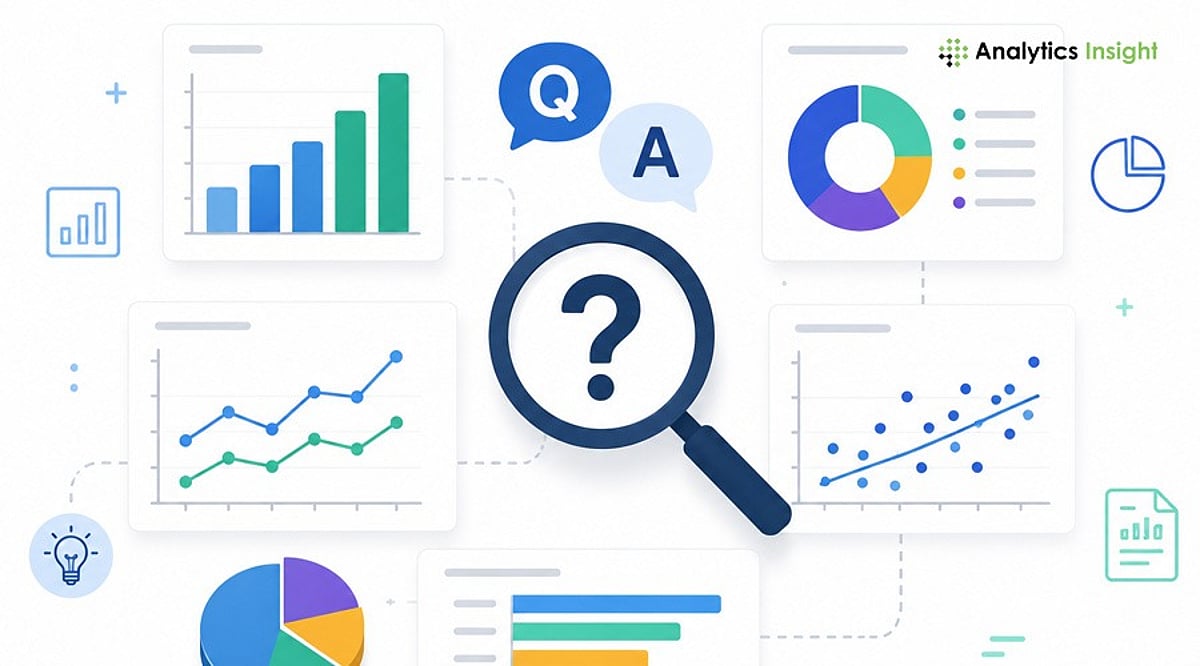
    Sample Answer: The chart type should match the story the data tells. Bar charts compare categories; line charts show trends over time; pie charts display simple proportions; scatter plots reveal relationships between variables; and maps visualize geographic data. I always prioritize clarity and ease of interpretation.

    4. What Makes a Good Dashboard?

    Sample Answer: A good dashboard is simple, organized, and aligned with business objectives. It highlights key performance indicators (KPIs), avoids unnecessary clutter, uses consistent colors, and allows users to find information quickly. Every element should serve a decision-making purpose.

    5. What KPIs Have You Displayed in Dashboards?

    Sample Answer: KPIs vary by industry. Common examples include revenue, sales growth, customer acquisition cost, conversion rate, customer retention, profit margin, inventory levels, and website traffic. The dashboard should always show metrics that directly support stakeholder decisions.

    6. How Do You Handle Large Datasets?

    Sample Answer: I clean data by removing redundant fields, apply data modeling, create summary tables, and use filters. To boost performance, I implement incremental refresh, optimized SQL queries, and efficient calculations. Pre-aggregation and indexing also help maintain speed.

    7. What Are Common Data Visualization Mistakes?

    Sample Answer: Frequent mistakes include using too many colors, choosing the wrong chart type, displaying unnecessary information, poor labeling, overcrowded dashboards, ignoring accessibility, and misleading scales or axes. Keeping visuals simple and purposeful improves readability and trust.

    8. How Do You Ensure Data Accuracy?

    Sample Answer: I cross-check dashboard values against original data sources, validate calculations, and test filters and business logic with stakeholders. Before publishing, I conduct user testing to confirm numbers meet business expectations and that no errors exist.

    9. Can You Explain a Dashboard You Built?

    Sample Answer: I built a sales performance dashboard that integrated data from multiple regions. It displayed revenues, profits, monthly sales trends, and product performance. Filters allowed drill-down by region, product category, and sales representative, enabling regional managers to identify opportunities quickly.

    10. How Do You Present Insights to Non-Technical Stakeholders?

    Sample Answer: I avoid technical jargon and focus on business implications. Instead of explaining how I calculated the numbers, I discuss what the data shows, why it matters, and what actions should be taken. Clear, story-driven communication turns data into decision fuel.

    Tips to Perform Better in Data Visualization Interviews

    • Build two or three dashboard projects for your portfolio.
    • Practice explaining dashboards in simple, non-technical language.
    • Learn when to use different chart types and why.
    • Understand basic data modeling concepts (star schema, measures, dimensions).
    • Review common KPIs for your target industry.
    • Be ready to discuss design decisions, not just technical features.

    Real project experience often makes a stronger impression than theoretical knowledge.

    Final Thoughts

    Data visualization interviews go beyond technical proficiency. Employers want candidates who understand the business context, communicate insights effectively, and empower decision-makers. By preparing these common questions and practicing with real dashboards, you can demonstrate both your technical skills and business mindset.

    FAQs

    What are the most common data visualization interview questions?

    Most interviews cover chart selection, dashboard design, KPI tracking, data storytelling, visualization tools, handling large datasets, ensuring data accuracy, and explaining insights to stakeholders. Both technical knowledge and communication skills are assessed.

    Which tools should I learn before an interview?

    Power BI, Tableau, Excel, Google Looker Studio, and Python libraries (Matplotlib, Seaborn, Plotly) are widely used. Mastering at least one enterprise BI tool and understanding dashboard fundamentals significantly improves readiness.

    How should I answer questions about dashboard design?

    Focus on simplicity, business relevance, and usability. Explain how you prioritize KPIs, maintain consistent formatting, avoid clutter, and design for quick trend identification and informed decision-making.

    How can I explain technical insights to non-technical stakeholders?

    Avoid jargon and emphasize business outcomes. Explain what the data shows, why it matters, and what action to take. Clear communication is as important as technical expertise in analytics roles.

    Do I need a portfolio for a data visualization interview?

    Yes. A portfolio with dashboards, reports, and real-world projects demonstrates practical skills. Recruiters value hands-on experience and problem-solving ability more than certifications alone.

  • Top 10 Microservices Interview Questions Every Java Developer Should Know

    Top 10 Microservices Interview Questions Every Java Developer Should Know

    Microservices have transformed how modern applications are built, offering scalability, resilience, and faster deployment cycles. Java developers, in particular, rely on frameworks like Spring Boot and Spring Cloud to implement microservices architectures. To help you prepare for your next technical interview, here are the ten most frequently asked microservices questions along with concise explanations.

    1. What Are Microservices?

    Microservices break down an application into small, independently deployable services. Each service handles a specific business capability and communicates with others via lightweight protocols. This architecture contrasts with monolithic applications by enabling modular deployment, fault isolation, and independent scalability. Teams can deliver updates more frequently without risking the entire system.

    2. Why Use Spring Boot for Microservices?

    Spring Boot simplifies microservices development by offering auto-configuration, embedded servers (Tomcat, Jetty), and dependency management through starter modules. It provides production-ready features like health checks, metrics, and externalized configuration. Developers can quickly build standalone services without cumbersome XML setup, making Spring Boot a top choice for Java microservices.

    3. What Is Spring Cloud?

    Spring Cloud extends Spring Boot to address common microservices challenges. It provides tools for service discovery (Eureka), centralized configuration (Config Server), distributed tracing (Sleuth), and circuit breakers (Hystrix). With Spring Cloud, developers can build cloud-native applications that integrate seamlessly with platforms like Kubernetes and Netflix OSS.

    4. How Does Service Discovery Work?

    In a microservices environment, service instances come and go, making static IP addresses impractical. A discovery server (e.g., Eureka or Consul) maintains a registry of available services. Each instance registers itself on startup and sends heartbeats. Clients query the registry to find service locations, enabling dynamic communication, load balancing, and resilience without manual configuration.

    5. What Is an API Gateway?

    An API Gateway acts as a single entry point for all client requests. It handles cross-cutting concerns like authentication, rate limiting, request routing, and protocol translation. By centralizing these tasks, the gateway simplifies client communication with multiple backend services and enforces security policies consistently across the microservices landscape.

    6. What Is the Circuit Breaker Pattern?

    The circuit breaker pattern prevents cascading failures when a service becomes unresponsive. It monitors calls and, after a configurable threshold of failures, opens the circuit to stop further requests. Fallback responses are returned to maintain partial functionality. Once the service recovers, the circuit closes again. This pattern improves overall system resilience and stability.

    7. How Do Microservices Communicate?

    Microservices communicate either synchronously via REST APIs or asynchronously through messaging queues (e.g., RabbitMQ, Apache Kafka). Synchronous calls are straightforward but introduce tight coupling and latency. Asynchronous messaging enables event-driven architectures where services react to events, improving decoupling and scalability. Many systems combine both patterns based on use-case requirements.

    8. What Is Distributed Tracing?

    Distributed tracing helps monitor requests as they travel across multiple services. Tools like Zipkin or Jaeger assign a unique trace ID to each transaction, allowing developers to identify bottlenecks, debug latency issues, and optimize performance. Observability is critical in complex microservices environments, and tracing provides deep insight into request flows.

    9. How Do You Secure Microservices?

    Security in microservices involves authentication, authorization, and secure communication. Common approaches include OAuth2 and JWT for token-based access control, HTTPS for encrypted data in transit, and API gateways to enforce policies. Service-to-service communication should also use mutual TLS (mTLS) to verify identities. Following identity management best practices ensures that each service only accesses permitted resources.

    Mastering these topics will give you a strong foundation in microservices architecture and help you succeed in Java developer interviews. Whether you’re building new systems or maintaining existing ones, understanding these concepts is essential for modern software engineering.