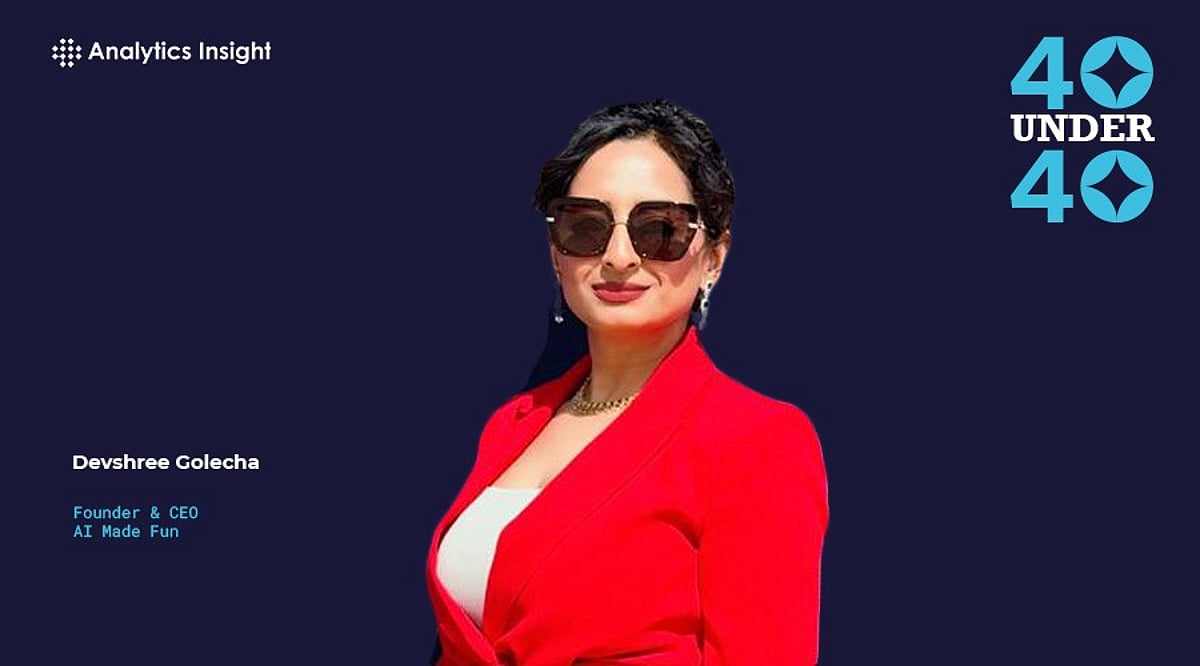
Devshree Golecha is the founder and CEO of AI Made Fun, an education technology company dedicated to building AI literacy for every K–12 learner. After 17+ years as a data and analytics executive leading enterprise data strategy, AI transformation, and governance, she left corporate leadership to focus on a mission she believed could not wait: helping children understand the technology that is already shaping their lives.
Her journey to this work is anything but conventional. It began with door-to-door sales in India, where she learned how to earn trust by listening before speaking. It continued through a chapter as a homemaker in the United States, followed by a reinvention into an award-winning data and AI leader. Across each phase, one belief remained constant: technology only matters when it empowers people.
That belief became the foundation for AI Made Fun. The company is building a comprehensive K–12 AI literacy curriculum with 60 interactive modules delivered through its own LMS, giving schools a structured and sequenced way to teach AI rather than relying on disconnected one-off activities. At the heart of the experience is an animated video universe featuring three mascots—two dogs and a child—who help students explore AI through stories, humor, and relatable real-world moments.
Inside the curriculum, students engage through role play, case studies, interactive decision making, and a Socratic approach that encourages them to ask questions, challenge assumptions, and think critically about how AI works and how it should be used. The goal is not just to teach children what AI is, but to help them become thoughtful, creative, and ethical participants in an AI-powered world.
In addition to building AI Made Fun, Devshree is the award-winning co-author of Data Made Fun for Kids, written with her daughter Kiara. The book has received the International Impact Book Award for Best in STEM, was named Best Math & Data Book 2025 by DataCamp, featured on Great Day Houston (KHOU 11), and adopted in more than 50 charter schools across Texas. Her work has also been recognized with honors including Global Data Power Women, 40 Under 40, Responsible AI Leader Award, High Flyer 50, Extraordinary Women in Tech, and Leading Academic Data Leaders.
Today, she also serves as an adjunct professor of Data Science, a keynote speaker at global data and AI conferences, a WiDS Ambassador with Stanford University, and a Global CDO Ambassador and Editorial Board Member with CDO Magazine. Her goal is simple but urgent: to make it easy for schools and families to bring a rigorous, engaging AI literacy curriculum to every child.
Q&A with Devshree Golecha
Q: What motivated you to launch AI Made Fun?
After years in data and AI leadership, one thing became impossible to ignore: AI was advancing quickly, but most people—especially children—were not being taught how it worked, how to question it, or how to use it responsibly. I was helping organizations adopt AI at scale while watching kids grow up surrounded by AI-powered tools with almost no real understanding of what was happening behind the screen. That gap is what motivated me to launch AI Made Fun. I wanted to take everything I had learned in enterprise data and AI and turn it into something children, families, and schools could actually use—something joyful, practical, and built for the real world.
Q: What sparked the idea for AI Made Fun and your book Data Made Fun for Kids?
It started with simple but powerful questions from children: How does this app know what I like? Why am I seeing this result? Is the machine really thinking? Those questions made it clear that kids were already interacting with data and AI every day, but no one was explaining it to them in a way that felt accessible or age-appropriate. Data Made Fun for Kids was the first step. It turned complex ideas into stories and relatable examples. As the book reached more families and schools, it became clear that the need was much bigger than one book. That is what sparked AI Made Fun—a full K–12 curriculum that helps students build AI literacy over time.
Q: Why is it important for children to understand AI at an early age?
Children are already growing up in an AI-shaped world. AI influences what they watch, what they buy, how they learn, and sometimes even how they are assessed. If we wait too long to teach AI literacy, we leave them vulnerable to systems they use every day but do not understand. Early AI literacy gives children the language and confidence to ask better questions: Who built this? What data trained it? Could it be biased? What should I trust? Those habits of thinking are essential not just for future careers, but for informed citizenship.
Q: How does your platform help children learn AI in a fun and engaging way?
We make AI feel human, relatable, and interactive. Our platform includes 60 modules across K–12 delivered through our LMS, and our animated video IP features three mascots—two dogs and a child—who guide students through AI concepts using stories and everyday scenarios. Students learn through role play, case studies, interactive decision-making, and a Socratic approach that constantly invites them to reflect, respond, and debate. Instead of passively receiving information, they actively step into the learning experience.
Q: Why are human-centered skills becoming even more important in the age of AI?
Because AI can generate answers, but it cannot replace judgment, empathy, values, or imagination. The more powerful AI becomes, the more important it is for children to know how to think critically, solve problems creatively, and make ethical decisions. That is why our curriculum focuses so intentionally on critical thinking, creativity, ethical reasoning, and problem-solving. We are not just teaching students how AI works—we are helping them understand how humans should work with AI.
Q: What leadership lessons have remained constant throughout each chapter of your career?
The biggest lesson is that listening comes first. Door-to-door sales taught me that trust is earned, not assumed. That same lesson has guided me in every role since—whether I was leading enterprise teams, teaching students, or building a company. The second lesson is resilience. Reinventing myself across countries, roles, and life stages taught me that a non-linear journey can still lead to meaningful impact. I have learned to see every chapter not as a detour, but as preparation.
Q: What impact stories have been most meaningful to you?
The stories that stay with me most are the ones where a child suddenly sees themselves differently. When a student realizes, “I can understand this,” or “I can question this,” that is powerful. It is not just about learning vocabulary; it is about building confidence and identity. Hearing that Data Made Fun for Kids has been adopted in more than 50 charter schools has been deeply meaningful, but even more meaningful are the moments when educators tell me their students are starting to question fairness, bias, and decision-making in the technology around them. That tells me the learning is sticking in a real way.
Q: How do you envision AI reshaping K–12 education, and what role does AI Made Fun play?
AI will absolutely reshape K–12 education, from personalization to content creation to teacher support. But the real question is whether students will simply use AI tools, or whether they will truly understand them. That is where AI Made Fun comes in. Our role is to give schools a structured, age-appropriate curriculum they can adopt across K–12 so students are not just consumers of AI, but thoughtful participants who know how to question, evaluate, and use it responsibly.
Q: What advice would you give to aspiring entrepreneurs and young professionals?
Start with a real problem, not just an exciting technology. AI is moving fast, but the strongest ideas come from understanding people deeply and building something that genuinely helps them. Also, do not wait for the perfect moment or a perfectly linear path. Some of the most meaningful work begins when you decide to take one small step with conviction, even before you feel fully ready.