
For independent diesel technicians, small repair shops, and fleet managers, selecting the right diagnostic equipment often comes down to balancing features against cost. Basic code readers can retrieve fault codes but lack the comprehensive coverage and advanced functions required for modern heavy-duty vehicles. Conversely, professional OEM diagnostic systems deliver extensive capabilities but at a significantly higher price.
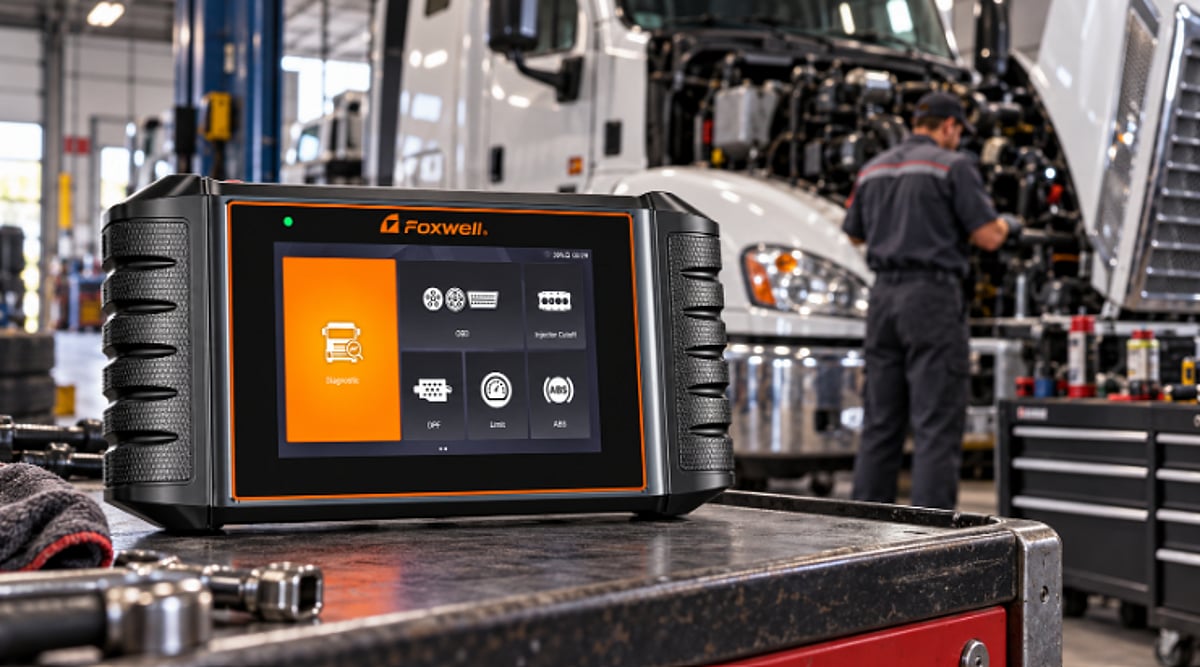
The FOXWELL HD500 positions itself between these extremes. It is a dedicated heavy-duty diagnostic scanner designed for trucks, buses, commercial vehicles, and other diesel-powered machines. The device offers full-system diagnostics, live-data monitoring, DPF-related functions, injector testing, ABS service tools, and support for multiple heavy-duty communication protocols.
What Is the FOXWELL HD500?
The HD500 is a portable diagnostic tablet tailored for heavy-duty diesel applications. Unlike standard OBD-II code readers, it communicates with commercial-vehicle systems using protocols such as J1939, J1708, and J1587. It also supports standard OBD-II and EOBD functions.
FOXWELL lists compatibility with several major manufacturers and engine platforms, including Cummins, Caterpillar, Detroit, PACCAR, International, Hino, Volvo, and others. However, the level of compatibility and available features can vary by vehicle, model year, ECU, and system setup. FOXWELL advises confirming compatibility before purchasing or performing a specific service.
Full-System Diagnostics for Heavy-Duty Vehicles
One of the HD500’s key advantages over a basic code reader is its broader system coverage. Instead of focusing only on the engine ECU, the HD500 accesses multiple vehicle systems on compatible vehicles. These systems may include:
- Engine control systems
- Transmission-related systems
- ABS and braking systems
- SRS systems
- EPB and parking-brake systems
- DPF and emissions-related systems
- Other supported electronic control modules
DPF Regeneration and Diesel Maintenance Functions
DPF-related issues are among the most common reasons heavy-duty vehicle owners and technicians use a diagnostic scanner. Excessive soot buildup can trigger the DPF warning light, regeneration failures, reduced engine power, or even torque-limiting conditions.
On compatible vehicles, the HD500 supports DPF-related diagnostic and maintenance functions, including forced DPF regeneration, DPF reset, and access to related live data.
DPF Clogging or Excessive Soot Load
When soot accumulates excessively, the HD500 can read fault codes and display parameters such as soot load, exhaust temperature, and differential pressure. This helps technicians evaluate DPF condition and decide whether regeneration is appropriate.
DPF Regeneration Failure
If a vehicle repeatedly fails automatic regeneration, the HD500 allows review of related fault codes and live data to identify causes like excessive soot buildup, abnormal temperatures, or sensor faults.
Engine Derate or Reduced Power
When DPF or emissions problems become severe, some vehicles limit engine RPM or torque. The HD500 helps identify related faults and, when conditions are met, perform supported regeneration or reset functions.
Forced DPF Regeneration
When automatic regeneration cannot complete, the HD500 supports forced regeneration on compatible vehicles. Technicians should check fault codes and live data before starting the procedure to ensure the vehicle meets required conditions.
The HD500 also includes an Injector Cutoff function that temporarily deactivates injectors one cylinder at a time. This helps pinpoint cylinders contributing to rough idle, vibration, power loss, or excessive fuel consumption, reducing unnecessary part replacements. Availability of these special functions varies by vehicle, engine, ECU, and model year, so compatibility must be verified beforehand.
Live Data and Graphing
Fault codes alone don’t reveal real-time system behavior. Live data is essential for determining whether sensors and parameters are operating correctly. The HD500 displays live sensor data and can graph selected information. FOXWELL emphasizes graphical displays to make sensor data more intuitive.
Depending on the vehicle and supported ECU, technicians can monitor parameters such as:
- Engine RPM
- Boost pressure
- Fuel pressure
- Exhaust-related parameters
- Temperature readings
- Sensor values
- DPF-related data
- Other ECU parameters
Heavy-Duty Protocol Support
A major difference between passenger-car tools and heavy-duty scanners is communication compatibility. The HD500 supports commercial-vehicle protocols like J1939, J1708, and J1587, along with other standards. FOXWELL states the tool is intended for a range of heavy-duty vehicle and engine manufacturers, but technicians should always check coverage for their specific vehicle before assuming advanced functions are available.
Adapter Selection and Connectivity
The HD500 comes with multiple diagnostic connectors for different vehicle types: 6 & 9-pin, CAT 9-pin, CAT 14-pin, and 16-pin adapters, plus additional adapters for specific Caterpillar applications. FOXWELL also promotes Wi-Fi-based software updates, offering lifetime free online updates for the HD500. Buyers should confirm the applicable update policy for their product version and market before purchasing.
Android Touchscreen Design
The HD500 uses a touchscreen interface rather than the button-based designs typical of older diagnostic tools. It runs on an Android-based operating environment. However, screen size and menu layout are subjective; some user feedback suggests text and graphing functions may not be as convenient in certain situations.
Who Is the FOXWELL HD500 For?
The HD500 suits users who regularly work on commercial diesel vehicles but don’t need a full dealer-level diagnostic setup.
Independent Technicians
Independent technicians gain access to standard heavy-duty diagnostic features without needing multiple basic scan tools.
Small and Medium-Sized Repair Shops
A smaller workshop may lack the budget or workload to justify multiple OEM diagnostic systems. A multi-brand diesel scanner like the HD500 serves as a practical alternative for routine repairs.
Fleet Managers
Fleet operators can use the equipment to check fault codes and monitor vehicle issues before sending trucks to external repair shops.
FOXWELL HD500 vs. Basic Code Readers
Basic readers typically only display and clear engine fault codes. The HD500 goes further with full-system diagnostics on supported vehicles, live data, graphical displays, DPF functions, and other service features.
FOXWELL HD500 vs. OEM Diagnostic Tools
OEM systems provide the deepest coverage for each manufacturer and specialized programming tools, but they are often expensive and less convenient for multi-brand workshops. The HD500 offers broad coverage and common diagnostic and maintenance functions in one device at a more accessible price.
Is the FOXWELL HD500 Worth Considering?
For its target audience, the HD500 delivers a practical mix of features for daily heavy-duty maintenance. Its strongest areas include multi-brand support, heavy-duty protocols, full-system diagnostics, DPF functionality, live data monitoring, and multiple diagnostic adapters.
Pros and Cons
Pros:
- Designed specifically for heavy-duty and diesel applications
- Supports J1939, J1708, and J1587 protocols
- Offers full-system diagnostics on supported vehicles
- Includes DPF regeneration and related features
- Provides live data and graphical monitoring
Cons:
- Coverage may vary depending on vehicle, ECU, and model year
- Not a full substitute for OEM diagnostic platforms
- Some advanced features have manufacturer-specific limitations
- Buyers should check compatibility before purchasing
- Interface may require a learning curve for unfamiliar technicians
FAQs
1. What is the FOXWELL HD500 used for?
The FOXWELL HD500 is a heavy-duty diagnostic scanner intended for trucks, buses, diesel vehicles, and other supported commercial uses.
2. Does the HD500 support DPF regeneration?
Yes. The HD500 supports DPF-related functions such as forced regeneration on supported vehicles. DPF capabilities vary by vehicle and ECU, so compatibility must be confirmed before starting regeneration.
3. What protocols does the FOXWELL HD500 support?
The scanner supports heavy-duty protocols like J1939, J1708, and J1587, as well as other automotive communication standards.
4. Is the FOXWELL HD500 suitable for a small repair shop?
It can be a good option for a small or medium-sized shop that regularly services heavy-duty diesel vehicles from different manufacturers.
Conclusion
The FOXWELL HD500 occupies a useful position in the heavy-duty diagnostic market. It delivers significantly more functionality than a basic code reader while avoiding the high cost and manufacturer-specific constraints of multiple OEM systems. Its combination of full-system diagnostics, DPF regeneration, live data monitoring, heavy-duty protocol support, and multi-brand coverage makes it a valuable tool for independent technicians, smaller repair shops, and fleet maintenance teams.