Tag: Make in India

  • Belden Ramps Up Ruckus Wireless Manufacturing in India with New Pune Production Line

    Belden Ramps Up Ruckus Wireless Manufacturing in India with New Pune Production Line

    Belden Inc., the US-based networking and connectivity specialist, is expanding its local manufacturing capabilities in India. The company’s Pune facility will now produce Ruckus ICX Ethernet switches, which are integral to Wi-Fi connectivity, networking equipment, and AI-powered automation systems.

    This strategic move follows Belden’s $1.8 billion acquisition of Ruckus Wireless and aligns with the Indian government’s ‘Make in India’ initiative, signaling a significant shift toward domestic production of enterprise networking hardware.

    Pune Facility to Drive Local Production

    The initial manufacturing of Ruckus ICX Ethernet switches will take place at Belden’s 300,000-square-foot facility in Pune. This expanded capacity is designed to meet domestic demand, with potential export opportunities to be assessed in later phases.

    Bart Giordano, senior vice president and general manager at Ruckus Networks, noted that the company has not disclosed specific investment figures or capacity metrics for the expansion. “The first batch of locally manufactured switches is set to roll off the assembly line as we speak,” Giordano said in a virtual interaction.

    The ICX Ethernet switching portfolio currently represents nearly 50% of Ruckus’s total business.

    Expansion to Include Workforce, Products

    Historically, Ruckus Wireless relied entirely on outsourced manufacturing. Following the integration with Belden, the company is leveraging Belden’s existing Pune facility to establish local production.

    Ruckus plans to make incremental investments and expand its local workforce as manufacturing scales up. Ethernet switches will form the first phase of production, while the company will evaluate manufacturing other enterprise networking products at the Pune facility in the future.

    Strengthening India Operations

    The Pune manufacturing operation adds to Ruckus’s existing presence in innovation, operations, and customer delivery across India. Bengaluru hosts the company’s largest global research and development and customer success site, along with Belden’s customer innovation center. Ruckus also operates an R&D center in Chennai in collaboration with the IIT Madras Research Park, focusing on software development and networking innovation.

    Beyond enterprise IT, the combined Belden-Ruckus portfolio will target industrial sectors such as advanced manufacturing, warehousing, and logistics.

  • India’s Proposed Tax Extension Through 2041 Could Boost Apple’s Manufacturing Expansion

    India’s Proposed Tax Extension Through 2041 Could Boost Apple’s Manufacturing Expansion

    India is considering a significant extension of tax exemptions for foreign electronics companies, a move that could substantially benefit Apple as it ramps up iPhone production in the country. The proposed amendment to tax laws would push the current incentives’ expiration date from 2031 to March 31, 2041, offering long-term fiscal certainty for global manufacturers.

    If approved by both houses of Parliament, the measure would extend tax breaks for foreign companies supplying machinery and components to contract manufacturers. This aligns with India’s broader strategy to solidify its position as a global electronics manufacturing hub, particularly under the ‘Make in India’ initiative.

    Apple Poised to Gain from Extended Tax Relief

    According to reports, Apple stands to benefit the most from this proposal. The tech giant had been seeking clarity on India’s tax regime concerning the supply of expensive equipment to its contractors, as ambiguity exposed it to higher tax risks. Under the proposed reforms, foreign firms supplying equipment used in manufacturing phones, tablets, laptops, wearables, and hearing aids would continue to enjoy tax exemptions until 2041.

    The draft also extends tax relief on income derived from storing and supplying electronic components through customs-bonded facilities, encouraging export-oriented manufacturing.

    India’s Electronics Manufacturing Strategy

    This tax extension is part of the government’s efforts to attract global manufacturers and reduce dependence on China. Apple’s manufacturing footprint in India has grown rapidly, with Counterpoint Research projecting that India will produce 26% of the world’s iPhones in 2026, up from just 6% four years ago. Industry experts believe the extended incentives could prompt more multinational electronics companies to invest in local production facilities and strengthen supplier networks.

    “The proposed tax changes will enable foreign companies to store and transfer critical equipment and components in India for their contract manufacturers, helping mitigate supply chain disruptions arising from trade uncertainties while providing greater tax certainty,” said Riaz Thingna, a partner at Grant Thornton Bharat.

    Wider Business Reforms in the Pipeline

    Beyond electronics, the proposed bills aim to improve India’s overall investment climate. For instance, foreign companies using data centers in India to serve global clients would no longer be required to own those facilities, but could lease them instead. Additionally, the bills recommend a 15-year tax exemption for foreign diamond miners and dealers operating through designated trading zones. Analysts say these measures are designed to enhance ease of doing business and provide long-term policy certainty for international investors.

    All these changes are subject to parliamentary approval and would take effect only after the bills are passed.

  • Edge AI Is the Missing Link in India’s Sovereign AI Strategy, Says embedUR CEO

    Edge AI Is the Missing Link in India’s Sovereign AI Strategy, Says embedUR CEO

    India’s AI conversation has centered on compute clusters and cloud infrastructure. Rajesh Subramaniam, CEO and founder of embedUR, argues this misses the bigger opportunity. In this exclusive interview with Analytics Insight, he makes the case for edge AI as the missing layer of India’s sovereignty strategy—one that keeps intelligence on factory floors, in clinics, and on farms rather than routed through servers abroad. He also explains how initiatives like IndiaAI Mission, Digital India, and Make in India could converge at the device level, and what enterprises need to do to turn AI pilots into measurable business results.

    Q: Can India truly achieve sovereign AI if intelligence remains concentrated in the cloud while edge deployment is overlooked?

    A: Sovereignty involves more than the location of model training or data centers. If every inference in an Indian factory, hospital, or utility relies on a cloud, often managed abroad, the intelligence layer of the economy remains dependent on external infrastructure, pricing, and policies. True sovereignty requires intelligence to operate where India’s data is generated: on devices, factory floors, clinics, vehicles, and other endpoints. Edge AI keeps data local by default, operates reliably with limited connectivity, and reduces foreign exchange costs associated with large-scale cloud inference. Cloud AI and edge AI are complementary. However, a sovereignty strategy limited to data centers perpetuates structural dependency. India should control both layers.

    Q: Why will sovereign edge infrastructure be critical to India’s long-term AI ambitions?

    A: When we look at India’s AI journey, three factors stand out: scale, resilience, and economics. Let’s start with scale. Our opportunity is massive—AI in India is not just about a few thousand enterprise deployments, but about reaching over a billion endpoints across agriculture, manufacturing, healthcare, energy, and mobility. Relying solely on the cloud for real-time inference at this scale is simply not practical or sustainable. The way forward is clear: embed intelligence directly into our devices, and use the cloud for training, coordination, and data aggregation. This is how we unlock true impact. Resilience comes next. Edge intelligence keeps working even when connectivity drops. For critical infrastructure like our power grids, water supply, and transportation, this is not just a feature—it is essential for national strength and reliability. The third factor is economics. Every time we use the cloud for inference, we pay ongoing costs—often to companies outside India. On-device intelligence, on the other hand, means we invest upfront and update as needed, but the value stays with us. By aligning our semiconductor ambitions with edge AI, we create a powerful ecosystem: chips made in India, models improved locally, and devices built by our own teams. This is how we achieve real independence and drive long-term growth.

    Q: How can Edge AI democratize AI adoption by bringing intelligence closer to where data is generated?

    A: Cloud-based AI demands high-speed internet, ongoing subscriptions, and complex data management. This leaves out a huge part of India’s economy: small manufacturers, rural healthcare providers, farmers, and businesses in Tier-2 and Tier-3 cities. Edge AI changes the game. Affordable, microcontroller-based solutions work offline, cut out per-inference fees, and keep sensitive data local. This is how we bring AI to everyone. Small foundries can now run visual inspections without cloud contracts. Primary health centers can deliver diagnostics on-site. Farmers can control pumps without relying on connectivity. Over the last two decades in embedded software, I have seen firsthand that technology becomes truly accessible when it is built into affordable hardware. As AI models get smaller and fit into MCUs and NPUs, embedding AI in the devices people already use is the most practical and inclusive way forward for India.

    Q: What is the role of embedded systems, edge computing, and intelligent devices in enabling scalable, real-world AI deployment?

    A: Real value comes when intelligence is built into products that ship, survive in the field, and run for years on limited power and memory. Models that stay in demos or data centers never make an impact. The real work is delivering solutions that last. This is the heart of embedded systems. Moving from research to real products means optimizing for the actual chip, integrating with sensors and connectivity, and making sure it works in the real world, not just the lab. Many AI projects get stuck here. The challenge is not building the model, but getting it deployed and keeping it running. This is exactly why we launched ModelNova as an independent company from embedUR. The industry is moving toward production-ready models that are proven on real silicon, so device makers are not left to bridge the gap alone. India has the talent and the drive in embedded engineering and electronics manufacturing. We have a real opportunity to lead the world in this deployment layer.

    Q: How can national initiatives such as the IndiaAI Mission, Digital India, and Make in India converge to strengthen India’s AI ecosystem?

    A: Each of these initiatives tackles a critical layer. IndiaAI Mission is driving our compute capacity, datasets, and model development. Digital India has laid the foundation with robust connectivity and digital public infrastructure. Make in India, alongside the India Semiconductor Mission, is powering up our hardware manufacturing. Where these efforts come together is at the intelligent device—the next frontier for India’s leadership in technology. Building an AI-enabled device entirely in India is within our reach: silicon designed and produced here, models trained on Indian data using our own compute, and seamless deployment and updates over our digital infrastructure. We have already proven our ability to deliver this kind of end-to-end innovation—UPI is a world-class example of how public infrastructure and private ingenuity can leapfrog outdated systems. Now, we have the opportunity to do the same for edge AI. The key is focused policy that brings it all together: incentives for manufacturing AI-capable devices, standards and certification tailored for Indian conditions and languages, and procurement that demands on-device intelligence for public projects in health, agriculture, and infrastructure. When these missions align at the device level, India moves from being a consumer of AI to becoming a global exporter of AI innovation.

    Q: What do Indian enterprises across manufacturing, healthcare, and energy need to do to translate AI innovation into measurable business impact?

    A: Start with the business outcome that truly matters. In my experience, technology earns its place only when it solves a real problem and drives results for the business. Too often, I have seen AI projects lose focus chasing the latest trends. The projects that succeed are the ones that zero in on the numbers that matter: reducing defects, cutting downtime, increasing patient throughput, or minimizing transmission losses. Identify the key metric, then work backward to the simplest AI solution that delivers measurable results. In manufacturing, I always advise starting with a single line. Focus on visual inspection or predictive maintenance for your most critical asset, and track progress against a clear baseline. Once you prove value, scale it across the plant. In healthcare, true impact comes from point-of-care intelligence that integrates directly into clinical workflows, operates on-device, protects patient privacy, and keeps running even when connectivity drops. In energy, drive intelligence to the grid edge, where losses occur and where waiting for the cloud is simply not an option. There are three disciplines that turn pilots into real business impact. First, deploy intelligence where the data is generated. Latency, connectivity, and data privacy challenges often derail cloud-only projects, especially in the realities of the Indian market. Second, treat AI as a product-engineering initiative, not just a data science experiment. Invest in integration, validation, and lifecycle maintenance, because that is where the real value is created. Third, measure relentlessly against your original baseline. If AI cannot deliver results you can show in a quarterly review, it is just a science project. If it does, it becomes a line item your CFO will champion.


  • India’s Semiconductor Ambitions Get a Boost as PM Modi Launches New Chip Plant and Electronics Roadmap

    India’s Semiconductor Ambitions Get a Boost as PM Modi Launches New Chip Plant and Electronics Roadmap

    India’s Electronics Sector Reaches New Heights

    India has solidified its position as the world’s second-largest mobile phone manufacturer, and Prime Minister Narendra Modi is now charting a bold course for the country’s electronics future. On July 4, 2026, Modi inaugurated the CG Semi Outsourced Semiconductor Assembly and Test (OSAT) facility in Sanand, Gujarat, marking a key milestone in India’s journey from assembling phones to producing semiconductors domestically.

    Speaking at the event, Modi emphasized that the plant represents the next logical step in a decade-long electronics revolution, moving the nation up the value chain and reinforcing its role in the global technology supply chain.

    The Shift from Phones to Chips: Key Numbers

    Modi highlighted India’s mobile manufacturing growth as the foundation for this shift. Since 2014, mobile phone production has surged approximately 33 times, making India the world’s second-largest mobile phone manufacturer and exporter. Overall electronics production has increased nearly sevenfold, while electronics exports have grown almost elevenfold over the same period.

    “The expansion of the semiconductor industry in India did not happen overnight. It is the next step in the electronics revolution that has taken place in India over the past decade,” Modi said. “First products, then components and now semiconductors… India is building the entire electronics value chain. This is the roadmap to Viksit Bharat. This is the next phase of Make in India.”

    Inside the Sanand Plant and Production Targets

    The Rs. 7,500 crore CG Semi facility has already begun commercial production of semiconductor packaging, with an initial annual target of 200 million chips. Modi expressed confidence that the plant will quickly scale toward a national goal of 500 million chips annually. Once the Sanand cluster is fully developed, he projected a daily output of 1.5 crore (15 million) chips.

    The Prime Minister credited the project as a collaboration between Indian, Japanese, and Thai industry partners. He also praised the facility’s diverse workforce, which includes women trained in states like Jharkhand, Madhya Pradesh, and Chhattisgarh, with some employees receiving advanced training in Malaysia. Modi called them representatives of a ‘Mini India’ operating within a single plant.

    Broader Make in India Push

    Modi tied the Sanand launch to a broader national roadmap, noting that four operational semiconductor facilities are expected in 2026 alone. The government’s goal is to cover design, manufacturing, packaging, and testing capabilities entirely within India. He framed this as the next phase of Make in India and a building block toward a ‘Viksit Bharat’ (Developed India) vision.

    He also pointed to parallel efforts to secure domestic access to critical and high-tech minerals needed to support long-term chip manufacturing, ensuring a resilient supply chain for the future.

    Political Framing and Reactions

    Modi used part of his address to contrast the current pace of semiconductor investment with what he described as a lack of follow-through on similar plans under previous governments, referencing past proposals that earmarked land near Gandhinagar and Sanand for chip projects but never materialized.

    Union Railway Minister Ashwini Vaishnaw and Gujarat Chief Minister Bhupendra Patel also spoke at the event, reinforcing the state’s positioning as an emerging hub within India’s broader semiconductor mission.

  • FUJIFILM India Partners with Gujarat Government to Advance Semiconductor Materials Manufacturing

    FUJIFILM India Partners with Gujarat Government to Advance Semiconductor Materials Manufacturing

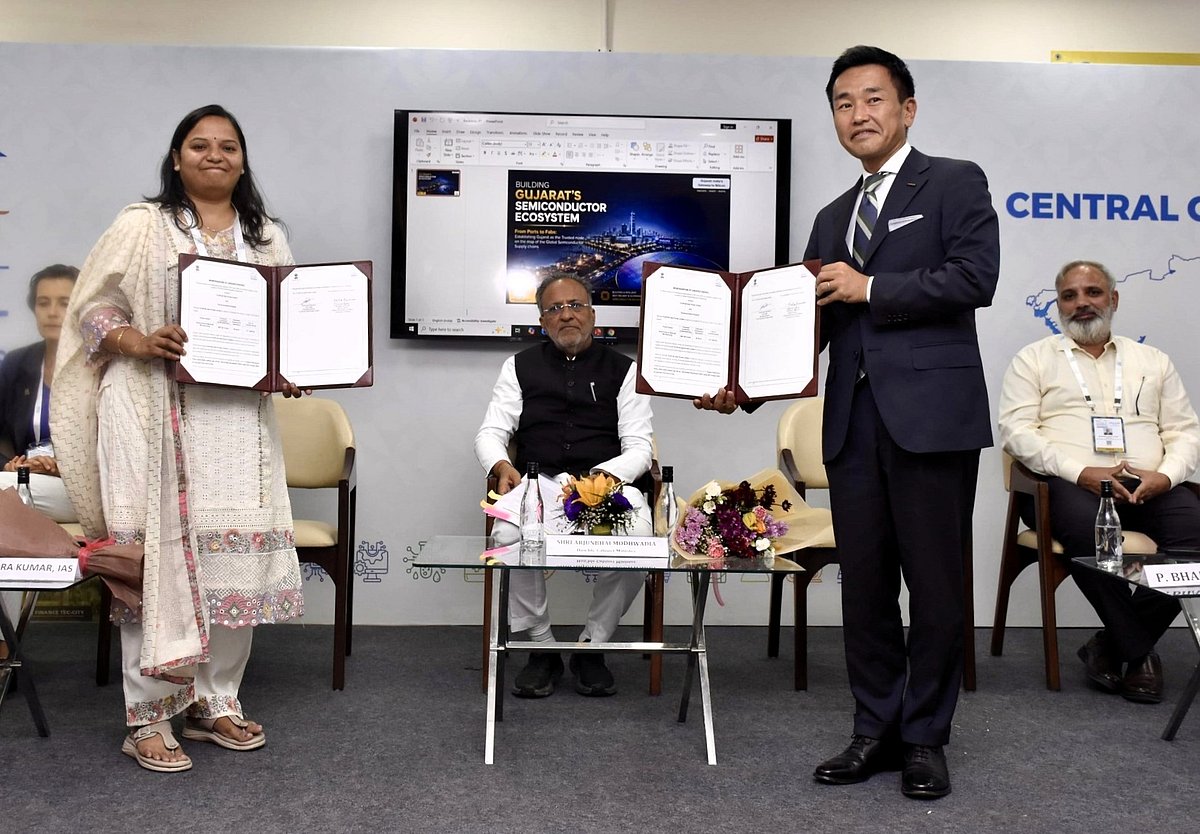
    FUJIFILM India has signed a Memorandum of Understanding (MoU) with the Gujarat State Electronics Mission (GSEM) under the Department of Science and Technology, Government of Gujarat, to explore opportunities for manufacturing advanced semiconductor materials in the country and strengthen the domestic supply chain. The agreement was formalized during the Vibrant Gujarat Regional Conference in Vadodara.

    The collaboration aligns with India’s goal of becoming a global semiconductor hub. Through the MoU, FUJIFILM India will assess the feasibility of establishing a semiconductor materials production base in Dholera. The initiative aims to work closely with government bodies, industry associations, and private enterprises to build a resilient semiconductor supply chain.

    As demand for semiconductors surges across electronics, automotive, telecommunications, and artificial intelligence sectors, this partnership is expected to boost India’s self-reliance in critical semiconductor materials and enhance its position in the global value chain.

    Koji Wada, Managing Director of FUJIFILM India, stated: “At FUJIFILM India, we have been closely assessing opportunities across the Indian market and evaluating how our diverse businesses can contribute to the country’s long-term growth and innovation ambitions. This MoU marks an important milestone and brings us a step closer to realizing our plans for investment in Dholera. Guided by our Group Purpose of ‘Giving our world more smiles,’ we believe innovation should create meaningful value for society.”

    Abhi Shekhar Singh, National Head – Strategy & Business Development, Electronic Materials Division, FUJIFILM India, added: “FUJIFILM Electronic Materials develops and manages chemical formulations that power the most critical semiconductor processes. We are a diverse global supplier delivering tailored support where our customers need us most. We are now gearing up to introduce our technology to India’s semiconductor ecosystem, supporting today’s aspirational India and guaranteeing tomorrow’s Viksit Bharat.”

    With more than 20 production bases worldwide and deep expertise in advanced materials, Fujifilm Electronic Materials views India as a strategic market. The MoU reflects the company’s support for the Government of India’s “Make in India” initiative through localized manufacturing, technology collaboration, and supply chain development. By strengthening its engagement with India’s semiconductor ecosystem, Fujifilm aims to contribute to a sustainable, future-ready manufacturing infrastructure that supports the nation’s long-term ambitions.