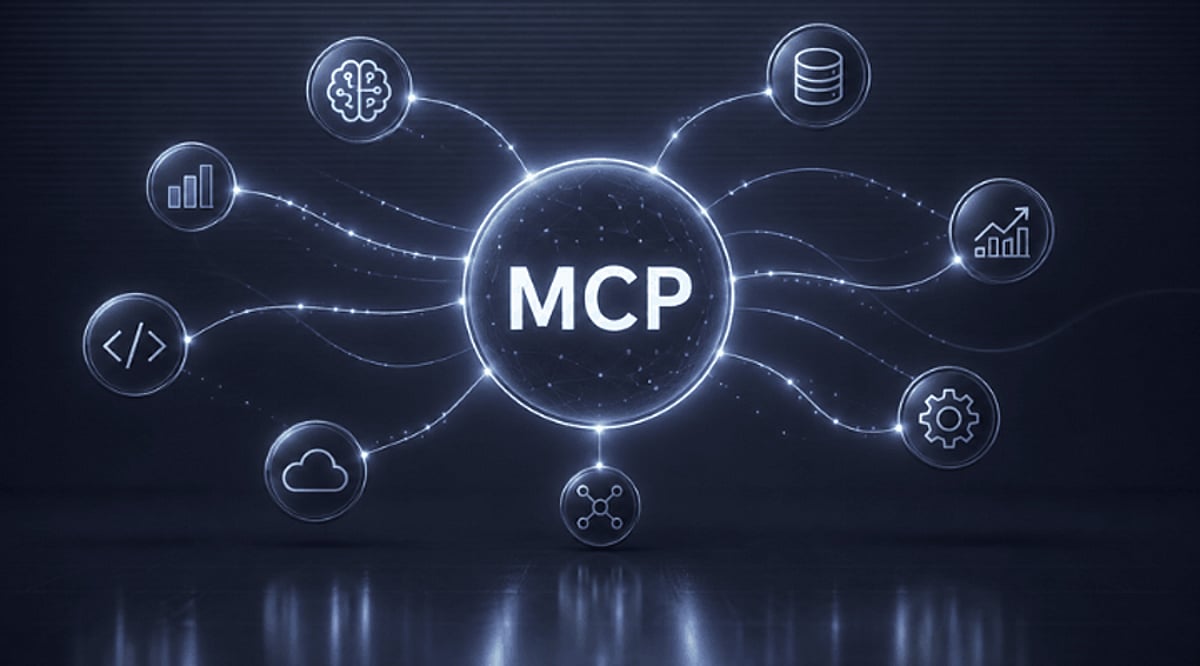
AI agents are only as powerful as the systems they can reach. A model that reasons well but cannot connect to your database, ticketing queue, or internal documents is just a chatbot with ambition. That gap is exactly what the Model Context Protocol (MCP) was built to close. As AI agents need to interact with more tools, MCP is proving itself the natural foundation for reliable, scalable connections. Here are the seven key reasons driving its adoption.
1. It Kills the Integration Sprawl
Before MCP, each agent-to-tool connection required a custom integration. Ten tools and three agent frameworks meant thirty separate connectors, each with its own authentication, error handling, and maintenance burden. Every connector broke in its own way, and every fix lived in a different codebase. MCP replaces that with a single protocol: build one MCP server for your tool, and any compliant agent can use it. The math changes from N times M integrations to N plus M — the difference between a weekend project and a standing engineering team.
2. Tools Become Plug-and-Play
An agent does not need to be rebuilt when you add a new capability. Connect a database server, a chat server, or a file-system server, and the agent discovers the available tools at runtime. Because tool definitions travel with the server rather than living inside the agent’s code, swapping or upgrading a tool never touches the agent itself. This works for creative tooling as well as infrastructure — for example, an image generation platform can expose its rendering pipeline through an MCP server, letting any agent generate visuals as one step in a larger workflow. The agent stays generic while the capabilities stay modular, and that separation is the whole point.
3. Context Stops Being Stale
Most agent failures trace back to missing or outdated context. A support agent working from a six-month-old knowledge dump gives six-month-old answers. MCP servers expose live data instead: current inventory, open tickets, the actual state of a codebase — whatever the agent needs to reason over what is true right now rather than what was true at training time. For anything operational, that difference is the whole ballgame. It also changes how teams think about knowledge management, since the source of truth stays in the source system instead of being copied into prompts.
4. It Is Model-Agnostic by Design
Teams do not want their tool layer welded to one vendor. An MCP server works with any client that speaks the protocol, and support now spans the major agent frameworks and coding environments. If you switch models next quarter, your integration layer survives the move without a rewrite. That portability alone justifies the setup cost for most engineering teams. It also lowers the risk of experimenting, because trying a different model no longer means rebuilding your connections from scratch.
5. The Ecosystem Hit Critical Mass
Standards win on adoption, not elegance. There are now thousands of community and vendor-built MCP servers covering everything from version control and cloud storage to niche internal tooling. Official SDKs exist in Python, TypeScript, and other major languages, which keeps the barrier to building your own server low. When the connector you need probably already exists, building on the protocol becomes the default choice rather than a bet. Momentum feeds itself: more servers attract more agent builders, and more agent builders create demand for more servers.
6. Security Gets a Defined Shape
Ad-hoc integrations tend to smear credentials across scripts and environment files. Nobody can audit that, and nobody wants to own it. MCP gives permissions a boundary. Each server declares what it exposes, clients can require human approval before sensitive actions run, and access can be scoped per server rather than granted wholesale. It does not solve agent security entirely — prompt injection remains a real concern — but it gives teams a consistent place to enforce controls instead of fifty inconsistent ones, and consistency is what makes security reviewable.
7. It Unlocks Multi-Tool Workflows
Real work crosses systems. Pulling a bug report from your tracker, checking the related code, and posting a summary to your team chat is one workflow, not three. Because every tool speaks the same protocol, an agent can chain these steps without custom glue code between each hop. The output of one tool becomes the input of the next, and the agent handles the routing. That is where agents stop being demos and start handling end-to-end tasks. It is also the strongest signal that MCP is not a passing convention but the connective layer the agent ecosystem was missing.
What This Means If You Are Building Agents Now
The practical takeaway is simple. Treat the protocol as your default interface for anything an agent needs to touch, and only build custom when a server genuinely does not exist. Start with one or two servers that cover your highest-friction workflow — usually your data store and your task tracker. Get the permission scoping right before you expand, because retrofitting access controls across a dozen servers is painful. Then add capabilities one server at a time, letting the agent’s tool list grow with your needs. Teams that follow this order tend to ship working agents in weeks rather than quarters.
MCP won because it solved a boring problem well. Agents needed a universal port to the outside world. Once one existed, everything else compounded around it: tooling, security patterns, and ecosystem momentum. The standard is not winning because it is clever. It is winning because every alternative means maintaining a pile of one-off connectors that nobody wants to touch twice.