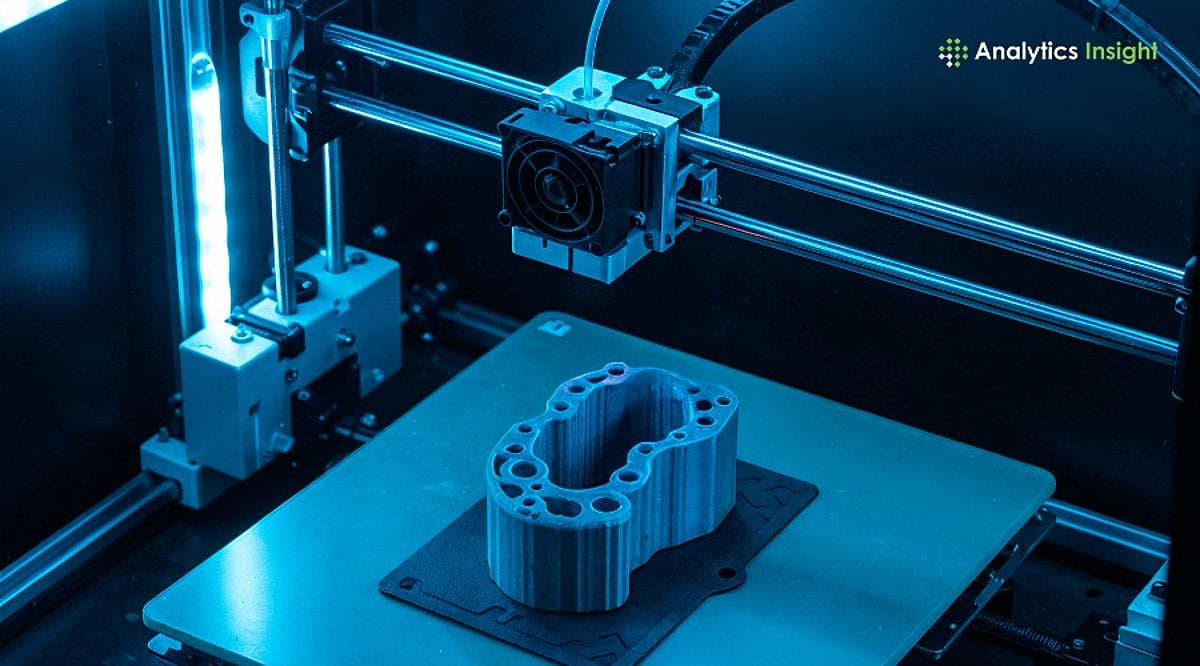
Metal 3D printing has evolved from a niche prototyping tool into a critical manufacturing technology powering aerospace, automotive, healthcare, defense, and industrial production. Modern systems can produce lightweight, high-strength parts with exceptional accuracy while reducing material waste and lead times.
From production-scale Laser Powder Bed Fusion (LPBF) machines to office-friendly bound metal systems, today’s best metal 3D printing machines cater to diverse manufacturing needs, balancing performance, precision, scalability, and long-term value. We have listed the best of the lot for you:
EOS M 290
Company: EOS
Technology: Direct Metal Laser Sintering (DMLS)
EOS M 290 continues to set the standard for additive metal manufacturing processes used in the industrial sector. The machine is fitted with a 400 W fiber laser and boasts a build envelope size of 250 x 250 x 325 mm. It is capable of producing metals such as stainless steel, titanium, aluminum, cobalt chrome, Inconel, and tool steels. The software package and processing controls are robust and make use of a tested material library.
TRUMPF TruPrint 3000
Company: TRUMPF
Technology: Laser Powder Bed Fusion (LPBF)
TruPrint 3000 is characterized by productivity through a dual-laser system and accuracy in an industrial environment. This machine comes with a 300 × 300 mm build platform, which makes it efficient in handling materials such as stainless steel, titanium, aluminum, and nickel alloy. Its stable process control makes it reliable and easy to integrate into automated factory environments.
SLM Solutions NXG XII 600
Company: SLM Solutions (Nikon SLM Solutions)
Technology: LPBF
The NXG XII 600 has been specifically developed for mass manufacturing. It features twelve 1 kW lasers and one of the biggest build sizes in the industry. It enhances productivity while ensuring that quality is not compromised. Best suited for aerospace assemblies, energy parts, and automotive manufacturing. This machine works with aluminum, titanium, stainless steel, and superalloys.
3D Systems DMP Flex 350
Company: 3D Systems
Technology: Direct Metal Printing (DMP)
The vacuum chamber used by the DMP Flex 350 helps to achieve accuracy and an excellent surface finish with reduced levels of oxygen contamination. This printer can use titanium, cobalt chrome, stainless steel, and nickel alloys, resulting in high-density products that find application in the medical, dental, and aerospace industries. The advanced software, consistent performance, and superior mechanical properties of the machine make it reliable.
Renishaw RenAM 500Q
Company: Renishaw
Technology: LPBF
With four lasers that increase productivity without compromising the level of dimensional accuracy achieved, the RenAM 500Q is well suited for industrial production. It has a powder management system as well as process monitoring software, which makes manufacturing easier and lowers costs. It can work with titanium, stainless steel, aluminum, and cobalt chrome.
Markforged Metal X
Company: Markforged
Technology: Bound Metal Deposition (BMD)
Unlike powder-bed systems, the Metal X printing process involves printing the bound metal filaments, which is much simpler and less hazardous. It works well with stainless steel, H13 tool steel, Inconel 625, copper, and several engineering materials. Reduced infrastructure needs have made it an ideal choice for engineers who need to produce tooling, jigs, and functional models.
Desktop Metal Studio System 2
Company: Desktop Metal
Technology: Bound Metal Deposition
This machine can help offices and engineering labs get rid of metal powders. It produces accurate metal parts through a printing and sintering process. The machine can work with stainless steel, copper, and various engineering alloys. This machine is easy to use, affordable, and requires few safety considerations, making it suitable for companies starting in metal additive manufacturing.
Metal 3D Printers: Future Outlook
Metal 3D printing is no longer limited to prototyping—it has become a practical manufacturing solution for producing complex, high-performance parts with greater design flexibility and lower material waste. If production consistency and certified quality are priorities, the EOS M 290 remains a strong choice.
The best choice will always depend on the volume of production, the material compatibility, software compatibility, post-processing required, and the total cost of ownership. High-volume production facilities will definitely make the best use of SLM Solutions’ NXG XII 600. The TRUMPF TruPrint 3000 and Renishaw RenAM 500Q provide the best compromise between precision, automation, and productivity. On the other hand, engineers who have just started using metal additive manufacturing in their projects can choose either Markforged’s Metal X or the Desktop Metal Studio System 2.
FAQs
- Which metal 3D printer offers the best overall performance? The EOS M 290 consistently delivers exceptional precision, repeatability, validated materials, and reliable production, making it the preferred industrial benchmark across aerospace, healthcare, and manufacturing sectors.
- Which machine is best for high-volume metal production? The SLM Solutions NXG XII 600 excels in high-volume manufacturing with twelve lasers, large build capacity, rapid throughput, automation, and excellent productivity for industrial production environments.
- Are bound metal printers suitable for small businesses? Yes. Markforged Metal X and Desktop Metal Studio System 2 reduce infrastructure costs, simplify operation, improve safety, and provide affordable entry into professional metal additive manufacturing.
- Which industries benefit most from metal 3D printing technology? Aerospace, automotive, medical devices, dental, defense, industrial tooling, energy, and research organizations benefit from lightweight, complex, durable, and highly accurate metal components produced efficiently.
- What should buyers evaluate before purchasing a metal 3D printer? Assess printing technology, supported materials, build volume, precision, software ecosystem, production speed, post-processing requirements, maintenance, operating costs, and long-term technical support before investing.