Tag: MiCA

  • EU Regulators Push for DeFi Lending Safeguards Ahead of September 30 MiCA Deadline

    EU Regulators Push for DeFi Lending Safeguards Ahead of September 30 MiCA Deadline

    The European Commission is set to close its targeted consultation on the Markets in Crypto-Assets Regulation (MiCA) on September 30, with banking regulators urging a closer look at decentralized finance (DeFi) lending and borrowing.

    The deadline is for feedback on possible changes to the EU crypto framework. It does not itself impose new lending requirements.

    EBA seeks review of DeFi loan access

    In a September 24 response, the European Banking Authority (EBA) asked the Commission to assess rules for firms that arrange crypto loans. The scope would also cover crypto companies that connect customers to DeFi lending through an app or product. In some cases, a loan may run through an automated protocol while a company controls the route customers use to reach it.

    The EBA outlined two potential changes to MiCA:

    • Add crypto lending and borrowing to the list of regulated services.
    • Impose duties on firms that provide access to DeFi lending.

    Before deciding whether to propose legislation, the Commission would need to assess the size of these activities, their retail use and the consumer risks involved.

    Consumer safeguards and risk gaps

    The EBA suggested examining suitability checks, leverage limits and clearer information about lending terms. It also floated warnings for customers using protocols described as “truly decentralized.” Another option would assess whether lending protocols could receive certification for their ability to withstand cyberattacks.

    The authority identified gaps in information about fees, yields and changes to collateral requirements. It raised concerns about losses tied to leverage, outages, hacks and poor recordkeeping. Borrowers may also take on too much debt when services do not check their ability to repay.

    Stablecoin-linked loans draw scrutiny

    A separate EBA proposal concerns loans involving certain stablecoins without an authorized issuer. The EBA said MiCA could bar crypto firms from arranging or facilitating loans involving those tokens. The suggestion focuses on firms providing the service. Lawmakers would still need to decide how any new rules treat customers who interact with smart contracts directly.

    Central banks seek broader rules

    The European System of Central Banks has submitted its own response to the MiCA review. It wants the EU to regulate crypto staking, lending and borrowing. The central banks also want the existing ban on stablecoin interest to cover indirect rewards offered through related services. Their recommendations require further legislative work before they can become binding.

    Access routes complicate the policy question

    The responses leave lawmakers with a practical question. Customers can reach a lending protocol through a company’s app, another interface or a direct smart contract transaction. Any proposal would need to define which firms provide a regulated service and what duties apply to each access route.

    The Commission’s consultation closes on September 30 at 11:59 p.m. Central European Summer Time. Feedback will inform its report on MiCA’s application. The Commission says it may submit a legislative proposal alongside that report if it finds changes are warranted.

  • MiCA Explained: The EU’s Unified Rulebook for Crypto Exchanges, Stablecoins and Token Issuers

    MiCA Explained: The EU’s Unified Rulebook for Crypto Exchanges, Stablecoins and Token Issuers

    What MiCA Is and Why It Matters

    The Markets in Crypto-Assets Regulation, known as MiCA, is the European Union’s harmonized framework for crypto assets and related services. It replaces much of the fragmented national approach with a single set of requirements for issuing, trading, safeguarding and transferring crypto assets across member states.

    MiCA became generally applicable on December 30, 2024. Existing crypto-asset service providers could rely on transitional arrangements for a limited time. That EU-wide transition ended on July 1, 2026, so firms serving EU clients now need MiCA authorization or must stop covered activities.

    Scope: What MiCA Covers

    MiCA targets crypto assets and services that fall outside other EU financial-services laws. Its main categories include:

    • General crypto assets not already covered by EU financial rules.
    • Asset-referenced tokens (ARTs), which may track currencies, commodities or other assets.
    • E-money tokens (EMTs), which aim to hold a stable value against one official currency.
    • Crypto-Asset Service Providers (CASPs), including custody providers, trading platforms, exchange services, order-execution venues and transfer services.

    Not every blockchain-based product falls under MiCA. Tokenized assets that qualify as financial instruments can be governed by existing securities legislation instead. That distinction matters for issuers and platforms deciding which authorization route applies.

    Authorization Rules for Crypto Companies

    CASPs must obtain authorization to provide covered services in the EU. The European Securities and Markets Authority (ESMA) maintains a public register of authorized providers, token issuers and crypto-asset white papers. The register gives customers and counterparties a central place to verify regulatory status.

    After the transition period expired, ESMA stated that firms offering covered crypto services to EU clients without MiCA authorization would be in breach of EU law and required to cease those services. For businesses, the practical question is no longer whether a license is optional, but which services require one and how to demonstrate compliance.

    Stablecoin Requirements

    MiCA sets separate rules for ARTs and EMTs. Issuers face obligations around authorization, governance, disclosure and reserve management. The framework also creates redemption rights and adds requirements for tokens classified as significant because of their scale or potential impact on the financial system.

    These rules are intended to address the risks that stablecoins can pose to payments, liquidity and market confidence. They also affect how token issuers structure reserves and communicate with holders.

    Investor Protection and Disclosure

    MiCA introduces standardized disclosure requirements for many crypto offerings. Crypto-asset white papers must describe the issuer or offeror, the project, the underlying technology, investor rights and relevant risks. The information must be fair, clear and not misleading, and white papers cannot promise future value.

    Disclosure does not eliminate risk. Crypto assets can still lose value, face liquidity constraints or suffer operational and cybersecurity failures. MiCA aims to improve transparency and conduct standards, not to guarantee investment outcomes.

    A Framework Still Under Review

    MiCA is not static. In May 2026, the European Commission opened public and targeted consultations to assess whether the framework remains fit for purpose as crypto markets and international rules evolve. The consultation closed on August 31, 2026, and responses are expected to inform future EU policy and possible changes.

    The consultation itself did not finalize new legislation. It signals that supervisors and policymakers are evaluating how MiCA works in practice, including areas where crypto markets may have changed since the rules were drafted.

    Why MiCA Matters for Businesses and Users

    For crypto businesses, MiCA offers a common regulatory pathway across the EU instead of a country-by-country approach. For users, it provides standardized disclosures and clearer expectations about which firms are authorized to serve EU customers. With transitional arrangements over, authorization status is becoming a key signal of whether a company can legally provide covered services.

    Final Thoughts

    MiCA has moved EU crypto regulation toward a unified authorization and disclosure model. Its rules cover CASPs, crypto issuers and major stablecoin categories. The end of the transition period marks a more mature supervisory phase, while future reviews may adapt the framework as digital-asset markets continue to develop.

    FAQs

    What is MiCA?

    MiCA is the EU’s Markets in Crypto-Assets Regulation. It sets common requirements for crypto issuers, service providers and certain stablecoins across EU member states.

    When did MiCA take effect?

    MiCA became generally applicable on December 30, 2024. Eligible existing providers could use transitional arrangements, but the EU-wide transition period ended on July 1, 2026.

    Which crypto companies need MiCA authorization?

    CASPs offering services such as custody, trading platforms, exchange services, order execution and certain transfer services generally need authorization to serve EU clients.

    How does MiCA treat stablecoins?

    MiCA separates asset-referenced tokens and e-money tokens. Issuers face requirements on authorization, reserves, governance, disclosures and redemption, with extra obligations for significant tokens.

    Does MiCA prevent crypto losses?

    No. MiCA adds disclosure, governance and conduct requirements, but crypto assets remain volatile and exposed to liquidity, operational and cybersecurity risks.

    This article is for informational purposes only and does not constitute investment advice. Conduct your own research before making any investment decisions.

  • Cryptocurrency Regulation in 2026: US Rules, MiCA, Stablecoin Laws, and Exchange Compliance

    Cryptocurrency Regulation in 2026: US Rules, MiCA, Stablecoin Laws, and Exchange Compliance

    Cryptocurrency regulation does not operate through one universal rulebook. Governments regulate different parts of the market, including exchanges, securities, commodities, stablecoins, taxation, custody and anti-money-laundering obligations through separate legal frameworks. As a result, the legal treatment of the same crypto activity can differ significantly depending on jurisdiction, asset structure and service provided.

    Why Crypto Can Fall Under Different Regulators

    A cryptocurrency’s regulatory treatment often depends on what the asset represents and how it is offered. In the United States, the Securities and Exchange Commission (SEC) oversees securities markets, while the Commodity Futures Trading Commission (CFTC) regulates derivatives and exercises authority under the Commodity Exchange Act.

    In March 2026, the SEC issued an interpretation establishing five crypto-asset categories: digital commodities, digital collectibles, digital tools, stablecoins and digital securities. The CFTC joined the interpretation regarding administration of the Commodity Exchange Act. The interpretation also addresses protocol staking, mining, airdrops and circumstances where transactions involving non-security crypto assets can become subject to securities laws through an investment contract. The framework became effective on March 23, 2026.

    US Crypto Rules Continue to Develop

    US regulation is still evolving. In August 2026, the SEC proposed Regulation Crypto Assets, a tailored securities-offering framework for certain investment contracts involving crypto assets. It builds on the agency’s March interpretation but remains a proposed rule rather than a finalized regulation. Stablecoins are developing under a separate framework. US regulators proposed rules in June requiring permitted payment-stablecoin issuers to operate customer identification programs under implementation of the GENIUS Act. This shows why crypto regulation can involve several distinct regulatory regimes.

    Exchanges Face Compliance Requirements

    Regulation also focuses heavily on intermediaries. Depending on the jurisdiction and services offered, exchanges and other crypto service providers can face registration, customer-identification, anti-money-laundering, custody, recordkeeping and transaction-reporting requirements. These obligations regulate businesses facilitating crypto activity rather than necessarily changing the underlying blockchain protocol.

    Europe Uses the MiCA Framework

    The European Union uses the Markets in Crypto-Assets Regulation (MiCA) to establish harmonized requirements for crypto-asset issuers and service providers. An important transition occurred in 2026. ESMA confirmed that MiCA’s EU-wide transitional period expired on July 1, 2026. Crypto-asset service providers relying on that transition without obtaining required MiCA authorization must cease providing affected services to EU clients. This creates a more standardized licensing environment across the EU compared with jurisdictions relying on multiple separate regulatory frameworks.

    Regulation Does Not Eliminate Investment Risk

    Regulatory authorization does not mean a government guarantees a cryptocurrency’s value. Investors still face price volatility, cybersecurity incidents, liquidity problems, fraud and custody risks. Regulatory frameworks primarily establish legal responsibilities, disclosure standards, operating requirements and consumer or market protections.

    Why This Matters

    Crypto increasingly connects with traditional finance through ETFs, stablecoins, tokenized assets and institutional markets. Understanding regulation helps investors distinguish between asset classification, exchange licensing and consumer protections while recognizing that requirements can differ significantly across jurisdictions and services.

    Final Thoughts

    Crypto regulation is becoming more structured, but there is still no single global framework. The US and EU demonstrate different approaches to classification, licensing and stablecoins. Investors and businesses therefore need to understand the rules applying specifically to their jurisdiction and activity.


    FAQs

    1. How does cryptocurrency regulation work? Crypto regulation depends on the jurisdiction, type of asset and activity involved. Different rules can apply to exchanges, securities, commodities, stablecoins, custody, taxation and anti-money-laundering compliance.
    2. Who regulates cryptocurrency in the United States? Multiple US authorities have responsibilities involving crypto. The SEC oversees securities markets, while the CFTC regulates derivatives and exercises authority under the Commodity Exchange Act within its statutory jurisdiction.
    3. What is MiCA cryptocurrency regulation? MiCA, or Markets in Crypto-Assets Regulation, establishes harmonized EU requirements for crypto-asset issuers and service providers. Its rules cover areas including authorization, disclosures, operations and certain stablecoin-related activities.
    4. Are stablecoins regulated differently from other cryptocurrencies? They can be. Since stablecoins are designed to maintain relatively stable values and may function as payment instruments, regulations can focus specifically on issuers, reserves, redemption rights, disclosures and customer-identification requirements.
    5. Does crypto regulation make cryptocurrency investing safe? No. Regulation can establish disclosure, licensing and consumer-protection requirements, but it does not guarantee investment returns. Crypto investors can still face volatility, fraud, cybersecurity incidents, liquidity problems and custody-related losses.
  • Who Regulates Tether (USDT)? A Global Guide to Stablecoin Oversight in 2026

    Who Regulates Tether (USDT)? A Global Guide to Stablecoin Oversight in 2026

    Tether’s USDT is the world’s largest stablecoin, with a market capitalization of $183.3 billion as of September 8, 2026. Yet no single regulator oversees USDT worldwide. Its treatment depends on the issuer, user location, distribution platform, and rules of each jurisdiction. CoinGecko data also showed daily USDT trading volume above $48.09 billion on September 8.

    Tether Is Regulated in El Salvador

    Tether has established significant operations in El Salvador, where the National Commission of Digital Assets (CNAD) regulates the country’s digital-asset market. CNAD lists USDT among the stablecoins authorized for trading, with its public-offering authorization dated May 19, 2025.

    Tether’s legal framework also identifies Tether International, S.A. de C.V. as operating under El Salvador’s digital-asset regime. However, authorization there does not automatically give USDT regulatory approval in other countries.

    United States Is Building a Different Framework

    The U.S. regulatory environment changed with the GENIUS Act. The Treasury said its expected effective date is January 18, 2027. From then on, a person generally cannot issue a payment stablecoin in the United States without an appropriate federal or state license.

    Treasury issued proposed implementation rules in August 2026. FinCEN and the Office of Foreign Assets Control have also proposed anti-money-laundering and sanctions-compliance requirements for permitted stablecoin issuers.

    Foreign-issued stablecoins face additional conditions, including requirements connected to compliance with lawful U.S. orders and recognition of comparable foreign regulatory regimes.

    Tether Created a Separate U.S. Stablecoin

    Tether launched USA₮ in January 2026 rather than making USDT its dedicated U.S.-regulated product. USA₮ is issued by Anchorage Digital Bank, N.A., a federally chartered bank supervised by the Office of the Comptroller of the Currency.

    Tether says USDT continues operating globally while progressing toward GENIUS Act compliance. USA₮ and USDT therefore remain separate products despite belonging to the broader Tether ecosystem.

    Europe Operates Under MiCA

    The European Union regulates crypto assets through Markets in Crypto-Assets (MiCA). The final transitional period for crypto-asset service providers expired on July 1, 2026, according to the European Securities and Markets Authority.

    After that date, firms serving EU customers generally need MiCA authorization. Whether a platform can offer USDT depends on the applicable MiCA requirements, the stablecoin’s status, and the platform’s own authorization.

    Why This Matters

    USDT’s regulatory status cannot be reduced to one regulator or license. Users need to consider the issuer, jurisdiction, and platform involved, as reserve, sanctions, licensing, and availability requirements can differ substantially across markets.

    Final Thoughts

    USDT remains a globally used stablecoin, but oversight is increasingly jurisdiction-specific. El Salvador authorizes USDT, while the U.S. and EU are applying separate frameworks. As stablecoin rules mature, regulatory compliance will increasingly determine where and how USDT can be offered.

    Also Read: How Long Does USDT Take to Transfer? TRC20 vs ERC20 Transfer Times, Fees

    FAQs

    1. Who regulates Tether USDT?
      There is no single regulator responsible for USDT worldwide. Oversight depends on where Tether operates, where USDT is offered, and the regulatory framework of each jurisdiction.
    2. Is USDT regulated in El Salvador?
      Yes. El Salvador’s National Commission of Digital Assets (CNAD) lists USDT among the stablecoins authorized for trading under the country’s digital-asset framework.
    3. How will the GENIUS Act affect USDT in the United States?
      The GENIUS Act introduces federal and state licensing requirements for payment stablecoin issuers. Foreign-issued stablecoins also face conditions involving lawful orders, sanctions compliance, and recognition of comparable regulatory regimes.
    4. What is the difference between USDT and USA₮?
      USDT is Tether’s globally used stablecoin, while USA₮ is a separate product launched for the U.S. market. USA₮ is issued by Anchorage Digital Bank under U.S. federal oversight.
    5. How does MiCA affect USDT in Europe?
      MiCA sets licensing, reserve, governance, and compliance requirements for crypto-asset firms serving EU customers. Whether platforms can offer USDT depends on MiCA rules, the token’s status, and each platform’s authorization.
  • Bitcoin ETF Inflows Surge, CLARITY Act Delayed, Cardano Wallet Hack Triggers SecondFi Closure

    Bitcoin ETF Inflows Surge, CLARITY Act Delayed, Cardano Wallet Hack Triggers SecondFi Closure

    Bitcoin ETF Inflows Surge, CLARITY Act Delayed, Cardano Wallet Hack Triggers SecondFi Closure

    Spot Bitcoin ETFs recorded $128.69 million in fresh inflows on August 6, 2026, with BlackRock’s IBIT leading institutional demand. Meanwhile, the U.S. Senate postponed consideration of the CLARITY Act until September, extending regulatory uncertainty. In a separate development, Cardano wallet provider SecondFi announced its shutdown after a $2.4 million exploit affected hundreds of user wallets. Bitcoin mining giants MARA and CleanSpark also reported double-digit revenue declines.

    Bitcoin ETF Inflows Hit $128.69 Million

    According to SoSoValue, Bitcoin spot ETFs saw a total net inflow of $128.69 million yesterday. BlackRock’s IBIT led with a daily net inflow of $128.33 million, bringing its historical total to $61.09 billion. Morgan Stanley’s MSBT followed with $14.94 million in daily inflows, accumulating $429.07 million historically. On the outflow side, VanEck’s HODL saw $32.77 million leave the fund, with a historical net inflow of $1.10 billion. The total net asset value of Bitcoin spot ETFs now stands at $78.77 billion, representing an ETF net asset ratio of 6.09%, and the cumulative historical net inflow has reached $52.08 billion.

    CLARITY Act Delayed Until September

    The U.S. Senate will wait until September to consider the CLARITY Act after lawmakers failed to reach an agreement before the August recess. Senate Majority Leader John Thune stated that Democrats opposed a pre-recess vote and wanted further negotiations on the crypto market structure bill. The delay gives senators more time to address ethics rules, banking concerns, and other disputed provisions. The bill still requires enough bipartisan support to clear the Senate’s 60-vote threshold. The Senate entered its August break without taking up the Digital Asset Market Clarity Act (H.R. 3633). Republican leaders had sought a time agreement covering items before lawmakers left Washington.

    SecondFi Shuts Down After Cardano Hack

    Cardano wallet provider SecondFi is shutting down after a software vulnerability enabled hackers to steal approximately 16.1 million ADA (valued at about $2.4 million) from hundreds of user wallets. The breach affected 374 wallets after attackers exploited a flaw in SecondFi’s transaction-signing software that exposed sensitive cryptographic information. The company said the vulnerability has since been patched but confirmed it will permanently discontinue normal operations despite securing additional customer assets before they could be compromised.

    MARA and CleanSpark See Double-Digit Revenue Drops

    Bitcoin mining giants MARA Holdings and CleanSpark reported revenue declines amid higher operational challenges and an ongoing diversification toward high-performance computing. In Q2 2026, MARA generated $174.9 million compared to $238.5 million the previous year. The company attributed much of this result to a $343 million fair-value loss on its digital assets, bringing the final net loss for the period to $611.3 million. In the same quarter of the previous year, the firm had posted a net income of $808.2 million. CleanSpark reported revenues of $138.0 million at the close of its third fiscal quarter on June 30, down from $198.6 million in the prior comparable period. The financial statement reflected a fair-value loss on its Bitcoin holdings of $116.3 million, contributing to a total net loss of $239.8 million.

    Stripe-Owned Bridge Joins EU MiCA Register

    Bridge, the stablecoin infrastructure company owned by Stripe, has joined the EU’s MiCA register, increasing the number of authorized electronic money token issuers to 42 after securing regulatory approval in Luxembourg. According to the latest update from the European Securities and Markets Authority (ESMA), Bridge Building, the Luxembourg-based entity behind Bridge, has been added as an authorized electronic money token (EMT) issuer. The addition raises the number of MiCA-authorized EMT issuers in the European Union to 42. ESMA’s update also added three new crypto-asset service providers (CASPs) from Germany, bringing the total number of authorized CASPs across the bloc to 324.

    Frequently Asked Questions

    Why are Bitcoin ETF inflows important?

    Bitcoin ETF inflows indicate growing institutional participation in the crypto market. Consistent inflows generally reflect stronger investor confidence and can provide long-term support for Bitcoin prices.

    What is the CLARITY Act?

    The CLARITY Act is proposed U.S. legislation designed to establish clearer regulatory oversight for digital assets by defining the responsibilities of agencies such as the SEC and CFTC.

    What happened to SecondFi?

    SecondFi announced it would cease operations after hackers exploited a software vulnerability that resulted in the theft of approximately 16.1 million ADA, valued at around $2.4 million, from 374 wallets.

    Why did MARA and CleanSpark report lower revenue?

    Both Bitcoin mining companies were impacted by weaker mining economics and large fair-value losses on their Bitcoin holdings, leading to double-digit revenue declines and substantial quarterly net losses.

    What does Bridge joining the EU MiCA register mean?

    Bridge’s approval under the EU’s MiCA framework allows it to operate as an authorized electronic money token issuer. The move strengthens regulatory compliance for stablecoin infrastructure and expands Europe’s regulated crypto ecosystem.

  • EU Warns of Surge in Crypto Impersonation Scams During MiCA Transition

    EU Warns of Surge in Crypto Impersonation Scams During MiCA Transition

    EU regulators have issued a fresh warning to cryptocurrency users about a sharp increase in impersonation scams following the conclusion of the MiCA (Markets in Crypto-Assets) transition period on July 1, 2026. Fraudsters across Europe are posing as regulators and authorized crypto firms, targeting customers of platforms that failed to secure MiCA approval.

    These criminals use fake emails, websites, and official-looking documents to trick victims into moving funds or sharing sensitive information. The European Securities and Markets Authority (ESMA) has specifically flagged fraudulent messages that misuse its name and branding.

    In a post on its official LinkedIn account, ESMA stated: “ESMA does not request personal data or payments through unsolicited emails.” The regulator urged users to verify any suspicious communication before taking action.

    France’s financial regulator, the Autorité des Marchés Financiers (AMF), has reported similar incidents where scammers impersonated its staff, directing victims to bogus websites and asking them to transfer crypto assets.

    By late July, ESMA’s official register listed 323 authorized crypto firms. However, more than 1,700 unlicensed firms could face closure or relocation, creating confusion that scammers are exploiting. Users searching for new regulated platforms are particularly vulnerable.

    To stay safe, regulators advise always checking a provider’s legal name against the official ESMA register before transferring funds. Avoid clicking links from unexpected emails, calls, or social media messages. Legitimate authorities will never ask for seed phrases, private keys, passwords, or payments via unsolicited communications.

    The MiCA transition aims to strengthen crypto market oversight, but fraudsters are taking advantage of the resulting uncertainty. Remaining vigilant is crucial.

  • Bitcoin ETFs See $233M Inflows, Ripple Gains MiCA Approval, BNB Volume Jumps 65%

    Bitcoin ETFs See $233M Inflows, Ripple Gains MiCA Approval, BNB Volume Jumps 65%

    The cryptocurrency market witnessed several major developments this week, with spot Bitcoin ETFs recording $233 million in net inflows, Ripple securing a MiCA license in Europe, and Binance Coin (BNB) trading volume surging 65%. Here’s a breakdown of the key stories.

    Bitcoin ETF Inflows Reach $233 Million

    According to SoSoValue, U.S. spot Bitcoin ETFs recorded a total net inflow of $233.13 million on Wednesday. BlackRock’s IBIT led the pack with $183.39 million in daily inflows, bringing its historical net total to $60.60 billion. Bitwise’s BITB followed with $20.74 million, accumulating $2.03 billion in total net inflows. The overall net asset value of spot Bitcoin ETFs now stands at $78.76 billion, with a historical cumulative net inflow of $51.59 billion.

    Ripple Receives MiCA Authorization in Europe

    Ripple secured full MiCA Crypto-Asset Service Provider authorization in Europe, a regulatory milestone expected to boost institutional XRP payments across the European Union. XRP perpetual futures open interest sits at 2.27 billion XRP, just below the week’s peak of 2.29 billion. Despite the positive news, XRP traded at $1.07, down 0.57% in the last 24 hours, as it continues to face resistance at the $1.10 level.

    BNB Trading Volume Surges 65%

    Binance Coin saw a notable increase in trading activity, with 24-hour volume surging more than 65% as traders returned to the exchange token. BNB’s spot trading volume exceeded $160 million, while futures volume surpassed $800 million. Open interest remained elevated at nearly $950 million, with long-to-short ratios above 1.9 across major platforms, indicating bullish positioning.

    Solana Pay Expands in South Korea

    South Korean payment provider KSNet signed a memorandum of understanding with the Solana Foundation to integrate Solana Pay into its commercial infrastructure. KSNet, which processes approximately 130 million transactions per month, will work with Solana on two proof-of-concept projects. The first phase will demonstrate the connection between Solana’s digital payment standard and KSNet’s merchant network, both online and offline.

    Strategy Reports $8.22 Billion Quarterly Loss

    Bitcoin traded near $64,700 following Strategy’s earnings announcement, down from approximately $88,400 at the end of 2025. The company reported an $8.32 billion unrealized loss on digital assets during the quarter, contributing to an operating loss of $8.33 billion. This reversed the $14.05 billion unrealized gain recorded in the same quarter a year earlier. Strategy posted a net loss of $8.22 billion, or $24.45 per diluted common share, compared to net income of $10.02 billion in the prior year. Shares were mostly unchanged in after-hours trading, suggesting investors had anticipated the impact of Bitcoin’s decline.

    FAQs

    1. Why are Bitcoin ETF inflows important for the crypto market?

    Bitcoin ETF inflows reflect growing institutional participation. Sustained inflows generally improve market sentiment, provide liquidity, and indicate continued long-term investor confidence in Bitcoin.

    2. What does Ripple’s MiCA authorization mean?

    Ripple’s MiCA license allows it to expand regulated digital asset services across the European Union. The approval could strengthen institutional adoption of XRP-powered payment solutions throughout Europe.

    3. Why did BNB trading volume increase sharply?

    BNB’s 24-hour trading volume jumped more than 65% as traders increased both spot and derivatives activity. Rising open interest and strong long-to-short ratios suggest bullish positioning among market participants.

    4. How does the Solana Pay partnership benefit Solana?

    The partnership with South Korea’s KSNet aims to integrate Solana Pay into an established payment network processing millions of monthly transactions. Successful implementation could expand real-world blockchain payment adoption.

    5. Why did Strategy report an $8.22 billion loss?

    Strategy’s quarterly loss was primarily driven by unrealized losses on its Bitcoin holdings following the cryptocurrency’s decline during the reporting period. The losses reflect accounting adjustments rather than realized asset sales.

  • Europe’s Strategic Imperative: A Decentralized Euro Stablecoin for Digital Autonomy

    Europe’s Strategic Imperative: A Decentralized Euro Stablecoin for Digital Autonomy

    Europe’s stablecoin debate has shifted from policy papers to real-world launches. European Central Bank President Christine Lagarde recently noted that stablecoins have surged from under $10 billion six years ago to over $300 billion today, with nearly 98% of the market dollar-denominated. In July, Crédit Agricole’s asset-servicing arm CACEIS launched EURXT, a euro-backed token on Ethereum, used for a tokenized Amundi money market fund. Europe is no longer observing from the sidelines—it is witnessing the next layer of payments and settlement take shape.

    This rapid development underscores the urgency of strategic autonomy. Most stablecoin activity relies on dollar-pegged tokens issued outside the EU, while the U.S. GENIUS law has turned stablecoins into an explicit instrument of dollar power and Treasury demand. European banks are moving from internal debate to product execution, building MiCA-compliant tokens and responding to corporate demand for faster, cheaper settlement outside traditional banking hours.

    Brussels must focus on this combination. MiCA gave Europe an early regulatory framework, and the ECB rightly worries about liquidity stress, fragmented issuance, and digital dollarization. But rules alone will not determine who shapes this market. Stablecoins promise near-instant settlement, lower fees, and programmable payments, but their public value depends on the architecture behind them. If Europe leaves the most scalable rails to dollar-based instruments, its regulators will supervise a system whose incentives are set elsewhere.

    The United States has understood this faster. By setting clearer rules for reserves, issuance, and compliance, Washington is giving stablecoins the legal scaffolding to move from crypto markets into mainstream finance. Europe has safeguards but still lacks a convincing euro-denominated alternative that is open enough to scale, trusted enough for institutions, and decentralized enough to avoid becoming another centrally controlled payment instrument.

    Alexandre Azoulay, managing partner of SGH Capital, argues that the current approach is too cautious. “Europe has tried to supervise a market it does not yet shape,” he says. “We need a digital asset that carries European values, not one borrowed from someone else’s system.” A decentralized euro-based stablecoin could achieve this without placing additional control in any single public authority. It could operate under transparent rules, with open protocols, broad participation, and oversight that protects users without stifling development.

    Lagarde’s warnings highlight a real problem: a rush by non-EU holders to redeem EU-issued tokens could strain liquidity and disrupt markets. However, these concerns speak to the design of specific models, not stablecoins themselves. A European decentralized stablecoin with reserves held domestically and governed by clear rules would address most issues. The problem is not the concept—it is the absence of a European version built for scale.

    The European Banking Authority notes that MiCA already contains safeguards for robust liquidity, sound governance, and transparency. National regulators can enforce compliance. But these tools do not replace the need for leadership. Europe has a long tradition of turning regulation into a competitive advantage—for data protection, consumer rights, and payments. Stablecoins should be no different.

    Azoulay frames the opportunity simply: “If Europe wants to remain influential in the next generation of commerce, it needs its own digital settlement layer. Not a copy of the dollar system, not a centralized instrument controlled from Frankfurt, but a decentralized asset that strengthens the euro.” A decentralized stablecoin would support cross-border businesses, improve transparency, and reduce reliance on private intermediaries. It would also reduce Europe’s exposure to regulatory shifts in Washington or geopolitical tensions affecting the dollar-based financial system.

    A centralized European stablecoin may appear safer, but centralization carries vulnerabilities—a single point of control influenced by political cycles, administrative delays, or shifting mandates. A decentralized structure distributes risk and reinforces trust by limiting unilateral intervention. Users would know the asset is governed by predictable mechanisms.

    Europe stands at a crossroads. It can continue managing the rise of foreign stablecoins through rules that address symptoms, or it can take the initiative and design a decentralized, euro-denominated stablecoin that reflects its economic weight and technological ambition. Lagarde’s intervention should encourage action rather than hesitation. Stablecoins are already reshaping global financial infrastructure. The question is whether Europe will shape their future or watch others do so.

  • How Paybis Rose to Become a Leading Crypto Exchange in the US Market

    How Paybis Rose to Become a Leading Crypto Exchange in the US Market

    Navigating the world of digital finance can be challenging, especially for beginners. For crypto enthusiasts in the United States, online exchanges must deliver a strong combination of fast transaction speeds, ease of use, high institutional trust, and deep knowledge of market regulations. Many traditional trading platforms are designed for institutional or professional day traders, featuring complex order books, charting interfaces, and technical jargon that intimidate the average retail consumer.

    Due to this complexity, there has been strong demand for alternative service providers that remove friction while maintaining strong security and transparency. Traders who buy Bitcoin on Paybis appreciate how the platform connects conventional fiat payment systems with the new digital economy. By simplifying the process and focusing on user-friendliness, Paybis has steadily increased its presence in the highly competitive US market, becoming a favorite for beginners and experienced users alike who value efficiency above all.

    Paybis Overview

    Paybis is a cryptocurrency exchange and digital wallet platform designed to make buying, selling, and exchanging digital assets as easy as possible. Instead of complicating things with margin trading mechanisms or liquidity pools, the platform focuses on direct, simple fiat-to-crypto transactions. According to Paybis, its service is available in over 180 countries, indicating extensive global reach.

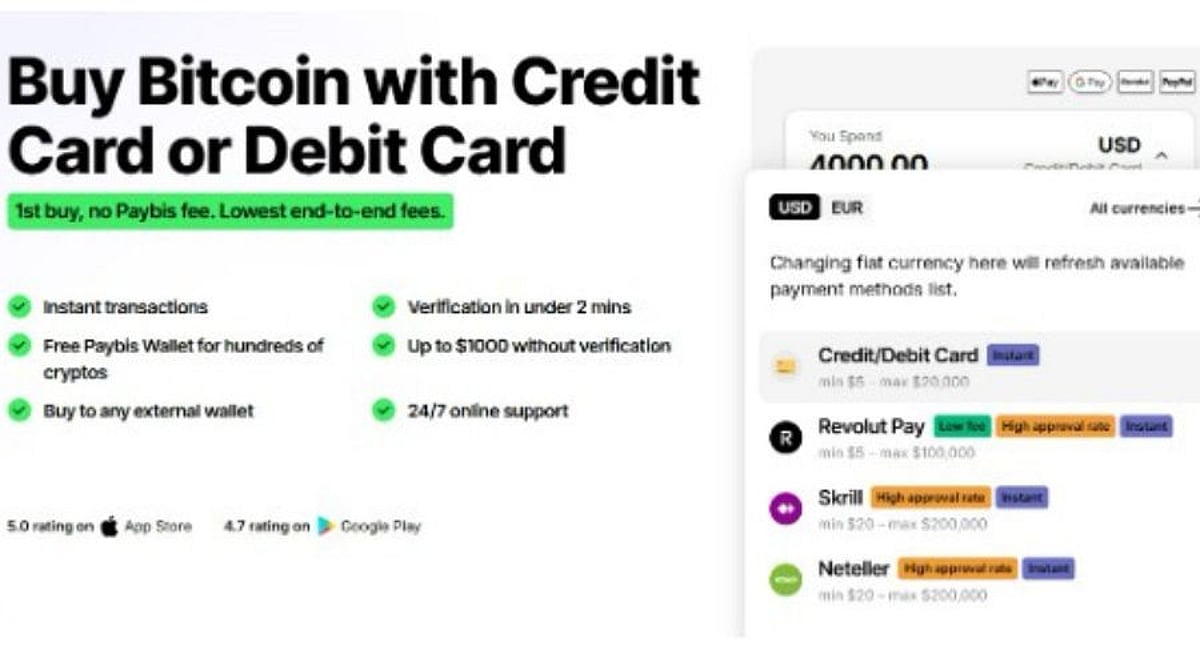
    The platform’s user experience design is built on minimizing traditional onboarding friction. This is evident in its quick user verification system, multiple payment options, and clear, visible pricing with no hidden fees. By allowing users to pay through familiar methods like credit or debit cards, Paybis mirrors a standard e-commerce checkout, lowering technical barriers often associated with blockchain.

    Paybis Regulatory Status

    Paybis operates in compliance with regulations across multiple jurisdictions, ensuring transparency and peace of mind for its growing user base.

    US Compliance Through FinCEN Registration

    Paybis operates in the United States through its official registration as a Money Services Business (MSB) with the Financial Crimes Enforcement Network (FinCEN). The company holds licenses to legally operate in 48 US states, demonstrating its commitment to navigating complex state-level regulations. This regulatory registration serves as a powerful trust signal for American users comparing crypto platforms, as it ensures the exchange follows strict Anti-Money Laundering (AML) and Combating the Financing of Terrorism (CFT) protocols. An MSB registration with FinCEN means the business complies with federal reporting and oversight systems.

    New MiCA and PSD2 Licenses in Europe

    Paybis’ EU branch has been officially recognized as a Crypto Asset Service Provider (CASP) under the Markets in Crypto-Assets (MiCA) regulation and has received a new Payment Institution License under the Revised Payment Services Directive (PSD2). By aligning with MiCA—one of the most detailed and strict digital asset laws worldwide—Paybis has opened its internal controls, capital adequacy, and customer protection mechanisms to regulatory scrutiny. The PSD2 Payment Institution license also enables highly integrated, secure, and efficient payment transactions across European countries. For American customers, this global regulatory compliance signals that they are dealing with a regulated crypto service provider that respects cross-border compliance—a key differentiator from less regulated or unregulated crypto services.

    Paybis Benefits for US Users

    Here are some of the key features and real advantages Paybis offers to customers. In addition to these online features, users who want a portable, integrated management solution can use the official Paybis app. The app covers the entire ecosystem—speedy verification, safe storage, and instant card payments—all accessible on mobile devices, allowing users to manage their accounts easily on the go.

    Why Choose Paybis as Your Crypto Exchange?

    Finding the perfect cryptocurrency exchange involves weighing convenience, speed, and a reliable, secure environment. Paybis is an excellent choice for those seeking a faster, simpler, and less troublesome alternative to formal trading desks. Users want to pay instantly with debit and credit cards, check out easily, complete identification verification quickly, see fees clearly, and have a good variety of assets to choose from.

    Supported by 24/7 customer service and a network of worldwide regulatory compliance, Paybis offers a stable, transparent, and reliable platform for managing digital transactions.

    Disclaimer: This article is for informational purposes only and does not constitute financial or investment advice. Cryptocurrency investments carry risk, and you should conduct your own research before making any investment decisions.

  • Bitcoin ETF Inflows Hit $79M, Visa Launches Stablecoin Platform, Polygon Adds 107K Holders in a Month

    Bitcoin ETF Inflows Hit $79M, Visa Launches Stablecoin Platform, Polygon Adds 107K Holders in a Month

    The crypto market saw a flurry of activity as Bitcoin spot ETFs recorded $79.15 million in net inflows, Visa introduced its Stablecoin Platform for financial institutions, and Polygon added over 107,000 new holders in just one month. Meanwhile, BitPay secured regulatory approval under the EU’s MiCA framework, and prediction market platform Kalshi hit a record $217.98 million in daily crypto contract volume.

    Bitcoin Spot ETFs See $79.15 Million in Inflows

    According to data from SoSoValue, Bitcoin spot ETFs recorded a total net inflow of $79.15 million on July 16. BlackRock’s IBIT led the pack with $33.44 million in daily net inflows, bringing its historical net inflow to $60.35 billion. Fidelity’s FBTC followed with $30.73 million, pushing its total historical net inflow to $9.97 billion. The combined net asset value of all Bitcoin spot ETFs now stands at $77.72 billion, with an ETF net asset ratio of 6.04% and historical cumulative net inflows reaching $51.22 billion.

    Visa Launches Stablecoin Platform for Institutions

    On July 16, Visa announced the Visa Stablecoin Platform (VSP), a new enterprise offering designed to help banks, fintechs, and payment providers integrate on-chain settlement without building their own infrastructure. The platform provides access to OpenUSD, a stablecoin launched by Open Standard with participation from over 140 institutions. VSP addresses the operational challenge of stablecoin adoption by offering pre-built wallet infrastructure via a Wallet-as-a-Service model, direct minting and burning of OpenUSD, and seamless connectivity to Visa’s settlement and treasury systems.

    Polygon Holders Surge 78% in One Month

    Polygon (POL) saw its holder count jump from 138,000 to 245,000 in just 30 days, adding more than 107,000 new wallets—a 78% increase. This growth was driven by rising payment activity on the network. Monthly Crypto Card Volume surged over 122% to a record high, with more than $30.5 million processed so far, compared to $13.69 million in June.

    BitPay Receives MiCA Approval in the Netherlands

    BitPay has secured authorization under the European Union’s Markets in Crypto-Assets (MiCA) framework through its Dutch subsidiary, BitPay B.V., from the Dutch Authority for the Financial Markets (AFM). This approval allows BitPay to offer regulated digital asset services—including payment acceptance and stablecoin transactions—across all EU member states via MiCA’s passporting rules. Thom de Jong, BitPay’s Chief Compliance Officer for Europe, emphasized that the authorization strengthens the company’s ability to serve EU businesses and consumers while reinforcing its compliance-focused approach.

    Kalshi Crypto Contract Volume Hits Record $217.98 Million

    Kalshi’s crypto event contracts set a new single-day volume record on July 15, reaching $217.98 million, according to Artemis data. Volume on the platform has been steadily climbing since May, rising from roughly $5 million daily on January 1 to the current record—a 44x increase in about seven months. Kalshi now controls roughly 84% of crypto-prediction volume, having overtaken Polymarket in the space.

    Frequently Asked Questions

    How much inflow did Bitcoin spot ETFs record?

    Bitcoin spot ETFs recorded $79.15 million in net inflows. BlackRock’s IBIT led with $33.44 million, followed by Fidelity’s FBTC at $30.73 million.

    What is Visa’s Stablecoin Platform?

    Visa’s Stablecoin Platform is an enterprise offering for banks, fintechs, and payment providers. It supports wallet infrastructure, OpenUSD minting and burning, and integration with Visa settlement systems.

    How many new holders did Polygon add?

    Polygon added more than 107,000 holders in one month. Its holder count rose from 138,000 to 245,000, marking a 78% increase.

    What MiCA approval did BitPay receive?

    BitPay secured authorization under the EU’s MiCA framework through its Dutch subsidiary. This allows it to offer regulated crypto payment and stablecoin services across EU member states.

    Why is Kalshi’s crypto contract volume important?

    Kalshi’s crypto event contracts hit a record $217.98 million in daily volume. The surge shows rising demand for regulated prediction-market exposure to crypto-related events.