Tag: Middle East tensions

  • FTSE 100 Drops 65 Points as Middle East Tensions and Weak China GDP Sour Investor Mood

    FTSE 100 Drops 65 Points as Middle East Tensions and Weak China GDP Sour Investor Mood

    The FTSE 100 opened 65 points lower at 10,464 on Wednesday, driven by escalating tensions between the United States and Iran that pushed oil prices higher, while disappointing Chinese economic growth data added to investor caution.

    Brent crude futures rose 1.64% to $86.12 a barrel, and US West Texas Intermediate (WTI) advanced 1.66% to $80.66 a barrel. Sterling strengthened slightly, quoted at $1.3405 early Wednesday, up from $1.3396 at the previous London close.

    Gainers & Losers

    Top Gainers

    • Barratt Redrow +3.06% to £286.70
    • ICG +2.24% to £1,830
    • Burberry Group +1.64% to £1,086.50
    • Smith & Nephew +1.21% to £1,127.50
    • Persimmon +1.14% to £1,064.50
    • Polar Capital Technology Trust +0.82% to £675

    Top Losers

    • Fresnillo -3.39% to £2,507
    • Antofagasta -2.91% to £3,731
    • Endeavour Mining -2.58% to £3,510
    • Lion Finance Group -1.40% to £11,290
    • Coca-Cola Europacific Partners -1.20% to £7,820
    • Games Workshop Group -0.59% to £20,220

    China’s Economic Slowdown

    China’s economy grew 4.3% year-on-year in the second quarter, its weakest pace since the fourth quarter of 2022, according to the National Bureau of Statistics. The reading missed the Reuters poll forecast of 4.5% and slowed from 5% growth in the first quarter, falling below Beijing’s full-year target range of 4.5% to 5%.

    B&M First Quarter Sales Rise

    B&M European Value Retail reported first-quarter sales growth of 2%, with revenue climbing to £1.43 billion in the 13 weeks to 27 June. Revenue at B&M UK increased 0.3% to £1.14 billion, though like-for-like sales fell 2.3%.

    Antofagasta Under Pressure from Rising Costs

    Antofagasta faced headwinds from falling production and rising operational costs. Year-to-date copper production declined 9.5% to 285,000 tonnes, while maintenance at Los Pelambres cut molybdenum output by 18% to 6,100 tonnes. Gold production increased 1.8% to 92,800 ounces, but raw production costs surged 22.8% to $2.8 per pound.

    Barratt Redrow Bets on Buybacks

    Barratt Redrow committed to returning £400 million to shareholders, citing that buybacks offer better value than larger cash dividends. The group completed 17,667 home sales in the year to 28 June, at the top end of its guidance and up from 16,826 a year earlier. Net cash stood at £772 million, well above the guided range of £550-£650 million.

    Global Market Overview

    In the US, the Nasdaq climbed 0.9% on semiconductor strength, while the S&P 500 added 0.4% and the Dow Jones edged up just 10 points. In Asia, Tokyo’s Nikkei 225 rose 1.49% to 68,751.51, China’s Shanghai Composite fell 0.29%, Hong Kong’s Hang Seng climbed 1.24%, and South Korea’s Kospi advanced 6.24%. In India, the Nifty 50 dipped 0.02% and the Sensex rose 0.04%.

    Disclaimer: This article is for informational purposes only and does not constitute investment advice. Always conduct your own research before making any financial decisions.

  • FTSE 100 Drops 68 Points as Middle East Tensions Boost Oil Prices and Energy Stocks

    FTSE 100 Drops 68 Points as Middle East Tensions Boost Oil Prices and Energy Stocks

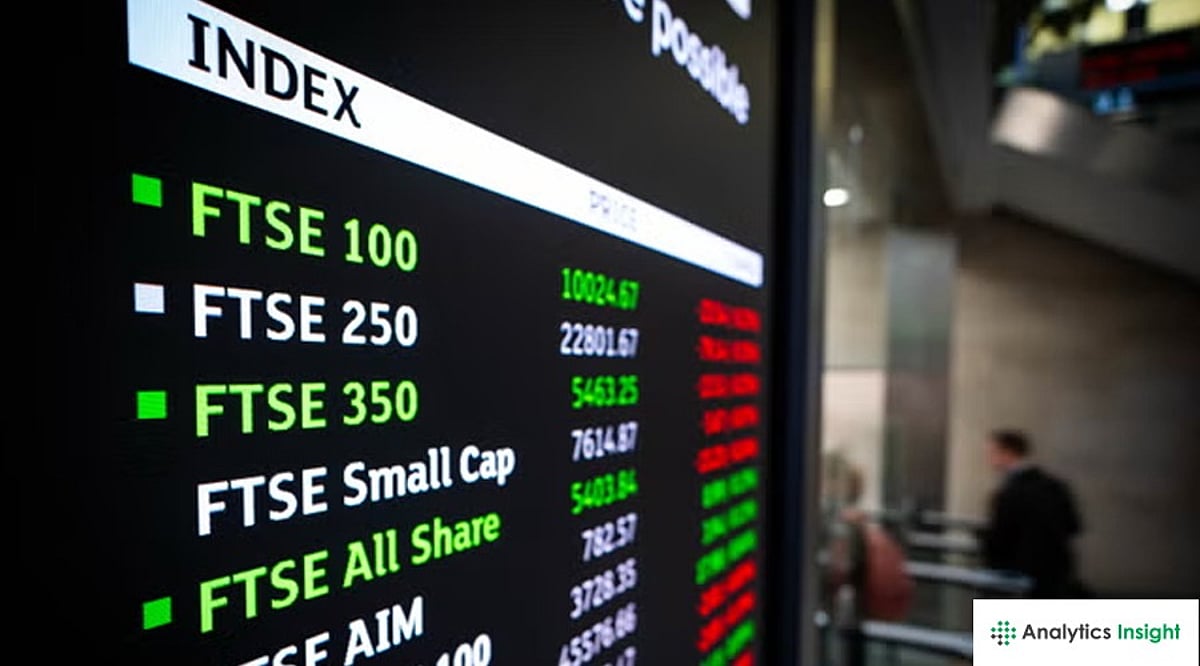
    The FTSE 100 opened 68.09 points lower at 10,430.20 on Monday, as escalating tensions in the Middle East—triggered by US strikes on Iran—pushed oil prices sharply higher and dampened risk appetite across European markets. Brent crude futures rose 3.54% to $86.25 a barrel, while US West Texas Intermediate (WTI) advanced 3.19% to $80.63 a barrel.

    Sterling was quoted at $1.3366 early Monday, lower than $1.3378 at the London equities close on Friday. Against the euro, sterling fell to €1.1727 from €1.1733 a day prior.

    Gainers & Losers

    On the upside, BP rose 2.99% to £520.10, while Vodafone Group advanced 1.72% to £118.15. Centrica gained 1.71% to £175.45, and Shell climbed 1.58% to £3,158. Glencore added 1.46% to £522, and Rio Tinto climbed 1.46% to £6,831.

    On the downside, Games Workshop Group declined 1.09% to £20,000, while AstraZeneca slipped 1.33% to £12,442. Next fell 1.12% to £14,595, and London Stock Exchange Group edged lower by 1.73% to £8,854. Lion Finance Group dropped 1.13% to £11,420, while 3i Group eased 3.09% to £2,603.

    Debenhams Owner Could Sell Brands

    Debenhams Group has said it could sell off some of its brands to eliminate its £90 million debt. The group, which owns Debenhams, Boohoo and Pretty Little Thing, said on Tuesday it plans to slash its debt, which stood at £93 million in its recent financial year, to below the level of its pre-tax earnings. “With strategic brand licensing opportunities and potential business disposals, there is the opportunity to eliminate the debt,” the firm said. Debenhams Group saw “positive” trading in June and July, it said, as it capitalised on the hot summer weather.

    BP’s Oil Production Declines

    BP’s oil production declined as upstream production of oil and gas is set to come in at as low as 2,170 thousand barrels equivalent in the second quarter of the year, a fall of 7.3% compared to the first quarter. However, BP has been fueled by soaring oil prices, which averaged $103.85 per barrel in the second quarter, a jump of 28% compared to the first quarter. Brent crude prices slid back to $72 per barrel at the start of the month on renewed hopes of an end to the Middle Eastern Conflict, but since then has climbed to a four-week high above $80.

    Retail Sales Growth Softens

    UK retail sales grew 1.9% year-on-year in June, down from a 3.7% gain in May, according to the BRC-KPMG Retail Sales Monitor. Like-for-like sales rose 1.7%, down from 3.4% in May, and below the consensus forecast of 2.7%. Food sales increased 2.8%, below the 12-month average growth of 3.4%, while non-food sales were up 1.2%, above the 12-month average growth of 0.6%. KPMG’s Linda Ellett says, “As the summer holiday season gets set to fully begin, retailers will be looking to build on the increase in clothing sales for both adults and children that was seen during June.”

    Global Market View

    In the US, Wall Street began the week on a weaker note, with the tech-heavy Nasdaq leading the decline, tumbling 1.6%, while the S&P 500 dropped 0.8% and the Dow Jones fell 0.3%. In Asia on Tuesday, Tokyo’s Nikkei 225 rose 0.74% to 67,743.5, while China’s Shanghai Composite gained 1.36%. Hong Kong’s Hang Seng climbed 0.50%, and South Korea’s Kospi advanced 0.72%. In India, Nifty 50 and Sensex declined by 0.5% and 0.52%, respectively.

    Disclaimer: Analytics Insight does not provide financial advice or guidance on cryptocurrencies and stocks. This article is provided for informational purposes and does not constitute investment advice. You are responsible for conducting your own research (DYOR) before making any investments.

  • US Stock Futures Decline as Middle East Tensions Drive Oil Prices Higher, Stoking Market Anxiety

    US Stock Futures Decline as Middle East Tensions Drive Oil Prices Higher, Stoking Market Anxiety

    US stock futures edged lower on Monday as renewed tensions in the Middle East unsettled investors and sent crude oil prices higher, raising concerns over inflation and global economic growth.

    Nasdaq futures suffered the biggest loss, with S&P 500 and Dow Jones Industrial Average futures indicating the market will open lower as investors weighed the impact of rising energy prices amid uncertainty over the interest rate outlook.

    Oil Rise Puts Pressure on Market Sentiment

    Oil prices increased amid growing tensions between the United States and Iran. Concerns about potential oil supply disruptions have arisen due to the strategically located Strait of Hormuz, which is among the most active oil transportation routes worldwide.

    Brent crude oil has been hovering near $79 per barrel, while West Texas Intermediate has exceeded $74 per barrel. Increased oil prices have caused inflation concerns.

    Tech and semiconductor stocks continued to underperform as investors cut positions in growth sectors. Increasing bond rates have contributed to weakness in tech stocks due to their sensitivity to rate changes.

    Attention Turns to Earnings and Inflation Reports

    Despite geopolitical and market uncertainties, investors are preparing for yet another busy week on Wall Street. Several big US banks are expected to report earnings next week, kicking off the earnings season. Market participants will watch how tech firms perform during earnings in the upcoming days.

    Moreover, investors will consider figures on US inflation and statements by Fed Chair Kevin Warsh, which may have a strong impact on market expectations for further Fed action. Any indications of inflation persistence, especially following the oil price hike, may add to the list of reasons to maintain high interest rates.

    For now, investors are trying to weigh geopolitical influences against company earnings and economic data. It seems that all these issues will play an important role in global markets in the coming days.

  • MCX Gold Drops 1% to Rs 1,42,050 as Middle East Tensions Boost Brent Crude 4%

    MCX Gold Drops 1% to Rs 1,42,050 as Middle East Tensions Boost Brent Crude 4%

    Gold prices on the Multi Commodity Exchange (MCX) fell 1% on July 13, with August futures settling at Rs 1,42,050 per 10 grams. The decline came as escalating tensions between the US and Iran drove crude oil prices higher and strengthened the US dollar, creating headwinds for the precious metal.

    September silver futures also declined, dropping 1.9% to Rs 2,18,439. Meanwhile, Brent crude futures surged 4.05% to $79.09 per barrel, and US West Texas Intermediate (WTI) advanced 4.13% to $74.36 per barrel.

    According to the CME FedWatch Tool, traders now price in a 72% chance of a Federal Reserve rate hike in September, up from 63% last week.

    Domestic Gold Prices

    In the Indian bullion market, 24K gold fell by Rs 142 to Rs 1,42,910 per 10 grams, while 22K gold declined by Rs 130 to Rs 1,31,000. City-wise, Mumbai and Kolkata quoted gold at Rs 1,42,910, Delhi at Rs 1,43,050, and Chennai at Rs 1,44,000.

    US Gold Prices

    US gold prices also declined over 1% on Monday amid concerns over the potential closure of the Strait of Hormuz, which pushed oil prices higher and revived expectations of elevated interest rates. Spot gold dropped 1.5% to $4,059.11 per ounce, and US gold futures for August delivery were down 1.1% at $4,067.10.

    Spot silver declined 2.9% to $58.14 per ounce, platinum shed 1.8% to $1,598.48, and palladium fell 2.3% to $1,247.27.

    Key Levels to Watch

    “Any breakout of violence in the Gulf is accompanied by pressure on gold,” said Nicholas Frappell, global head of institutional markets at ABC Refinery. “The question is, if the Strait of Hormuz remains effectively or partially closed, does that lead to a deflationary effect, further down the road, that might actually be supportive for gold if you have demand destruction leading to lower economic activity,” Frappell added.

    Internationally, gold has support at $4,074 and $4,040, while resistance is at $4,144 and $4,180 per troy ounce. Silver has support at $59.10 and $57.70, with resistance at $61.20 and $62.40 per troy ounce.

    On MCX, gold has support at Rs 1,42,400 and Rs 1,41,100, and resistance at Rs 1,44,400 and Rs 1,45,550. Silver has support at Rs 2,20,000 and Rs 2,16,600, and resistance at Rs 2,26,000 and Rs 2,28,800.

  • FTSE 100 Opens Lower as Middle East Tensions Drive Brent Crude Up 3.72%

    FTSE 100 Opens Lower as Middle East Tensions Drive Brent Crude Up 3.72%

    The FTSE 100 opened 10 points lower at 10,486.74 on Monday, as renewed escalation in the Middle East pushed oil prices sharply higher. Energy-heavy blue-chip stocks helped offset a broader risk-off mood across the market.

    Brent crude futures surged 3.72% to $78.90 a barrel, while US West Texas Intermediate (WTI) advanced 3.74% to $74.08 a barrel. Sterling weakened to $1.3380, down from $1.3419 at the London close on Friday, and fell against the euro to €1.1730 from €1.1737.

    Gainers and Losers

    Top Gainers:

    • Persimmon: +3.52% to £1,073.50
    • Vodafone Group: +3.13% to £113.55
    • Shell: +1.38% to £3,080.50
    • BP: +2.59% to £495.15
    • Computacenter: +1.93% to £4,540
    • BT Group: +1.55% to £193

    Notable Losers:

    • AstraZeneca: -1.26% to £12,672
    • Spirax Group: -1.53% to £6,455
    • Endeavour Mining: -1.80% to £3,610
    • Diploma: -0.96% to £6,735
    • Halma: -1.70% to £3,578
    • Antofagasta: -1.43% to £3,724

    Corporate Updates

    ME Group Reaffirms Profit Guidance

    ME Group has expanded into user-operated dog washing machines to recover from the revenue hit caused by the Iran war. The firm installed 200 machines across the UK, France, and the Republic of Ireland, noting they are proving popular. Revenue slipped 1% to £152 million on a constant currency basis in the six months to end of April, while pre-tax profit fell 6% to £32 million.

    PageGroup Profit Declines 5.4%

    Recruiter PageGroup reported a 5.4% drop in second-quarter profit to £21.8 million, an improvement from the 11.4% decline in the prior quarter. Temporary recruitment rose 1%, outperforming permanent recruitment, which fell 8%. Group profit remained flat at £197.6 million, with about half of operating markets seeing growth, particularly southern Europe.

    Plus500 Half-Year Revenue Jumps 12%

    Plus500 reported its highest half-year revenue in three years at $462.9 million, up 12% year-over-year. Customer income rose 24% to a five-year record of $460.8 million. Underlying EBITDA edged up 1% to $187.5 million, though the margin slipped to 41% from 45% due to increased spending on customer acquisition and US investment.

    Global Market Overview

    US futures pointed lower, with the Nasdaq expected to fall 1.3%, while the Dow Jones and S&P 500 were seen dropping 0.35% and 0.55%, respectively. In Asia, Tokyo’s Nikkei 225 fell 1.92% to 67,242.73, China’s Shanghai Composite dropped 2.06%, and Hong Kong’s Hang Seng edged up 0.064%. Australia’s S&P/ASX 200 rose 0.03%. In India, the Nifty 50 and Sensex advanced 0.14% and 0.11%, respectively.

  • Nifty 50 Holds Above 23,800, Sensex Targets 77,000 as Middle East Tensions Fuel Volatility

    Nifty 50 Holds Above 23,800, Sensex Targets 77,000 as Middle East Tensions Fuel Volatility

    The Indian stock market is expected to open higher on short covering after a sharp sell-off as investors remain cautious about the renewed US-Iran war tensions and rising crude oil prices. GIFT Nifty also indicates a gap-up opening, trading at 23,976 with a premium of 64 points from its previous Nifty futures close.

    On Wednesday, the Sensex plunged 1,677.12 points or 2.15% to settle at 76,503.60, while the Nifty 50 fell 516.65 points or 2.12% to finish at 23,882.05.

    Among broader indices, Nifty Midcap 100 shed 1.5% and the Nifty Smallcap 100 index declined 2.2%.

    The Indian rupee opened flat at Rs. 95.55 per dollar on Thursday versus the previous close of Rs. 95.55.

    Foreign institutional investors (FIIs) remained net buyers in Indian equities on July 8, purchasing shares worth Rs. 1,962.80 crore, while Domestic institutional investors (DIIs) also stayed on the buying side, investing Rs. 790.16 crore.

    Sensex Outlook

    Technically, the Sensex formed a long bearish candle on the daily chart, indicating further weakness from the current levels.

    “We are of the view that the short-term texture of the market has changed to negative from positive, and for day traders, selling on rallies would be the ideal strategy. For day traders, 77,000 and 77,100 would act as immediate resistance levels for the bulls. As long as it is trading below these levels, weak sentiment is likely to continue on the downside. The market could retest the level of the 50-day SMA (Simple Moving Average), around 76,000. Further downward movement may also continue, which could drag the index to 75,800,” said Shrikant Chouhan, Head Equity Research, Kotak Securities.

    On the flip side, above 77,100, the sentiment could change. If the index moves above this level, a pullback could continue till 77,400-77,500. The current market texture is volatile; hence, level-based trading would be the ideal strategy for day traders, he added.

    Nifty 50 Outlook

    The Nifty 50 formed a long bearish candle with a lower high, lower low and a bearish gap, indicating that sellers currently have the upper hand.

    Bajaj Broking noted that the index erased its recent gains after slipping below the important support zone around 24,250 and eventually tested the 23,800 mark during intraday trade.

    “Going ahead, a breach below the key support area of 23,800 will open further downside towards the 23,500-23,600 levels in the coming sessions being the confluence of the previous gap area and 61.8% retracement of the entire previous up move 23,070-24,530. While holding above 23,800 will lead to consolidation in the range of 23,800-24,350. Immediate bias remains down below Wednesday’s gap down area of 24,350,” said the brokerage.

    Bank Nifty Outlook

    On Wednesday, Bank Nifty slumped 1,458.10 points or 2.51% to close at 56,742.60, forming a bearish candle on the daily chart and slipping below its 20-day EMA for the first time since June 8.

    “The index has entered a corrective phase after failing to hold key support levels. Index contrary to our expectations closed below the immediate support area of 57,000-56,800 signaling corrective bias. A follow through weakness will open further downside towards 55,500-56,000 levels in the coming sessions,” said Bajaj Broking Research.

    The brokerage further added, “On the higher side only a move above 58,000 will signal resumption of the up-move failure to do so will lead to some consolidation in the range of 55,000-58,000 levels.”

    Disclaimer: This article is provided for informational purposes and does not constitute investment advice. You are responsible for conducting your own research before making any investments.

  • MCX Gold Declines 0.35% to ₹1,44,885 as Middle East Tensions and Fed Rate Concerns Weigh

    MCX Gold Declines 0.35% to ₹1,44,885 as Middle East Tensions and Fed Rate Concerns Weigh

    Gold prices on the Multi Commodity Exchange (MCX) slipped on July 8, tracking weakness in global bullion markets as escalating tensions between the United States and Iran in the Middle East stoked inflation fears and strengthened the U.S. dollar. August gold futures fell 0.35% to ₹1,44,885 per 10 grams, while September silver futures dropped 0.8% to ₹2,29,007 per kilogram.

    Brent crude futures jumped 2.55% to $76.05 a barrel, and U.S. West Texas Intermediate (WTI) advanced 2.51% to $72.21 a barrel, reflecting supply concerns from the geopolitical unrest.

    Fed Rate Hike Expectations Rise

    According to the CME FedWatch Tool, traders now see a 63% probability of a rate hike in September, up from 57% previously. Higher interest rates tend to pressure gold prices by increasing the opportunity cost of holding non-yielding assets.

    Domestic Gold Prices

    In the domestic market, 24K gold fell by ₹77 to ₹1,44,490 per 10 grams, while 22K gold declined by ₹70 to ₹1,32,450. City-wise, Mumbai and Kolkata quoted gold at ₹1,44,490, Delhi at ₹1,44,640, and Chennai at ₹1,45,420.

    U.S. Gold and Metals Market

    In the U.S., spot gold rose 0.5% to $4,125.59 per ounce, while August gold futures shed 0.5% to $4,136.30. Spot silver gained 0.8% at $60.47 per ounce, platinum slipped 0.3% to $1,635.45, and palladium dropped 0.6% to $1,268.64.

    Key levels for MCX gold indicate immediate resistance at ₹1,46,000 per 10 grams and support at ₹1,44,000. Analysts note that while the broader trend remains under pressure, a technical pullback is possible at current levels. For MCX silver, major resistance is at ₹2,32,500 per kilogram, with support at ₹2,28,000.

    “Over the past 24 hours, there was a little bit of a scare again on the inflation front. So bonds came in lower, the dollar popped a little, gold pulled back, and now seems to be kind of stabilising after that correction. At this point, we’ve been watching gold attempt to carve out a bottom,” said Ilya Spivak, head of global macro at Tastylive.

  • Gold Prices Dip on MCX to ₹1,43,350 as Middle East Tensions Stoke Inflation Fears

    Gold Prices Dip on MCX to ₹1,43,350 as Middle East Tensions Stoke Inflation Fears

    Gold futures on the Multi Commodity Exchange (MCX) declined on June 24, 2026, amid renewed hostilities between the US and Iran that sent oil prices higher and reignited inflation concerns. The escalation is prompting traders to bet on tighter monetary policy from the US Federal Reserve.

    August gold futures on MCX fell 0.56% to ₹1,43,350 per 10 grams. July silver futures also slipped 0.7% to ₹2,19,863. In the international market, Brent crude futures edged down 0.67% to $72.47 a barrel, while US West Texas Intermediate (WTI) crude dropped 1.80% to $70.05 a barrel.

    According to the CME FedWatch Tool, traders now anticipate three rate hikes from the US Federal Reserve this year, with an 80% probability of a December hike.

    Domestic Gold Prices

    In the domestic spot market, 24K gold fell by ₹93 to ₹1,43,020 per 10 grams, and 22K gold dropped by ₹85 to ₹1,31,100. Regional variations were minimal: Mumbai and Kolkata both quoted ₹1,43,020, Delhi ₹1,43,170, and Chennai ₹1,45,090.

    US Gold Prices

    US gold prices also eased on Monday as recent US-Iran strikes in the Gulf pushed oil prices higher. Spot gold was down 0.6% at $4,062.89 per ounce, while US gold futures for August delivery lost 0.5% to $4,077.50. The metal is heading for a fourth consecutive monthly loss of 10.4%.

    Spot silver fell 1.2% to $58.47 per ounce. Platinum gained 0.2% to $1,617.15, and palladium rose 0.4% to $1,213.60.

    Key Levels to Watch

    Tim Waterer, chief market analyst at KCM Trade, commented: “US and Iran were at it again over the weekend, with fresh military strikes reported from both parties, which casts further doubt over how long oil can stay at these subdued levels and therefore over the broader inflation and interest rate outlook.”

    Waterer added: “Gold could see the $5,000 level again this year, but this would be based on further de-escalation, oil having a sustained move to pre-war levels to dull the inflationary impact of the conflict, and a softer dollar.”

    Internationally, gold has support at $4,055 and $4,010, while resistance is at $4,135 and $4,180 per troy ounce. Silver has support at $57.40 and $55.80, with resistance at $61.20 and $62.80 per troy ounce.

    On MCX, gold has support at ₹1,43,300 and ₹1,42,400 and resistance at ₹1,45,150 and ₹1,46,200. Silver has support at ₹2,20,000 and ₹2,16,600 and resistance at ₹2,26,000 and ₹2,29,100.

    Stay updated with the latest gold price movements and market insights.