
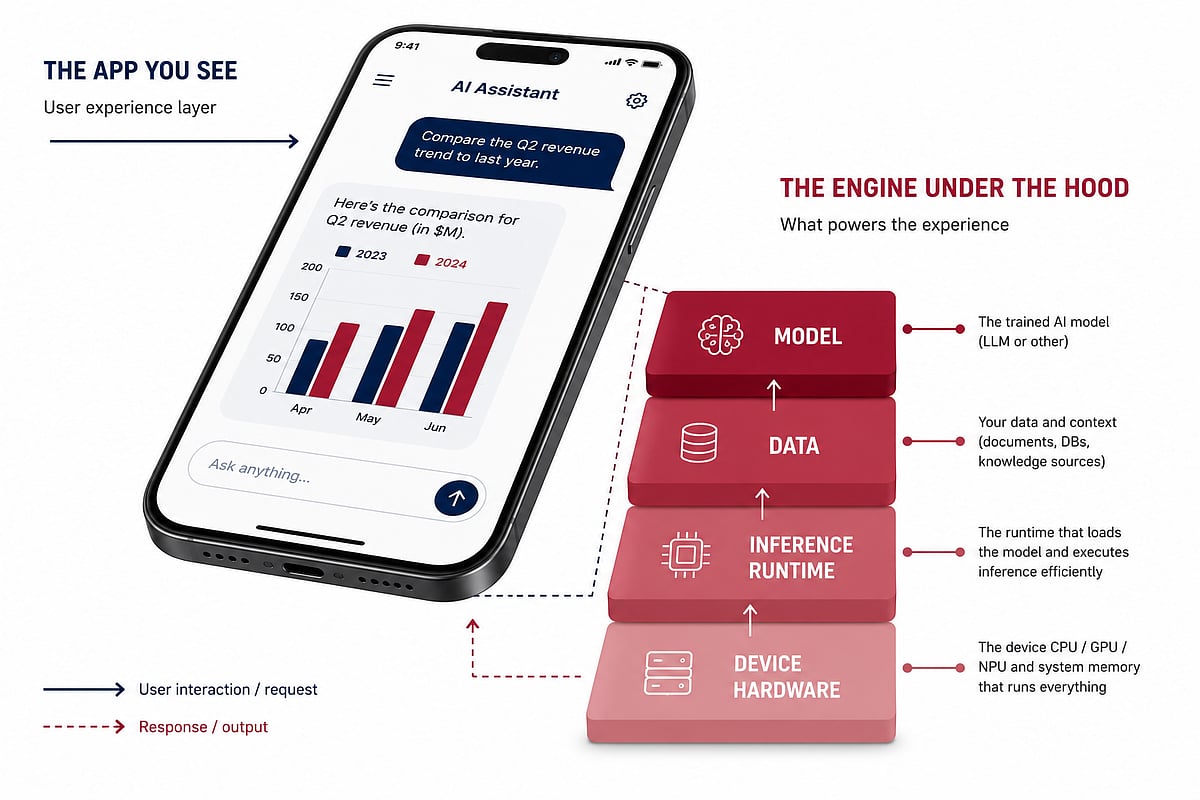
A year ago, adding AI to a mobile app meant bolting on a chat widget and calling it a feature. That era is over. In 2026, AI has moved from a visible add-on to an infrastructure decision, fundamentally changing what “building an app” means for development teams.
The shift is evident in usage data. According to Sensor Tower’s year-end report, the total U.S. audience for AI assistants surpassed 200 million by the end of 2025, with more than half accessing those assistants exclusively on mobile devices—up from roughly 13 million mobile-only users the year before. This is no longer a niche behavior; it’s the default way most people interact with AI. The app is no longer a wrapper around the model—the app is the product.
From Cloud Round-Trips to On-Device Inference
For years, AI features followed a predictable pattern: capture input, send it to a server, wait for a model response, and render the result. That pattern is breaking down—not because cloud models got worse, but because users now expect AI features to behave like native app features: instant, available offline, and private by default.
Apple’s Neural Engine, Google’s Tensor chips, and Qualcomm’s on-device AI silicon have matured to the point where running a capable model locally is a realistic option for consumer apps. This changes the engineering conversation from “which API do we call” to “which parts of this feature can run on the device, and which parts genuinely need the cloud.” Getting that split wrong is expensive in ways that don’t surface until the app is already in users’ hands.
The Unglamorous Engineering Problem Nobody Mentions
On-device AI is a battery, memory, and fallback-path problem before it’s a model problem. A locally running model that drains a phone’s battery in an afternoon or locks up the UI thread during inference will get uninstalled regardless of output quality. The model is the easy part. The packaging, memory management, graceful fallback for devices without the necessary hardware, and testing across dozens of device and OS combinations are where most AI feature timelines go sideways.
This pushes product teams toward dedicated mobile app development partners rather than retrofitting AI onto an existing roadmap. Teams that get this right treat AI features as an architecture decision made early, not a plugin added late. Retrofitting almost always costs more because the data flow, caching layer, and offline state all have to be rethought rather than extended.
Why iOS Has Become Its Own Specialized Lane
The platform split has also sharpened. Apple’s approach to on-device intelligence—from Apple Intelligence’s privacy-first design to the App Intents framework—is deliberately different from Android’s. A model and pipeline built for one platform’s AI stack rarely transfers cleanly without real rework.
This has pushed specialized iOS development expertise higher on the priority list for any team shipping AI features on Apple’s platform. Knowing how to call a model API is no longer enough. Teams need to understand Apple’s specific constraints around on-device processing, App Store disclosure requirements for AI-generated content, and the Neural Engine’s actual performance ceiling on the device generations their user base is running. Get that platform-specific layer wrong, and a feature that demoed perfectly in a controlled environment becomes sluggish or inconsistent in the real world.
What This Means for Decision-Makers
For product and engineering leaders deciding how to staff an AI-feature build, a few questions separate a smooth rollout from a six-month detour:
- Does the team have hands-on experience with on-device inference, not just API integration?
- Is there a clear, tested fallback path for devices that can’t run the model locally?
- Has the architecture been designed for AI from the outset, rather than adapted after the fact?
- Does the team understand the platform-specific rules, especially on iOS, where Apple’s review process and hardware constraints are unusually strict?
A development partner without direct experience answering these questions will end up learning the hard parts on the client’s budget and timeline—an expensive lesson that is avoidable with the right questions asked before a single line of code is written.
The Bigger Shift
What’s happening in mobile development right now isn’t really about AI getting smarter. It’s about AI becoming infrastructure—the same way push notifications, offline sync, and biometric auth became infrastructure a decade ago. Once something becomes infrastructure, the teams that win aren’t the ones with the flashiest demo. They’re the ones who treated it as a core architectural decision from day one.
That’s the quieter story behind every AI feature that feels instant, private, and reliable on a phone in 2026. The visible part is the interface. The real work happened underneath it.