
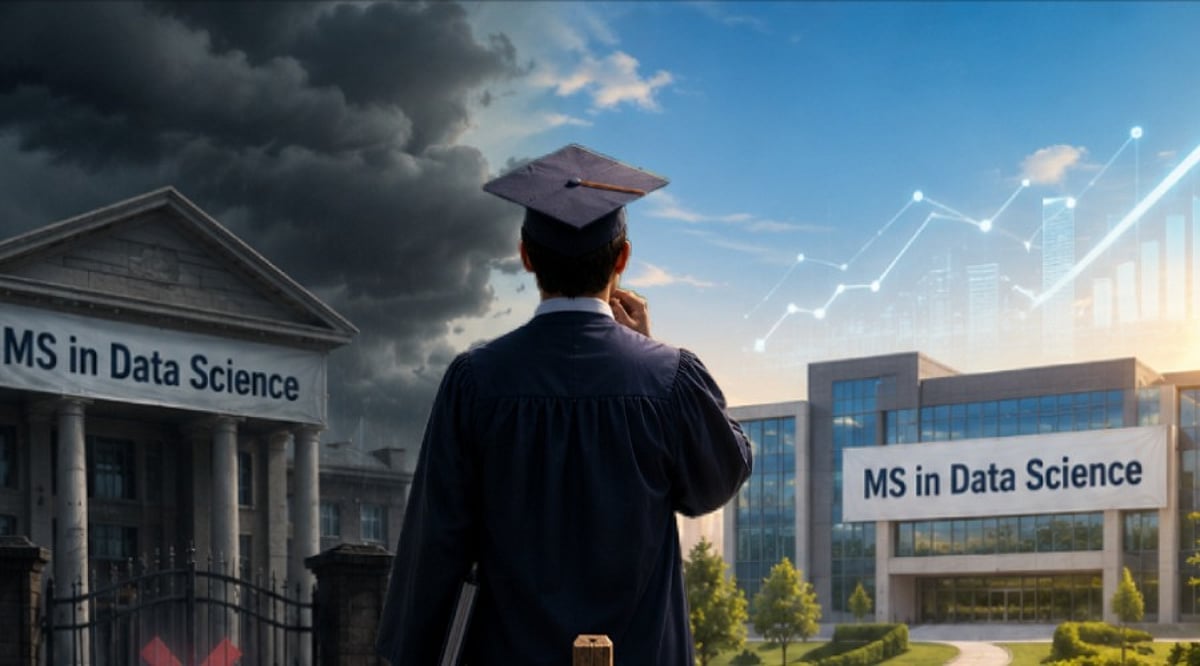
The boom in artificial intelligence has turned data science into one of the world’s most sought-after career paths. Universities across the globe have responded by launching hundreds of Master’s programs promising lucrative jobs, cutting-edge skills, and six-figure salaries. But not every MS in Data Science degree is built the same.
For aspiring professionals, choosing the wrong program can have consequences that extend far beyond graduation. A poor curriculum, limited industry exposure, or weak placement support could leave graduates struggling to compete in a job market that increasingly values practical skills over academic credentials.
As employers raise hiring standards, students are learning that the name of a degree matters far less than what they actually learn during it.
Degree Alone No Longer Guarantees a Job
Just a few years ago, having a master’s degree in data science was enough to grab recruiters’ attention. Today, the landscape has changed dramatically. When companies look to hire data scientists, they usually expect a certain level of programming skill, primarily in Python and SQL, plus the ability to build machine learning models. They also care that you can navigate cloud platforms without getting lost in today’s AI tools. Recruiters tend to scan your GitHub profile and want to see internships and projects from real life—stuff that quietly proves you can solve problems instead of only talking about them.
Meanwhile, students who graduate from programs that focus largely on classroom theory often notice they’re missing the hands-on experience employers actually want. So a lot of people end up signing up for extra bootcamps or taking certification courses even though they already put a lot into a postgraduate degree.
Outdated Curriculum Can Quickly Become Irrelevant
Data science is one of the most rapidly changing areas of technology. Every year, new frameworks, AI model architectures, and other automation solutions completely change the industry. However, some courses still teach ideas that do not align with the present-day needs of the job market. Although basics are essential, companies demand more knowledge in cloud services, machine learning operations (MLOps), deep learning, large language models, and AI deployment. Two years of studying a curriculum that has become irrelevant may be a mistake for students, as they will enter the job market with obsolete knowledge.
Industry Exposure Often Makes the Biggest Difference
One of the major signs of a good data science program is industry interaction. Students get the chance to solve actual problems rather than examples through internships, projects, hackathons, collaborative research, and mentoring from the corporate world. This not only improves students’ technical skills but also their communication and analytical skills. Those programs that lack industry interaction would graduate students who know everything in theory but nothing about how data science is applied in real-world business. Experience weighs more than grades when hiring.
Placement Support Matters More Than Rankings
When some people select colleges based on rankings or the promise of high salaries, placements may be more complicated. A career service center, company contacts, an alum network, and recruitment days play important roles in helping people get placed. Colleges with strong industry connections give students a better chance of securing internships and on-campus placements. On the other hand, colleges without assistance in placing students face difficulty, making students’ lives difficult when entering the competitive labor market alone. In the opinion of experts, future college students need to look at the employment rates, average salaries, internships, and alum success stories.
Financial Cost Extends Beyond Tuition Fees
A foreign MS in Data Science costs lakhs, while a national MS in Data Science program is also substantial. Selecting a program that does not equip the candidate with valuable skills means they will have to invest money to gain those skills, either through certification courses, self-study, or low-paid jobs. Opportunity cost also becomes immense, since with each passing month, the individual becomes more employable yet earns less due to a lack of job-related skills. For some, the wrong program choice proves costlier than choosing a good course.
What Prospective Students Need to Consider Before Applying
Many experts advise going beyond college promotional materials when making decisions. The effective program must be characterized by modern courses and field practice, qualified lecturers, ongoing research, partnerships, and transparency concerning the placement of its alums. Prospective students should consult alums of the university, examine its programs, and find out whether its graduates work at major technology companies, rather than simply considering its placement statistics. Accreditation, faculty quality, and internship opportunities still matter.
Final Thought
Due to the high demand for specialists in artificial intelligence and data science, organizations have become very selective in hiring candidates with the required knowledge and competencies. MS in Data Science is an excellent choice, yet not every program provides its graduates with the required expertise. The hiring environment makes it necessary not only to earn the right degree but also to gain valuable skills and confidence and to pursue other opportunities after two years of study.