
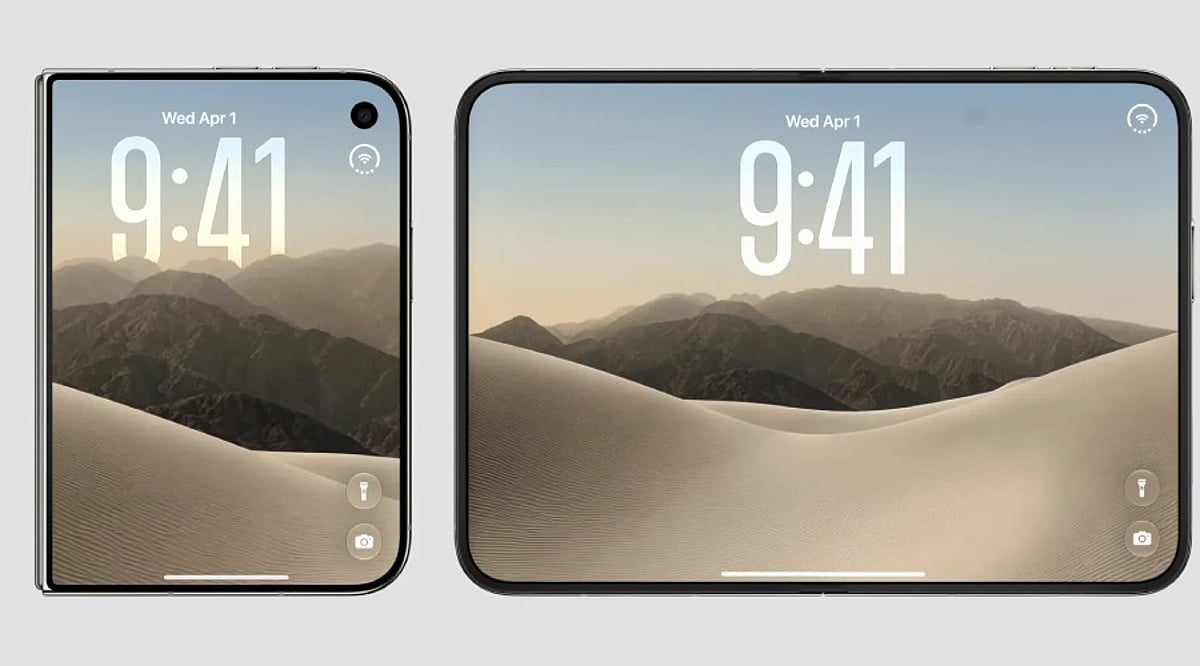
Apple has taken a distinct approach to the display on its first foldable iPhone, the iPhone Duo. The device features a 7.6-inch inner folding display with a resolution of 1878 x 2670 pixels and 430 ppi, alongside a 5.4-inch outer display offering 460 ppi. Both screens support ProMotion at up to 120Hz and achieve a peak outdoor brightness of 3,000 nits.
iPhone Duo Display Specifications
The 7.6-inch Super Retina XDR inner OLED display packs approximately 5.01 million pixels, while the 5.4-inch outer display (1398 x 2034 resolution) delivers around 2.84 million pixels. Apple states that the inner display is 50% larger than the display on the iPhone 18 Pro Max, and the outer display provides 90% of the iPhone 18 Pro’s screen area.
Both displays offer 1,000 nits typical brightness, 1,600 nits for HDR content, and 3,000 nits peak brightness outdoors, with a minimum brightness of 1 nit. Additional features include a 2,000,000:1 contrast ratio, Always-On display, Dynamic Island, HDR, True Tone, and P3 wide color gamut.
The inner display’s 430 ppi is the highest pixel density among current folding screens. For comparison, the Galaxy Z Fold 8 has 404 ppi, Honor Magic V6 has 403 ppi, Motorola Razr Fold reaches 412 ppi, Oppo Find N6 has 413 ppi, and the Pixel 10 Pro Fold comes in at 374 ppi.
A Closer Match Between the Two Screens
Apple says both displays share the same aspect ratio. The actual resolutions have a disparity of only 2.34% (1:1.4217 for the inner display vs. 1:1.4549 for the outer). This is a relatively small difference compared to the Galaxy Z Fold 8, whose two displays have a 20.8% disparity.
Nano-Texture Finish Tackles the Crease
The iPhone Duo introduces a nano-texture matte finish to a folding display. The surface scatters reflections rather than reflecting them directly, reducing the visual prominence of the crease. Apple did not claim the crease disappears completely, but says the matte surface minimizes its visibility. The display uses 10 ultrathin layers, while viscoelastic adhesives allow the layers to move against each other during folding, helping reduce bend stress.
More than 100 Components in the Hinge
Apple designed the hinge system with over 100 components manufactured from titanium and aluminum. This hinge mechanism holds the center portion of the display in place. Carbon fiber support plates provide a stiff, lightweight base, and Apple uses machine-learning software during production to pair individual hinges with the housings they fit best. The iPhone Duo measures 9.5mm when folded.
Glass, Polymer and Ceramic Shield 2
Apple placed high-strength glass above and below the folding panel, along with a titanium plate and carbon fiber support structure. The custom polymer cover is rated up to 40% stiffer than materials used across the industry. The outer display is protected by Ceramic Shield 2, which Apple says offers three times the scratch resistance of the previous generation. The phone also carries an IP68 rating, putting it among the most protected announced foldables.
While the specifications indicate a quantum leap from previous models, the long-term viability of the device will only become clear after several years of constant use have tested the performance of the display and the hinge design.