
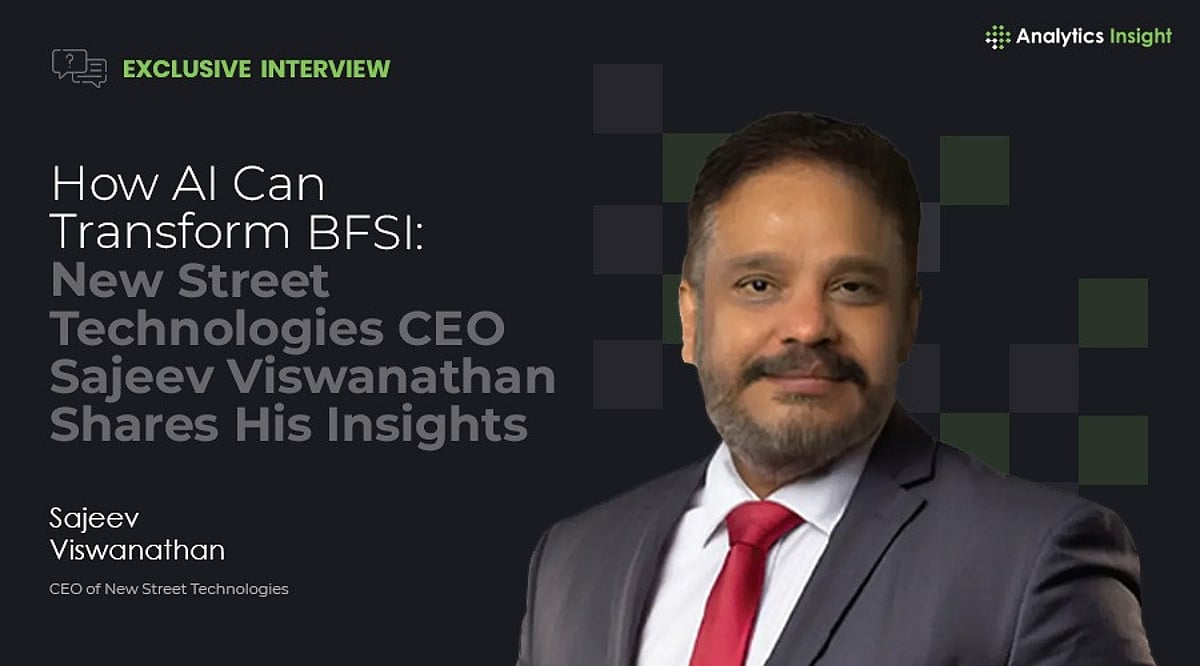
In a recent interview, Sajeev Viswanathan, CEO of New Street Technologies, shared his vision for how artificial intelligence can transform the banking, financial services, and insurance (BFSI) sector. Rather than deploying AI as isolated point solutions, Viswanathan argues that financial institutions must build a connected, governed intelligence layer that spans the entire organization.
According to Viswanathan, fragmentation occurs when AI is deployed as a collection of individual tools—such as a voice bot in one department, a coding assistant in another, and employees using consumer-grade LLMs for research. While each may solve a local problem, collectively they create new silos, data boundaries, and governance challenges. The solution is not to ban these tools but to provide a common foundation: a shared layer for identity, audit, version control, and domain intelligence.
Viswanathan emphasizes the importance of Domain Intelligence Models (DIMs)—permissioned, shared intelligence that multiple processes and products can draw upon, with an optional interface to external LLMs when needed. Keeping AI decoupled from production execution is also critical. When AI-generated designs pass through maker-checker approval before deterministic engines run them, institutions achieve consistency and auditability by design.
On fraud detection and regulatory compliance, Viswanathan notes that industry-specific AI models—shaped around BFSI transaction patterns, SWIFT message structures, KYC/AML workflows, and regulatory reporting formats—can identify anomalies that general-purpose models miss. However, the real strength comes from the architecture: separating AI that flags or designs from the deterministic engine that executes, ensuring explainability, auditability, and human oversight. Privacy is built in by allowing domain intelligence to be permissioned without moving sensitive customer data outside its governed environment.
Viswanathan believes that as AI models become more accessible, differentiators will shift from model size to governance, deployment architecture, data strategy, and execution discipline. Banks that can implement regulatory changes in hours or launch new products in days on a well-governed platform will have a significant advantage. Key metrics like time-to-market and total cost of technology ownership become crucial.
Regarding collaboration to combat financial crime, Viswanathan suggests that shared pattern intelligence and threat signals can be exchanged without compromising competitive advantage. Fraud typologies and money laundering patterns are not areas of competition; differentiation comes from customer experience, pricing, and product design. Federated approaches—where signals or models are shared while underlying data remains local—are particularly relevant. Regulator-sponsored or industry utility models also hold promise.
Looking ahead, Viswanathan sees industry-specific AI ecosystems becoming as foundational as payment networks. Banks should prioritize three things: modernizing the operational core (not just customer-facing channels), embedding governance by design (audit trails, version control, maker-checker workflows, human oversight), and investing in domain intelligence rather than relying solely on generic AI tools. Ultimately, customers will choose a bank not because it uses AI, but because it responds faster, manages risk better, and earns their trust. AI may be the engine, but trust remains the defining differentiator.