
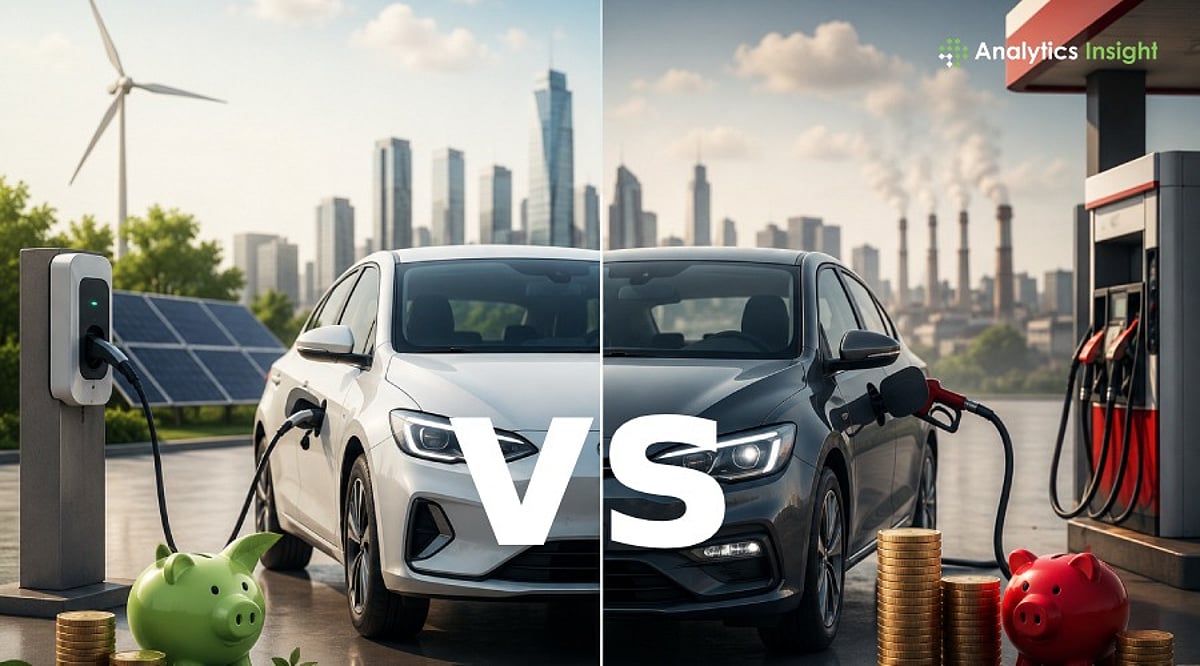
Electric cars are more expensive upfront but offer significantly lower running costs, making them cheaper than petrol cars over time, especially for daily commutes. In 2026, the gap in total ownership costs has narrowed further, with electric vehicles (EVs) recovering their price premium within three to four years.
Daily Cost of Driving
Petrol prices remain near Rs. 100 per litre in many parts of India. A typical petrol car delivers about 14 km per litre, translating to roughly Rs. 7 per kilometer. In contrast, electric cars consume 15–18 kWh per 100 km. At home electricity rates of around Rs. 8 per unit, the cost drops to Rs. 1.2–Rs. 1.5 per kilometer. Even using public fast chargers, the cost stays between Rs. 2.5 and Rs. 4.5 per km — a 70–80% reduction compared to petrol.
Yearly Fuel and Charging Expenses
For a driver covering 15,000 km annually, petrol costs about Rs. 105,000 per year. Home-charging an electric car for the same distance costs just Rs. 20,000–Rs. 25,000. That’s over Rs. 80,000 in annual savings, a gap that widens as petrol prices rise.
Maintenance Costs Remain Lower for EVs
Petrol cars require regular oil changes, filter replacements, spark plug service, clutch and gearbox work, and exhaust repairs — costing Rs. 12,000–Rs. 20,000 per year. Electric cars have far fewer moving parts, no engine oil, and no exhaust system, reducing annual maintenance to Rs. 4,000–Rs. 8,000. Studies show EVs cut maintenance expenses by 40–60%.
Purchase Price Still Favors Petrol Cars
In 2026, a compact petrol SUV in India costs around Rs. 13–14 lakh, while a comparable electric SUV ranges from Rs. 16–18 lakh — a premium of Rs. 3–5 lakh. However, manufacturers like Tata and Mahindra are introducing lower-priced EVs, gradually closing the gap.
Charging Infrastructure Still Creates Problems
Petrol stations are ubiquitous, but charging stations remain limited in many areas. A June 2026 survey of Uber drivers found charging availability is now a bigger concern than vehicle price for those considering switching to EVs. Fast-charging stations also cost more than home charging, reducing savings for drivers dependent on public networks.
Five-Year Ownership Cost Comparison
A petrol car priced at Rs. 13.5 lakh incurs about Rs. 5 lakh in fuel and Rs. 70,000 in maintenance over five years — total approximately Rs. 19.2 lakh. An electric car at Rs. 17 lakh needs only Rs. 70,000 for charging and Rs. 25,000 for maintenance, totaling about Rs. 17.95 lakh. Despite the higher upfront cost, the EV recovers the difference within three to four years.
Final Verdict
Electric cars clearly cost less to run. Daily expenses are much lower, yearly fuel savings are significant, and maintenance remains minimal. Petrol cars still appeal to buyers seeking a lower purchase price and easy access to fuel stations, especially for long-distance travel. However, for regular city driving and higher annual mileage, EVs offer better long-term value. The shift toward electric vehicles continues because lower running costs have become impossible to ignore.
FAQs
- Are electric cars cheaper to run than petrol cars in 2026? Yes, electric cars cost much less per kilometer because electricity remains far cheaper than petrol.
- How much does a petrol car cost per kilometer in 2026? A petrol car costs around Rs. 7 per kilometer based on average fuel prices and mileage.
- How much does an electric car cost per kilometer in 2026? An electric car usually costs between Rs. 1.2 and Rs. 1.5 per kilometer with home charging.
- Why do electric cars have lower maintenance costs? Electric cars have fewer mechanical parts and do not require engine oil changes, exhaust repairs, or spark plug replacement.
- Which car type saves more money over five years? Electric cars usually save more money over five years because charging and maintenance costs stay much lower than petrol cars.