Tag: Physical AI

  • Top 7 AI Trends Transforming Business Technology in 2026

    Top 7 AI Trends Transforming Business Technology in 2026

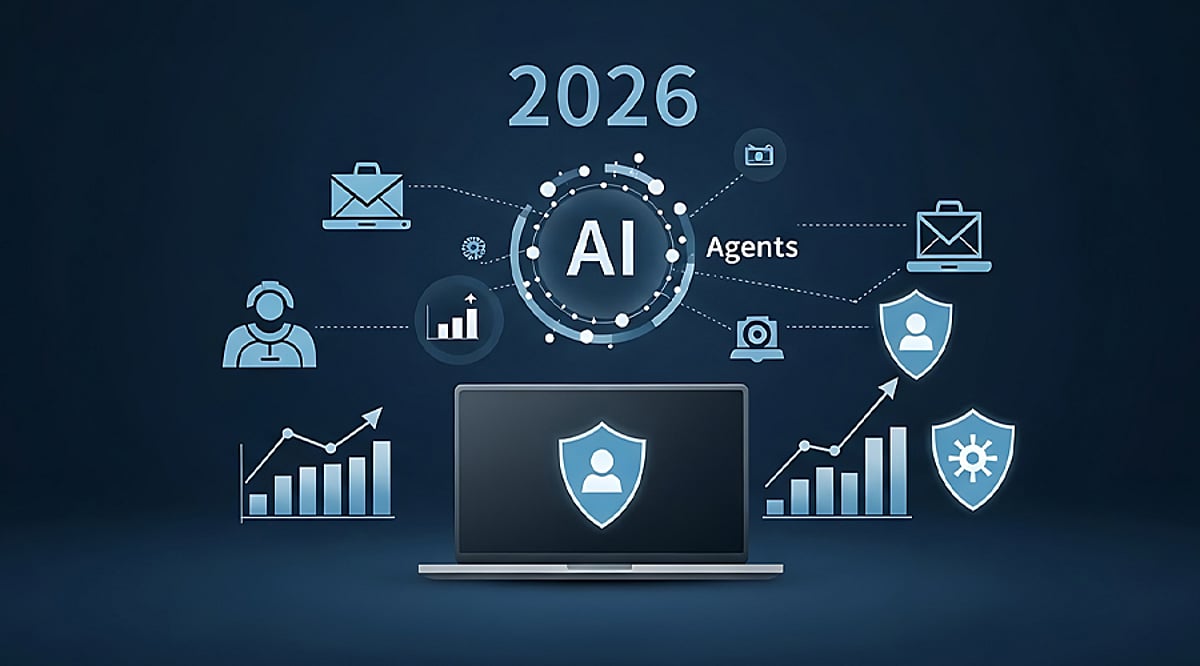
    Artificial intelligence is moving beyond chatbots and into the core of business operations. In 2026, companies are leveraging AI not just for automation but for autonomous workflows, specialized models, and measurable returns. Here are the seven key trends reshaping business technology this year.

    1. Agentic AI Moves Into Business Workflows

    AI agents are evolving from simple chatbots to autonomous systems that plan tasks, use business tools, and complete multi-step processes. Organizations are testing multiagent setups where different agents handle research, analysis, approvals, and execution—all under human oversight.

    2. Smaller AI Models Drive Enterprise Efficiency

    Enterprises are shifting away from relying solely on the largest AI models. Smaller, domain-specific models excel at document processing, customer support, internal search, and invoice extraction. These models reduce costs and latency while giving companies greater control over sensitive data.

    3. AI Infrastructure Becomes a Business Priority

    The growing demand for AI workloads is pushing companies to invest in robust infrastructure. Combining GPUs, CPUs, specialized chips, cloud systems, and edge computing helps manage latency, privacy, and large data volumes. Local and hybrid setups are gaining traction.

    4. AI Strengthens Cybersecurity and Governance

    As AI becomes more autonomous, businesses need stronger controls around access, data, and model behavior. AI can detect unusual activity and speed up threat response, while governance systems track agents, permissions, risks, and compliance. Security is now an integral part of AI development.

    5. Physical AI Brings Intelligence to the Real World

    AI is moving from screens into factories, warehouses, and logistics. Intelligent robots support quality inspection, predictive maintenance, warehouse operations, and manufacturing. This trend bridges AI software with real-world automation.

    6. Multimodal and Voice AI Enter Core Operations

    AI systems now handle text, images, audio, video, and documents in a single workflow. Businesses use these capabilities for call centers, document processing, field services, compliance, and regional-language support. Voice AI is also becoming more practical for customer and employee interactions.

    7. Measurable ROI Defines the Next Phase of AI

    Companies are moving from AI experiments to measurable outcomes. They track metrics like cost reduction, faster workflows, productivity gains, revenue impact, and customer experience. In 2026, the focus is on building reliable systems that deliver value at scale.

    These trends highlight a shift from experimentation to strategic integration, where AI is embedded into every layer of business technology.

  • Why the Chief Robotics Officer Could Be the Next Big C-Suite Role

    Why the Chief Robotics Officer Could Be the Next Big C-Suite Role

    Robots are no longer confined to factory floors and warehouses. With advances in physical AI, they are moving into logistics, healthcare, manufacturing, agriculture, retail, and field services. That expansion raises a strategic question for business leaders: who should own the company’s robotics agenda?

    Most organizations still distribute robotics responsibilities across engineering, operations, technology, and innovation teams. A dedicated chief robotics officer (CRO) could eventually consolidate those duties into one C-suite role. While the title is not yet common, growing enterprise deployments could make it increasingly necessary.

    Robotics Is Becoming a Company-Wide Strategy

    For decades, robotics sat squarely in manufacturing. Industrial machines performed repetitive tasks in controlled environments. Physical AI changes that model. Modern robots can perceive their surroundings, learn new tasks, and adapt to unpredictable conditions.

    Capgemini found that 79% of surveyed organizations were already engaging with physical AI, and 27% had begun deploying or scaling solutions. The impact is no longer limited to manufacturing. Logistics, healthcare, agriculture, retail, and field services are all exploring robotics. As a result, robotics decisions now touch budgets, technology, safety, and workforce planning across multiple departments.

    Why Existing Executive Roles May Not Be Enough

    CTOs, CIOs, COOs, and innovation leaders each oversee pieces of the robotics puzzle. But a single deployment can require software, hardware, connectivity, maintenance, safety protocols, and workforce changes at the same time. That cross-functional complexity often leaves no one with end-to-end ownership.

    Intel’s research from August 2026 underscores the gap: 74% of surveyed leaders expect workforce planning and robotics strategy to become inseparable by 2030, while only 40% currently report having a formal human-robot workforce strategy.

    What a Chief Robotics Officer Would Actually Do

    • Set a company-wide robotics roadmap and identify the best automation opportunities
    • Evaluate vendors, robotics platforms, AI models, and infrastructure needs
    • Define measurable targets for productivity, quality, safety, service levels, and operating costs
    • Lead workforce planning and training for employees who supervise or collaborate with robots
    • Address cybersecurity, compliance, and risk management for connected robot fleets

    In practice, a CRO would act as a bridge between technology teams and operations, ensuring robotics investments deliver business value rather than existing in silos.

    Physical AI Expands the Leadership Challenge

    Physical AI is more adaptive than traditional automation. Capgemini describes the shift as a move toward context-aware robotics, with 67% of executives viewing physical AI as potentially game-changing. But flexibility brings risk. Robots operating near people require stronger safety controls, and data quality, integration, cybersecurity, and reliability remain major barriers.

    Deloitte similarly identifies these issues as constraints on broader robotics growth. A future robotics executive would therefore need business judgment and risk management skills, not just engineering expertise.

    Could Humanoid Robots Accelerate the Trend?

    Humanoid robots have captured attention in 2026. Xpeng’s CEO He Xiaopeng says he will personally lead the company’s robotics division, with mass production of the IRON humanoid targeted for late 2026. Agility Robotics has unveiled Digit 5 for commercial use and reports more than USD 300 million in multiyear orders.

    These announcements do not guarantee rapid adoption. Commercial economics, safety, reliability, and deployment timelines remain open questions. Still, more capable robots would likely increase the need for central leadership of robotics strategy.

    Will the Chief Robotics Officer Become Common?

    The title is likely to emerge gradually. Some companies may hire robotics heads or vice presidents first; others may keep robotics oversight with a CTO or COO for years. A dedicated CRO becomes more plausible when robot fleets are large, business-critical, and spread across multiple functions.

    The broader trend is already clear: organizations are moving from isolated automation projects toward integrated human-robot operations. Whether the title becomes a standard C-suite role remains uncertain, but the underlying responsibility is becoming harder to ignore.

  • Mowito Secures $3 Million Pre-Seed Funding to Advance Physical AI for Industrial Robots

    Mowito Secures $3 Million Pre-Seed Funding to Advance Physical AI for Industrial Robots

    Mowito, a startup building foundation models for industrial robot arms, has raised $3 million in a pre-seed funding round led by Version One Ventures. The round also saw participation from All In Capital, Unisol, iSeed, and a roster of angel investors, including Soumith Chintala of Thinking Machines Lab, Adarsh Kulkarni of Foundry Robotics, Ashish Kulkarni of Coformer.ai, and Vaibhav Domkundwar of Better Capital.

    How the Funding Will Be Used

    Mowito plans to use the capital to accelerate its expansion into the US market, grow its engineering and go-to-market teams, and scale deployments across automotive and electronics manufacturers globally. Co-founder and CEO Puru Rastogi emphasized that hardware is no longer the bottleneck in manufacturing—software is. “Factory robots shouldn’t need to be reprogrammed every time production changes. We believe robots should learn the same way people do: by observing and repeating,” Rastogi said. “This funding allows us to accelerate that vision, expand globally, and bring Physical AI to more manufacturing environments.”

    What Mowito is Building

    Founded in 2024, Mowito is developing physical AI models that let industrial robots learn tasks directly from demonstration, eliminating the need for engineers to hand-code every movement. Instead of reprogramming robots each time a production line changes, Mowito’s robots can observe a task once and replicate it with the precision that manufacturing demands. The company operates teams in Bengaluru and Detroit. It already has robots deployed on live manufacturing lines at a Fortune 500 automotive company and one of the world’s largest electronics contract manufacturers, supporting high-precision assembly work across automotive and consumer electronics production.

    Why Investors Are Backing the Category

    Kushal Bhagia, Partner at All In Capital, noted that manufacturing is entering a phase where AI will fundamentally reshape industrial automation. He pointed to robot programming complexity as one of the biggest structural barriers still facing the sector. Bhagia cited Mowito’s technical depth and early customer validation as reasons for backing the round, positioning the startup to help define the physical AI category as it matures.

    The funding arrives amid a broader wave of investor interest in physical and robotics-focused AI startups, as manufacturers seek ways to automate precision tasks without the lengthy reprogramming cycles required by traditional industrial robotics.

  • Top Physical AI Development Tools and Frameworks to Watch in 2026

    Top Physical AI Development Tools and Frameworks to Watch in 2026

    Physical AI is revolutionizing robotics and automation by enabling machines to operate in unpredictable, real-world environments. In 2026, several advanced tools and frameworks are leading the charge, helping developers simulate, train, and deploy intelligent robots more efficiently. From NVIDIA’s powerful commercial stack to promising open-source alternatives, here’s a detailed look at the best physical AI development platforms this year.

    Key Platforms for Physical AI Development

    1. NVIDIA Isaac Sim & Isaac Lab

    Built on Omniverse with the PhysX 5 engine, NVIDIA Isaac Sim is the most comprehensive option for creating digital twins and generating synthetic perception data. Its companion framework, Isaac Lab, is a reinforcement learning platform optimized for training humanoid and quadruped locomotion on NVIDIA GPUs. These tools are widely adopted in industrial robotics, from surgical systems to autonomous construction equipment.

    2. MuJoCo (with MuJoCo-Warp)

    MuJoCo remains the go-to open-source physics engine for academic research, especially for manipulation tasks and vision-language-action policy evaluation. Google DeepMind’s MuJoCo-Warp provides a GPU-accelerated reimplementation that delivers parallel-simulation speed while maintaining full backward compatibility with existing models.

    3. NVIDIA Cosmos 3 – World Models

    Announced in 2026, Cosmos 3 is NVIDIA’s frontier foundation model for physical AI. It understands both video and text, predicts physical scene outcomes, and generates synthetic training data at scale—eliminating the need for extensive real-world data capture. Companies like FieldAI and Skild AI already use Cosmos to overcome data bottlenecks.

    4. Genesis & Newton – Open-Source Alternatives

    Genesis is a pure-Python physics engine designed to avoid vendor lock-in, mixing rigid-body, deformable, and fluid dynamics in a single framework. Newton, built on NVIDIA’s Warp library but governed by the Linux Foundation, was developed with Google DeepMind and Disney Research to offer GPU-level performance without single-vendor dependency. Both are production-viable for teams prioritizing platform independence.

    How to Choose the Right Tool

    Selection depends on your hardware commitment and tolerance for vendor dependence. If you are deeply invested in NVIDIA GPUs and need the most mature, best-documented pipeline, Isaac Sim and Isaac Lab remain the safest bet. For those seeking open-source flexibility, Genesis or Newton provide robust, platform-independent alternatives that are now production-ready, not just research projects.

    Why Physical AI Matters

    Physical AI is reshaping industries like manufacturing, healthcare, logistics, and autonomous vehicles. Using advanced simulation, reinforcement learning, and world models, developers can reduce hardware costs, accelerate training, improve safety, and deploy intelligent machines more efficiently in real-world environments.

    Frequently Asked Questions

    What is Physical AI?
    Physical AI refers to AI systems that control robots and autonomous machines interacting with the physical world, combining perception, reasoning, planning, and movement to perform complex tasks.

    Why is simulation important?
    Simulation enables training and testing without physical hardware, reducing costs, minimizing risks, and enabling large-scale experimentation.

    What is NVIDIA Isaac Sim used for?
    It’s a robotics simulation platform for creating digital twins, generating synthetic data, and training reinforcement learning models.

    How does MuJoCo differ from Isaac Sim?
    MuJoCo is an open-source academic physics engine focused on manipulation and reinforcement learning, while Isaac Sim offers broader industrial simulation and NVIDIA hardware integration.

    What is NVIDIA Cosmos 3?
    Cosmos 3 is a world foundation model that predicts physical interactions and generates synthetic training data for physical AI development.