Tag: public health

  • Top 20 Healthcare Project Ideas for Students: From AI Diagnostics to Public Health

    Top 20 Healthcare Project Ideas for Students: From AI Diagnostics to Public Health

    Healthcare innovation is transforming disease diagnosis, remote monitoring, hospital management, and public health through AI, IoT, and digital technologies. Practical solutions such as telemedicine platforms, wearable devices, and health informatics systems improve care delivery. Responsible data handling and ethical AI remain essential for building effective healthcare solutions.

    Healthcare sits at the intersection of urgent real-world need and fast-moving technology. That combination makes it one of the few project categories where a student build can resemble something an early-stage health-tech startup might create. The twenty healthcare project ideas below span five categories: AI diagnostics, wearable and remote monitoring, telemedicine and access, hospital and health informatics systems, and public health and accessibility.

    AI Diagnostics

    A disease prediction model built on public datasets, such as the UCI Machine Learning Repository’s diabetes or heart disease records, teaches the full pipeline from cleaning to evaluation. A medical image classifier trained on the NIH Chest X-ray Dataset introduces convolutional neural networks in a context where accuracy differences carry real stakes. Brain tumor detection using MRI scans goes deep learning and image segmentation, and it remains a common final-year project in biomedical engineering programs. A skin condition scanner, built on the ISIC Skin Lesion Dataset and wrapped in a phone app, pairs a trained model with a usable interface instead of leaving it in a notebook.

    Wearables and Remote Monitoring

    A vital-sign smartwatch prototype, built on Arduino or Raspberry Pi with heart rate and oxygen sensors, teaches hardware and software integration end to end. A fall detection system for elderly users combines accelerometer data with a simple alert mechanism. This idea maps directly onto assistive technology already sold commercially. A glucose tracking app can simulate continuous monitoring and alert logic similar to tools diabetics use today. An ICU remote monitoring dashboard introduces real-time data streaming and threshold-based alerting, both core skills in health tech engineering roles.

    Telemedicine and Access

    A video consultation platform with appointment scheduling and secure record sharing covers full-stack development, along with an introduction to healthcare data privacy. An AI triage chatbot that routes patients to the right specialist combines natural language processing with a decision-tree backend. A rural health kiosk concept pairs basic vital-sign hardware with a video link to a doctor. It addresses a real access gap in regions with limited clinic coverage. An e-prescription system with pharmacy integration shows how healthcare software connects across multiple stakeholders rather than working in isolation.

    Hospital and Health Informatics Systems

    A hospital readmission predictor, built on public hospital datasets like MIMIC-IV, sits among the more research-backed categories on this list. Predictive analytics for readmissions is already deployed at many health systems, so the project mirrors real practice closely. A bed and resource allocation tool applies operations research to a scheduling problem hospitals face daily. An EHR summarizer uses natural language processing to condense long patient records into key points, addressing a documented pain point for clinicians managing heavy caseloads. A medication error checker that flags drug interactions from a prescription list combines a rules engine with a real safety use case. Students drawn to health informatics can also explore FHIR or HL7-based interoperability projects that improve secure data exchange between healthcare systems.

    Public Health and Accessibility

    A mental health check-in app, using short daily surveys and a simple analytics dashboard, offers an approachable way to work with sensitive personal data responsibly. Assistive technology for people with disabilities, such as voice-controlled home devices, blends hardware design with real accessibility research. An outbreak tracking dashboard, pulling from public health sources like WHO Open Data or the Johns Hopkins COVID-19 dataset, introduces geographic visualization and epidemiological reasoning. A nutrition planning tool for low-income families applies data science to a public health problem outside the usual hospital-centric framing.

    Working with Health Data Responsibly

    The protection of patient privacy must be built into any project that involves the use of actual or simulated patient information. Remove personal information before using the data. Apply basic principles of HIPAA and GDPR privacy as appropriate. Evaluate AI models by age and demographics for bias. The AI diagnosis or recommendations should be used to assist human decision-making, not to replace it.

    Choosing a Project

    The strongest student projects pick one clear problem and build a working version, rather than attempting an entire category at once. A disease prediction model with clean data and honest accuracy reporting outperforms an ambitious multi-feature platform left half-finished. Hosting the project on GitHub and deploying a live demo with Streamlit, Flask, or Vercel makes the work easier for recruiters and faculty to evaluate. What tends to matter most is a working prototype with clear documentation and results measured against real or well-known datasets, not a polished pitch alone.

    Final Thought

    The healthcare projects that stand out are rarely the most technically complex ones. They are the ones built around a problem the student can explain in one sentence and defend with real data. That clarity separates a project that reads well on paper from one that actually demonstrates working judgment.

    FAQs

    1. What are the best healthcare project ideas for students? Some of the best healthcare project ideas for students include disease prediction models, AI-powered medical image classifiers, telemedicine platforms, wearable health monitoring devices, hospital management systems, mental health apps, and public health dashboards. These projects combine practical technology skills with real-world healthcare applications.
    2. Which healthcare projects are suitable for final-year engineering students? Final-year engineering students can build projects such as AI disease diagnosis systems, ICU remote monitoring dashboards, electronic health record (EHR) summarizers, medication error detection tools, hospital bed allocation systems, or IoT-based wearable health devices. These projects demonstrate skills in AI, IoT, data analytics, and software development.
    3. What technologies are commonly used in healthcare student projects? Healthcare student projects often use Python, TensorFlow, Scikit-learn, OpenCV, React, Node.js, Flutter, Arduino, Raspberry Pi, Firebase, SQL databases, and cloud platforms. The choice of technology depends on whether the project focuses on AI, mobile applications, IoT, or healthcare data management.
    4. Can I build a healthcare project without access to medical equipment? Yes. Many healthcare projects can be developed using publicly available datasets, simulated patient data, or software prototypes. Examples include AI diagnostic models, telemedicine applications, hospital analytics dashboards, nutrition planning tools, and healthcare chatbots without requiring specialized medical hardware.
    5. How do I choose the right healthcare project for my skill level? Choose a project that matches your technical skills and available time. Beginners can start with healthcare apps or data visualization projects; intermediate students can build machine learning models or telemedicine platforms, while advanced learners can develop IoT-based monitoring systems or deep learning applications using medical datasets.
  • How Agentic AI and Data Modernization Are Building Trustworthy Public Health Systems

    How Agentic AI and Data Modernization Are Building Trustworthy Public Health Systems

    Artificial intelligence is transforming how organizations analyze data, generate insights, and support decision-making, but in high-stakes environments such as public health, success depends on far more than model performance alone. As governments and healthcare organizations increasingly adopt large language models, agentic AI, and advanced analytics, the focus is shifting toward building systems that are transparent, governed, measurable, and capable of delivering reliable results at scale.

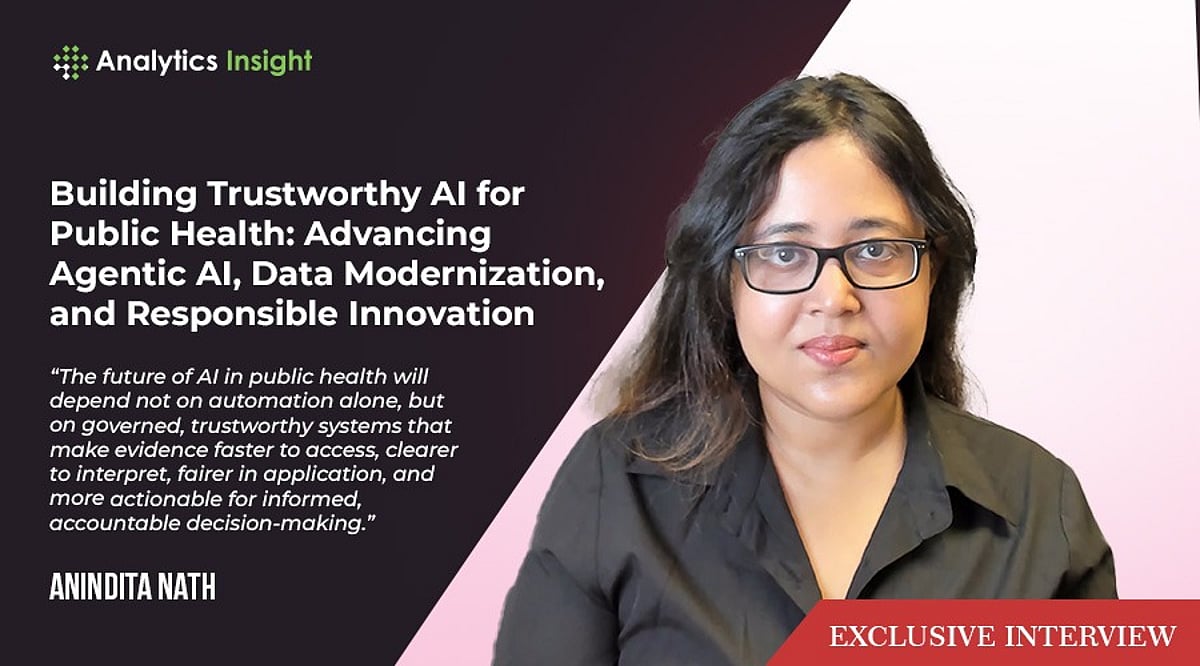
    In this interview, Anindita Nath discusses how advances in generative AI, biomedical informatics, and data modernization are reshaping public health and scientific research. With more than a decade of experience developing AI and machine learning solutions across industry and research, they have led initiatives spanning large language models, natural language processing, metadata engineering, and AI-ready data infrastructure. Their work includes co-leading one of the first agentic AI deep-research evaluation initiatives in the federal public health space, helping establish early frameworks for the responsible evaluation and adoption of autonomous AI systems.

    Drawing on experience building AI systems for disease surveillance, biomedical research, and large-scale public health data platforms, Nath shares insights into the challenges of governing AI in mission-critical environments, modernizing legacy data systems, and ensuring that intelligent technologies augment human expertise rather than replace it. They also explore the future of trustworthy AI, explaining why robust evaluation, transparency, and interdisciplinary collaboration will be essential as AI becomes increasingly embedded in healthcare and public health operations.

    Q: Please tell us about your professional journey and what inspired you to pursue a career in data science and artificial intelligence?

    A: My career began in software engineering and enterprise IT digitization, then expanded into computer science research in natural language processing, speech and audio signal processing, statistical machine learning, deep neural networks, and biomedical informatics. I was particularly drawn to AI’s potential to reduce cognitive load in operational environments. My early work in conversational AI and assistive health technologies shaped my view that intelligent systems should go beyond text generation to support information retrieval, knowledge synthesis, and decision support. This perspective continues to guide my work in public health, where AI and modern data engineering can strengthen surveillance, accelerate scientific discovery, and improve evidence-based decision-making.

    Q: Your work spans AI, public health, biomedical informatics, and data modernization. How would you describe your current role and areas of focus?

    A: My current role centers on designing governed, production-oriented AI systems for public health intelligence. My work spans generative AI, large language models, agentic AI enabled system evaluation, disease surveillance, metadata engineering, and AI-ready data infrastructure. I convert fragmented public health and biomedical datasets into structured, provenance-aware assets that support analytics and decision-making. A core priority is ensuring that these systems are measurable, reproducible, privacy-preserving, and operationally useful for analysts, researchers, and public health leaders.

    Q: Over the past decade, what have been some of the most defining moments or achievements in your career?

    A: Several achievements have shaped my professional trajectory. I co-led the first agentic AI deep-research evaluation initiative in federal public health, integrating advanced AI capabilities with governance, safety assessment, and operational validation to inform the agency’s agentic AI adoption strategy. I also led GENEVIC, an Azure OpenAI-enabled biological copilot for genomic data exploration, improving access to complex genomic information while preserving scientific rigor. Additional accomplishments include developing AI-enabled metadata and surveillance tools that reduced manual review burden by almost 50%, publishing first-author research in Bioinformatics, AMIA, ACM, and Speech Prosody venues, mentoring learners across computing and AI, receiving the Generation Google Scholarship in 2020, and being featured among Influential Women in 2026 and several such recognitions that reflect sustained technical performance, leadership, and impact.

    Q: For readers who may be new to your work, what excites you most about the intersection of AI and public health today?

    A: I am most interested in AI’s capacity to move public health from retrospective, static reporting toward interactive, evidence-driven intelligence. Public health decision-making, for example, in disease surveillance monitoring requires integrating heterogeneous signals from surveillance systems, clinical encounters, laboratory testing, immunization records, demographic datasets, scientific literature, and policy guidance. AI can accelerate signal integration and knowledge synthesis when supported by high-quality data, transparent methods, robust validation, and expert oversight. Its value is not to replace public health judgment, but to augment experts’ ability to detect patterns earlier, evaluate uncertainty, and act on stronger evidence.

    Q: You co-led the first agentic AI evaluation initiative in the federal public health space. What motivated this effort, and what were some of the key learnings from the project?

    A: The motivation was clear: before autonomous or semi-autonomous AI systems can support high-stakes public health work, they must be carefully evaluated. We needed to understand how agentic AI performs across complex questions involving epidemiology, informatics, policy guidance, and legal review. A key learning was that accuracy alone is not enough. Evaluation must include relevance, completeness, source reliability, safety, reproducibility, compliance screening, human subject-matter expert review, documentation of model behavior, source verification, and explicit identification of limitations. Governance must be designed from the beginning, not attached later.

    Q: As organizations increasingly deploy autonomous AI systems, how should leaders approach the challenge of evaluating and governing these technologies in high-stakes environments?

    A: Leaders should treat evaluation as an operational requirement, not a one-time technical test. Autonomous AI systems need clear task boundaries, trusted data sources, audit trails, privacy safeguards, human review, and continuous monitoring. A public health AI system should know whether it is retrieving evidence, summarizing a report, analyzing data, drafting communications, supporting policy planning, or identifying limitations. In high-stakes environments, leaders must ask not only whether a model can answer, but whether the organization can trust, verify, reproduce, and govern that answer.

    Q: You have worked extensively on AI-driven data modernization. What are the biggest challenges public health organizations face when transforming legacy data systems into AI-ready infrastructure?

    A: The biggest challenge is fragmentation. Public health knowledge is often trapped in isolated spreadsheets, inconsistent field definitions, separate dashboards, different reporting timelines, and legacy systems that were not designed for AI. Before AI can be useful, organizations need strong foundations: standardized data models, metadata, provenance, quality checks, access controls, documentation, interoperability, and reliable pipelines. Data modernization is also a workflow and trust challenge. AI-ready infrastructure requires clear accountability so that every output can be traced back to the evidence that produced it.

    Q: Your work has involved leveraging Azure OpenAI, Databricks, and Palantir Foundry for large-scale metadata analysis and knowledge discovery. Can you share a real-world example where these technologies delivered measurable impact?

    A: One example is my work on LLM-enabled metadata exploration and visualization. Through systems such as MetaMation and related enterprise metadata tools, users could ask natural-language questions over complex health surveillance and program-inventory metadata, retrieve relevant information, and generate visual summaries. This reduced manual analyst effort by more than 50% and made siloed metadata more accessible to program managers. GENEVIC was another example: a grounded biological copilot that used curated data, APIs, secure cloud deployment, prompt optimization, and validation so genomic exploration could become more intuitive without sacrificing scientific integrity.

    Q: Looking ahead, how do you see large language models and agentic AI reshaping healthcare, public health surveillance, and government operations over the next five years?

    A: Over the next five years, large language models and agentic AI will likely mature into governed orchestration layers across clinical care, public health surveillance, and government operations. In healthcare delivery, domain-specific agents could support ambient clinical documentation, EHR-integrated decision support, diagnostic triage, longitudinal patient summarization, prior authorization workflows, medication reconciliation, care-gap detection, remote monitoring, and precision-medicine recommendations. More transformative strategies may include multimodal models that integrate clinical notes, imaging, laboratory results, genomics, wearables, and social-risk indicators to enable earlier risk stratification and more personalized intervention planning. In public health, similar systems can strengthen evidence retrieval, epidemiologic signal detection, literature synthesis, metadata discovery, automated reporting, and cross-jurisdictional situational awareness. The most effective implementations will be embedded within secure informatics infrastructure rather than standalone chat interfaces. Their reliability will depend on grounding, provenance tracking, uncertainty estimation, continuous model monitoring, access control, interoperability, and human-in-the-loop review. These capabilities can expand expert capacity, reduce administrative burden, and improve operational responsiveness; however, accountability for interpretation, clinical action, ethics, equity, and final decisions must remain with human experts.

    Q: Beyond your technical contributions, you are actively involved in mentorship and STEM advocacy. What advice would you give to aspiring AI professionals looking to build impactful and purpose-driven careers?

    A: My advice is to develop technical depth alongside a clear sense of purpose. Aspiring AI professionals should build strong foundations in programming, machine/deep learning, AI evaluation strategies, and technical communication while remaining attentive to the communities and decisions their systems are intended to support. My own path has been shaped by perseverance, first-generation challenges, and a commitment to making computing both rigorous and accessible. Through initiatives such as Microsoft TEALS, Girls Who Code, CodePath, AnitaB.org, IEEE, Data for Impact, Women in STEM Network, and CAHSI-related workshops, I aim to help emerging technologists build confidence, strengthen their skills, and see themselves as contributors to the systems that will shape the future.

    Q: If you would like to add or highlight any other interesting insights that we might have missed in our questionnaire, please feel free to do so.

    A: The next phase of AI leadership will require interdisciplinary fluency. Effective AI professionals must pair algorithmic expertise with domain knowledge, ethics, governance, communication, accessibility, and implementation skills. In public health, impact depends on turning technical capability into trusted, practical systems.

  • How Ranjit Champawat Transformed COVID Safety Rules into Usable Workplace Playbooks

    How Ranjit Champawat Transformed COVID Safety Rules into Usable Workplace Playbooks

    COVID forced restaurants to operate like health sites. Teams still had to move fast, but safety moved to the center of every shift. Guidance changed often. Fear showed up in break rooms and group texts. A policy memo did not solve that. Ranjit Champawat approached the problem like an epidemiology exercise that also had to function as daily operations.

    In his workplace safety leadership role, he oversees compliance programs across restaurant locations in multiple areas. He also earned an MPH at Monroe College with a focus in epidemiology and biostatistics.

    “Safety has to be usable,” Champawat says. “If people cannot follow it on a busy shift, it is not safety.”

    Turning Changing Guidance into a Repeatable Playbook

    Public health advisories moved quickly during the pandemic. A process that worked one week could be outdated the next. Champawat led COVID response efforts that covered exposure rules, reporting steps with health authorities, and staff education on protective practices.

    “People do not need panic from leadership,” he says. “They need a clear plan they can repeat.”

    He built a simple expectation. Each site needed the same core steps, even if the staffing mix changed. He focused on what workers needed to know first, what supervisors needed to document, and what leaders needed to escalate.

    “Consistency keeps small misses from turning into a bigger spread,” he says.

    Exposure Events as Workflow, Not Drama

    An exposure can trigger rumors and confusion. It can also trigger defensible action. Champawat treated each case like a workflow. Identify the event. Confirm the facts. Notify the right parties. Track the response. Close the loop.

    “One missing step can multiply the problem,” he says.

    He helped standardize testing steps and reporting channels and reinforced follow-through through repeated training. He also emphasized calm communication so staff heard next steps instead of noise.

    “Clarity lowers stress,” he says. “Lower stress improves compliance.”

    Consistency Across Locations Takes Design

    Champawat’s role includes risk reviews, staff instruction, and compliance work tied to OSHA rules and local public health guidance. He describes the work as practical. It is about habits and checks, not slogans.

    “A rule on paper does not protect anyone,” he says. “A habit does.”

    He built routines that made safety visible. Supervisors knew what to watch. Teams knew what to do. Leaders knew what to measure.

    Documentation as Protection for People and for Truth

    Pandemic work produces questions later. Who knew what. When did it happen. What was done. Champawat brought strong record discipline to that environment. He has worked with EMR tools, including Allscripts and eClinicalWorks, and he carried that attention to detail into safety reporting.

    “Records keep the story straight,” he says. “They also help you improve the system.”

    Education That Respects the Room

    Champawat has created and delivered health education in New York for communities with different cultures and languages. He learned to avoid lectures and focus on practical choices people can act on.

    “Health messages fail when they sound like blame,” he says. “They land when they sound like support.”

    That experience translated into workplace training. Staff came with different comfort levels and different questions. He built a shared baseline that reduced uncertainty and improved follow through.

    “Training should make work easier,” he says. “It should not add confusion.”

    A Career Built Across Care and Prevention

    Champawat has more than ten years of experience spanning public health, clinical work, and safety leadership in Australia and the United States. He began in Australia in direct care, supporting older adults and medically complex residents in long term settings. He later moved through nursing education and into public health.

    “Care teaches attention,” he says. “Public health teaches patterns.”

    That mix helps him translate between frontline realities and leadership decisions. He contributes through protocols, training systems, and risk updates that are grounded in what sites can actually execute.

    “Leadership needs plans that hold,” he says. “They do not need extra noise.”

    Where He Is Building Next

    Champawat is expanding toward research-focused work. He is enrolled in a Clinical Research Associate training program and aims to contribute to public health programs that lift community outcomes through evidence-based methods and strong compliance.

    “I want work that can stand up to review,” he says. “It needs to be measured and responsible.”

    The pandemic exposed a simple point. Workplace safety is not a memo. It is a set of actions people can repeat under pressure. Champawat’s focus has been building those actions into the day, so teams stay protected even when the guidance shifts.