
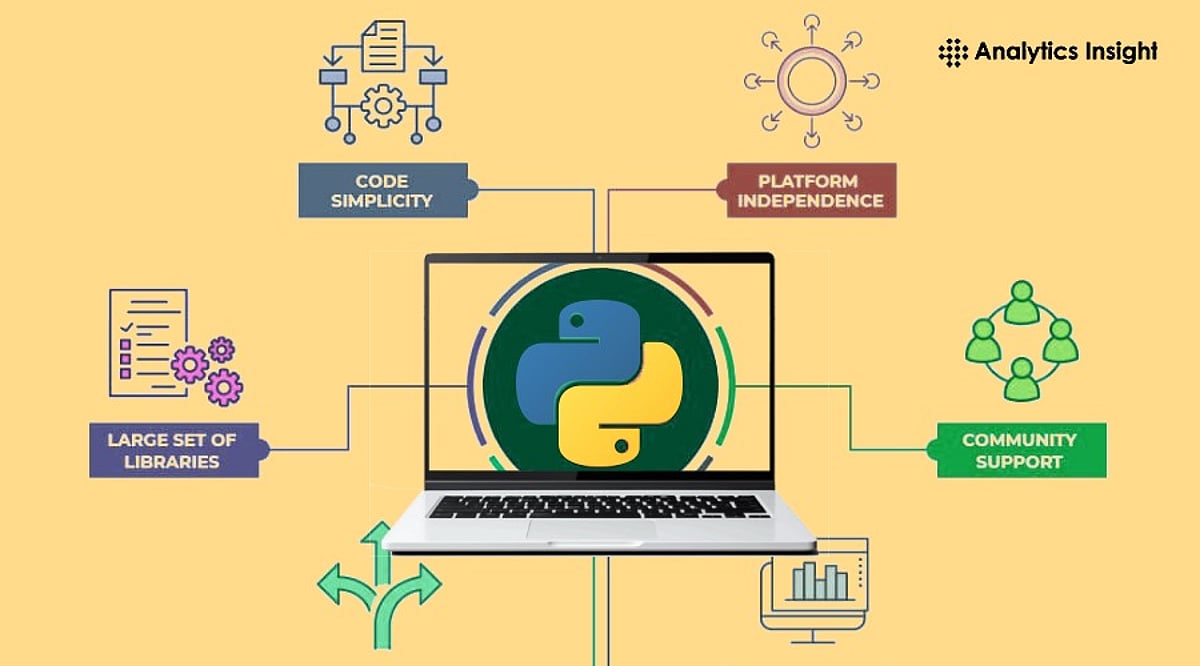
Python has become the go-to programming language for artificial intelligence and machine learning due to its simplicity, readability, and rich ecosystem of libraries. Developers can build smart applications faster, test ideas quickly, and deploy models with minimal friction.
Why Python Leads in AI Development
Python’s clean syntax and minimal learning curve allow developers to focus on solving problems rather than wrestling with complex code. Its extensive library collection, strong community support, and flexibility across industries make it the trusted choice for AI projects, from startups to global enterprises.
1. Simple, Readable Code Speeds Development
Python’s syntax is intuitive and clean. Even when reading someone else’s project, the logic is easy to follow. This simplicity reduces the time spent debugging and improves collaboration—critical when AI models frequently need updates and iteration.
2. Powerful Libraries Save Hours of Work
Developers don’t have to build AI features from scratch. Python offers mature libraries for every task:
- TensorFlow and PyTorch for deep learning
- Scikit-learn for classical machine learning
- Pandas and NumPy for data manipulation
- OpenCV for computer vision
These pre-built tools let developers focus on refining models instead of rewriting boilerplate code.
3. A Thriving Community Offers Endless Support
Python’s huge global community means help is always just a search away. Forums, tutorials, guides, and open-source projects ensure that even complex problems have documented solutions. This collective knowledge keeps Python evolving with regular updates and new features.
4. Versatility Across Industries and Projects
AI is no longer confined to tech companies. Python powers applications in healthcare, finance, retail, manufacturing, agriculture, and more. The same language can drive a chatbot, a fraud detection system, a recommendation engine, or an image recognition pipeline—eliminating the need to learn a new language for each domain.
5. Seamless Integration with Modern Infrastructure
Building an AI model is only half the battle; deploying it matters too. Python integrates smoothly with cloud platforms, databases, APIs, and web frameworks. Many cloud services run Python natively, so moving from training to production requires minimal changes.
Why This Matters
Python isn’t just another language—it’s the backbone of many AI tools used daily. As companies embed AI into their products, knowing Python gives developers a durable advantage. While Python may not be the fastest language, its clarity and rapid prototyping capabilities often matter more in AI. With continuous improvements and a growing ecosystem, Python is well-positioned to remain at the center of AI innovation.
Frequently Asked Questions
1. Why do most AI developers choose Python?
Python’s readability, ease of learning, and vast library ecosystem enable faster development with fewer errors.
2. Which Python libraries are popular for AI?
TensorFlow, PyTorch, Scikit-learn, Pandas, NumPy, Keras, and OpenCV are widely used for machine learning, deep learning, and data analysis.
3. Is Python good for AI beginners?
Yes, its simple syntax and abundant free resources make it one of the best starting points.
4. Do large companies use Python for AI?
Yes, many tech giants rely on Python for AI, data science, and automation due to its reliability and strong ecosystem.
5. Will Python remain important for AI?
Almost certainly. Its community continues to grow, and new AI tools consistently support Python.