
Despite widespread announcements about skills-based hiring, the reality on the ground tells a different story. According to NACE’s Job Outlook 2026 survey, 70% of employers report using skills-based hiring for entry-level roles, up from 65% the year before. TestGorilla’s 2025 research similarly found that 53% of employers had eliminated degree requirements, a sharp increase from 30% in the previous year. Yet when researchers from Harvard Business School and the Burning Glass Institute examined actual hiring outcomes, they discovered that the removal of degree requirements led to fewer than one in 700 hires coming from workers without degrees. The job postings changed, but the hires did not.
The Policy Changed, but the Hires Did Not
This gap is the most telling number in talent acquisition today, and it is not simply a matter of insincerity. Employers have genuine incentives to broaden their talent pools. McKinsey has cited research showing that skills are about five times more predictive of job performance than education and more than twice as predictive as work experience. Many organizations genuinely want to widen their candidate pools and place greater emphasis on demonstrated capability. However, they are doing it at the top of the funnel and then reverting at the next step. A job posting goes out without a degree requirement. Applications arrive. Someone sorts them—and the sorting instrument is still a resume, a document organized around where a person studied and which employers they passed through. Screening for skills while reading a credential summary inevitably produces credential-based outcomes.
The Resume Survives Because Nothing Cheaper Replaced It
The resume persists because it remains an efficient first source of candidate information. The problem begins when it becomes the primary evidence of capability rather than one input among several. Skills assessment has historically meant building a test, which requires someone to define what the role demands, write items that measure it, and validate that the results predict anything. For a single high-volume role, that investment makes sense. Across a requisition list running to dozens or hundreds of distinct jobs, it does not. So most employers test for a handful of technical positions and read resumes for everything else. The volume problem has since worsened with generative AI tools making applications uniformly polished, stripping the resume of what little discriminating power it retained. Recruiters now spend more time assessing whether a strong-looking application reflects real capability, which pushes them back toward using credentials as a shortcut. When direct evidence of capability is expensive to collect, credentials and prior experience remain convenient screening signals, even when an organization has formally adopted a skills-first policy.
Replacing the Filter, Not the Wording
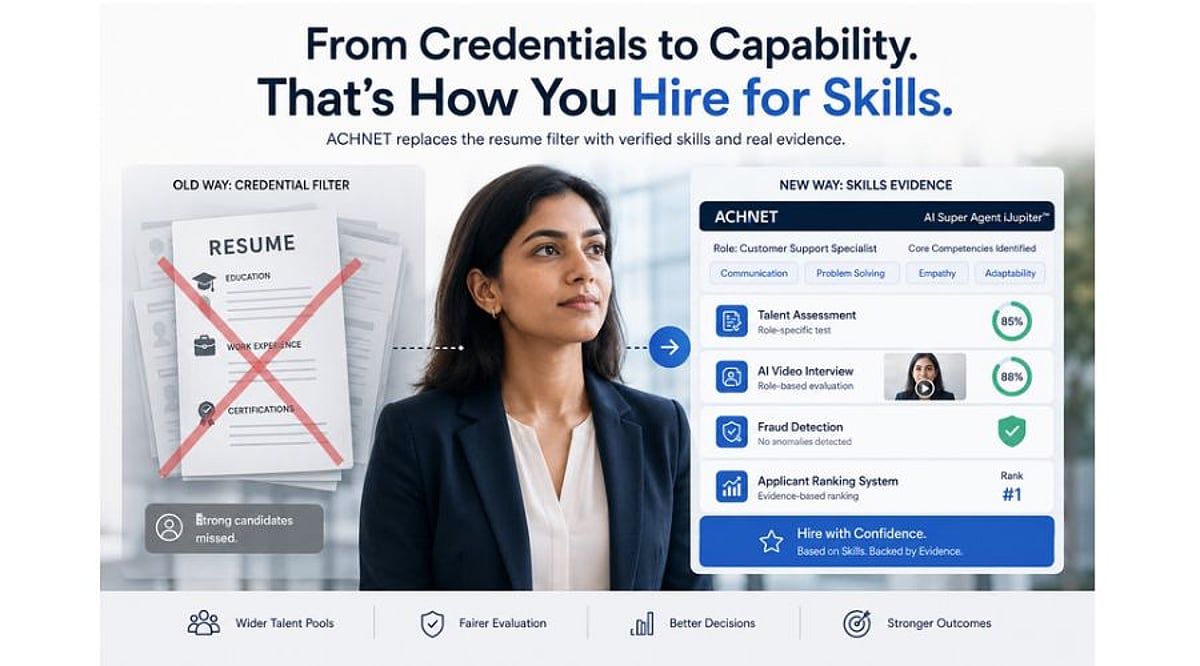
ACHNET is targeting the mechanism rather than the intent. The platform analyzes the job description to identify role-relevant skills and competencies, which then inform role-specific talent assessments and AI video interview questions. The test is generated from the role rather than pulled from a library, making per-role assessment economical across a long requisition list rather than only for a few positions. As Manouj Gupta, CEO and Founder of ACHNET, puts it: “Dropping a degree requirement from a job posting changes nothing if the next screen is still a resume. You have to replace the filter, not just the wording.”
Where the evidence lands is the second half. ACHNET’s Applicant Ranking System weighs the resume, the assessment result, and the interview score against the competencies written into the role, and any ranking can be opened up to show what produced it. The candidate report sets out what actually moved someone up or down, rather than just handing over a score. An employer can therefore see whether a candidate advanced on demonstrated competency or on background, which is precisely the audit most skills-first programs cannot currently perform on themselves.
Scale Determines Usability
Scale determines whether any of this is usable. ACHNET reports facilitating 150,000 interviews over a three-month period, demonstrating the volume at which structured evaluation can be delivered. These are company figures, and the relevant point is not the speed—it is that structured assessment at that volume is what a skills-first policy requires to be more than a posting change. None of this guarantees a different outcome. An employer can run competency assessments and still promote the familiar resume to the top of the pile, and the Harvard and Burning Glass findings suggest many will. But technology alone will not close the gap between skills-first policy and hiring outcomes. Manager behavior, organizational culture, and selection practices all matter. What better evaluation infrastructure can do is give employers clearer evidence of whether candidates advanced because of demonstrated capability rather than credentials alone. Companies cannot tell whether their skills-first policy is working because their process never produced the evidence either way. Replacing the filter at least makes the answer visible, and a policy nobody can measure is one nobody has to honor.