Tag: Ripple

  • Ripple to Release 1 Billion XRP From Escrow: What Investors Should Expect

    Ripple to Release 1 Billion XRP From Escrow: What Investors Should Expect

    Ripple is scheduled to unlock up to 1 billion XRP from escrow on October 1, continuing its monthly token release system that began in 2017. The program was designed to make XRP supply changes more predictable for the market.

    However, the headline figure of 1 billion XRP does not mean all tokens will immediately enter circulation or reach cryptocurrency exchanges. Ripple has the ability to return unused XRP to new escrow contracts, effectively reducing the amount that becomes available in the market.

    Recent releases illustrate why context is crucial. After September’s unlock of 1 billion XRP, 700 million was re-escrowed, meaning only 300 million actually entered circulation. The October release could similarly produce less new supply than the initial figure suggests.

    Investors will closely monitor Ripple wallets after the unlock to determine whether XRP is re-escrowed, transferred, or moved toward exchanges. XRP’s price response may depend on actual market supply, broader crypto sentiment, and demand around the scheduled release.

    The key takeaway is straightforward: watch where the unlocked XRP goes next, rather than treating the entire billion as immediate selling pressure.

  • XRP Ledger Stablecoin Market Cap Surpasses $1.159 Billion; RLUSD Leads with 92% Share as Permission Delegation Upgrade Nears Activation

    XRP Ledger Stablecoin Market Cap Surpasses $1.159 Billion; RLUSD Leads with 92% Share as Permission Delegation Upgrade Nears Activation

    XRP Ledger Stablecoin Market Cap Hits $1.159 Billion

    The XRP Ledger’s stablecoin market capitalization reached approximately $1.159 billion on September 25, after adding $67.12 million over the previous week, according to data from DefiLlama. Ripple USD (RLUSD) was the primary driver, accounting for $1.067 billion of the total — a dominant 92.1% share of the tracked stablecoin market on the network.

    RLUSD Continues to Dominate Stablecoin Growth

    RLUSD’s market cap on the XRP Ledger rose 11.55% over the past 30 days, outpacing the overall stablecoin market on the network, which expanded 9.8% in the same period. This growth further widened the gap between RLUSD and its competitors. For example, USDC’s tracked market cap on XRPL dropped 21.86% over the month to approximately $4.62 million, although it rebounded 6.71% in the latest week — just above RLUSD’s 6.69% weekly increase. Other stablecoins also saw declines: Valtorum USD fell 7.03% to $72.77 million, and EUR CoinVertible dropped 2.37% to around $11.37 million.

    These figures track only balances recorded on the XRP Ledger and do not represent each stablecoin’s total circulation across all supported blockchains. The data also does not confirm that holders exchanged USDC or other tokens directly for RLUSD; such movement would require transaction-level evidence.

    Stablecoin Growth Is Not Directly Tied to XRP Buying

    DefiLlama defines chain stablecoin market capitalization as the total tracked value of stablecoins on a blockchain, distinct from trading volume or DeFi deposits. Therefore, the $67.12 million weekly increase does not represent an equivalent amount of XRP purchases, nor does it confirm institutional investment without identifying the entities behind the balances. The available data shows RLUSD as the most tracked stablecoin on XRPL but does not reveal who holds the tokens or why balances grew.

    RLUSD is designed to maintain a one-dollar value, backed by segregated cash and cash-equivalent reserves. It operates on both the XRP Ledger and Ethereum, meaning the $1.067 billion figure only reflects the portion on XRPL. Ripple notes that RLUSD targets payments, settlements, and treasury flows, while XRP remains XRPL’s native cryptocurrency with a market-determined price.

    XRPL Upgrade Targets Institutional Permission Controls

    The XRP Ledger is approaching a second attempt at the PermissionDelegationV1_1 amendment, which entered a 14-day activation countdown on September 21 after 29 of 35 trusted validators signaled support. If validator support holds at or above the required 80% threshold, the amendment could activate on October 5.

    This feature would allow account owners to delegate specific actions — such as transaction processing — without granting full control over the account. Each delegate can receive up to 10 permissions, and the main account can revoke them at any time. For example, a payments desk could be authorized to process transactions without the ability to change critical security settings. Stablecoin issuers and custodians could use internet-connected systems for daily operations while keeping higher-level account keys offline.

    The amendment replaces an earlier version that was rejected by validators after a community tester discovered a flaw on a testnet. The flaw allowed an attacker to make another account pay fees for improperly signed transactions, potentially draining XRP through repeated transaction charges. The revised amendment, included in xrpld 3.3.0, changes how the network handles unauthorized transactions, preventing fee charges before signature verification.

    Conclusion

    The XRP Ledger’s stablecoin market capitalization has reached $1.159 billion, with RLUSD commanding a 92.1% share. Meanwhile, the PermissionDelegationV1_1 amendment, which introduces more granular account controls, is on track for possible activation on October 5 after developers fixed a security flaw in the earlier version.

  • Why XRP’s Price Moves With Bitcoin and the Broader Crypto Market

    Why XRP’s Price Moves With Bitcoin and the Broader Crypto Market

    XRP operates on its own blockchain network with its own catalysts, yet its price frequently rises and falls with Bitcoin and the wider cryptocurrency market. Shared liquidity, investor sentiment, derivatives positioning, and macroeconomic conditions all connect XRP to the broader digital asset ecosystem.

    Bitcoin Sets the Market Tone

    Bitcoin remains the largest and most closely watched cryptocurrency. Significant BTC price moves often shift risk appetite across all digital assets. When Bitcoin rallies, traders tend to rotate capital into altcoins; during sharp declines, investors frequently reduce exposure across their portfolios.

    For example, Bitcoin reached an eight-month high above $87,000 on September 21, supported by ETF inflows and short liquidations. The broader crypto market strengthened in tandem, illustrating how Bitcoin-led liquidity shifts can influence altcoins.

    However, correlation does not mean identical performance. XRP can outperform or underperform Bitcoin when token-specific developments change demand.

    Liquidity and Derivatives Connect Markets

    Centralized exchanges, market makers, and algorithmic trading strategies continuously move liquidity between Bitcoin, stablecoins, and altcoins. During volatile periods, portfolio-wide buying or selling can strengthen short-term correlations.

    Derivatives add another layer of interconnection. XRP futures open interest fell 16% between August 17 and August 31, even as XRP rallied nearly 40%. Meanwhile, CME’s share of outstanding XRP futures exposure rose from roughly 10% to 17%. This shows how leverage can change independently of spot price while institutional derivatives participation grows.

    Macroeconomic Conditions Affect XRP

    Interest rates, Treasury yields, dollar strength, and overall risk appetite influence cryptocurrencies collectively. When investors seek risk, liquidity flows into Bitcoin and subsequently altcoins. During risk-off periods, traders may shift toward cash or stablecoins. XRP nevertheless has independent catalysts capable of producing temporary divergence.

    XRPL Activity Provides XRP-Specific Signals

    During Q2 2026, XRP Ledger (XRPL) order-book trading averaged 3.57 million XRP daily, up 79% year over year. The number of accounts initiating those trades fell roughly 41%, indicating larger activity among fewer accounts.

    Average tokenized-asset balances reached $3.72 billion, while average RLUSD balances were $539 million. Combined value reached approximately $4.26 billion, compared with just $99 million six quarters earlier.

    Institutional investment products provide another demand channel. US spot XRP ETFs recorded $273 million of net inflows during Q2. According to SoSoValue, XRP ETFs attracted $14.89 million on September 24, with cumulative inflows reaching $1.74 billion.

    Why This Matters

    Understanding XRP’s connection with the wider crypto market helps investors separate market-wide moves from XRP-specific developments. Bitcoin sentiment can influence short-term direction, while ETF flows, XRPL activity, tokenization, and institutional adoption can create independent demand.

    Final Thoughts

    XRP remains connected to broader crypto through liquidity, sentiment, and leverage. However, XRPL fundamentals and institutional flows can drive divergence. Bitcoin influences XRP’s market environment without determining every price move.

    FAQs

    1. Why does XRP price often move with Bitcoin?

    Bitcoin strongly influences sentiment and liquidity across the cryptocurrency market. When BTC experiences major price movements, traders frequently adjust exposure to altcoins such as XRP, creating correlated market moves.

    2. Does XRP always follow Bitcoin’s price movements?

    No. XRP can outperform or underperform Bitcoin when XRP-specific developments influence demand. ETF flows, XRP Ledger activity, tokenization, regulatory developments, and institutional participation can all contribute to divergence.

    3. How do XRP derivatives affect its price?

    Futures and other derivatives introduce leverage and institutional positioning into XRP markets. Changes in open interest, liquidations, and trader positioning can amplify volatility or create price movements independent of spot-market demand.

    4. Do XRP ETFs influence demand for XRP?

    Spot XRP ETFs provide investors with regulated exposure through traditional investment accounts. Net inflows can create an additional source of XRP-related demand, although ETF activity is only one factor influencing market prices.

    5. Can XRP Ledger activity influence XRP’s price?

    Growing trading, tokenization, and institutional activity on XRPL can strengthen the network’s fundamental usage. However, increased blockchain activity does not automatically translate into higher XRP prices since broader market conditions also matter.

  • Absa Rolls Out Institutional Digital Asset Custody in South Africa Using Ripple

    Absa Rolls Out Institutional Digital Asset Custody in South Africa Using Ripple

    Absa Corporate and Investment Banking (CIB) has launched an institutional digital asset custody service in South Africa, built on Ripple’s custody technology. The new offering gives corporate and institutional clients a bank-operated environment for storing cryptocurrencies and other tokenized assets.

    What Absa Digital Asset Custody Offers

    Absa Digital Asset Custody is designed for custody rather than trading. Clients can store digital assets without relying on retail exchanges or managing private keys through their own systems. The platform includes private-key management tools, approval workflows, transaction controls, and audit trails. These features help institutions meet security, governance, and regulatory requirements when holding digital assets.

    Ripple Provides the Underlying Technology

    Ripple’s custody technology powers the platform, allowing financial institutions to control private keys, define approval policies, and manage digital assets within their existing operating structures. Absa remains responsible for its service and customer relationships.

    “By leveraging Ripple’s custody technology, Absa is setting a new benchmark for secure, compliant, and bank-grade digital asset management on the continent,” said Reece Merrick, Ripple’s managing director for the Middle East and Africa.

    Absa and Ripple first announced their partnership on October 15, 2025, with Ripple identifying Absa as its first major custody partner in Africa.

    Built for Corporate and Institutional Clients

    The service is aimed at corporate and institutional clients, not retail users. It enables organizations to set stronger approval controls, defined access rules, and clear records while keeping custody within a bank-led service.

    Absa has not disclosed which cryptocurrencies or tokenized assets are supported, nor has it published fees or named early customers. Prospective clients must contact Absa’s sales team for eligibility and service terms.

    What’s Next for Absa and Ripple

    Absa plans to expand the platform as institutional demand evolves, while monitoring South Africa’s regulatory framework. Future additions will depend on customer needs, compliance requirements, and operating conditions.

    Ripple continues to grow its institutional custody business. In February 2026, it added Securosys hardware security modules and Figment staking capabilities, giving financial institutions more options for protecting private keys and managing proof-of-stake assets.

  • Peter Brandt Highlights $5.40 XRP Price Target as 2026 Correction Reshapes Long-Term Outlook

    Peter Brandt Highlights $5.40 XRP Price Target as 2026 Correction Reshapes Long-Term Outlook

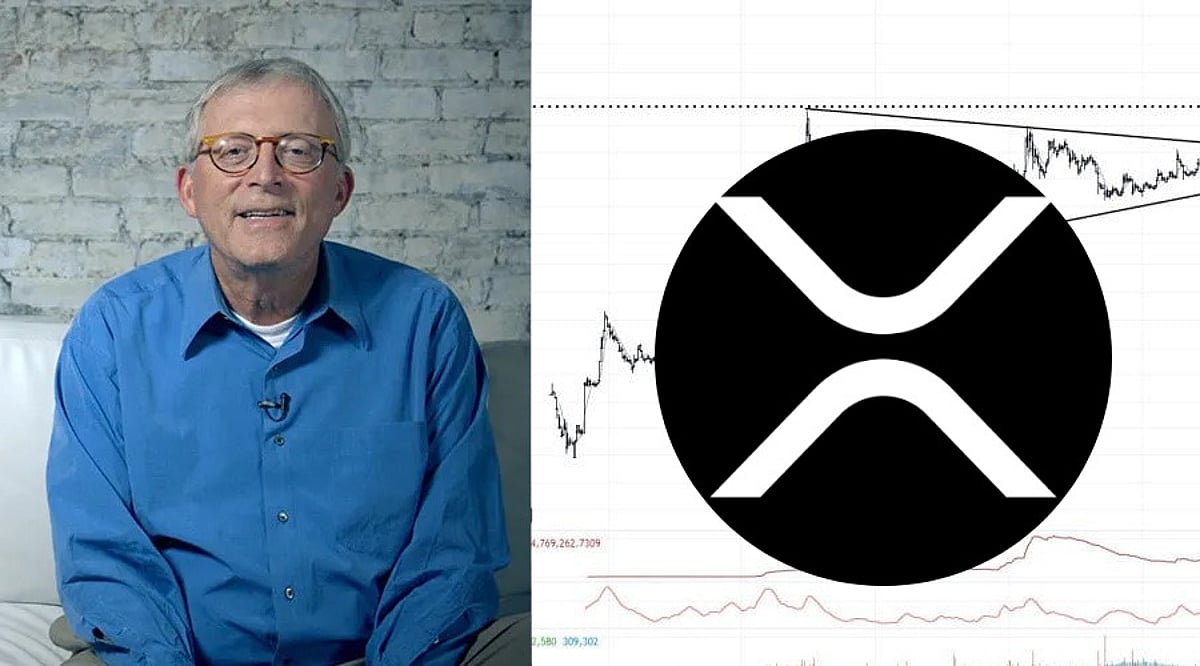
    Veteran trader Peter Brandt has pointed to $5.40 as a potential long-term target for XRP in a monthly chart shared on September 21. The projection is based on a technical structure that has formed over nearly a decade, although Brandt did not specify a timeline for the move.

    What the Monthly Chart Shows

    Brandt’s XRP/USD chart tracks roughly ten years of price action and highlights both a rising support line and a descending resistance line. The resistance line begins at the 2018 cycle peak, while support has been drawn from lows recorded in 2020 and subsequent pullbacks.

    Between those two boundaries, XRP spent several years compressing in a broad range. The 2021 rally produced a high below the 2018 peak, keeping the downward-sloping resistance intact. That pattern eventually led to a breakout in 2024–2025, with monthly candles climbing toward the $3.00–$3.50 zone — the highest sustained area since 2018.

    Current Price Position

    After the sharp advance, XRP entered a correction in 2026. The latest part of the chart shows a pullback unfolding in a smaller descending channel or wedge. In September 2026, XRP was trading near $1.4901, roughly 20.6% below its 18-month moving average of about $1.877. A faster moving average sits closer to price, but the longer-term trend measure remains above the token.

    Interpreting the $5.40 Objective

    Brandt described $5.40 as an eventual technical objective rather than an active trade. The figure is not drawn as a horizontal line directly on the chart, and the trader did not provide a completion date.

    From the chart’s displayed price near $1.49, XRP would need to gain approximately 262% to reach $5.40. Based on the slightly higher market price near $1.54, the required advance would be about 251%, placing the target at roughly 3.5 times the reference price.

    XRP was reported near $1.54 after gaining around 8.7% in 24 hours as Brandt’s chart drew attention. Even so, the token remains far below the projected level. The key tension in the setup is that XRP is still under its 18-month moving average and trading inside a declining structure from the 2025 highs, even as the broader multi-year formation supports a much higher long-term target.

    Brandt’s use of the word “eventual” leaves the timing open. For traders watching the trend, the main question is whether the current descending structure resolves before the next major monthly advance begins.

  • Ripple and XRP in the Age of Agentic AI: Opportunities and Challenges for Autonomous Payments

    Ripple and XRP in the Age of Agentic AI: Opportunities and Challenges for Autonomous Payments

    AI Agents Need Payment Infrastructure

    Autonomous AI agents require payment systems that can handle frequent, small transactions without manual approval. Traditional systems are adapting, with Mastercard launching Agent Connect and partnering with Alchemy for AgentCard.

    Ripple’s Move into Agentic Payments

    Ripple launched the XRPL AI Starter Kit in June, enabling developers to build agents that create wallets, check balances, and make payments. The kit supports x402 for purchasing API calls and AI inference using XRP or RLUSD. The September update added support for Stripe and Tempo’s Machine Payments Protocol and the Open Wallet Standard.

    XRP and RLUSD: Different Roles

    XRP can be used for frequent small payments through XRPL payment channels, while RLUSD offers stable dollar-denominated value for agents that prefer predictable costs. RLUSD has $2.39 billion in circulation as of September 21.

    Does Agentic AI Guarantee Higher XRP Demand?

    Not necessarily. Agents can use RLUSD or other assets on XRPL, so network activity doesn’t directly translate to XRP demand. Ripple’s MPP integration is still in beta with no disclosed customers or volumes.

    Why This Matters

    Agentic commerce could generate millions of automated transactions. XRPL’s fast settlement and support for both XRP and stablecoins position Ripple to compete in the emerging machine-payment standards.

    Final Thoughts

    Agentic AI may create a new class of blockchain users: autonomous software. Ripple is positioning itself, but adoption is early. The impact on XRP will depend on developer usage and transaction volumes.

    Frequently Asked Questions

    1. How could AI agents use the XRP Ledger? AI agents can create wallets, check balances, and pay for APIs and digital services using XRPL’s fast settlement.
    2. What is the XRPL AI Starter Kit? A toolkit from Ripple for connecting AI agents to XRPL payments, supporting x402, Machine Payments Protocol, and Open Wallet Standard.
    3. What role could XRP play in agentic payments? XRP can serve as a native settlement asset, but agents may also use RLUSD or other assets.
    4. Why could RLUSD be useful for AI agents? It provides dollar-denominated value for predictable purchasing power in automated transactions.
    5. Will growth in agentic AI automatically increase XRP demand? Not necessarily; impact depends on adoption, transaction volumes, and asset preferences.

    Disclaimer: This article is for informational purposes only and does not constitute investment advice. Cryptocurrencies carry risk; always conduct your own research before investing.

  • Ripple CLO Urges Crypto Industry to Unite After Senate Blocks CLARITY Act

    Ripple CLO Urges Crypto Industry to Unite After Senate Blocks CLARITY Act

    Ripple CLO Calls for Industry Unity After CLARITY Act Stalls

    Stuart Alderoty, Ripple’s Chief Legal Officer and president of the National Cryptocurrency Association, is urging cryptocurrency firms to align their messaging after the CLARITY Act failed to advance in the U.S. Senate. In a September 17 post on X, Alderoty said “politics beat policy this week” and emphasized that the industry must speak with one voice when engaging with lawmakers and regulators.

    Senate Vote Details

    The Senate voted 49-50 on September 15 against invoking cloture on the motion to proceed to H.R. 3633, falling short of the required three-fifths majority. This procedural setback stalled the comprehensive crypto market structure bill after months of negotiations. Ripple expressed disappointment, calling it a missed opportunity, and reiterated its support for uniform federal standards that would provide clearer rules for digital asset businesses and stronger consumer protections.

    Bipartisan Talks Continue

    Despite the vote, seven Democratic senators released a statement on September 16 committing to continued bipartisan negotiations on crypto legislation. They described the vote as a setback rather than an end to the effort. Ripple CEO Brad Garlinghouse had supported the revised version of the bill, which incorporated over 100 changes.

    Crypto Adoption and XRP in Focus

    Alderoty also cited the National Cryptocurrency Association’s 2026 State of Crypto Holders survey, conducted with The Harris Poll, which estimated over 67 million U.S. adults own cryptocurrency. The survey found that 40% of holders use crypto for shopping and payments, while 41% send digital assets to friends and family. Meanwhile, XRP has declined roughly 25% from its August high. Community analyst Dark Defender pointed to lower exchange balances and RLUSD activity, suggesting the drop may precede a rally according to Elliott Wave analysis. However, Ripple maintains that XRP’s regulatory status remains separate from the legislative outcome.

    Conclusion

    Ripple’s Stuart Alderoty wants the crypto industry to coordinate its policy message after the CLARITY Act stalled in the Senate. The 49-50 vote stopped the measure from advancing, although seven Democratic senators committed to further bipartisan talks. Ripple continues to support uniform federal rules for digital assets.

  • XRP Rebounds Above $1.40: Support Levels, ETF Demand, and Market Signals to Watch

    XRP Rebounds Above $1.40: Support Levels, ETF Demand, and Market Signals to Watch

    XRP has bounced back above $1.40 after a sharp weekly selloff, with lower open interest and heavy short liquidations shaping the recovery. The token had fallen from a weekly peak of $1.50 to below $1.30 after the U.S. Senate failed to advance the CLARITY Act in a 49–50 cloture vote. However, a broader crypto recovery—led by Bitcoin reclaiming $80,000—triggered a short squeeze that lifted several altcoins.

    Spot Volume and Short Liquidations Spike

    XRP spot volume reached approximately $1.36 billion in 24 hours as the price climbed about 7% to $1.41. Total turnover tracked by CoinMarketCap jumped nearly 90% to $4.9 billion. Meanwhile, short liquidations hit roughly $8.05 million, showing how quickly bearish positions came under pressure.

    The rebound followed a drop toward the $1.23–$1.30 area earlier in September. The move did not arrive with a fresh fundamental catalyst. Instead, it tracked the broader crypto recovery as Bitcoin pushed back above $80,000.

    Key Support and Resistance Zones in Focus

    Analyst Ali Martinez identified the $1.31–$1.35 range as the immediate support zone, with XRP repeatedly trading around that area after this week’s decline. A sustained hold would keep attention on $1.38–$1.40, followed by heavier resistance near $1.50–$1.54.

    The technical setup also includes a potential golden cross, as XRP’s five-day moving average approaches its 200-day moving average. Traders often treat that crossover as a bullish momentum signal, although it does not guarantee further gains.

    Can XRP defend $1.31–$1.35 while building enough spot demand to challenge the $1.50 area again? That question now sits at the center of the short-term price setup. Analysts also point to improving altcoin conditions as traders watch for capital rotation away from Bitcoin.

    Leverage Declines as Short Liquidations Rise

    Futures open interest dropped more than 20% within several days during this week’s deleveraging. That decline shows leveraged traders reduced exposure after regulatory and macro volatility. Lower leverage can weaken immediate momentum, but it can also reduce the risk of a liquidation cascade.

    Saturday’s rebound still carried a strong derivatives component. XRP shorts absorbed about $8.05 million in liquidations, while long liquidations reached roughly $2.36 million. Across the broader crypto market, leveraged liquidations totaled about $300 million as Bitcoin moved above $81,000.

    XRP futures volume remained near $5.71 billion, more than four times spot volume. Futures activity had also reached a six-month high in August before later volatility. That balance keeps leverage central to the next move even after open interest declined.

    The gap between futures and spot activity remains important because large derivatives positions can amplify price swings. Another leverage flush could reverse a fast rally, while lower open interest may reduce the risk of a similar cascade.

    ETF Flows and Utility Remain in the Spotlight

    Institutional demand remains visible through U.S. spot XRP ETFs, which have recorded more than $1.7 billion in inflows. That figure stands apart from the token’s recent price weakness and gives traders another measure of demand beyond short-term market moves.

    At the same time, 21Shares has pointed to a gap between XRPL utility growth and XRP price performance. Whale activity has also increased: about 1.6 billion XRP moved into Binance over 30 days, marking a six-month high, while exchange reserves reached a 69-day high.

    CryptoQuant analysts said those flows could reflect reallocation rather than direct selling. Even so, the larger Binance balance creates potential supply if holders choose to sell. Ripple has also added XRP and RLUSD to Stripe and Tempo’s AI agentic payments effort.

    Another derivative catalyst arrives next: the Moscow Exchange plans to launch XRP perpetual futures on September 22. That product will add another venue for XRP-linked derivatives as traders continue watching spot demand, leverage, support levels, and ETF flows.

    Conclusion

    XRP has recovered above $1.40 after its sharp selloff, with lower open interest and short liquidations shaping the rebound. Traders are now tracking $1.31–$1.35 support, resistance near $1.50, XRP ETF inflows, Binance whale activity, and the September 22 Moscow Exchange futures launch.

  • Ripple CEO Says Crypto Adoption Can Thrive Even as CLARITY Act Stalls in Senate

    Ripple CEO Says Crypto Adoption Can Thrive Even as CLARITY Act Stalls in Senate

    Ripple CEO Brad Garlinghouse says the crypto industry has more than one path to growth, even as the U.S. CLARITY Act remains stuck in Congress. The bill, designed to provide clearer federal rules for digital assets, failed to advance in the Senate last week.

    What Happened With the CLARITY Act?

    The Senate voted 49–50 against moving the CLARITY Act forward, well short of the 60 votes needed to proceed. The legislation would have clarified which federal agencies oversee different segments of the crypto market and given companies a more defined compliance roadmap.

    Garlinghouse: Technology and Adoption Matter More Than Legislation

    Speaking at a digital asset conference in Kansas City on September 15, Garlinghouse said crypto growth doesn’t depend on any single bill. He pointed to faster, more efficient blockchain technology as a key adoption driver.

    “The industry can keep building, and users can keep adopting the technology while lawmakers debate new rules,” Garlinghouse emphasized.

    Market Impact and Ripple’s Legal Battle

    The Senate setback added fresh uncertainty to U.S. crypto policy, and the market reacted sharply. Roughly $571 million in crypto long positions were liquidated across exchanges following the vote.

    Separately, Ripple has spent more than $150 million defending itself in an ongoing legal battle with the U.S. Securities and Exchange Commission. The company remains focused on expanding its cross-border payment solutions despite regulatory headwinds.

    Why This Matters for Crypto Companies

    Clearer rules would make it easier for companies to launch new products and services, but innovation isn’t on hold. Real-world use cases, lower costs, and faster settlement times continue to attract users regardless of legislative progress.

    Garlinghouse’s remarks underscore a broader industry sentiment: while clear regulation is welcome, the long-term growth of crypto isn’t dependent on any one piece of legislation.

  • Crypto Roundup: $296M Bitcoin ETF Outflows, Aave’s RWA Hub, and Strategy’s $950M Buyback

    Crypto Roundup: $296M Bitcoin ETF Outflows, Aave’s RWA Hub, and Strategy’s $950M Buyback

    Today’s crypto market is marked by significant capital movements and strategic expansions. Spot Bitcoin ETFs saw a combined daily net outflow of $295.98 million, led by BlackRock’s IBIT. Meanwhile, Aave is building an institutional real-world asset (RWA) hub on Avalanche, and Strategy has deployed nearly $1 billion to repurchase its preferred stock. Ripple also unveiled new AI payment capabilities, and Zcash surged 15% amid regulatory uncertainty.

    Bitcoin ETFs Record $295.98 Million in Outflows

    According to SoSoValue, Bitcoin spot ETFs experienced a net outflow of $295.98 million yesterday. BlackRock’s IBIT led the outflows with $144.11 million leaving the fund, while Morgan Stanley’s MSBT was the top gainer, attracting $3.47 million in net inflows. The total net asset value of all Bitcoin spot ETFs stands at $95.19 billion, with the historical cumulative net inflow reaching $54.57 billion.

    Aave Plans RWA Hub on Avalanche for Institutional Borrowing

    Aave is set to deploy a real-world asset hub on the Avalanche network, targeting institutional borrowers. Through this infrastructure, approved entities can use tokenized financial instruments as collateral to access digital fiat liquidity, enabling direct loans without liquidating underlying on-chain holdings. The initiative will run on Aave V4 and uses a Hub and Spoke architecture to partition credit markets into independent modules.

    Strategy Spends $950 Million on STRC Buybacks

    Strategy has been aggressively repurchasing its perpetual preferred stock (STRC) to push the price back toward the $100 par value. Between July 20 and September 13, the company bought back 9.96 million STRC shares, spending approximately $950 million—about 18% of trading volume during that period. Funding came from MSTR common stock sales ($765 million) and Bitcoin disposals ($161 million). STRC has rebounded from around $70 to nearly $99, and analysts note that reaching par value will allow Strategy to more effectively reissue the security and raise funds for Bitcoin purchases.

    Ripple Expands AI Payment Capabilities with MPP

    Ripple announced the XRPL AI Starter Kit 1.1, adding support for the Machine Payment Protocol (MPP) and an open wallet standard developed by Stripe and payment chain Tempo. This enables AI agents to pay for online services—such as data and computing power—using XRP, RLUSD, and other tokens. Jazzi Cooper, RippleX product lead, said the goal is to make XRP and RLUSD the preferred payment options for developers. MPP allows service providers to quote prices, agents to authorize payments, and providers to deliver resources upon authorization.

    Zcash Jumps 15% as Privacy Coins Gain Traction

    Zcash (ZEC) is trading at $1,330, up 15% in the last 24 hours. The surge is linked to the stalled CLARITY Act, which leaves US crypto market structure rules in limbo, driving traders toward privacy-focused coins that don’t rely on regulatory clarity. Paradigm co-founder Matt Huang publicly disclosed his firm’s ZEC position, calling Zcash “a private complement to Bitcoin.” Additionally, Zcash holders have backed proposals for faster transactions and bitcoin-style halving schedules, signaling strong community governance.

    Key Takeaways

    • Bitcoin spot ETFs saw a daily net outflow of $295.98 million.
    • Aave plans an institutional RWA hub on Avalanche using Aave V4.
    • Strategy spent $950 million on STRC buybacks to restore its Bitcoin financing capability.
    • Ripple’s new toolkit enables AI agents to pay for services with XRP and RLUSD.
    • Zcash rose 15% to $1,330 amid regulatory uncertainty and governance momentum.