Tag: ROI

  • Top 7 AI Trends Transforming Business Technology in 2026

    Top 7 AI Trends Transforming Business Technology in 2026

    Artificial intelligence is moving beyond chatbots and into the core of business operations. In 2026, companies are leveraging AI not just for automation but for autonomous workflows, specialized models, and measurable returns. Here are the seven key trends reshaping business technology this year.

    1. Agentic AI Moves Into Business Workflows

    AI agents are evolving from simple chatbots to autonomous systems that plan tasks, use business tools, and complete multi-step processes. Organizations are testing multiagent setups where different agents handle research, analysis, approvals, and execution—all under human oversight.

    2. Smaller AI Models Drive Enterprise Efficiency

    Enterprises are shifting away from relying solely on the largest AI models. Smaller, domain-specific models excel at document processing, customer support, internal search, and invoice extraction. These models reduce costs and latency while giving companies greater control over sensitive data.

    3. AI Infrastructure Becomes a Business Priority

    The growing demand for AI workloads is pushing companies to invest in robust infrastructure. Combining GPUs, CPUs, specialized chips, cloud systems, and edge computing helps manage latency, privacy, and large data volumes. Local and hybrid setups are gaining traction.

    4. AI Strengthens Cybersecurity and Governance

    As AI becomes more autonomous, businesses need stronger controls around access, data, and model behavior. AI can detect unusual activity and speed up threat response, while governance systems track agents, permissions, risks, and compliance. Security is now an integral part of AI development.

    5. Physical AI Brings Intelligence to the Real World

    AI is moving from screens into factories, warehouses, and logistics. Intelligent robots support quality inspection, predictive maintenance, warehouse operations, and manufacturing. This trend bridges AI software with real-world automation.

    6. Multimodal and Voice AI Enter Core Operations

    AI systems now handle text, images, audio, video, and documents in a single workflow. Businesses use these capabilities for call centers, document processing, field services, compliance, and regional-language support. Voice AI is also becoming more practical for customer and employee interactions.

    7. Measurable ROI Defines the Next Phase of AI

    Companies are moving from AI experiments to measurable outcomes. They track metrics like cost reduction, faster workflows, productivity gains, revenue impact, and customer experience. In 2026, the focus is on building reliable systems that deliver value at scale.

    These trends highlight a shift from experimentation to strategic integration, where AI is embedded into every layer of business technology.

  • 10 Supply Chain Priorities for AI-Driven Operations in 2027

    10 Supply Chain Priorities for AI-Driven Operations in 2027

    Supply chains are entering a new phase of AI adoption. Chief Supply Chain Officers (CSCOs) must now move beyond isolated pilots and build operating models designed for continuous AI-assisted decision-making. According to recent Gartner research, data readiness, legacy-system integration, talent, governance, and measurable value are critical foundations. Agentic AI and physical AI are also pushing supply chains toward greater autonomy.

    1. Build an AI-Ready Data Foundation

    AI-driven supply chains depend on accurate, accessible, and contextual data. Poor master data undermines forecasting, planning, and automation. CSCOs should audit critical datasets, assign clear ownership, and improve data quality across functions. A unified data foundation supports faster insights and more consistent decisions across the network.

    2. Integrate AI with Legacy Systems

    Replacing every legacy platform is neither practical nor necessary. Gartner reports that 56% of CSCOs identify integration with legacy systems as a major AI challenge. Leaders should create integration layers that connect existing systems with newer AI capabilities while gradually moving toward a more composable architecture.

    3. Scale Demand Forecasting and Predictive Planning

    Forecasting remains one of the clearest opportunities for supply chain AI. CSCOs should identify planning processes where AI can improve demand sensing, inventory decisions, and scenario analysis. Start with measurable use cases, establish baseline performance, and scale only when accuracy, speed, or service improvements are demonstrated.

    4. Prepare for Autonomous Decision-Making

    Agentic AI can move beyond generating recommendations to planning and executing actions. Gartner identifies agentic AI as a major supply chain technology trend, but stresses the need for guardrails around accountability and explainability. CSCOs should define which decisions AI can recommend, execute, or escalate.

    5. Strengthen AI Governance and Security

    As AI influences procurement, planning, and logistics, governance cannot be an afterthought. Establish policies covering data access, model monitoring, cybersecurity, explainability, and human escalation. Decision governance should make AI-enabled decisions auditable and accountable, especially when autonomous workflows affect customers or suppliers.

    6. Redesign Supply Chain Workflows Around AI

    Adding AI to inefficient processes can simply automate existing problems. Gartner recommends reimagining operating models rather than bolting AI onto traditional workflows. CSCOs should map end-to-end processes, identify unnecessary handoffs, and redesign decision flows around AI-assisted planning and execution.

    7. Upskill Planners and Build an AI-Ready Workforce

    Technology alone will not deliver an AI-driven supply chain. Gartner says 50% of CSCOs cite limited internal AI expertise as a major challenge, while demand for supply-chain roles requiring AI skills has risen sharply. Leaders should invest in AI literacy, digital skills, and redesigned roles rather than relying solely on external hiring.

    8. Improve Visibility and Supply Chain Resilience

    AI should help organizations detect disruptions earlier and respond faster. Connect supplier, inventory, manufacturing, logistics, and customer data to create greater end-to-end visibility. AI-enabled analysis can then help teams evaluate alternatives and respond to geopolitical, operational, or demand-related shocks.

    9. Create a Clear AI Investment and ROI Framework

    AI spending must translate into measurable business value. Gartner reports that 55% of CSCOs are unclear about the ROI of their AI investments. For every major initiative, define baseline metrics, target outcomes, adoption measures, and financial impact. Tie change-management resources to the initiatives with the strongest strategic value.

    10. Balance Human Judgment with AI

    The autonomous supply chain should not mean removing people from critical decisions. Human expertise remains essential for exceptions, strategic trade-offs, and accountability. CSCOs should establish clear decision rights that specify when AI acts independently, when employees approve recommendations, and when issues must be escalated.

    The goal for 2027 should not be maximum automation. It should be a supply chain that uses AI where it creates measurable value while maintaining resilience, governance, and human oversight. Leaders who combine strong data foundations with better workflows, skilled teams, and controlled autonomy will be better positioned to build an AI-driven supply chain that can adapt as technology and business conditions change.

  • Top 7 Meme Coins to Watch: Apeing Presale Gains Momentum with $70K Raised and 2400% ROI Potential

    Top 7 Meme Coins to Watch: Apeing Presale Gains Momentum with $70K Raised and 2400% ROI Potential

    Meme coins continue to be a hot topic in the crypto market, with established names like Dogecoin, Shiba Inu, and Pepe drawing attention while newer projects compete for market share. As trading activity heats up, investors are scanning for the next potential opportunity. One emerging project, Apeing, is currently in a live presale stage that has already raised over $70,000 and is attracting interest for its structured price progression.

    1. Apeing Presale: Early Entry at $0.0004 Before Price Increase

    Apeing (ticker: $APEING) is running its presale in stages. Currently in Stage 3, tokens are priced at $0.0004, with a limited allocation of 300 million tokens. The next stage will increase the price to $0.0005, and the project has stated a listing price of $0.01. This creates a significant gap between the presale entry and the planned listing level, appealing to those seeking early-stage opportunities. Apeing is built as an Ethereum ERC-20 token with a fixed supply of 16.75 billion $APEING, 40% allocated to the presale. It also offers tiered staking rewards ranging from 10% to 85% APY across four levels.

    To join the Apeing presale, visit the official website, connect a compatible wallet, select the current stage, enter your purchase amount, and confirm the transaction. The current allocation and pricing are available through official channels.

    2. Shiba Inu (SHIB): Established Ecosystem with Strong Community

    Shiba Inu has evolved from a Dogecoin parody into a broad ecosystem featuring Shibarium, decentralized applications, and community initiatives. Its large community and market cap keep it a staple among meme coin portfolios.

    3. Floki (FLOKI): Utility Beyond Meme Culture

    Floki has positioned itself with a broader ecosystem including DeFi, gaming, and token utilities. Its focus on practical applications alongside meme-driven branding helps maintain visibility in the crypto market.

    4. Dogecoin (DOGE): The Original Meme Coin Leader

    Dogecoin remains the benchmark for the entire meme coin category. Its brand recognition, liquidity, and community support continue to influence the broader narrative.

    5. Pepe (PEPE): Viral Internet Meme Coin

    Pepe quickly rose to prominence through its internet-native community and viral branding. Its fast growth demonstrated the power of meme culture in crypto, and it remains a major player.

    6. Official Trump (TRUMP): Politics Meets Meme Coins

    Operating on Solana, the Official Trump token merges political identity with meme culture. Its market profile is tied to the Trump brand and the intersection of politics, internet culture, and crypto.

    7. Brett (BRETT): Base-Native Meme Coin

    Brett has built a dedicated following within the Base ecosystem, benefiting from its association with Ethereum’s Layer 2 network. Its community-driven branding keeps it relevant among emerging meme coins.

    Conclusion

    From established ecosystems like Shiba Inu and Dogecoin to newer presale opportunities like Apeing, the meme coin market offers diverse options. Apeing’s live presale at $0.0004 with a limited allocation and a stated $0.01 listing price provides an early-stage angle that could appeal to those seeking high-growth potential. Always conduct your own research before investing.

  • Apeing Presale Aims for 10,000% ROI While XRP Price Prediction Turns Bullish: Top Crypto Picks

    Apeing Presale Aims for 10,000% ROI While XRP Price Prediction Turns Bullish: Top Crypto Picks

    What could become the best crypto to explode before the next major market move? Established names like XRP continue to climb, while early-stage projects like Apeing offer crypto buyers a second chance to enter before its presale pricing changes.

    Crypto markets create a strange contrast. Large assets such as XRP already have years of market history, while newer projects attract attention because their stories are still being written. That difference makes price analysis especially interesting for anyone searching for the next big crypto or a potential 10,000x-style opportunity.

    For XRP, current model-based forecasts point toward a measured path higher across several time frames. For Apeing, the story is different. Its live presale is already progressing through a structured 33-stage system, creating an early-entry narrative based on stage pricing rather than an established market price.

    Apeing: Best Crypto to Explode Contender With a Live Presale

    Apeing enters the best crypto to explode conversation from a completely different angle. Its presale is already LIVE, meaning the project is no longer waiting for its token sale to begin. The active sale is moving through a structured 33-stage system, with each stage carrying its own allocation and pricing structure.

    The presale generally operates for one week or until the allocated tokens are sold. Prices increase between stages according to the project’s structure. That creates a simple early-entry concept: participants entering during an earlier stage can access the stage price available at that point, while later participants face the pricing assigned to subsequent stages.

    For readers searching for the best crypto to explode, this structure makes Apeing an early-stage crypto story rather than another established market asset. The live token presale also gives the project a clear progression that can be followed as the stages advance.

    Get 100x Gains With Apeing Presale

    An Apeing price prediction works differently from an XRP price prediction because $APEING is currently in its presale phase. There is not yet a long public trading history from which conventional chart-based forecasting can be built.

    Instead, the most relevant reference points are the project’s stated presale prices and planned listing structure. The current brief places the Apeing presale at $0.0001 and the stated listing price at $0.01. That represents a 100x difference between the two stated price points.

    A hypothetical example shows mathematics clearly. A hypothetical $5,000 purchase at $0.0001 would correspond to 50,000,000 $APEING tokens. At a hypothetical $0.01 value, those tokens would equal $500,000. The difference is 100x, or a 9,900% increase relative to the original amount.

    Best Crypto to Explode: Why Apeing’s Stage Pricing Matters

    One of the strongest parts of Apeing’s current narrative is its 33-stage presale structure. The sale includes 40% of the total token supply, equal to 6.7 billion $APEING tokens, while individual stage allocations vary throughout the campaign.

    That limited-allocation structure creates movement. When one stage ends, the presale advances rather than remaining at the same entry point indefinitely. This makes stage progression central to the best crypto to explode discussion surrounding Apeing.

    The project is also positioned toward crypto participants interested in early access before its planned exchange listing. The current presale therefore sits at a very different point on the crypto timeline than XRP or Bitcoin.

    For someone searching for the best crypto to explode, the key distinction is timing. XRP and Bitcoin already have established market prices. Apeing’s live presale offers access during an earlier phase of its planned journey.

    XRP Price Prediction: Can XRP Push Higher From Current Levels?

    The latest supplied market snapshot places XRP at approximately $1.40, with a model price prediction of $1.95. The same snapshot shows a 14-day RSI of 62.24, a 50-day SMA of $1.19, and a 200-day SMA of $1.27. It also records 16 green days out of the last 30, suggesting that recent price action has retained a constructive tone.

    For readers following an XRP price prediction, the short-term model gives a five-day target of $1.50 and a one-month prediction of $1.96. The three-month estimate stands at $1.95. These figures point to a market narrative centered on continued strength rather than an explosive overnight move.

    The XRP price prediction becomes even more interesting when viewed across longer periods. The supplied model estimates an end-of-2026 price of $1.66, followed by $5.79 by the end of 2030. Longer-range estimates place XRP at $8.27 by 2040 and $13.58 by 2050.

    These are model estimates, not guaranteed future prices. Still, they help explain why XRP continues to appear in searches for crypto price predictions. CoinCodex’s latest published XRP forecast also shows short-term targets moving around the $1.40 to $1.55 region, although model outputs can change as market conditions change.

    Conclusion: Join Apeing at $0.0001 Entry Price

    XRP remains a major name for anyone following an XRP price prediction, with supplied model estimates pointing toward higher potential price levels across several future periods. Bitcoin remains the established market benchmark, while Apeing occupies a very different position through its live presale and early-stage pricing structure.

    Based on the latest research and market trends, the best crypto to explode conversation depends heavily on timing and market position. XRP offers an established crypto narrative, while Apeing provides an early-stage crypto presale that is already LIVE. Its 33-stage structure, limited allocations, and stage-based price increases create a clear reason to follow the project as its token sale progresses. Readers exploring the best crypto to explode and the next big crypto can visit the official Apeing website and review the current presale information before the pricing structure moves to another stage.

    Frequently Asked Questions

    What is the best crypto to explode in 2026?
    The best crypto to explode cannot be reduced to one established market asset. XRP remains a prominent cryptocurrency for price analysis, while Apeing is attracting attention as an early-stage project with a live presale and structured stage pricing.

    What is the latest XRP price prediction?
    The supplied XRP model snapshot lists a five-day prediction of $1.50, a one-month prediction of $1.96, and a three-month prediction of $1.95. Longer-term estimates place XRP at $1.66 by the end of 2026 and $5.79 by the end of 2030.

    Can XRP reach higher prices in the coming years?
    The supplied XRP price prediction model projects higher end-of-year estimates over longer periods, including $5.79 for 2030, $8.27 for 2040, and $13.58 for 2050. These figures are model-based estimates rather than fixed future prices.

    Is the Apeing presale live?
    Yes. The Apeing presale is already LIVE and is progressing through its structured 33-stage token sale. Stage allocations and prices change as the presale advances.

    What makes Apeing different from established cryptocurrencies?
    Apeing is currently in an early-stage presale, while assets such as XRP and Bitcoin already trade in established markets. The Apeing presale uses limited stage allocations and planned price increases between stages, giving it a distinct early-entry narrative for readers searching for the best crypto to explode.

  • BlockDAG’s 10 Billion Staked and 135X ROI Potential Outshines Aave and Bittensor

    BlockDAG’s 10 Billion Staked and 135X ROI Potential Outshines Aave and Bittensor

    Every market cycle, investors search for the next cryptocurrency poised for explosive growth. Most finds are noise—flashy roadmaps with little substance. BlockDAG breaks that pattern with hard data. Batches 1 through 7 are live with claims, staking is operational, and over 10 billion BDAG tokens are already locked by holders. This is the result of two years of disciplined, no-shortcut development now translating into real numbers.

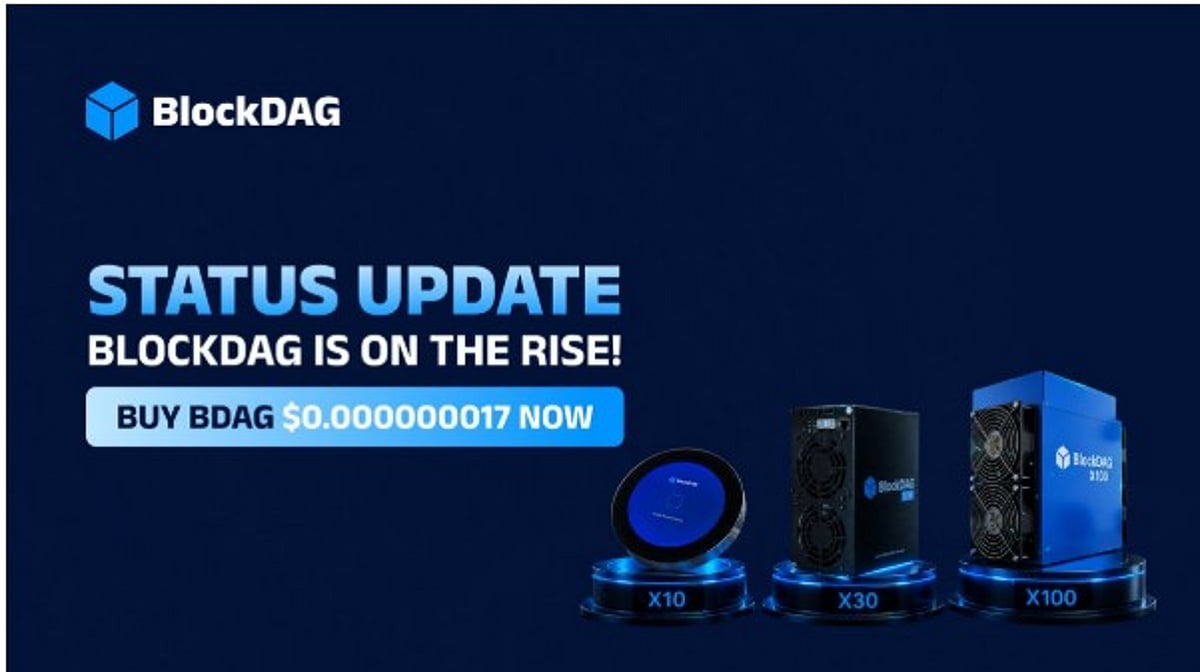
    Meanwhile, traders tracking Aave price movements and Bittensor TAO price charts are monitoring tokens that captured their early gains years ago. BlockDAG still sits at $0.000000017, with a 22% live swap discount and a $0.025 buyback price pointing toward a staggering 135X ROI.

    Two Years of Building Now Paying Off

    BlockDAG is not pitching a future—it’s showing receipts from one already in motion. The mainnet is live with EVM-compatible smart contracts, GHOSTDAG consensus, and an explorer processing over 4 million on-chain transactions across 374,400+ holders in more than 130 countries. Physical miner deliveries are underway, with X30 production at full scale, a first delivery wave within 45 days, and over 3.6 million X1 app miners active worldwide. BlockDAG.com Casino is a live commercial product with over $200 million wagered and 100+ games running—real revenue, not a whitepaper promise.

    Upcoming milestones include the BlockDAG Exchange (a company-owned trading platform offering spot and multi-asset markets) scheduled for August 2026, followed by the Super App in September, unifying mining, staking, trading, swaps, casino access, and a RedotPay-powered payment card. With claims live, staking live, over 10 billion BDAG locked, and a presale price of $0.000000017 backed by a $0.025 buyback pointing toward 135X ROI, it’s clear why many traders call this the next crypto to explode before the Exchange even opens its doors.

    Aave Price Reflects a Fully Matured Market

    Aave remains a respected DeFi lending protocol, and current Aave price action reflects a project that has matured into its valuation. AAVE trades near $97, inside a tight $96.87–$101.83 range, with a market cap around $1.5 billion and total value locked at $14.3 billion. However, circulating tokens sit at 15.4 million against a hard-capped 16 million max—almost the entire supply is already unlocked and priced in. Aave’s $50 million annual buyback program and pending Grayscale ETF filing are strong fundamentals, but this maturity means most easy multiples were captured years ago, unlike a presale-stage token still building its base.

    Bittensor TAO Price Faces a Long Climb Back

    Bittensor has built a credible AI-crypto story, and TAO currently trades near $193, with roughly 70% of total supply staked and subnet capacity doubled to 256 slots under the “Robin τ” upgrade. A Grayscale spot TAO ETF filing is pending, and Kraken’s addition of TAO spot trading in July added liquidity. Still, Bittensor TAO price sits nearly 75% below its all-time high near $758, and has fallen about 28% over the past year even as the AI narrative remained strong. BlockDAG’s presale-stage entry offers a different risk profile: ground-floor pricing instead of a token working to reclaim old highs.

    The Best Bet in a Choppy Market

    The wider market has spent months chopping sideways, grinding down portfolios. Against that backdrop, the case for BlockDAG grows stronger. Aave price strength and Bittensor TAO price resilience prove those projects are legitimate, mature players, but their easy upside is largely behind them. BlockDAG is still at ground level: claims live, staking live, over 10 billion BDAG locked, and an Exchange and Super App both landing within weeks. For anyone hunting the next crypto to explode this cycle, a proven presale with a real delivery record and a $0.000000017 entry price may be the best bet in the market right now.

    Disclaimer: Analytics Insight does not provide financial advice or guidance on cryptocurrencies and stocks. Cryptocurrencies mentioned may be risky and could result in loss of capital. This article is for informational purposes only and does not constitute investment advice. Always do your own research before making any investment decisions.

  • AWS Co-Founder Matt Domo on Why Enterprise AI Pilots Fail and How to Scale

    AWS Co-Founder Matt Domo on Why Enterprise AI Pilots Fail and How to Scale

    According to a recent Forrester analysis, only 10-15% of artificial intelligence pilots successfully transition into long-term production. That means most enterprise AI investments stall before they ever deliver real impact. Matt Domo, a co-founder of Amazon Web Services (AWS) and creator of foundational Microsoft enterprise technologies, has a clear explanation: the problem is rarely the technology itself, but rather how organizations are structured around it.

    Now advising Fortune 500 companies, government agencies, and universities, Domo shared his insights with AI Magazine on moving from experimentation to enterprise-scale execution.

    Why Most AI Initiatives Fail at the Executive Level

    Domo identifies three root causes for AI failure: unclear ownership of outcomes, misaligned incentives across teams, and operating models that were not built for AI-driven decision-making. “Leaders fund pilots, but they don’t redesign how work happens. They treat them as technology projects instead of using them to change how the business operates,” he said. Without organizational alignment, AI simply gets layered onto existing processes, which looks like progress but yields no measurable results.

    Scaling AI from Pilot to Enterprise-Wide Deployment

    Scaling does not come from running more pilots; it comes from standardization. “Companies that succeed define a repeatable path from pilot to production, assign clear ownership of outcomes, and integrate AI into core workflows instead of layering it on top,” Domo explained. He warns that when every team starts from scratch, you end up with scattered experiments, not scale.

    ROI Metrics That Convince Boards

    To secure board-level investment, Domo advises focusing on metrics directly tied to financial results and strategic goals. “Boards aren’t convinced by activity. They’re convinced by measurable impact tied to the P&L,” he said. The metrics that matter include cost reduction, revenue lift, and faster decision cycles. Vague reporting like usage or engagement does not work; clear attribution of what changed, by how much, and how it ties to financial outcomes is essential.

    Avoiding AI-Washing and Misaligned Projects

    Organizations avoid AI-washing by starting with the desired outcome, not the tool. “Define the business result first, assign clear ownership of that outcome, and only then determine where AI actually improves the workflow,” Domo advised. Misalignment often happens when teams are incentivized to launch initiatives rather than deliver results. The fix is to tie every AI effort to a measurable objective and hold a single owner accountable.

    Speeding Up AI-Driven Decision-Making

    Speed in AI adoption comes from clearer ownership and fewer handoffs. In large organizations, decisions slow down due to fragmented accountability and excessive alignment steps. Domo recommends defining who owns the outcome, standardizing the inputs those decisions rely on, and reducing the number of required approvals. “AI can surface better insights, but unless the organization is structured to act on them quickly, those insights sit in dashboards,” he noted. Speed comes from aligning decision rights with the people closest to the outcome.