Tag: Skyroot Aerospace

  • Skyroot Vikram-1 Launch Fuels Interest in Indian Aerospace and Defense Stocks

    Skyroot Vikram-1 Launch Fuels Interest in Indian Aerospace and Defense Stocks

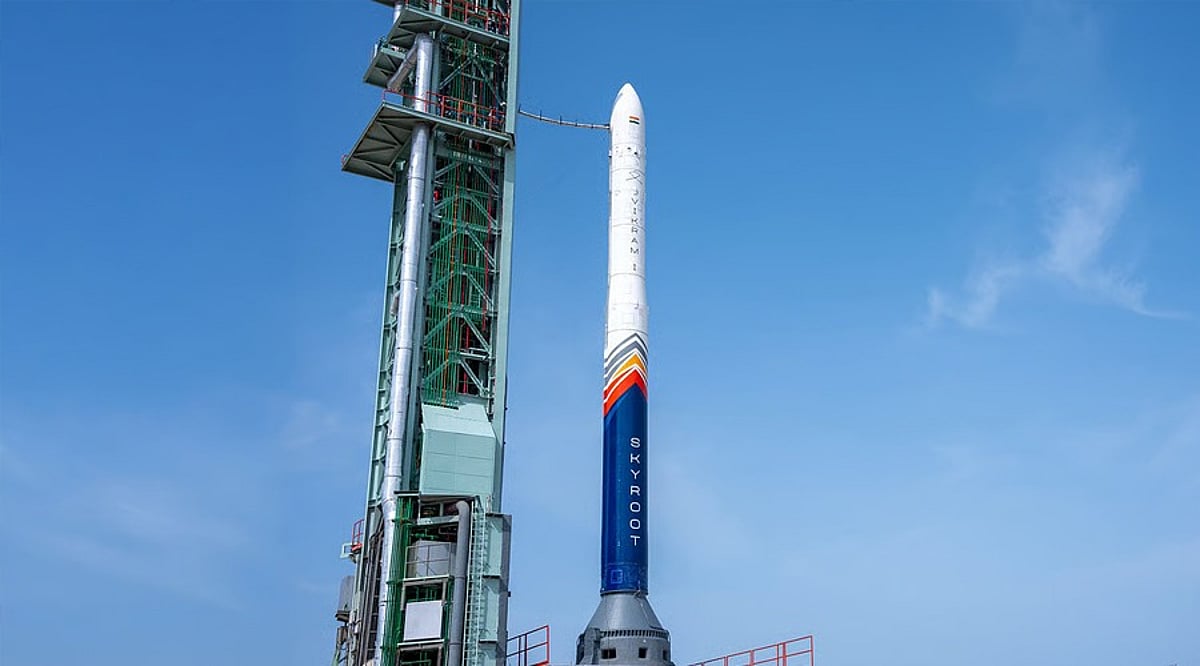
    Skyroot Aerospace’s upcoming Vikram-1 launch is drawing attention beyond India’s private space industry. As the company prepares to launch the country’s first privately built orbital rocket, investors are also looking at listed companies that supply critical technologies to the aerospace and defense sectors.

    An analysis identifies three Indian aerospace and defense stocks that could benefit from the momentum around the country’s growing commercial space industry. The report says companies with expertise in precision engineering, aerospace manufacturing and mission-critical components are well placed as private space activity gathers pace.

    Azad Engineering Among the Key Names

    One of the companies highlighted is Hyderabad-based Azad Engineering. The company manufactures precision-engineered components used in aircraft engines, space systems, defense platforms, power generation and industrial applications. According to Simply Wall St, Azad Engineering is strengthening its position in the aerospace supply chain by expanding manufacturing capacity. The company is investing in eight lean manufacturing facilities to support a growing order book and meet rising demand from global original equipment manufacturers (OEMs). Its products include turbine blades, actuators and other high-precision components used in aerospace and defense applications. The report says these long-term customer relationships and specialized manufacturing capabilities position the company to benefit as India’s private space ecosystem expands.

    Growth Opportunities Come with Risks

    There are some risks which investors need to keep in mind. Azad Engineering has quite a high price-to-earnings ratio, and it depends upon external borrowing to fuel its expansion plans. Customer concentration and the difficulties associated with the expansion of the manufacturing process can also be regarded as some other risk factors. Analysts say that even though the firm enjoys a strong market presence, its ability to implement its growth plans will be a major concern for investors.

    India’s Space Ambitions Fuel Broader Industry Interest

    The Vikram-1 space mission represents another milestone for India’s increasing private space ventures. The success of the mission would demonstrate the technical abilities of indigenous private firms and bolster confidence in India’s commercial space endeavors. This trend is also expected to work in favor of those firms providing parts, engineering expertise, and manufacturing solutions to the aerospace and defense industry. Despite a positive outlook for the industry, according to Simply Wall St, any investment decisions should be made on the basis of the company’s business acumen, financial strength, and execution, rather than the excitement of a single mission. With India’s private space industry maturing, companies with manufacturing prowess and customer connections are expected to continue receiving the attention they do.

    Related: How Skyroot Aerospace is Transforming India’s Private Space Industry with Vikram-1
  • Skyroot Aerospace’s Vikram-1 Rocket Poised to Reshape India’s Private Space Sector

    Skyroot Aerospace’s Vikram-1 Rocket Poised to Reshape India’s Private Space Sector

    India’s private space industry is undergoing a transformation, and Hyderabad-based startup Skyroot Aerospace is at the forefront. With its upcoming Vikram-1 orbital rocket, the company aims to make satellite launches faster, more affordable, and accessible to customers worldwide.

    Founded in 2018, Skyroot has rapidly evolved from a small team with a bold vision into one of India’s most prominent private space companies. Unlike traditional missions focused solely on research, Skyroot’s commercial approach targets the growing demand for reliable small satellite launch services.

    From Vikram-S to Vikram-1: A Milestone Journey

    In 2022, Skyroot made history with Vikram-S, India’s first privately built rocket to reach space. Though a suborbital test flight, it validated the company’s technology and provided critical data for the development of Vikram-1.

    Vikram-1 is Skyroot’s first orbital launch vehicle, designed to carry small satellites into Low Earth Orbit (LEO) and Sun-synchronous Orbit (SSO). The rocket incorporates modern manufacturing techniques, including 3D printing and lightweight materials, to reduce costs and speed up production.

    The inaugural mission, named Mission Aagaman, will carry payloads from Indian and international customers, demonstrating confidence in Skyroot’s capabilities even before its first orbital flight.

    Why Vikram-1 Matters for India’s Space Economy

    With the global demand for satellite-based services—internet, weather monitoring, agriculture, navigation, and research—rising every year, affordable and dedicated launch options are needed. Skyroot aims to fill this gap by offering flexible launch schedules for small satellite operators who often wait months for rides on larger rockets.

    Beyond launches, Skyroot is developing debris-removal technology, including a robotic system to capture defunct satellites and orbital debris—a growing concern as Earth’s orbit becomes increasingly crowded.

    A successful Vikram-1 mission would not only be a win for Skyroot but also signal that Indian startups can compete globally. It could attract investment, create skilled jobs, and position India as a trusted hub for affordable commercial satellite launches.

    India’s Space Future: A Collaborative Ecosystem

    Skyroot’s journey highlights the maturation of India’s private space sector. While ISRO will continue to lead major national missions, companies like Skyroot complement its efforts by building a robust commercial space industry. Together, they can elevate India’s standing in the global space economy.

  • India’s Space-Tech Startups Driving Commercial Innovation in 2026

    India’s Space-Tech Startups Driving Commercial Innovation in 2026

    India’s space-tech ecosystem is experiencing rapid expansion in 2026, fueled by private sector innovation, government reforms, and increasing global demand for satellite-based services. A new generation of startups is redefining the nation’s role in the commercial space industry.

    Skyroot Aerospace is making strides with cost-effective launch vehicles, having completed successful missions that bolster India’s private launch capabilities. The company aims to reduce barriers to orbit for small satellites.

    Agnikul Cosmos is advancing small satellite launches with its 3D-printed rocket engine technology, offering flexible and rapid mission deployment tailored to emerging needs.

    Pixxel is building one of the world’s largest hyperspectral satellite constellations, delivering high-resolution Earth observation data for applications in agriculture, climate monitoring, and defense.

    Digantara focuses on space situational awareness, developing solutions to track satellites and orbital debris, thereby improving overall space safety and sustainability.

    Bellatrix Aerospace is pioneering advanced satellite propulsion systems and orbital transportation technologies, supporting future commercial space missions with efficient in-space mobility.

    Government initiatives, including reforms by IN-SPACe (Indian National Space Promotion and Authorization Centre), and growing private investment continue to accelerate the growth of India’s commercial space sector.

    Despite these advances, the sector faces challenges such as securing adequate funding, navigating regulatory compliance, managing long development cycles, and competing on a global scale. Nevertheless, with rising demand for satellite services and expanding launch opportunities, India’s space-tech startups are well-positioned for sustained global growth.

  • India’s Private Space Ecosystem: Why It Won’t Be a SpaceX Clone but Could Be Even Stronger

    India’s Private Space Ecosystem: Why It Won’t Be a SpaceX Clone but Could Be Even Stronger

    In November 2022, a rocket called Vikram-S lifted off from Sriharikota and reached space for a few minutes before falling back to Earth. The mission carried no significant satellite and accomplished nothing of immediate commercial value—yet it changed the direction of an entire industry almost overnight. For the first time, a private Indian company had built and launched a rocket. That company was Skyroot Aerospace, founded by two former ISRO engineers four years earlier.

    Three and a half years later, Skyroot has become India’s first space-tech unicorn, raising $60 million at a $1.1 billion valuation. It is now preparing for the maiden orbital launch of Vikram-1—a moment that will determine whether an Indian private company can put a satellite into orbit on its own rocket, something fewer than a handful of companies worldwide have managed.

    This naturally invites the question: Can India build its own SpaceX? The answer is more nuanced than a simple yes or no.

    Why the Comparison Is Tempting, and Slightly Wrong

    SpaceX built a vertically integrated company controlling launch vehicles, engines, spacecraft, and a satellite constellation, scaled by reusability and an enormous addressable market. Valued north of $400 billion, it has no true global peer.

    India’s emerging space sector looks different. Rather than a single company replicating SpaceX’s everything-at-once model, India is producing a cluster of specialised companies, each going deep on one part of the problem:

    • Skyroot Aerospace – building launch vehicles
    • Agnikul Cosmos – launch vehicles with a fundamentally different manufacturing philosophy (3D-printed single-piece engines)
    • Pixxel – hyperspectral imaging satellites
    • Dhruva Space – satellite platforms and ground station networks
    • Digantara – orbital debris tracking and space traffic management

    This is not a smaller ambition than SpaceX’s; it’s a different shape of ambition—closer to Europe’s multi-specialist model than America’s increasingly SpaceX-centric approach.

    The Companies Actually Doing This

    Agnikul’s approach deserves special attention. Its Agnibaan rocket uses a single-piece, 3D-printed engine that collapses what normally takes months of assembly into weeks, eliminates hundreds of individual mechanical parts, and makes engine iteration nearly as fast as updating software. That is a structural advantage competitors using conventional manufacturing cannot easily close.

    India’s space economy was valued at roughly $8.4 billion in 2022 (about 2% of the global market). The government targets $44 billion by 2033, aiming for 8–10% global share. By early 2026, India has close to 400 active space-tech startups, up from a single company in 2014. Cumulative private investment has crossed roughly $380 million, and the space economy reportedly generates $2.54 in returns for every dollar invested—2.5 times the productivity multiplier of the broader Indian industrial economy.

    These gains stem from reforms beginning in 2020 that opened ISRO facilities to private companies. IN-SPACe, the regulatory body, now runs a dedicated venture capital fund to lower capital barriers for early-stage space startups. State governments compete for investment: Tamil Nadu passed a Space Industrial Policy in 2025 targeting Rs. 10,000 crore in investment.

    What’s Genuinely Hard

    Three major challenges remain:

    1. Unproven orbital launch capability – As of mid-2026, neither Skyroot’s Vikram-1 nor Agnikul’s Agnibaan has completed a successful commercial orbital mission. If Vikram-1’s maiden flight fails, the narrative shifts instantly from “India’s SpaceX moment” to “the sector needs more time.”
    2. Competitive pricing – SpaceX, Rocket Lab, and increasingly aggressive Chinese providers are pricing small-satellite launches hard in exactly the market Indian startups target. Lower Indian manufacturing costs help, but are not an automatic win against flight-proven reliability and reusable rocket economics.
    3. Talent pipeline – India’s startups have aggressively recruited former ISRO engineers, but the number of aerospace-trained graduates from Indian universities has not scaled to match ambition. IN-SPACe chairman Dr. Pawan Goenka has stressed that skilling is a precondition for reaching the $44 billion target, not an automatic byproduct of investment.

    The Part of the Story That’s Easy to Miss

    A meaningful share of the engineers building these rockets are in their mid-twenties, many leaving high-paying jobs at global tech companies. One Skyroot engineer, speaking after Prime Minister Modi inaugurated the company’s Hyderabad campus, put it simply: they grew up watching ISRO’s PSLV launches on Doordarshan, and now they are building the next chapter themselves.

    That generational pipeline—engineers who watched India’s state space program as children and are now building its private successor—is cultural infrastructure as much as technical infrastructure, and it may end up mattering as much as any funding round.

    So, Can India Build Its Own SpaceX?

    Probably not in the literal sense. A single company achieving SpaceX’s scale, reusability, and vertical integration within a similar timeframe looks unlikely given where Indian launch technology stands today. But that may be the wrong question.

    India appears to be building a distributed version of the same outcome: multiple specialised companies, each strong in one layer of the stack, collectively giving the country independent and increasingly commercial access to space without depending on a single company’s success or failure. If Vikram-1 reaches orbit successfully, it will be a genuine milestone. The more important test, over the next three to five years, is whether the cluster as a whole—rockets, satellites, propulsion, and debris-tracking—keeps growing fast enough to make the $44 billion target look conservative rather than fantastical.