Tag: smart contracts

  • Why Onchain Data Verification Is Critical for Blockchain Trust and Security

    Why Onchain Data Verification Is Critical for Blockchain Trust and Security

    Every blockchain data provider claims their product is verifiable. The problem is that few of them mean the same thing, and that gap has become a critical issue as more capital moves through automated systems and smart contracts that rely on accurate onchain data.

    The simplest approach to data extraction involves a team pulling data directly from blockchain nodes via JSON-RPC, extracting blocks, transactions, and logs, then loading them into a custom pipeline. With some human curation—people checking numbers and catching anomalies—this setup works well for small to medium projects. However, it does not scale effectively. When a provider using this pipeline calls its data verifiable, it typically means the numbers can be spot-checked against another source and the methodology is open to manual audit. This is a real capability, but it is far from cryptographic proof and still requires trusting that someone extracted and curated the data honestly.

    That trust gap has shifted from a nuisance to a liability. Most applications accept whatever an RPC endpoint returns at face value, meaning compromised infrastructure can feed convincing but incorrect data into downstream systems. This is not hypothetical. In April 2026, attackers manipulated the RPC infrastructure behind a verification layer tied to KelpDAO, contributing to a loss estimated at around $290 million. No blockchain cryptography was broken. Instead, the trust chain was exploited. As more capital flows through agents and treasuries that execute automatically, bad data becomes a security issue rather than a quality issue.

    Teams requiring stronger verification typically choose among three approaches, and only one fully earns the descriptor without an asterisk.

    1-of-N Trust Model

    The first is a 1-of-N trust model. Instead of relying on a single provider, work is distributed across many independent participants. Correctness becomes contestable: it takes just one honest party to catch bad data and hold the offender accountable. The Graph’s decentralized network uses this model, where Indexers submit Proofs of Indexing, and other participants can challenge results they believe are incorrect. Disputes go to arbitration, and an Indexer caught serving bad data is slashed. The math is compelling. With five participants, each having a 20% chance of using a faulty RPC, a consensus model requiring majority agreement has about a 5.8% chance that the majority is wrong and bad data wins. Under a 1-of-N model, corruption only slips through if all five participants fail simultaneously, about 0.03% risk, making it nearly two orders of magnitude safer. This gap explains why 1-of-N scales better as networks grow.

    However, this model has a flaw. A gateway pulling from multiple Indexers can receive correct data from two sources and bad data from a third. Until the dispute resolves, users may see flickering between correct and incorrect data. Developers often prefer consistently wrong data over visibly inconsistent data, a real tradeoff in permissionless systems that centralized systems typically hide.

    Consensus Model

    The second approach is consensus, which is often confused with 1-of-N. This distinction matters because the two models make fundamentally different bets. Consensus treats majority agreement as a stand-in for correctness, as Chainlink’s oracle network does. The problem is that a majority can be wrong. If enough participants collude or are compromised, the entire agreement mechanism breaks down.

    Verifiable Extraction

    The third approach deserves the term without qualification. Verifiable extraction bypasses the question of whom to trust and instead relies on the blockchain’s cryptographic commitments: the hashes linking every block, transaction, and log in a way that cannot be altered without detection. Edge & Node’s Amp recomputes these commitments during data extraction, before the data becomes queryable, checking Keccak-256 hashes and Merkle Patricia Tries against the block header. If anything has been tampered with, the mismatch appears immediately. StreamingFast’s verifiable extraction for Firehose closes the remaining gap by proving that a specific block belongs to the chain’s actual canonical history, not just that the extracted data matches the header it claims. Together, these cover the full claim: the data is faithful to the block, and the block is real, and anyone can recompute both independently.

    However, this approach has costs. Recomputing commitments and reconstructing proofs requires computational work, so the most rigorously verified data tends to arrive slower than a raw, unchecked feed. The blockchain data trilemma—fast, comprehensive, verifiable, pick your tradeoffs—does not disappear just because a team has chosen the strongest form of verification. Even cryptographic verification has a boundary: it proves data was processed and preserved correctly, but not that the original source was honest. That is a different problem, the oracle problem, and it remains unsolved.

    The real issue is the weight the word is being asked to carry. “Verifiable” is applied to benchmarkable transparency, majority agreement, and cryptographic proof as if they are interchangeable guarantees with different marketing. They are not. They fail in different ways, under different conditions, for different reasons. For anyone building a system where a wrong number costs real money, this distinction is not academic. It is the entire ballgame.

  • How Blockchain Strengthens Business Data Security: Benefits and Challenges

    How Blockchain Strengthens Business Data Security: Benefits and Challenges

    Data breaches cost companies more than money now. They cost trust, and trust is hard to rebuild once it’s gone. That gap is pushing more businesses toward blockchain, a technology once tied mostly to crypto trading, now finding a second life as a security layer for sensitive records.

    What Makes Blockchain Hard to Break Into

    A blockchain stores data across many computers instead of one central server. Each new entry links back to the one before it through cryptographic proof, forming a chain that every participant can see. Changing one record means rewriting every entry after it. That change also needs approval from most nodes on the network before it sticks. This setup is what draws security teams in. A single hacked server can bring down a whole database. A blockchain spread across participating organizations gives an attacker no single point to target.

    This setup is also what gives blockchain its core security value: a record that is hard to alter once written, paired with a clear audit trail. Every entry stays linked to a timestamp and the entries before it, so an unauthorized change is easy to spot rather than easy to hide. That same trail helps after an attack too. If ransomware or a breach hits other systems, a verifiable blockchain record can help a business confirm what data was touched and support the forensic work that follows.

    Where Businesses Are Putting It to Work

    Banks and payment firms were early adopters. They use blockchain to record transactions in a way auditors can check without trusting a middleman. Supply chain firms now track goods from factory to shelf on shared ledgers, making it easy to spot a tampered shipment record or a fake product entering the chain. Healthcare providers are testing blockchain for patient records too, using it to manage patient consent and track who has viewed a file, letting hospitals share records safely without losing a clear history of every change.

    Government agencies have started piloting blockchain for land registries and identity systems, where a forged document can cause real financial harm. Beyond these industries, many organizations face the same challenge: several parties need access to the same data, but no single organization can always be trusted to manage it alone. Blockchain solves this problem by letting everyone share and verify the same records without relying on one central authority.

    Smart Contracts Add a Second Layer

    Many enterprise blockchain systems also run smart contracts, small pieces of code that execute automatically once agreed terms are met. A payment can be released only when a shipment is confirmed delivered. A contract can hold funds until both sides sign off. This cuts out manual approval steps that are often the weak point in a security chain, the spot where a forged email or a stolen login can slip past a human reviewer.

    Encryption and Access Control Get an Upgrade

    Traditional databases rely on passwords and firewalls, which can be compromised if login credentials are stolen. Blockchain uses public and private cryptographic keys to verify access instead of depending only on passwords. Many enterprise blockchain platforms also offer permissioned access, allowing businesses to decide who can view or update specific records while keeping the ledger secure and tamper-resistant.

    The Limits Businesses Still Face

    Blockchain does not fix every security problem. Running a full network takes real computing power, and public blockchains can run slower than a standard database built for speed. Rules around data storage, especially in finance and healthcare, are still catching up with how blockchain actually works. Some businesses stay cautious about full adoption. There is also a skills gap: setting up and running a blockchain system takes specialized skills that many IT teams are still building.

    Enterprise blockchains are expensive, often costing lakhs to set up and run. For smaller companies, the investment doesn’t really pay off until they are handling massive amounts of data or facing heavy regulatory pressure. For many, a mixed approach works best: sensitive records on a blockchain layer, routine work left on existing systems.

    A Shift in How Trust Gets Built

    What blockchain offers, at its core, is a different way to build trust. Instead of asking everyone to trust one company or one server, it spreads that trust across a network where tampering becomes hard to pull off rather than simply against the rules. For businesses handling sensitive data—whether financial records, medical files, or supply chain documents—that shift is worth real thought, even if it doesn’t fit every system on day one.

    Final Thoughts

    Blockchain adoption in enterprise security is still young, and most businesses will end up running it alongside older systems rather than replacing them outright. The companies gaining the most ground now are the ones testing it on a narrow, high-value problem first, then scaling once the results hold up under pressure.

  • Leading Web3 Development Companies in the United States for 2026

    Leading Web3 Development Companies in the United States for 2026

    The United States continues to lead many Web3 projects in 2026. Startups, brands, and large firms are looking for teams that can build safe, useful, and easy-to-run digital products. A strong Web3 company does more than write code; it helps a business plan, build, test, and launch with care.

    Web3 has moved past the hype stage for many firms. It now serves real work in finance, gaming, digital ownership, supply chain tracking, and online identity. The best companies in this field focus on clear results, not loud promises. They help clients turn a rough idea into a working product that can serve real users.

    Why Companies Matter

    A Web3 project can fail fast if the team rushes the work. Smart contract mistakes, poor design, and weak testing can all create problems later. That is why buyers often look for firms with solid past work, a clear process, and a steady support team.

    The U.S. market has depth. DesignRush lists 319 Web3 companies in the United States, which shows how active the space has become. Clutch also notes that U.S. teams are active across major hubs like Silicon Valley, New York, and Miami. This spread gives buyers more choice and more room to compare.

    Web3 Companies in 2026

    A few firms appear often in 2026 lists. They include Cleveroad, Altoros, Vention, Iron Forge Development, and The Blockchain Team. These names stand out for different reasons. Some focus on enterprise work, while others build for startups, and some handle both.

    Techanic Infotech, Crinpro Solutions, MindSea, ArcTouch, TechMahindra, WillowTree, Dogtown, Blue Label Labs, Infosys, and Media Sidebench also appear in AVIXA’s 2026 list of leading U.S. Web3 companies. The mix shows how broad the market is. Some firms lean toward app design and user flow, while others focus on blockchain systems, token tools, or private company use cases.

    What Separates the Best

    The best Web3 companies are usually strong in three areas: they understand the full build cycle, they test carefully, and they explain things in plain language. That matters because many clients do not need hype; they need a team that can guide them step by step.

    Expert insight in the sector points to one clear pattern. Firms that do well in 2026 are those that connect tech skill with business sense. A good example is a company that can build a wallet or NFT platform, then also help the client think through user trust, launch timing, and long-term support. That mix is often what separates a useful product from a short-term experiment.

    How Buyers Can Choose

    A buyer should look at more than a company name. Past projects and industry focus matter. Clear communication matters too. A team that has built for finance may fit a payment product better than a team that only knows art or games.

    A buyer should also ask simple questions: Has the team built similar products before? Does it test for security? Will it stay involved after launch? These questions help cut through noise and show which firm can handle real work. In a market with hundreds of choices, that kind of focus saves time and reduces risk.

    Final Thoughts

    Top Web3 development companies in the United States in 2026 bring skill, speed, and practical thinking to a fast-changing field. The strongest firms do not chase buzz; they build products that work, scale, and make sense for the client’s goals. For any business entering Web3, the best partner is the one that keeps the process clear and the product solid in an operational cycle.

    FAQs

    What is a Web3 development company?

    A Web3 development company builds blockchain-based applications, smart contracts, crypto wallets, NFT platforms, DeFi solutions, and other decentralized digital products for businesses and startups.

    Why should businesses hire a Web3 development company?

    Hiring a Web3 development company gives businesses access to blockchain expertise, secure smart contract development, faster product launches, ongoing technical support, and scalable solutions tailored to their needs.

    Which industries benefit the most from Web3 development?

    Industries such as finance, gaming, healthcare, supply chain, real estate, e-commerce, and digital identity are increasingly using Web3 technologies to improve security, transparency, and efficiency.

    What should I look for when choosing a Web3 development company?

    Look for proven blockchain experience, strong security practices, relevant industry expertise, client reviews, a transparent development process, and reliable post-launch support before making a decision.

    Are Web3 development services suitable for startups?

    Yes. Many Web3 development companies offer flexible solutions for startups, helping them build MVPs, launch blockchain products, and scale their platforms as their business grows.

  • Ethereum Breaks Above $1,900: Is a Rally to $2,100 Next?

    Ethereum Breaks Above $1,900: Is a Rally to $2,100 Next?

    Ethereum has reclaimed the $1,900 mark, fueled by strong institutional demand, robust ETF inflows, and improving market sentiment. After hovering below $1,800 for weeks, the second-largest cryptocurrency by market cap surged past $1,900 and is now trading around $1,925–$1,930. With a market capitalization exceeding $232 billion and daily trading volume near $10 billion, analysts are watching whether ETH can break through $2,000 and target $2,100.

    Institutional Demand Keeps Ethereum on Track

    One of the biggest drivers behind Ethereum’s recent rise is sustained interest from institutional investors. Large financial firms continue to increase exposure through spot Ethereum exchange-traded funds (ETFs), which have helped improve market confidence. Recent data shows U.S. spot Ethereum ETFs attracted approximately $72.7 million in net inflows, marking another day of positive investment. This institutional buying reduces the available supply of ETH, supporting higher prices.

    Ethereum Continues to Lead the Smart Contract Market

    Ethereum remains the most valued smart contract blockchain, powering countless decentralized platforms, applications, and token projects daily. Its dominance in the smart contract space gives it a competitive edge over rival cryptocurrencies. Additionally, Ethereum’s staking mechanism allows investors to earn rewards by locking their coins, while its burn mechanism removes a portion of transaction fees from circulation, reducing selling pressure and supply over the long term.

    Positive Market Sentiment Supports the Rally

    The broader cryptocurrency market has seen positive momentum, with Bitcoin trading steadily and boosting investor confidence. This has encouraged buyers to invest freely in altcoins like Ethereum. Traders have become more active, bringing fresh purchases into the market. Based on current feedback, Ethereum could continue its recovery unless market conditions change dramatically.

    Technical Picture Shows More Upside

    Ethereum has moved above the important resistance level at $1,900, which now acts as first support. Many analysts believe this level could help protect the rally if buyers continue to defend it. The next challenge sits near $1,950, followed by the psychological barrier at $2,000. If Ethereum breaks above these levels, the price could move toward $2,100. On the downside, support remains at $1,850, with $1,800 as the next major level if sellers regain control.

    On-Chain Activity Reflects Healthy Demand

    Blockchain data supports the recovery. Large investors, often called whales, have increased their activity during the latest rally. Network activity has remained stable, and transaction volumes show healthy participation. This suggests that Ethereum’s recovery comes from genuine market demand rather than short-term speculation.

    Risks Still Deserve Attention

    Despite the positive outlook, investors should remain cautious. The cryptocurrency market still reacts to interest rate decisions, economic uncertainty, and regulatory developments. Any unexpected event could slow the rally. Additionally, security incidents across the crypto ecosystem—such as recent attacks on Bitcoin- and Ethereum-related protocols causing losses of around $35 million—remind investors that risks persist.

    Why This Matters

    Moving past $1,900, Ethereum reflects surging institutional confidence and growing on-chain adoption. Given its foundational role across decentralized finance, ETH’s rally serves as a key sentiment driver for all digital assets.

    Can Ethereum Reach $2,100?

    After rising back above $1,900, Ethereum has gained considerable momentum. Institutional demand remains strong, the platform continues to dominate the smart contract segment, and market sentiment has improved. As long as bulls remain in charge and ETF interest stays strong, Ethereum will likely attempt to breach $2,000 soon. A successful move above that level could open the path toward $2,100. While short-term volatility is possible, the conditions for a continued recovery remain favorable.

    Frequently Asked Questions

    1. Why has Ethereum moved above $1,900? Ethereum has gained support from strong institutional demand, positive ETF inflows, and improved sentiment across the cryptocurrency market.
    2. What is the next price target for Ethereum? Analysts believe $2,000 is the next key resistance, while $2,100 remains the next major upside target if buyers stay in control.
    3. How much money entered Ethereum ETFs recently? Recent data shows U.S. spot Ethereum ETFs recorded approximately $72.7 million in net inflows.
    4. What support level should investors watch? The first major support sits at $1,900, followed by $1,850 if the market faces short-term pressure.
    5. What risks could affect Ethereum’s rally? Economic uncertainty, regulatory decisions, and security incidents across the crypto industry could slow Ethereum’s upward momentum.

    Disclaimer: This article is for informational purposes only and does not constitute investment advice. Cryptocurrency investments carry risk. Always do your own research before investing.

  • BlockDAG, Litecoin, and Hyperliquid: Key Developments and Market Moves as Keynote 6 Approaches

    BlockDAG, Litecoin, and Hyperliquid: Key Developments and Market Moves as Keynote 6 Approaches

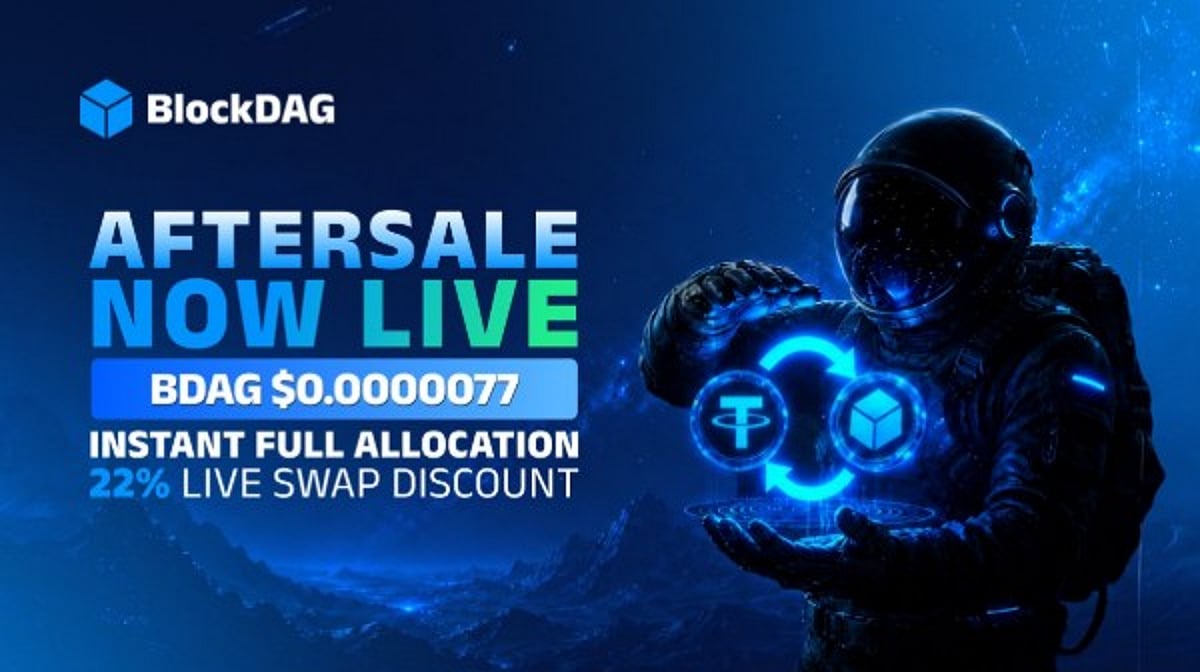
    The cryptocurrency market is buzzing with activity as three major projects make headlines. Litecoin is preparing to introduce smart contracts through its LitVM upgrade, Hyperliquid price holds steady above key support, and BlockDAG captures attention with a low entry price of $0.0000077 ahead of its highly anticipated Vision Keynote 6 on July 30.

    Litecoin News: LitVM Smart Contracts Coming in Q4 2026

    Recent Litecoin news reveals that the network is expanding beyond simple digital payments. The LitVM upgrade will bring smart contract functionality, with a mainnet launch planned for Q4 2026. The project has already processed over 75 million transactions on its testnet, indicating extensive technical preparation. However, testnet activity does not guarantee real-world adoption. Success will depend on developer and user engagement after launch. If the rollout succeeds, decentralized applications and programmable services could increase network activity and demand for LTC.

    Hyperliquid Price Momentum Builds Toward New Highs

    Hyperliquid (HYPE) is trading at $61.01, up 2.41% in the last 24 hours, with a market cap of $15.43 billion and $235.1 million in trading volume. The token has held above a key support level, preserving its bullish structure. Analysts suggest that a break above $74 resistance could open the door to a rally toward $172. However, a drop below $58 would weaken the outlook. Beyond price action, Hyperliquid’s network generates nearly $1.9 million in daily fees, ranking sixth among crypto protocols by fee revenue—a sign of strong user activity and trading demand.

    BlockDAG: Low Entry Price and Major Upcoming Launches

    BlockDAG is drawing significant interest with an entry price of $0.0000077 and instant full allocation for buyers. A 22% discount on the CoinMarketCap price is available through the live swap. Such terms are rare for a project with this level of development. The BlockDAG Exchange is nearing full launch, including spot and futures trading, along with dedicated iOS and Android apps. Vision Keynote 6 on July 30 is expected to reveal updates that could boost global demand and outline BDAG’s long-term roadmap.

    Additionally, BlockDAG’s Casino and Sportsbook platform has already processed over $200 million in wagers, demonstrating real-world utility. The platform runs on BlockDAG’s DAG network, designed to handle high transaction throughput without congestion. Planned upgrades to 7,000 TPS and the recent BDAG AI launch, which reportedly increased valuation by $500 million, further fuel demand. Between the exchange countdown, the keynote, and a proven gaming platform, BlockDAG is positioning itself as a top crypto gainer to watch this year.

    Overall Market Outlook

    Litecoin’s smart contract push hinges on post-launch adoption. Hyperliquid’s price action remains bullish above $58, with targets at $74 and $172. BlockDAG, however, is not waiting for confirmation. At $0.0000077 with instant allocation and a 22% discount, the entry window is compelling. With the Exchange, Keynote 6, and a casino already handling $200M in wagers, plus a jump to 7,000 TPS and a $500M valuation boost from BDAG AI, many now consider BlockDAG the next big crypto worth acting on early.

    Disclaimer: This article is for informational purposes only and does not constitute investment advice. Cryptocurrencies are highly volatile and involve financial risk. Always conduct your own research (DYOR) before making any investment decisions.

    For more information:
    Presale: https://purchase.blockdag.network
    Website: https://blockdag.network
    Telegram: https://t.me/blockDAGnetworkOfficial
    Discord: https://discord.gg/Q7BxghMVyu

  • How Blockchain Is Powering the Rise of Machine-to-Machine Transactions

    How Blockchain Is Powering the Rise of Machine-to-Machine Transactions

    As AI agents, smart meters, and connected devices begin executing payments independently, Layer 2 blockchain networks and programmable smart contracts are creating the foundation for a high-speed, machine-driven global transaction economy.

    The Shift from Human-Mediated to Machine-Mediated Commerce

    The digital economy is undergoing a structural shift. Machines are no longer passive processors of human instructions. They are active economic agents, purchasing bandwidth, settling energy trades, and coordinating supply chains without waiting for human approval. This transition from human-mediated to machine-mediated commerce is accelerating faster than most enterprise frameworks have anticipated.

    The global machine-to-machine (M2M) payment market is projected to grow from $11.29 billion in 2026 to $54.95 billion by 2034, expanding at a compound annual growth rate of 21.9%. The infrastructure that enables this growth requires speed, security, and borderless settlement. Traditional banking systems cannot provide that at scale, but blockchain can.

    What Are Machine-to-Machine Transactions?

    M2M transactions describe financial exchanges that occur directly between devices, with no human authorizing each step. Sensors, autonomous vehicles, smart meters, and AI agents all participate. The challenge is that traditional payment infrastructure was designed for human actors operating within banking hours, geographic boundaries, and institutional oversight.

    Blockchain addresses each of these limitations. Its decentralized ledger allows devices to transact peer-to-peer, with cryptographic verification replacing institutional authorization. Smart contracts execute payment terms automatically when pre-set conditions are met. No clearinghouse is required.

    How Blockchain Supports M2M Payments

    Smart Contracts as Autonomous Payment Engines

    Smart contracts are self-executing code deployed on a blockchain. When a smart meter records energy consumption beyond a threshold, a smart contract triggers immediate payment to the grid operator. No invoice, no approval workflow. The machine reads the condition and settles it.

    This automation removes the human bottleneck entirely. In logistics, a delivery drone can pay a warehouse node for storage space. In manufacturing, a production line component can authorize its own maintenance purchase. The transaction logic is embedded in code, not in process.

    Layer 2 Solutions and Scalability

    A common concern with blockchain is throughput. With Layer 2 solutions and advancements in blockchain infrastructure, scalability is no longer a barrier — systems can handle millions of machine transactions per second, which is crucial for IoT ecosystems. Payment channels and sidechains batch transactions off-chain and settle the net result on the main chain, preserving security without sacrificing speed or increasing per-transaction cost.

    Institutional Infrastructure Is Now Catching Up

    Mastercard has introduced Agent Pay for Machines, designed to help businesses support secure, continuous machine payments across cards, accounts, and stablecoins. This signals that established payment networks are repositioning around autonomous transaction flows, not resisting them. Autonomous AI agents are already executing payments, purchasing APIs, accessing compute resources, and interacting with digital services without direct human intervention. The infrastructure shift is no longer theoretical.

    Benefits of M2M Transactions Through Blockchain

    • Decentralization: No single point of failure controls the transaction flow. Machines transact on equal footing without relying on a central authority.
    • Low-Cost Microtransactions: Traditional gateways make sub-cent transactions economically unviable. Blockchain Layer 2 networks bring that cost to near zero.
    • Immutable Audit Trail: Every transaction is permanently recorded. This is critical for regulatory compliance in energy, healthcare, and logistics.
    • Programmable Conditions: Payment logic is embedded directly in smart contracts, removing manual verification at every step.
    • Cross-Border Native: A sensor in Germany can pay a data node in Singapore without currency conversion delays or correspondent banking fees.

    Blockchain’s cryptographic protocols ensure secure transactions, while its transparent ledger provides an immutable record of payments, essential for auditing and accountability in automated systems. The industries already deploying M2M blockchain infrastructure include automotive, energy utilities, retail, and manufacturing. Each sector benefits from the same core property: the ability to move value between machines at the speed of data.

    What This Means for the Digital Economy

    “As machines begin to settle transactions autonomously, the financial plumbing underneath the digital economy changes entirely. Blockchain provides the only settlement layer that is fast enough, cheap enough, and open enough to serve a machine-native economy. Businesses that integrate this infrastructure early will hold a structural advantage over those still relying on human-mediated payment rails.”

    Final Words

    The expansion of machine-to-machine transactions through blockchain is not a speculative outcome. The market data, institutional infrastructure, and technical foundations are already in place. A market growing toward $54.95 billion by 2034 does not emerge without structural demand driving it. What remains is the question of execution speed. Organizations that treat blockchain-based M2M infrastructure as a long-term consideration risk falling behind those treating it as a present-day operational priority. The machines are ready. The networks are ready. The financial logic is written. The window for early-mover advantage is open, and it will not stay open indefinitely.

    Frequently Asked Questions

    What are machine-to-machine transactions?

    Machine-to-machine transactions are automated financial exchanges between devices, systems, or AI agents that occur without direct human authorization at each step.

    Why is blockchain suited for M2M payments?

    Blockchain provides decentralized settlement, smart contract automation, low transaction costs, and an immutable audit trail, all of which traditional banking infrastructure cannot deliver at machine speed.

    What is the projected size of the M2M payment market?

    The global M2M payment market is projected to grow from $11.29 billion in 2026 to $54.95 billion by 2034, at a CAGR of 21.9%, according to Fortune Business Insights.

    Which industries are adopting M2M blockchain payments?

    Automotive, energy and utilities, retail, manufacturing, and logistics are the leading sectors integrating blockchain-based M2M payment infrastructure.

    What role do smart contracts play in M2M transactions?

    Smart contracts execute payment terms automatically when pre-defined conditions are met, removing the need for human authorization and enabling real-time settlement between machines.