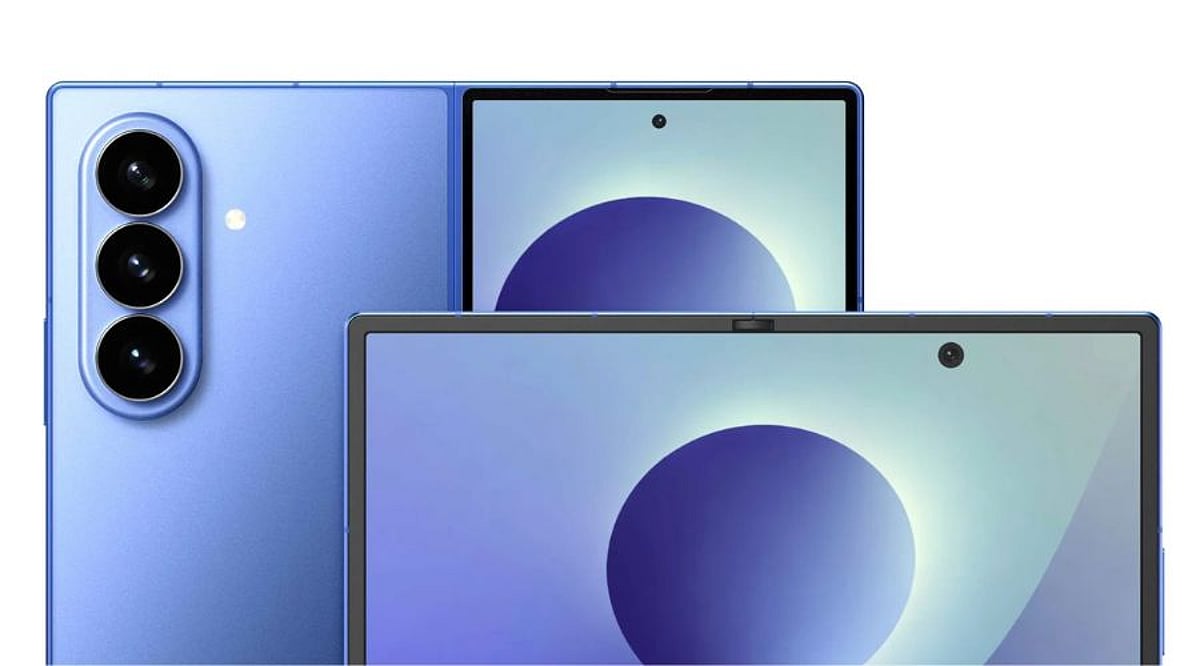
Since the original Galaxy Fold launched in 2019, Samsung has steadily trimmed weight from its foldable lineup. Over eight generations, the company cut 75 grams — from 276g to 201g — without compromising on flagship features or durability. The Galaxy Z Fold8, released in 2026, weighs just 201 grams, making it significantly lighter and more portable than its predecessors.
The weight reduction didn’t happen overnight. Samsung achieved it through a series of iterative engineering improvements: redesigned hinges, thinner display structures, lighter materials, and meticulous component optimization. The folded thickness also dropped from 17.1mm to 8.9mm over the same period.
Notably, the journey wasn’t a straight line downward. The Galaxy Z Fold2 actually gained 6 grams in 2020, reaching 282g, as Samsung added a larger 6.2-inch cover display and a more robust Hideaway Hinge. That extra weight made the closed device far more practical for everyday use. From there, the company began trimming grams through successive hinge innovations.
The Galaxy Z Fold4 introduced a linear hinge mechanism that weighed 21% less than the previous gear-based design. The Galaxy Z Fold5 followed with the Flex Hinge, enabling a waterdrop-style fold that reduced stress on the display. The Galaxy Z Fold6 refined the dual-rail structure, and the Galaxy Z Fold7 delivered a major thickness reduction, bringing the folded body to 8.9mm and weight to 215 grams.
The Galaxy Z Fold8 capped the effort with Flex Titanium — a titanium alloy film just tens of micrometers thick — integrated into the display structure. Precision-machined support components measure around 0.2mm, achieved through refined tooling and cooling processes. Samsung also examined nearly 270 core components and over 180 auxiliary parts, removing about 15 auxiliary parts and redesigning many others. Some changes shaved as little as 0.001 grams per part.
“No single material or component made that transformation possible,” Samsung stated, emphasizing that eight generations of engineering were responsible for the cumulative weight loss. The recovered space also enabled larger batteries and cameras: the Galaxy Z Fold8 Ultra packs a 5,000mAh battery and a 200MP main camera, while graphite heat-dissipation volume increased by about 7%.
The Galaxy Fold story illustrates how small, relentless engineering changes can reshape an entire device category. Samsung managed to cut weight while expanding battery capacity, camera capability, cooling, and overall foldable functionality — a testament to the power of iterative design.