
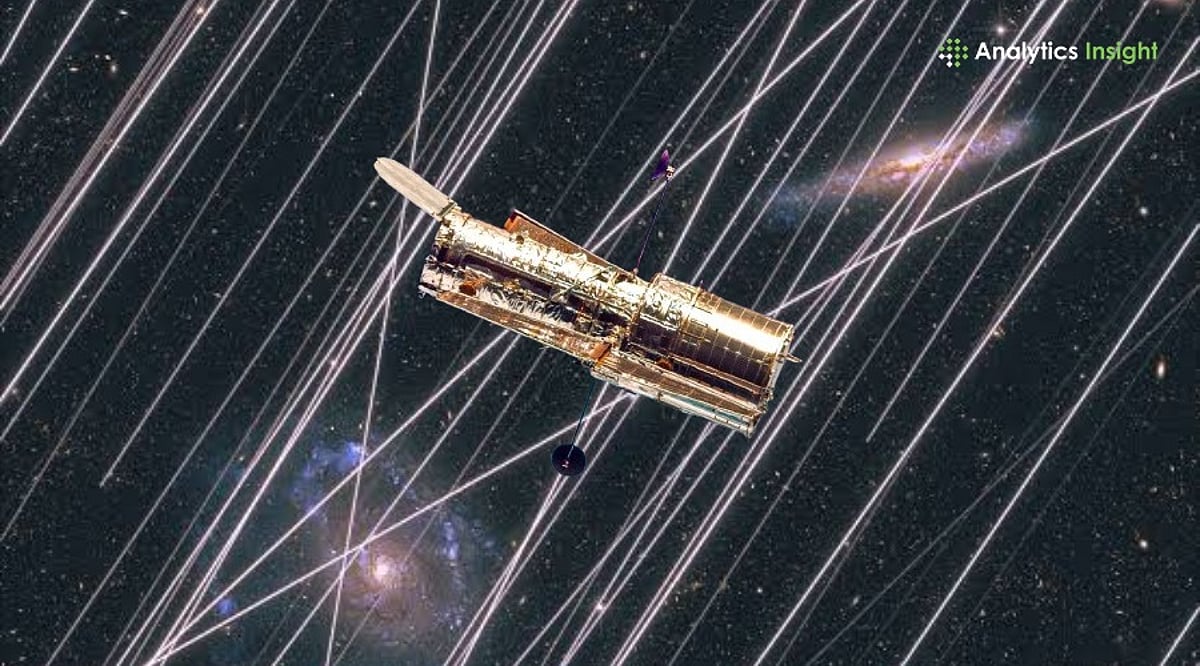
The night sky, once a pristine canvas of stars and galaxies, is increasingly crisscrossed by artificial satellites. Thousands of these spacecraft now orbit Earth daily, providing essential services like global internet, communication, and navigation. However, this rapid proliferation is creating a significant problem for astronomers: satellite crowding is blinding telescopes and threatening our ability to explore the universe.
While satellites have revolutionized modern life—enabling faster internet, precise GPS, weather monitoring, and emergency communications—their growing numbers come with a cost. Every satellite reflects sunlight, leaving bright streaks across telescope images. These streaks can obscure faint celestial objects, corrupting valuable data and making astronomical observations slower, more difficult, and more expensive.
Radio telescopes face an additional challenge: satellites emit radio signals that interfere with the weak cosmic signals scientists are trying to detect. This interference can render observations useless, especially for projects studying distant galaxies, exoplanets, and the early universe.
The problem is accelerating. Lower launch costs and the demand for global connectivity have spurred companies and governments to deploy massive satellite constellations. Without careful planning, the number of satellites in orbit could exceed 100,000, a threshold that some experts warn could make ground-based astronomy nearly impossible.
Scientists are not opposed to satellite technology, but they advocate for a balance. Proposed solutions include using darker materials on satellites to reduce reflectivity, better coordination between satellite operators and observatories to avoid imaging conflicts, and responsible space policies that prioritize both technological progress and scientific discovery.
The night sky belongs to everyone. Protecting it for future generations requires immediate action. By adopting smarter satellite designs, fostering collaboration, and implementing thoughtful regulations, we can preserve our ability to study the cosmos while still reaping the benefits of satellite technology.
Key Takeaways
- Satellite crowding creates bright streaks and radio interference that disrupt astronomical observations.
- Modern telescopes, designed to study faint objects, are particularly vulnerable to these disruptions.
- Proposed solutions include darker satellite materials, improved coordination, and responsible space policies.
- Balancing technological growth with astronomical research is essential for future discoveries.