
Tag: space

  • Astounding Black Hole Facts That Seem Too Bizarre to Be True

    Astounding Black Hole Facts That Seem Too Bizarre to Be True

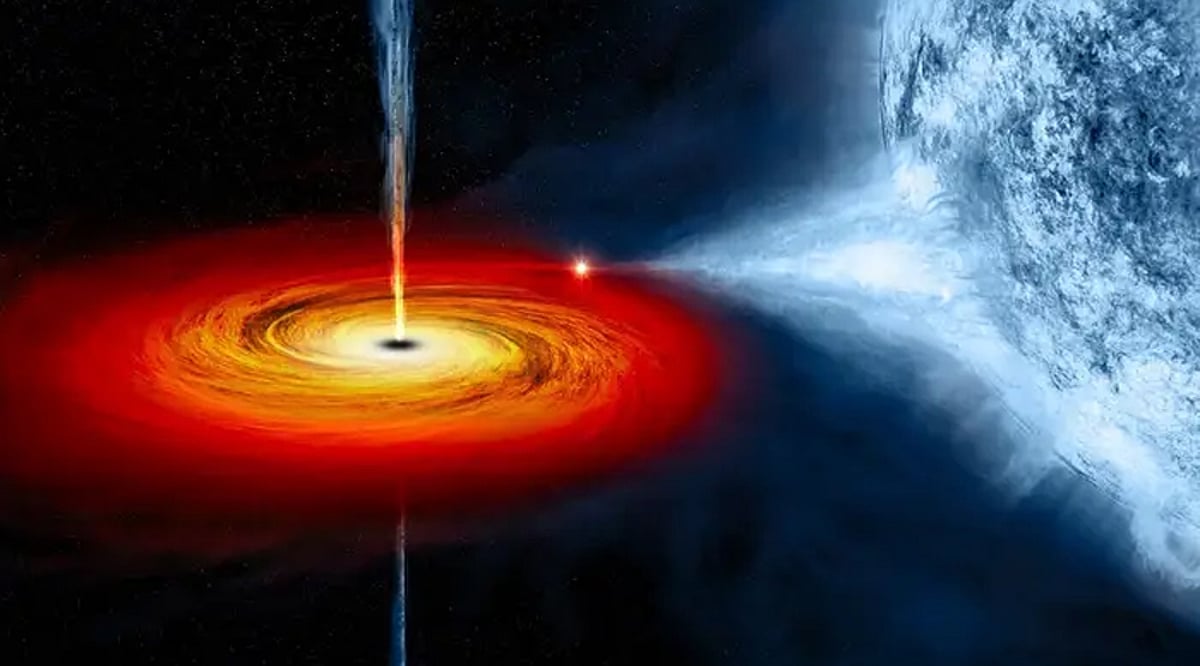
    Black holes are among the most enigmatic entities in the cosmos, defying our conventional understanding of space, time, and gravity. Ongoing scientific research continues to unveil astonishing revelations about these gravitational behemoths, many of which read like science fiction yet are grounded in rigorous observation and theory.

    Not Even Light Can Escape

    A black hole’s gravitational pull is so immense that once anything crosses the event horizon—the point of no return—it can never escape. Even light, the universe’s fastest traveler, becomes permanently trapped. This inherent invisibility means black holes cannot be observed directly. Instead, astronomers detect them by analyzing the telltale effects on surrounding stars, gas clouds, and light patterns distorted by the black hole’s extreme gravity.

    Time Slows Down Near a Black Hole

    Einstein’s theory of general relativity predicts that time dilates in strong gravitational fields. For an observer close to a black hole, time passes much more slowly compared to someone far away. If a person were to venture near a black hole and return, they might find that decades or even centuries have elapsed on Earth—a phenomenon famously explored in the film Interstellar.

    Supermassive Black Holes Lurk at Galactic Centers

    Nearly every large galaxy, including our own Milky Way, harbors a supermassive black hole at its core. These colossal objects can weigh billions of times more than our Sun. Their gravitational influence shapes the orbits of nearby stars and is thought to play a pivotal role in galaxy formation and evolution.

    Black Holes Can Produce Powerful Jets

    Paradoxically, while black holes devour matter, they can also launch colossal jets of high-energy particles. These jets are propelled outward from the region around the black hole at speeds approaching that of light. Some extend across thousands of light-years and are detectable with advanced telescopes, offering insights into the energetic processes at work.

    Black Holes Can Slowly Evaporate

    According to Stephen Hawking’s theory of Hawking radiation, black holes are not eternal. Over unimaginably long timescales, they gradually lose mass and energy, eventually evaporating completely. This process is extraordinarily slow—a black hole with the mass of our Sun would take about 10^67 years to disappear, dwarfing the current age of the universe.

    You Would Be Stretched Like Spaghetti

    The extreme tidal forces near a black hole would subject any infalling object to a dramatic stretching effect known as spaghettification. The gravitational pull on your feet would be far stronger than on your head, causing your body to elongate and thin out as you approach the singularity. This grim fate underscores the violent nature of these cosmic objects.

    We Have Actually Seen One

    In 2019, the Event Horizon Telescope collaboration released the first-ever direct image of a black hole’s shadow, capturing the supermassive black hole at the center of galaxy M87. This historic achievement confirmed decades of theoretical predictions. Then, in 2022, scientists unveiled an image of Sagittarius A*, the black hole at the heart of our Milky Way, marking yet another milestone in observational astronomy.

  • MIT Aeronautics and Astronautics News: Key Breakthroughs and Updates

    MIT Aeronautics and Astronautics News: Key Breakthroughs and Updates

    Explore the latest developments in aeronautical and astronautical engineering from MIT. This roundup covers recent research and innovations, including AI-powered robotics, satellite traffic management, quantum systems, and more.

    • LLMs help robots understand vague instructions and focus on key details – To help robots do chores in places like homes and factories, a new approach from MIT uses one language model to clarify users’ instructions, then another to ignore irrelevant info. June 26, 2026
    • Exploring the societal impacts of AI – During the AI and Society Forum, leading MIT researchers examined critical questions about AI’s influence on employment and democracy. June 23, 2026
    • New chip could help tiny robots traverse complex environments – Researchers combined an efficient algorithm with dedicated hardware to rapidly generate 3D maps for navigation using minimal memory and power. June 23, 2026
    • QS ranks MIT the world’s No. 1 university for 2026-27 – Ranking at the top for the 15th year in a row, the Institute also places first in 12 subject areas. June 17, 2026
    • Could AI tell you where you left your keys? – A new spatial memory system for robots efficiently captures details about the objects they see while exploring their environment. June 17, 2026
    • The tenured engineers of 2026 – Ten faculty members have been granted tenure in five units across MIT’s School of Engineering. June 15, 2026
    • How to create distinguishable states for quantum systems – Researchers establish key insights for reading and writing information for quantum sensing, communication, computing, and control. June 15, 2026
    • New imaging system sees through murky waters – The “Sonar-MASt3R” combines sonar and visual data to create real-time 3D maps, even in cloudy water. June 11, 2026
    • The crucial human component in computing and AI – The MIT Ethics of Computing Research Symposium brought together experts and researchers working at the heart of ethical and social impact in technology. June 5, 2026
    • New propulsion system could make tiny satellites both fast and fuel-efficient – For satellites as small as a briefcase, getting around in space just got a whole lot easier. June 1, 2026
    • New research enables a robot to chart a better course – By rapidly generating a smooth path plan that cuts travel time and avoids obstacles, the open-source “MIGHTY” system could streamline disaster recovery and parcel delivery. May 19, 2026
    • MIT School of Engineering faculty receive awards in winter 2026 – Faculty members and researchers were honored in recognition of their scholarship, service, and overall excellence. May 7, 2026
    • MIT affiliates awarded 2026 Guggenheim Fellowships – Afreen Siddiqi, Kathleen Thelen, and Vinod Vaikuntanathan, along with alumna Kate Manne, are appointed to the 2026 class of “trail-blazing fellows.” May 1, 2026
    • Tackling the housing shortage with robotic microfactories – Reframe Systems, co-founded by Vikas Enti SM ’20, creates microfactories for modular home construction, reducing carbon emissions and costs. April 21, 2026
    • Managing traffic in space – Associate Professor Richard Linares is helping satellites safely navigate in increasingly congested orbits. April 19, 2026

    For more details, visit the MIT News topic page on Aeronautical and astronautical engineering.