
Tag: specialization

  • AI Learning Roadmap: From Beginner to Advanced Skills in Four Stages

    AI Learning Roadmap: From Beginner to Advanced Skills in Four Stages

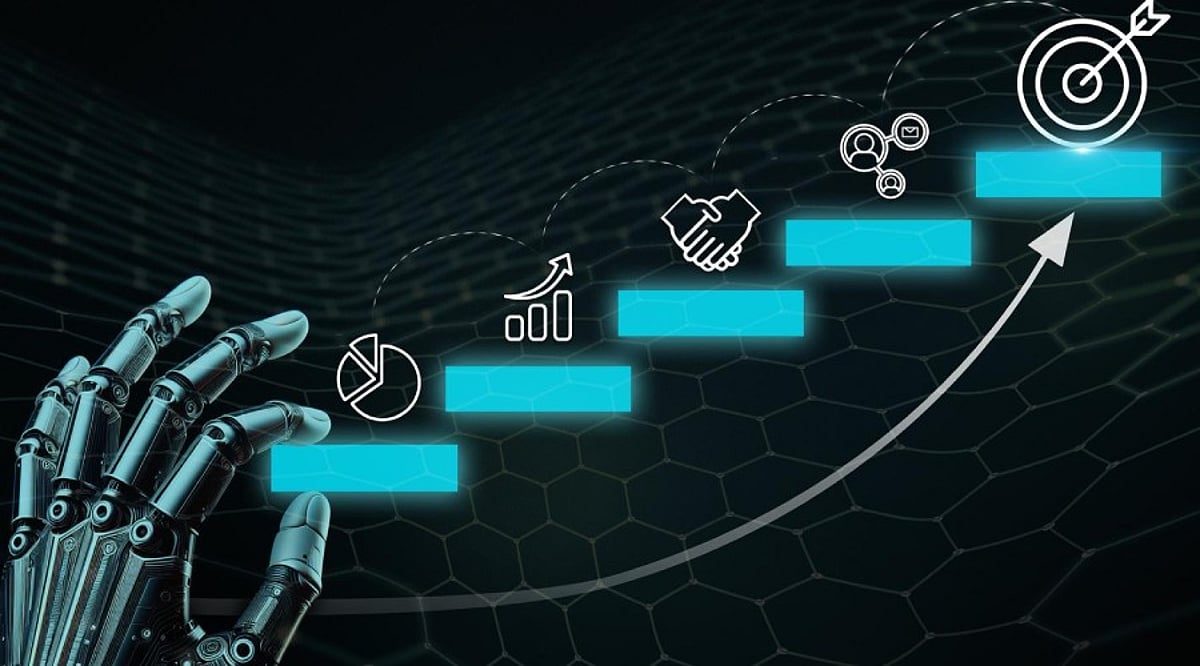
    An AI learning roadmap is a staged path that moves learners from basic literacy to advanced specialization. Rather than a random collection of courses, it provides a sequence where each level builds on the previous one. With AI skills increasingly demanded in entry-level roles, following the right progression is more important than simply accumulating knowledge.

    The Four Stages of an AI Learning Roadmap

    Stage 1: Building AI Literacy (Weeks 1–4)

    This foundation stage covers what large language models do, why they hallucinate, the difference between a model and an application built on it, and basic data and AI ethics. Employers value the ability to choose the right AI tool and verify its output over deep technical expertise. Free resources like Google’s AI Essentials, Anthropic’s documentation, and Andrew Ng’s introductory courses are excellent starting points. The goal is to be able to explain in plain terms what a model does and where its output needs a second check.

    Stage 2: Applying AI in Real Workflows (Months 2–4)

    Once the basics are set, hands-on use begins. Prompt engineering is part of this stage, but the real skill is workflow design: breaking tasks into steps, providing the right context, checking output, and automating repetitive parts. Building a pipeline that pulls data, summarizes it with AI, and flags anomalies for review is a practical achievement. A few finished workflows carry more weight than a certificate.

    Stage 3: Moving Into AI Engineering (Months 4–10)

    This is where technical depth starts. Python and SQL come first, then statistics, classical machine learning, neural networks, embeddings, and finally retrieval-augmented generation (RAG) and LLM-based applications. Each step supports the next. Learners should become comfortable with a major deep-learning framework like PyTorch or TensorFlow. Fast.ai’s practical deep learning course, DeepLearning.AI specializations, and Kaggle competitions provide strong open resources and a public portfolio.

    Stage 4: Choosing an Area of Specialization (Year 1 and Beyond)

    The field is too wide for anyone to cover all of it. This stage focuses on picking a problem to master, such as MLOps, AI security, multimodal systems, or agentic AI. Stanford’s 2026 Index shows agentic AI mentions in U.S. job postings grew over 280% in one year. Specialization turns general fluency into a defensible skill set. Advanced ability is measured by the complexity of problems solved, not the number of frameworks known.

    Why Sequence Matters

    The biggest risk in learning AI is not falling behind but learning the wrong things in the wrong order. Skipping stages explains why some self-taught learners can describe transformers but cannot ship a working chatbot. A roadmap ensures that each level builds a foundation for the next, turning scattered knowledge into practical, demonstrable skills.

    Final Thought

    The roadmap itself will shift as AI capabilities evolve—agentic AI barely existed as a hiring category two years ago. What stays fixed is the order: literacy, application, engineering, specialization. Learners who follow that sequence build something they can point to and explain, not just a list of finished courses.

  • Multi-Agent Systems: Enhancing AI Speed, Accuracy, and Scalability

    Multi-Agent Systems: Enhancing AI Speed, Accuracy, and Scalability

    Artificial intelligence has transformed how we solve problems, create content, analyze data, and automate workflows. As AI evolves, tasks grow increasingly complex. A single AI agent can handle many duties, but it often struggles when a job demands diverse skills, careful planning, or simultaneous steps. This challenge has given rise to multi-agent systems—a setup where multiple AI agents collaborate, each with a specific role, to achieve superior performance.

    How Multi-Agent Systems Work

    A multi-agent system breaks a large task into smaller, manageable pieces. An orchestrator agent receives the initial request and decides the workflow. Then, specialized agents take over based on their strengths: a planner outlines the strategy, a researcher gathers data, a tool agent interacts with software or databases, a reviewer checks for errors, and a final agent compiles the response. This division of labor makes the entire process more organized and reliable.

    Better Results Through Specialization

    Specialization is a key advantage. Instead of burdening one agent with everything, each agent focuses on a single objective. For example, a coding agent writes code while another inspects it for bugs. A research agent finds facts while a verifier confirms their accuracy. This clear separation improves quality because every agent performs tasks aligned with its design.

    Faster Performance with Parallel Execution

    Multi-agent systems excel at speed by running tasks in parallel. While a single agent processes sequentially, multiple agents can simultaneously gather data, analyze it, and produce reports. This concurrency dramatically reduces completion times, especially for large-scale operations in software development, research, and enterprise projects.

    Higher Accuracy Through Verification

    Accuracy is a top priority. Multi-agent systems add a verification layer: one agent reviews another’s work. For instance, an agent drafts a report, then a reviewer checks facts, calculations, and references. Errors are flagged before finalization, cutting down on misinformation and boosting trust in the output.

    Research Backing Multi-Agent Systems

    Recent Google research examined 180 different multi-agent designs. The study found these systems perform best when tasks split into independent parts. Researchers also developed prediction models to identify the optimal agent structure for various jobs. Fields like software development, customer support, enterprise automation, and data analysis benefit greatly from this approach.

    More Agents ≠ Better Performance

    Adding more agents doesn’t automatically improve results. Some complex multi-agent systems can be ten times more expensive than a strong single-agent solution while yielding weaker outcomes. Poor coordination leads to delays, redundant work, and excessive communication. Experts emphasize careful design over sheer quantity—a small, well-organized team of specialized agents often outperforms a large, uncoordinated group.

    Why Real-Time Information Matters

    Modern businesses operate in fast-changing environments. Multi-agent systems perform better when all agents access the latest data. Event-driven architectures allow agents to share current information, reducing conflicting decisions and enabling quicker responses to changes while maintaining consistency.

    Enterprise Improvements

    Companies now build multi-agent systems for business operations. Recent enterprise frameworks achieve up to 4.5 times higher throughput without major resource increases, using smaller models for specific tasks. This efficiency lets organizations process larger workloads cost-effectively.

    Common Business Applications

    • Software Development: Agents handle planning, coding, testing, debugging, and documentation, improving quality and speed.
    • Research: One agent searches, another summarizes, a third verifies references, and a fourth prepares the final report, reducing errors.
    • Customer Support: Specialized agents classify requests, search knowledge bases, verify policies, draft responses, and review replies, boosting consistency and satisfaction.
    • Business Automation: Multi-agent systems manage financial analysis, supply chain operations, compliance checks, and scheduling.

    Current Challenges

    Despite benefits, multi-agent systems introduce infrastructure costs and complexity. Communication between agents requires careful management to avoid duplication or conflicting decisions. Debugging becomes harder due to multiple interactions. Companies need robust monitoring, clear governance, and reliable coordination to maintain high performance.

    Final Thoughts

    Multi-agent systems represent a significant advancement in AI. Instead of relying on a single agent, they leverage the strengths of many to handle complex tasks more efficiently. They improve speed, accuracy, scalability, and reliability across diverse fields. However, success depends on thoughtful design—not just the number of agents. A well-structured team of specialized agents consistently outperforms general-purpose or poorly designed systems.

    Frequently Asked Questions

    1. What is a multi-agent system? A group of AI agents collaborating, each handling a specific task toward a common goal.
    2. Why are they better than a single AI agent? They boost speed, accuracy, and efficiency by dividing complex work among specialized agents.
    3. Where are they commonly used? In software development, research, customer service, business automation, financial analysis, and supply chain management.
    4. Do more agents always improve performance? No. Well-designed systems outperform large, poorly coordinated groups.
    5. What is the biggest advantage? The ability to solve complex problems faster and more accurately through collaboration between specialized agents.