
Tag: STEM Education

  • Top Classroom Simulation Activities by Subject: Boost Engagement and Real-World Learning

    Top Classroom Simulation Activities by Subject: Boost Engagement and Real-World Learning

    Classroom simulations transform passive students into active decision-makers. They negotiate, defend positions, and solve problems under constraints—changing the energy of the room. The challenge is finding simulations that deliver on that promise, not just look good in a lesson plan. Below are some of the strongest classroom simulation activities, organized by subject, each giving students a real job to do.

    Mission.io – Full-Class Collaborative Simulations (All Grade Levels)

    Mission.io brings the whole class into shared problem-solving, improving engagement and retention. Instead of a few students carrying the experience, no one sits on the sidelines. Teachers select from 100+ standards-aligned Missions covering science, math, language arts, and more. A simple session code launches the entire class into the experience together—no prep, no cleanup, and it runs on any internet-connected device.

    Missions include scenarios like applying coordinate graphing to redirect an asteroid or using environmental science standards to clean up a contaminated water supply. The scenario is fictional, but the skills are real. Mission.io tracks six dimensions: Knowledge, Application, Initiative, Collaboration, Critical Thinking, and Resilience. It works for grades K–8, scaling across grade levels without needing adaptation.

    Financial Literacy and Economics

    The Classroom Economy

    Students are assigned daily jobs, earn mock currency, and pay “rent” for their desk space. Some lose money if they skip responsibilities, creating real economic stakes. Teachers can introduce taxes, loans, or charitable giving. The activity culminates in a reflection on financial decisions, teaching budgeting, scarcity, and opportunity cost.

    The Market Exchange

    The class becomes a live trading floor. The teacher introduces a scarcity event mid-session, and prices shift dramatically. Students argue prices with genuine urgency. At the end, the teacher presents new market conditions, helping students understand supply, demand, and price elasticity while building negotiation skills.

    The Checkbook Project

    Students receive a fictional monthly income and a list of real-world expenses. They track every transaction in a physical checkbook and balance it at the end of each “month.” Unexpected costs like a car repair force students to make hard choices. This project teaches financial risk anticipation and problem-solving, often leading to honest discussions about money management.

    History and Social Studies

    Mock Trial for Critical Thinking

    The classroom becomes a courtroom. Students take on roles as attorneys, witnesses, jury members, and judges to argue a historical case (e.g., trial of Socrates, a Reconstruction-era case). Preparation involves reading primary sources and organizing evidence, developing historical thinking, public speaking, and collaboration. The simulation fosters empathy and understanding of judicial processes.

    Model United Nations

    Students represent countries, research issues, draft resolutions, negotiate, and debate global topics. The structure builds critical thinking as students defend positions not necessarily their own. The simulation can be adapted to any unit—environmental disaster, refugee crisis, trade conflict—and teaches research, negotiation, and conflict resolution.

    The Explorer’s Route

    Students become historical navigators or explorers, plotting trade routes, managing resources, and making decisions under tight constraints. The activity pairs well with units on early global trade or colonization, surfacing ethical dimensions. It promotes experiential learning as students make decisions under pressure and reflect on outcomes.

    STEM and Science

    Human Molecular Builders

    Students physically arrange themselves as protons, neutrons, or electrons to form atomic structures and chemical bonds. When the teacher calls out a compound, students negotiate who goes where. This reinforces abstract concepts through movement and collaboration, helping students understand molecular geometry and bonding types.

    Cell Component Walkthrough

    The entire classroom becomes a cell. Different areas represent organelles, and students physically act out processes like transcription, translation, and energy production. This spatial activity makes the geography of the cell intuitive, fostering deeper understanding of cellular processes and interdependence.

    Digital Physics Labs with Digital Tools

    Platforms like the Smithsonian Science Education Center provide interactive simulations for when physical equipment is limited. A kinetic energy rollercoaster simulation lets students adjust variables like height and mass, observing changes in speed and energy transfer. The speed of iteration changes how students think about hypothesis testing, and digital tools support differentiated instruction and remote learning.

    A Note on What Makes These Simulations Effective

    The simulations on this list work because they create meaningful engagement, not just movement. In the Market Exchange, the student isn’t acting—they’re trying to get the best deal. In Mock Trial, they’re trying to win. That shift from performance to problem-solving is where learning happens. The true value comes in the debriefing phase, where teachers connect decisions back to course objectives and extract the biggest lessons.

  • Elephant Robotics Debuts All-in-One Robotics Kits to Transform STEM Learning in the Americas

    Elephant Robotics Debuts All-in-One Robotics Kits to Transform STEM Learning in the Americas

    STEM education has seen explosive growth as demand for practical engineering skills and artificial intelligence literacy skyrockets. Yet schools, universities, and research labs have long struggled to assemble functional robotics environments, often spending weeks integrating disparate hardware and software from multiple vendors. Elephant Robotics is tackling this head-on with a new line of integrated educational robotics solutions that simplify deployment, reduce technical barriers, and accelerate hands-on learning across the Americas.

    Compound Robot Logistics Solution for Smart Logistics and Robotics Education

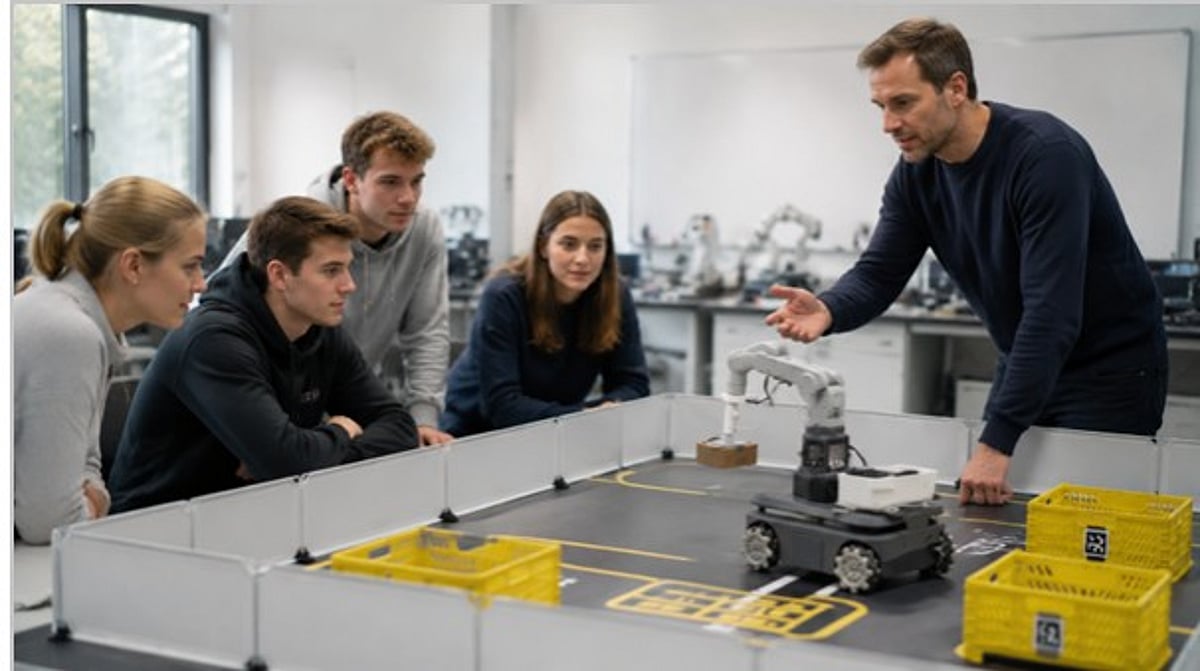
    The company’s Compound Robot Logistics Solution is a fully integrated training platform that combines hardware and software to teach robotics, automation, and intelligent logistics. Built around the 6-DOF collaborative robotic arm mechArm 270 and the mobile robot platform myAGV Jetson Nano, the system simulates real-world warehouse and production workflows. It covers mobile manipulation, material handling, path planning, and multi-component coordination. With one-click startup and visual demonstrations, instructors can launch lessons immediately, and students interact directly with the system. The solution includes a complete curriculum and lab manuals on robotic arm control, mobile robot navigation, machine vision, and system-level automation. Institutions can customize courses and build scenario-based applications for research or industry needs.

    Portable Artificial Intelligence Educational Workstation

    To lower the barrier to AI education, Elephant Robotics developed the Portable Artificial Intelligence Educational Workstation—a compact, suitcase-style system that deploys quickly in classrooms, labs, workshops, or exhibitions. At its core is the mechArm 270 with a modular quick-plug architecture, integrating machine vision, sensor interaction, and motion control. Five built-in vision algorithms let students explore object recognition, visual positioning, and automated tasks. A structured 15-week curriculum with tutorials, labs, and projects helps learners build skills in machine vision, sensor integration, and collaborative robotics. The workstation bridges theory and real-world engineering.

    Advanced Compound Robot Solutions for Research

    Beyond education, Elephant Robotics offers advanced compound robots for scientific research and high-level development. Based on the omnidirectional myAGV Pro chassis and myCobot Pro Series with harmonic drive joints, these platforms are equipped with precision LiDAR and cameras for perception-driven manipulation and autonomous navigation. Fully open interfaces support integration with major AI frameworks, machine learning models, reinforcement learning systems, and simulation environments. Research teams and tech companies have already adopted these systems for work in autonomous systems, embodied intelligence, and intelligent manufacturing.

    Expanding Access Across the Americas

    Elephant Robotics also offers a wide range of platforms for makers, educators, and developers, including the myPalletizer and myCobot series, myArm embodied intelligence robots, and the dual-arm semi-humanoid myBuddy. These products support everything from DIY projects to advanced research, creating an accessible robotics ecosystem tailored to local educational and research needs. By removing integration hurdles, the company aims to accelerate STEM talent development across the Americas.

    For more information, visit americas.elephantrobotics.com.

  • MIT Mechanical Engineering Department News: Pioneering Research, Rankings, and Innovations in 2026

    MIT Mechanical Engineering Department News: Pioneering Research, Rankings, and Innovations in 2026

    MIT Mechanical Engineering: A Hub of Innovation

    MIT’s Department of Mechanical Engineering continues to be a global leader in engineering education and research. In 2026, the Institute once again topped the QS World University Rankings as the No. 1 university, marking its 15th consecutive year at the pinnacle. The department itself advanced breakthroughs in biomedicine, manufacturing, climate technology, and student-led initiatives.

    Top Stories from MIT Mechanical Engineering

    QS Ranks MIT World’s No. 1 University for 2026-27

    For the 15th year in a row, MIT secured the top spot in the QS World University Rankings, also placing first in 12 subject areas. The ranking reflects the Institute’s sustained excellence across disciplines.

    MIT’s Initiative for New Manufacturing Builds Momentum

    In its first year, the Initiative for New Manufacturing (INM) has accelerated research, workforce development, and industry engagement to bring new manufacturing technologies to real-world deployment.

    The Tenured Engineers of 2026

    Ten faculty members across MIT’s School of Engineering received tenure in 2026, including several from the Department of Mechanical Engineering, highlighting the strength of the academic community.

    Ingestible Sensor Measures Temperature Inside the Body

    MIT engineers developed a tiny ingestible sensor that can continuously monitor body temperature from inside the gastrointestinal tract, offering a noninvasive way to track patients at risk of hypothermia.

    Drug Delivery Directly to the Esophagus

    A new gel-like drug formulation coats the esophageal lining, enabling targeted treatment for inflammatory conditions affecting the esophagus. This innovation could improve patient outcomes and reduce side effects.

    Hertz Foundation Fellowships Awarded to MIT Affiliates

    Several MIT affiliates received 2026 Hertz Foundation Fellowships, supporting doctoral students tackling pressing challenges in science and technology.

    Innovative Projects to Combat Extreme Heat

    With seed funding from MIT’s Climate Project, researchers are exploring low-cost personal cooling and emissions-free air conditioning as part of broader efforts to address extreme heat.

    Novel Carbon Capture Methods

    MIT researchers developed an efficient, flexible alternative to conventional carbon capture, offering a promising pathway to reduce atmospheric CO₂.

    Ambassadors of STEM: Promoting Hands-On Education

    A new student club for FIRST Robotics alumni aims to enhance K-12 STEM education through hands-on activities and mentorship.

    Ultrasound-Based Pacemaker Steadies the Heart Noninvasively

    Engineers designed a pacemaker that uses ultrasound to stimulate the heart without surgery, potentially replacing traditional implants.

    Eleven from MIT Accept 2026 Fulbright Awards

    Over half of MIT’s Fulbright applicants won awards this year, with students and alumni embarking on research and teaching projects abroad in 2026-27.

    Bridging Human Movement and Digital Technology

    MIT.nano’s Immersion Lab collaborated with Emerson College to advance virtual production, merging real human motion with digital tools.

    MIT Affiliates Elected to National Academy of Sciences for 2026

    Six MIT faculty and ten additional alumni were recognized by the National Academy of Sciences for their contributions to natural and social sciences.

    Building ‘Hardcore’ Advanced Machines

    In the course 2.72/2.270 (Elements of Mechanical Design), students learn that “if it doesn’t break the laws of physics, it’s possible; you just have to figure out how to engineer it.”

    Measuring the ‘Klein’ – A New Unit in Honor of an MIT Alumnus

    In a playful nod to the smoot, MIT researchers introduced the “klein” to honor Martin Klein ’62, renaming a section of the Charles River bridge the “Shortfellow Bridge.”

    For more details, visit the MIT Mechanical Engineering News page.