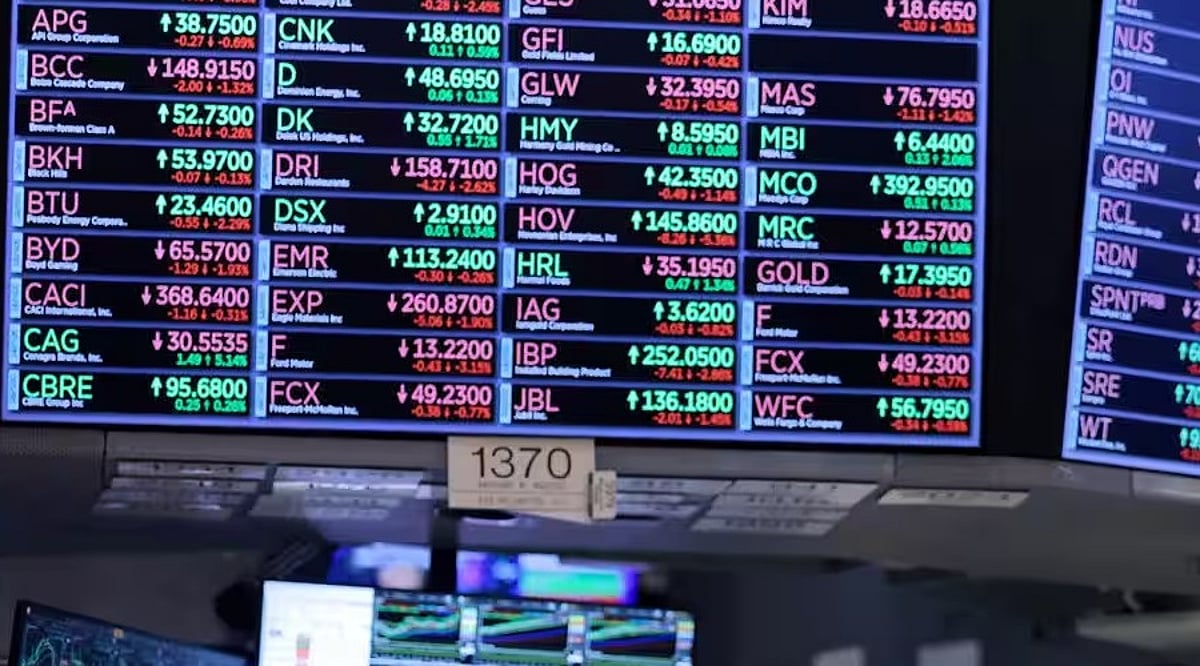
US stock futures declined on Wednesday as Brent crude oil prices climbed above $100 per barrel for the first time since July, reigniting concerns about inflation ahead of key economic data releases. Investors are closely monitoring rising oil prices, elevated Treasury yields, and the Federal Reserve’s upcoming policy decision.
Dow Jones Industrial Average futures fell approximately 331 points, or 0.6%, while S&P 500 futures dropped 0.4%. NASDAQ-100 futures also declined 0.5%. The losses followed a weak session on Tuesday, when the Dow dropped 1.2%, its largest one-day decline in nearly three weeks. The S&P 500 fell 0.6%, and the NASDAQ Composite lost 0.3%.
Brent crude rose more than 2%, briefly surpassing $100 per barrel. The surge was driven by escalating tensions between the United States and Iran, which raised worries about energy supplies from the Middle East. Reports of attacks involving oil tankers and military assets heightened concerns about shipping through the Strait of Hormuz.
Kara Murphy, chief investment officer at Kestra Investment Management, described the market move as “a little bit of a speed bump.” She noted that with fewer earnings reports to follow, investors are focusing more on macroeconomic risks.
Treasury yields also rose, with the 10-year US Treasury note briefly exceeding 4.8% on Tuesday. Higher yields can pressure stock valuations by making government bonds more attractive relative to equities.
Investors are now preparing for two critical inflation reports: the Producer Price Index on Thursday and the Consumer Price Index on Friday. These data points will help shape expectations ahead of the Federal Reserve’s September policy meeting. Market pricing currently implies about a 60% probability of a 25-basis-point rate increase. A stronger-than-expected inflation reading could boost those expectations, while a softer reading might support holding rates steady.
Fed Chair Kevin Warsh and other policymakers have continued to emphasize inflation in their recent communications, keeping oil prices and inflation data at the center of trader attention.
Global markets also reflected the cautious mood. European stocks traded lower, with the Stoxx 600 falling 0.7%. Germany’s DAX and France’s CAC 40 declined, while Italy’s FTSE MIB recorded a steeper drop. The UK’s FTSE 100 also moved lower. In Asia, results were mixed: Japan’s Nikkei 225 closed 0.19% lower, South Korea’s Kospi gained 1.4%, Australia’s S&P/ASX 200 fell 0.11%, and China’s CSI 300 rose 0.3%.
The Cboe Volatility Index (VIX) remained near 15, below its long-term median of 17.6, suggesting that while near-term volatility is low, traders face several risk events in the coming weeks, including inflation data, the Federal Reserve meeting, and further developments in the US-Iran conflict.