Tag: talent acquisition

  • AI in Hiring: How Automated Tools Are Reshaping Talent Acquisition in 2026

    AI in Hiring: How Automated Tools Are Reshaping Talent Acquisition in 2026

    AI recruitment tools are transforming the hiring landscape in 2026, helping companies automate significant portions of the recruitment process. From sourcing candidates and screening resumes to scheduling interviews and summarizing conversations, these technologies reduce repetitive administrative work, allowing recruiters to focus on top candidates and final hiring decisions.

    AI-Powered Candidate Sourcing

    AI-driven sourcing tools search talent databases, job platforms, and professional networks to identify potential candidates. Platforms such as SeekOut, hireEZ, LinkedIn Recruiter, and Beamery excel at uncovering passive talent and enabling recruiters to create personalized outreach at scale.

    Automated Resume Screening

    AI screening systems convert resumes into structured candidate profiles by extracting skills, experience, education, and work history. Tools like Eightfold AI use skills-based matching to connect candidates with suitable roles, moving beyond reliance on exact job titles or keywords.

    Chatbots for Candidate Communication

    Recruitment chatbots handle the first stage of candidate interaction. Platforms such as Paradox and Humanly answer common questions, collect basic information, send updates, and manage high-volume screening. AI also coordinates interview schedules, eliminating lengthy email exchanges.

    AI in Interviews and Assessments

    AI is redefining interviews and candidate assessments. Tools like HireVue conduct structured interviews, transcribe responses, and generate summaries. However, companies should avoid using facial expressions, voice tone, or body language to judge personality, honesty, or competence, as these methods can introduce bias.

    Recruitment Analytics and Dashboards

    Recruitment dashboards help organizations track metrics such as time-to-hire, candidate drop-off rates, sourcing channels, and pipeline performance. AI can also rediscover past candidates and identify skills gaps, enabling recruiters to refine workflows and reduce administrative overhead.

    The Importance of Human Oversight

    While AI accelerates hiring, human oversight remains essential. Companies should use job-related criteria, test systems for bias, protect candidate data, explain AI usage, and provide applicants with a way to request human review. AI should assist recruiters, not become an unaccountable hiring gatekeeper.

  • Why Skills-Based Hiring Claims Fall Short and How ACHNET Aims to Bridge the Gap

    Why Skills-Based Hiring Claims Fall Short and How ACHNET Aims to Bridge the Gap

    Despite widespread announcements about skills-based hiring, the reality on the ground tells a different story. According to NACE’s Job Outlook 2026 survey, 70% of employers report using skills-based hiring for entry-level roles, up from 65% the year before. TestGorilla’s 2025 research similarly found that 53% of employers had eliminated degree requirements, a sharp increase from 30% in the previous year. Yet when researchers from Harvard Business School and the Burning Glass Institute examined actual hiring outcomes, they discovered that the removal of degree requirements led to fewer than one in 700 hires coming from workers without degrees. The job postings changed, but the hires did not.

    The Policy Changed, but the Hires Did Not

    This gap is the most telling number in talent acquisition today, and it is not simply a matter of insincerity. Employers have genuine incentives to broaden their talent pools. McKinsey has cited research showing that skills are about five times more predictive of job performance than education and more than twice as predictive as work experience. Many organizations genuinely want to widen their candidate pools and place greater emphasis on demonstrated capability. However, they are doing it at the top of the funnel and then reverting at the next step. A job posting goes out without a degree requirement. Applications arrive. Someone sorts them—and the sorting instrument is still a resume, a document organized around where a person studied and which employers they passed through. Screening for skills while reading a credential summary inevitably produces credential-based outcomes.

    The Resume Survives Because Nothing Cheaper Replaced It

    The resume persists because it remains an efficient first source of candidate information. The problem begins when it becomes the primary evidence of capability rather than one input among several. Skills assessment has historically meant building a test, which requires someone to define what the role demands, write items that measure it, and validate that the results predict anything. For a single high-volume role, that investment makes sense. Across a requisition list running to dozens or hundreds of distinct jobs, it does not. So most employers test for a handful of technical positions and read resumes for everything else. The volume problem has since worsened with generative AI tools making applications uniformly polished, stripping the resume of what little discriminating power it retained. Recruiters now spend more time assessing whether a strong-looking application reflects real capability, which pushes them back toward using credentials as a shortcut. When direct evidence of capability is expensive to collect, credentials and prior experience remain convenient screening signals, even when an organization has formally adopted a skills-first policy.

    Replacing the Filter, Not the Wording

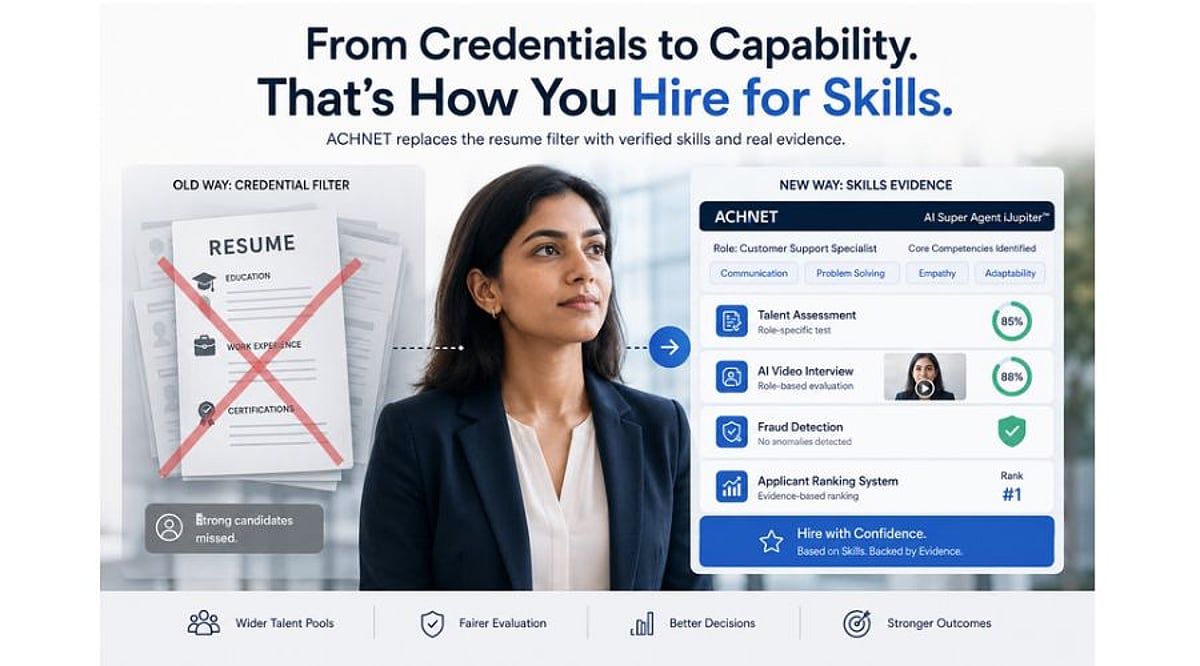
    ACHNET is targeting the mechanism rather than the intent. The platform analyzes the job description to identify role-relevant skills and competencies, which then inform role-specific talent assessments and AI video interview questions. The test is generated from the role rather than pulled from a library, making per-role assessment economical across a long requisition list rather than only for a few positions. As Manouj Gupta, CEO and Founder of ACHNET, puts it: “Dropping a degree requirement from a job posting changes nothing if the next screen is still a resume. You have to replace the filter, not just the wording.”

    Where the evidence lands is the second half. ACHNET’s Applicant Ranking System weighs the resume, the assessment result, and the interview score against the competencies written into the role, and any ranking can be opened up to show what produced it. The candidate report sets out what actually moved someone up or down, rather than just handing over a score. An employer can therefore see whether a candidate advanced on demonstrated competency or on background, which is precisely the audit most skills-first programs cannot currently perform on themselves.

    Scale Determines Usability

    Scale determines whether any of this is usable. ACHNET reports facilitating 150,000 interviews over a three-month period, demonstrating the volume at which structured evaluation can be delivered. These are company figures, and the relevant point is not the speed—it is that structured assessment at that volume is what a skills-first policy requires to be more than a posting change. None of this guarantees a different outcome. An employer can run competency assessments and still promote the familiar resume to the top of the pile, and the Harvard and Burning Glass findings suggest many will. But technology alone will not close the gap between skills-first policy and hiring outcomes. Manager behavior, organizational culture, and selection practices all matter. What better evaluation infrastructure can do is give employers clearer evidence of whether candidates advanced because of demonstrated capability rather than credentials alone. Companies cannot tell whether their skills-first policy is working because their process never produced the evidence either way. Replacing the filter at least makes the answer visible, and a policy nobody can measure is one nobody has to honor.

  • Aerospace Engineer Shortage Worsens as AI Firms Attract Top Graduates with Higher Pay and Faster Growth

    Aerospace Engineer Shortage Worsens as AI Firms Attract Top Graduates with Higher Pay and Faster Growth

    The global aerospace industry is facing an escalating talent crisis as artificial intelligence companies lure skilled engineering graduates with superior salaries, accelerated career progression, and fewer entry barriers. Industry leaders warn that the shortage could hamper aircraft production at a time when demand for new planes is soaring.

    AI Boom Reshapes Engineering Career Choices

    At the recent Farnborough International Airshow, recruiters intensified efforts to attract Generation Z and Generation Alpha, hoping to spark interest in aerospace careers. However, the talent pipeline is narrowing as more graduates gravitate toward AI, software, and other emerging technologies.

    The UK aerospace and defense sector alone faces a shortfall of roughly 10,000 specialized engineers annually. Over half of the nation’s licensed aerospace engineers are over 50, and fewer than 10% are under 30, raising concerns about the industry’s long-term viability. According to trade body ADS, the sector has grown 31% in the past decade, but hiring has not kept pace.

    Retirement Wave Compounds the Problem

    This shortage coincides with record order backlogs at aircraft manufacturers like Boeing and Airbus, which are also preparing for a wave of retirements among experienced engineers. Many companies previously scaled back apprenticeship programs as a cost-saving measure, relying on graduate intake routes that have not produced enough trained professionals to meet demand.

    To make aerospace careers more appealing, firms set up interactive displays, hands-on engineering puzzles, and flying demonstrations at Farnborough, aiming to capture the attention of younger visitors who might otherwise be uncertain about aviation roles.

    Industry Seeks Broader Appeal

    Experts note that aerospace employers are competing fiercely with AI companies, which often offer slightly better compensation and faster career advancement. Even top engineering graduates are increasingly choosing AI firms over traditional aerospace manufacturers.

    Industry leaders believe that developments in sustainable aviation, electric aircraft, and air taxis could make aerospace roles more attractive again. They also advocate for engaging more women and school students early—before university—to consider engineering careers.

    Last year, the UK aerospace, defense, and security sectors contributed £46.8 billion to the economy, underscoring their importance. However, companies warn that without a stronger influx of young engineers, sustaining future growth and innovation will become increasingly difficult.

  • How Data-Driven People Analytics Is Reshaping Global Talent Strategy and Hiring

    How Data-Driven People Analytics Is Reshaping Global Talent Strategy and Hiring

    As corporate planning shifts from subjective management to rigorous measurement, advanced data architecture is driving substantial profit increases and cutting recruitment biases.

    The infrastructure of human resources has undergone a fundamental redesign over the past decade. The traditional reliance on intuitive hiring and subjective management has been replaced by a rigorous, statistical approach to organizational design. Human resources departments now operate as central intelligence hubs, analyzing vast datasets to anticipate workforce trends, measure funnel velocity, and optimize talent allocation. This shift represents a broader recognition that labor is an optimization challenge best managed through quantitative measurement and strategic analysis. Metrics such as cost-per-hire, compensation benchmarking, and organizational footprint analysis are no longer supplementary; they are the primary drivers of corporate planning.

    The necessity of this data-centric approach is clear across major enterprises as they scale their global operations. SHRM research indicates that 71% of HR executives whose organizations use people analytics say it is essential to their HR strategy. Organizations rely on these analytical frameworks to dissect performance patterns, identify operational bottlenecks, and align their human capital with their broader operational objectives. Without a centralized analytics function, executives risk making critical structural decisions based on fragmented or entirely anecdotal information.

    This evolution extends beyond simply counting headcount or tracking administrative functions. The CIPD factsheet defines strategic workforce planning as the process of balancing labor supply against demand, analyzing the current workforce, identifying future needs, and implementing solutions to help organizations accomplish their mission and strategic plan. By evaluating both the quantitative and qualitative aspects of the workforce, companies can preemptively address skills gaps before they disrupt commercial output. The ability to model future workforce dynamics against projected business growth defines the modern standard for talent strategy.

    The financial implications of deploying sophisticated talent acquisition systems are substantial and well-documented. McKinsey research demonstrates that companies using data and advanced analytics to inform their talent decisions realize up to a 30 percent increase in profits through hiring focus alone. These systems enable organizations to evaluate candidate pipelines mathematically, reducing the subjective variables that frequently lead to costly hiring errors. Consequently, human resources teams are heavily investing in robust data architecture.

    From Data to Strategy

    Kwan Chun Clinton Ngan knows this challenge firsthand. A people analytics professional with more than ten years of experience across HR data and workforce intelligence roles in Asia, Europe, and the United States, he has built his career translating complex workforce data into C-suite decisions. At Meta, he served as the sole owner of offer health analytics across a workforce of approximately 75,000 employees and developed the organization’s first standardized metric for evaluating recruiting effectiveness at scale.

    “The true function of a workforce intelligence system goes beyond simple measurement. It provides a reliable, objective foundation for organizational growth, replacing subjective bias with mathematical clarity,” Ngan explains.

    This analytical philosophy is essential when managing data infrastructure at global scale. Operating in an environment of this magnitude requires a departure from manual reporting and disconnected spreadsheets. Instead, it demands automated dashboards and unified metric definitions to ensure that vice presidents and chief executives receive accurate, standardized information for structural and resource allocation decisions.

    Maintaining organizational effectiveness requires an exact understanding of employee sentiment and its relation to long-term operational health. According to Gallup, employee engagement and strengths-based development are two of the strongest predictors of team performance, retention, and profitability.

    “By treating employee sentiment as actionable data, organizations can align their structural policies with the actual realities of their workforce,” Ngan observes.

    When organizations treat sentiment as structured data rather than anecdotal feedback, it becomes a direct input to policy-shaping decisions on everything from remote work arrangements to office infrastructure.

    Automation, Prediction, and Retention

    The speed of data processing and reporting is equally critical to maintaining a competitive human resources strategy. A TMI report notes that effectively implementing people analytics can cut biases and boost recruiting efficiency by 80% while simultaneously lowering attrition by 50%.

    “By automating core analytical workflows, human resources teams can shift their focus from manual data assembly to strategic intervention and high-level evaluation,” Ngan emphasizes.

    This principle guided his approach to revamping major recruiting reports for specific, high-priority populations such as Engineering and Artificial Intelligence teams. Ngan leveraged artificial intelligence and process automation to reduce executive-level reporting time by over 90 percent. This structural overhaul condensed a three-day engineering reporting process into a 45-minute task, and transformed a weekly team allocation report into a single-day operation. By redesigning the end-to-end production process, the reporting mechanisms became vastly more efficient and resistant to human error. The infrastructure behind these gains wasn’t off-the-shelf—Ngan built the underlying data pipelines and dashboards from scratch, including a competitor intelligence mapping framework that became the organization-wide standard for reconciling offer data across People Analytics and Compensation teams, addressing a data integrity problem that remains one of the most persistent structural challenges facing the people analytics industry at scale.

    Anticipating workforce turnover is another area where advanced data models provide a distinct advantage over traditional observation. An MDPI study demonstrated that integrating explainable AI techniques into attrition modeling significantly enhances the ability to make robust, accurate, and actionable employee attrition predictions.

    “Predictive frameworks allow leadership to address retention proactively rather than reactively, giving decision-makers a standardized measure to evaluate organizational risks,” Ngan notes.

    At organizations operating at global scale, this type of ongoing attrition analysis gives leadership the intelligence needed to adjust retention strategies before critical talent is lost to competitors.

    Ultimately, the primary goal of these analytical systems is to identify and secure individuals who will drive outsized value for the business. McKinsey research shows that individuals who are top performers in highly critical roles deliver 800 percent more productivity than average performers in the same role.

    “When you establish empirical data on offer health and funnel activity, you ensure that the organization consistently secures the high-impact talent necessary for technical and specialized functions,” Ngan states.

    Organizations that build this capability into their talent infrastructure gain a measurable edge—not only in securing high-performers, but in retaining them and deploying them where they create the most value.

    The Data-Driven Imperative

    The shift toward people analytics is no longer an emerging trend but the new baseline for competitive workforce management. Organizations that continue to rely on intuition over infrastructure will find themselves at a structural disadvantage, unable to move at the speed modern talent markets demand. Those that invest in the analytical frameworks, automation capabilities, and predictive models outlined here will be better positioned to attract and retain the right people and deploy them more effectively. The future of human resources is not purely human but human and analytical in equal measure, with data serving as the connective tissue between organizational strategy and workforce execution. For enterprises operating at scale, this combination is no longer optional, but the foundation for sustainable growth.