
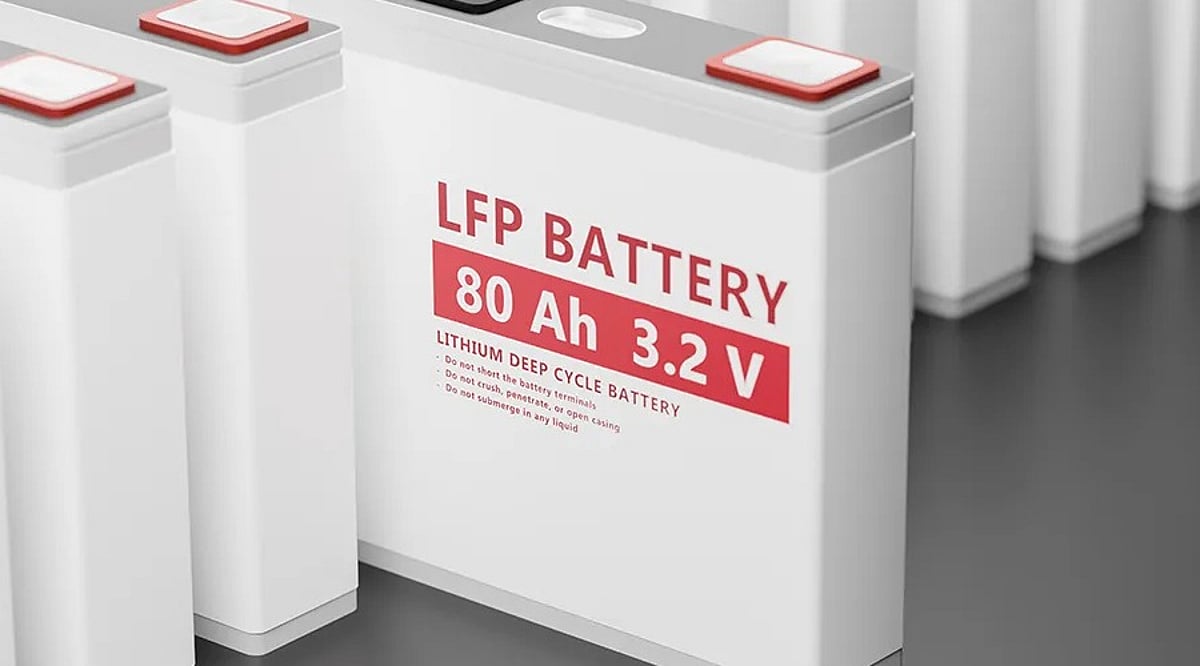
Tag: thermal management

  • LFP vs. NMC: Why India’s Hot Climate Favors Lithium Iron Phosphate EV Batteries

    LFP vs. NMC: Why India’s Hot Climate Favors Lithium Iron Phosphate EV Batteries

    Overview

    India’s high temperatures put electric vehicle batteries under constant stress. Summer heat can exceed 40°C in many regions, and a car parked in direct sunlight can get even hotter. That heat accelerates battery aging, which helps explain why lithium iron phosphate—commonly called LFP—has become a major chemistry in India’s EV market.

    LFP is not a universal solution. It trades energy density for thermal stability, durability, and lower material costs. For many mass-market EVs designed around daily city driving, that trade-off lines up well with Indian conditions.

    Why heat is hard on EV batteries

    Every charge and discharge cycle changes a battery’s internal chemistry slightly. Heat speeds up those changes. That is why EV makers include thermal management systems in battery packs regardless of where the vehicle is sold. In India, those systems often have to work harder because fast charging, stop-and-go traffic, and hot pavement all add strain.

    Battery safety and longevity are not determined by cell chemistry alone. Cooling design, battery management software, charging habits, and pack construction all play a role. Chemistry sets the baseline, but the surrounding systems determine how well a pack performs over time.

    How LFP and NMC compare

    LFP and nickel manganese cobalt, or NMC, approach the same problem from different directions. LFP offers more intrinsic thermal stability and typically costs less, while NMC stores more energy per kilogram.

    Factor LFP NMC
    Thermal stability Stronger built-in margin Depends more on pack-level cooling and controls
    Cycle life Generally strong under repeated cycling Varies by formulation and operating conditions
    Material cost No cobalt or nickel Uses cobalt and nickel
    Energy density Lower Higher
    Best fit City and short-range EVs Long-range and performance EVs

    Thermal stability and battery life

    LFP’s iron-phosphate bond is more resistant to breakdown under heat than the layered oxide structure used in NMC cells. That does not mean NMC cannot work in hot climates. NMC packs operate worldwide in warm regions, with cooling systems and battery management software managing their heat sensitivity.

    The difference is where the safety margin comes from. LFP carries more of that margin inside the chemistry itself. NMC relies more heavily on the systems built around the cells. Heat still degrades LFP over time, but LFP cells often hold up well under repeated heat exposure, especially when paired with effective cooling and sensible charging practices.

    Cost and safety considerations

    LFP cathodes avoid cobalt and nickel entirely. Both metals are expensive and depend on a limited number of global suppliers. Removing them can lower pack costs and reduce exposure to commodity price swings. In India’s price-sensitive EV market, those savings can translate into more affordable vehicles.

    Safety is broader than chemistry. Battery management, cooling design, and charging behavior all share responsibility. LFP’s additional thermal margin can provide extra headroom during demanding use, such as fast charging on a hot day. That margin supports the vehicle’s safety systems; it does not replace them.

    The energy-density trade-off

    LFP stores less energy per kilogram than NMC. A pack built to deliver the same range will generally be larger or heavier. That is why some long-range and high-performance EVs still choose NMC and manage its heat sensitivity with robust cooling systems.

    For city cars built around short daily trips, the trade-off is often easier to accept. Manufacturers can use a somewhat larger pack while gaining LFP’s cost and durability benefits. For vehicles where maximum range, low weight, or compact packaging are priorities, energy density remains a significant design consideration.

    Where LFP fits in India’s EV market

    LFP is not simply a “hot climate battery.” Its value in India comes from a combination of traits: strong thermal behavior, solid cycle life, and lower material costs, balanced against lower range per kilogram. For mass-market EVs used mainly for city commuting and short trips, that combination matches how many Indian owners actually drive.

    LFP is unlikely to replace every chemistry. Range-focused vehicles still have valid reasons to choose NMC. But for a large share of India’s EV lineup, LFP offers a practical way to balance heat resistance, cost, and durability in a single pack.

    Frequently asked questions

    Why is LFP considered suitable for EVs in India?

    LFP offers strong thermal stability, favorable cycle-life characteristics, and lower material costs. Those traits make it relevant for EVs operating in India’s hot climate, especially city-focused models.

    Are LFP batteries safer than NMC batteries?

    LFP generally has greater thermal stability and a lower tendency to release oxygen during thermal decomposition. However, EV safety also depends on cell design, battery management, cooling, and charging systems.

    Do LFP batteries degrade in high temperatures?

    Yes. High temperatures can accelerate degradation in LFP cells as well. Proper thermal management, charging practices, and battery design help control the effect.

    What is the main disadvantage of LFP batteries?

    LFP generally has lower energy density than NMC. A comparable range may require a larger or heavier battery pack.

    Can LFP batteries be used in long-range EVs?

    They can, but lower energy density can make them less attractive where maximum range, low weight, or compact battery packaging are key priorities.
  • Why Chip Packages Are the Front Line of AI Hardware’s Thermal Challenge

    Why Chip Packages Are the Front Line of AI Hardware’s Thermal Challenge

    Most discussions about AI hardware focus on the chips themselves: more compute, faster interconnects, and larger models packed onto denser infrastructure. But every one of those gains carries a physical consequence that software alone cannot fix. More compute means more heat, and that heat must escape through an increasingly constrained space.

    AI’s Growing Power Problem Starts Inside the Package

    The International Energy Agency estimates that data centers consumed roughly 415 TWh of electricity in 2024 and could approach 945 TWh by 2030, with AI infrastructure driving much of that growth. Yet the true origin of the thermal challenge is often overlooked. It does not begin at the rack or even at the cold plate. It begins right at the chip package, where dense compute creates intense localized heat.

    As AI accelerators and high-performance processors shrink their footprints, the heat they produce is concentrated into tighter areas. Fans, cold plates, and liquid loops can move heat away from the system, but none of that cooling matters if the heat cannot first leave the chip package cleanly.

    The Critical First Handoff: Small Parts, Big Thermal Impact

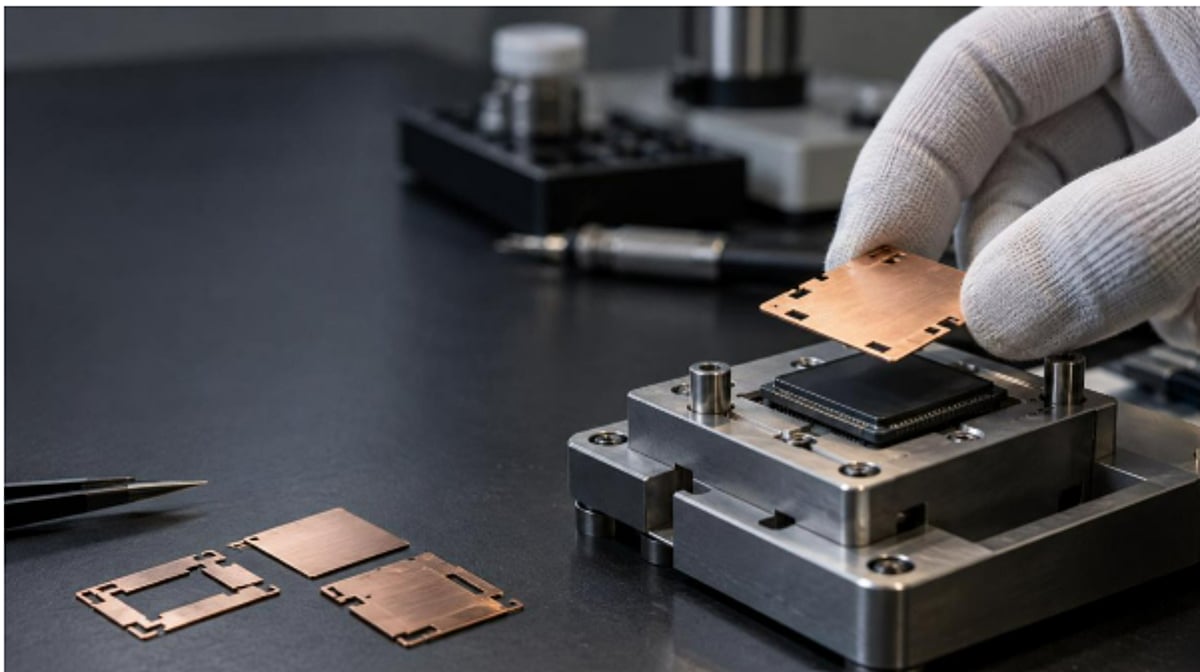
    The first stage of the thermal path is easy to miss because it is physically small. Heat spreaders, thin copper or aluminum layers, shims, package lids, shielding pieces, and other precision metal parts bridge the concentrated heat source to the next cooling stage. These are not the large server heat sinks most people picture. They are thin, drawing-defined components sitting closest to the chip, where cramped space, tight interfaces, and high local heat density turn tiny manufacturing details into major performance factors.

    Intel describes the integrated heat spreader as the part attached to the processor package that provides a mating surface for the thermal solution above it. That handoff is decisive. A thermal part may be nothing more than a thin piece of metal, yet it determines how efficiently heat reaches the next layer of the stack. If it does not fit flat or hold a controlled interface, the entire cooling system above it can be capped before heat ever reaches the cold plate.

    Material choice alone does not guarantee performance. Copper offers excellent thermal conductivity, while aluminum provides lower weight and easier fabrication, but neither metal ensures good thermal transfer by itself. Geometry, flatness, surface condition, and assembly quality determine what the material actually delivers.

    Flatness and Precision Are Thermal Performance

    Thermal performance depends on a controlled interface between the spreader, the thermal interface material, and the cooling layer that follows. Flatness and coplanarity keep gaps small, and small gaps keep thermal resistance low. Thermal interface materials can fill minor surface irregularities, but they cannot rescue poor geometry or an oversized gap. Intel’s own guidance notes that the gap between a spreader and a heat-sink base directly drives thermal resistance, and that the flatness of both surfaces sets that gap.

    For compact AI hardware, this translates into a demanding set of simultaneous requirements:

    • The metal must stay flat through fabrication and assembly, resisting warpage even when thin.
    • Its profile must respect keep-out areas around chips, modules, and boards.
    • Edges must be clean enough to avoid fouling mating surfaces or neighboring components.
    • Fine openings, tabs, locating features, or vent structures may be required.
    • The part must repeat dimension for dimension from prototype through qualification into production.

    A component that looks trivial on a drawing becomes difficult once it has to be thin, flat, feature-dense, and identical part after part.

    Manufacturing for Function, Not Arbitrary Tolerances

    Small deviations may be acceptable on ordinary parts as long as the piece fits. In a thermal assembly, the same deviation can change interface pressure, gap thickness, contact consistency, or the position of adjacent parts. The stakes on a dimension are simply higher when heat has to cross it.

    That does not mean over-specifying every feature. Tightening all dimensions drives up cost and slows production without real benefit. The key is identifying which dimensions affect thermal contact, assembly alignment, and finished-device performance, then controlling those tightly while treating less critical features practically. On a small chip-level thermal part, flatness, profile accuracy, edge condition, and a clean finished surface usually matter more than chasing the tightest possible number on every dimension.

    Matching the Manufacturing Process to the Part

    Large, stable, high-volume heat sinks are often best produced by extrusion, casting, or conventional machining, and those methods remain efficient for standard cooling jobs. But they are not always suitable for thin, custom, feature-dense parts living close to a chip. When a thermal component has a changing layout, fine features, thin material, or a design still moving through prototype revisions, the manufacturing route must fit both the geometry and the production stage.

    This is where precision thermal parts earn their place: thin heat spreaders, thermal shims, fine-featured covers, and custom metal layers built around a specific package rather than a generic heat-sink profile. Making precision heat sink parts with controlled interfaces, thin and flat, is a different task from cutting a finned block. It requires a process chosen to produce the part reliably, inspect it meaningfully, and hold up at the required volume. No single process replaces all others; the part simply has to be matched to the method that can actually make it.

    Design for Manufacture Is Essential in AI Hardware

    The strongest thermal designs bring manufacturing considerations in early. Before a drawing is frozen, the team should know which surfaces must stay flat, which features affect assembly, how thin the material can be, and how the finished part will be inspected. This matters more in AI hardware than almost anywhere else because design cycles are fast and package layouts keep shifting. A part that works for one prototype but cannot be produced the same way at volume is a production risk waiting to surface.

    Getting thermal engineers, package designers, and manufacturers into the same conversation early prevents that risk. It helps the team identify which requirements are truly critical, which can be relaxed, and which process fits the part in hand.

    AI’s Thermal Constraint Is a Manufacturing Constraint

    AI hardware will continue to put more pressure on every part of the thermal path. Data-center infrastructure, liquid cooling, and system-level design all matter, but the path still begins at the chip package, where heat must first cross a small, carefully controlled interface. The parts closest to that interface are thin, quiet, and easy to miss. They are also becoming harder to make and more important to get right.

    As AI chips run hotter and cooling space continues to tighten, the precision metal parts that spread, bridge, shield, and steer heat become a genuine factor in hardware performance. The wall in front of AI is a cooling problem, and underneath it, a manufacturing problem.