
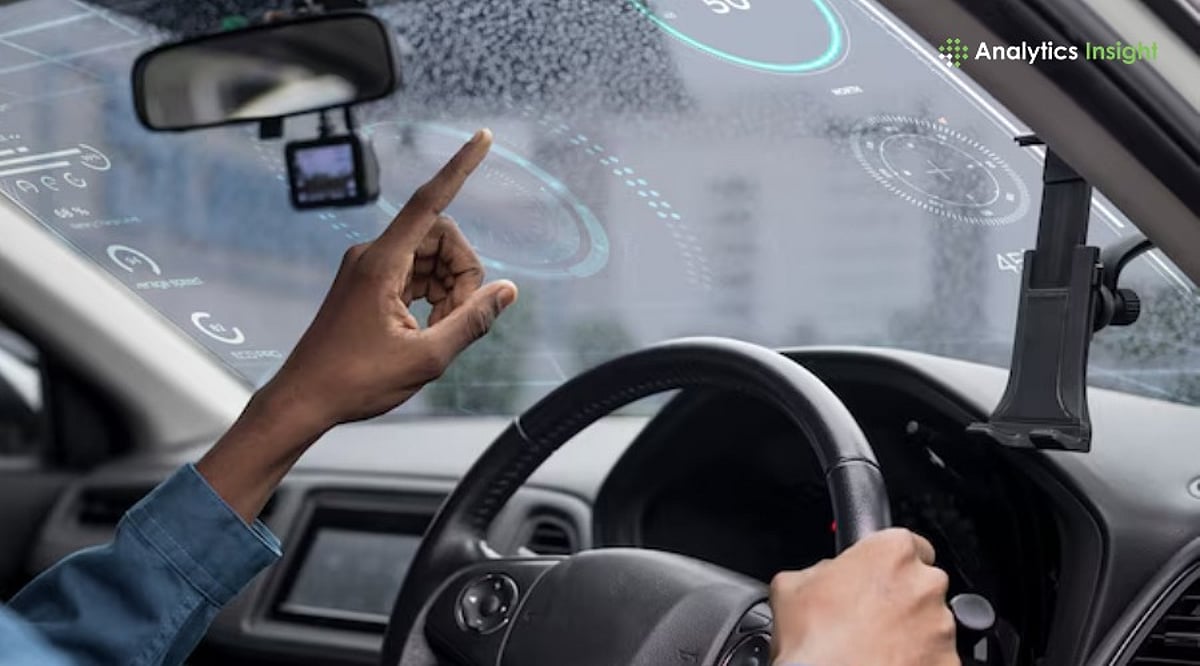
The era of frustrating voice commands in cars is ending. Major automakers are replacing rigid rule-based systems with conversational AI assistants powered by large language models (LLMs). This shift promises to transform vehicles from mere transportation into intelligent digital companions.
The in-car voice assistant market is projected to grow from $3.27 billion in 2026 to $5.49 billion by 2029, at a compound annual growth rate of 13.9%, according to The Business Research Company. This growth is fueled by new capabilities and fierce competition among automakers to secure the best AI partners.
From Rigid Commands to Natural Conversation
Traditional voice assistants required memorized phrases and often failed. Modern LLM-based systems understand context, prioritize results, and handle multi-step requests. For example, a driver can say, “Take me to the nearest coffee shop and text my mom I’ll be late,” then follow up with, “Actually, make it one with outdoor seating,” without repeating context.
This capability depends on a pipeline of technologies: Automatic Speech Recognition (ASR), Natural Language Understanding (NLU), and real-time data from maps, weather, charging-station APIs, and vehicle sensors. For EV owners, this means asking about a nearby fast charger and receiving live availability, pricing, and operating hours in one exchange.
Major Automaker-AI Partnerships Reshaping Dashboards
Automakers are choosing different AI partners:
- General Motors integrates Google’s Gemini into Buick, Chevrolet, Cadillac, and GMC vehicles with “Google built-in,” leveraging its OnStar network. Nearly four million cars in the US are affected.
- Mercedes-Benz incorporates ChatGPT via Microsoft Azure OpenAI Service into its MBUX Voice Assistant, enabling open-ended question answering with Bing search.
- BMW integrates Amazon’s Alexa+ into its Intelligent Personal Assistant, launching with the new iX3 at CES 2026 and expanding to 40 models by 2027.
- Tesla uses xAI’s Grok.
- Stellantis partners with French AI company Mistral.
- Lucid teams up with SoundHound.
Each approach is unique: GM uses its connectivity history to scale Gemini; BMW focuses on continuity across devices; Mercedes emphasizes knowledge depth. No single standard has emerged.
What These Assistants Can Actually Do Behind the Wheel
Beyond trivia, these systems perform context-aware tasks. BMW’s Alexa+ can adjust cabin temperature and find Italian restaurants along a route from a single sentence. Mercedes partners with Liquid AI to run parts of the assistant on-device for low-latency responses. GM envisions a future where drivers ask specific questions about vehicle parts and systems, answered by an assistant fine-tuned on proprietary data. Some automakers layer assistants over driver-assistance functions, allowing voice control of driving modes, diagnostics, and maintenance alerts.
Real Challenges Behind the Conversational Upgrade
LLMs can hallucinate, producing confident but incorrect answers—problematic for navigation or safety. Most systems rely on cloud connectivity, introducing latency and failure in poor signal areas (hence on-device processing experiments). Data privacy concerns have grown, prompting GM to commit to opt-in consent and no data selling. Driver reception is mixed; some worry about accidental activation or unwanted processing of everyday conversations. Automakers emphasize that microphones require explicit wake words or button presses, and core functions work without linking AI accounts.
Where In-Car AI Goes From Here
The current wave is a stepping stone. GM’s Gemini rollout is interim; a proprietary OnStar-trained assistant is planned. Automakers are linking conversational AI to advanced driver-assistance systems, predictive maintenance, and autonomous driving. As competition among Google, OpenAI, Amazon, xAI, and Mistral plays out across dashboards, cars become connected devices in a digital ecosystem. Over-the-air updates will allow continuous improvement, unlike traditional fixed infotainment systems. The next two to three years will reveal whether this leads to safer, more useful driving companions or more sophisticated distractions.