Author: vitorcherulli

  • How Paybis Rose to Become a Leading Crypto Exchange in the US Market

    How Paybis Rose to Become a Leading Crypto Exchange in the US Market

    Navigating the world of digital finance can be challenging, especially for beginners. For crypto enthusiasts in the United States, online exchanges must deliver a strong combination of fast transaction speeds, ease of use, high institutional trust, and deep knowledge of market regulations. Many traditional trading platforms are designed for institutional or professional day traders, featuring complex order books, charting interfaces, and technical jargon that intimidate the average retail consumer.

    Due to this complexity, there has been strong demand for alternative service providers that remove friction while maintaining strong security and transparency. Traders who buy Bitcoin on Paybis appreciate how the platform connects conventional fiat payment systems with the new digital economy. By simplifying the process and focusing on user-friendliness, Paybis has steadily increased its presence in the highly competitive US market, becoming a favorite for beginners and experienced users alike who value efficiency above all.

    Paybis Overview

    Paybis is a cryptocurrency exchange and digital wallet platform designed to make buying, selling, and exchanging digital assets as easy as possible. Instead of complicating things with margin trading mechanisms or liquidity pools, the platform focuses on direct, simple fiat-to-crypto transactions. According to Paybis, its service is available in over 180 countries, indicating extensive global reach.

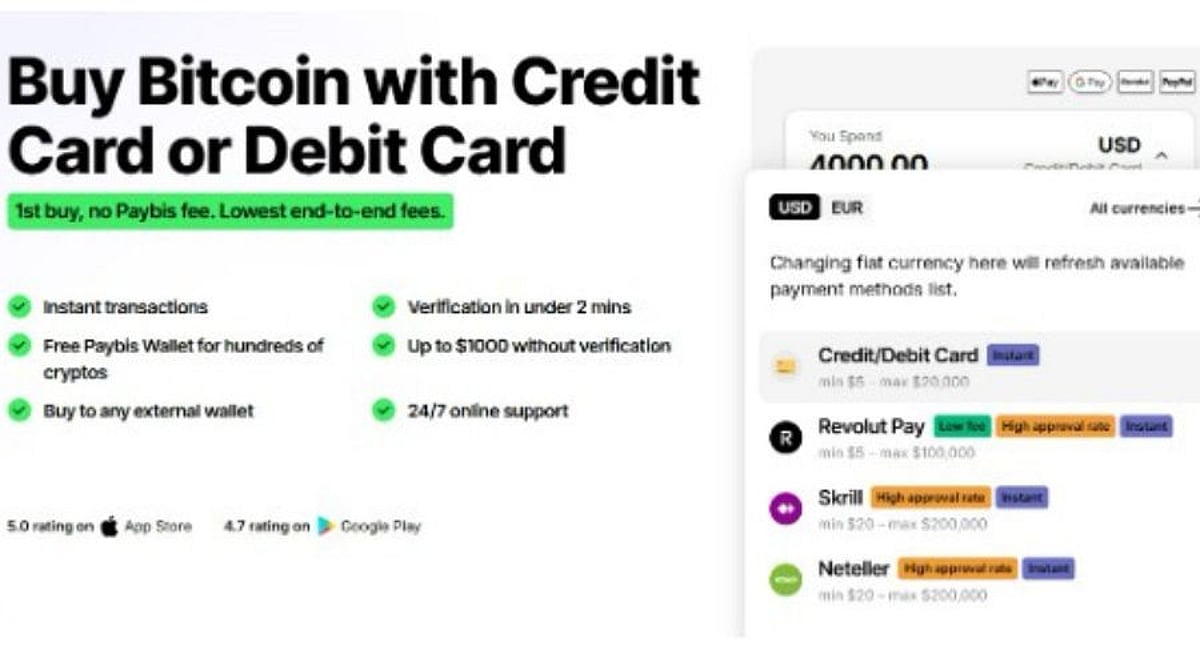
    The platform’s user experience design is built on minimizing traditional onboarding friction. This is evident in its quick user verification system, multiple payment options, and clear, visible pricing with no hidden fees. By allowing users to pay through familiar methods like credit or debit cards, Paybis mirrors a standard e-commerce checkout, lowering technical barriers often associated with blockchain.

    Paybis Regulatory Status

    Paybis operates in compliance with regulations across multiple jurisdictions, ensuring transparency and peace of mind for its growing user base.

    US Compliance Through FinCEN Registration

    Paybis operates in the United States through its official registration as a Money Services Business (MSB) with the Financial Crimes Enforcement Network (FinCEN). The company holds licenses to legally operate in 48 US states, demonstrating its commitment to navigating complex state-level regulations. This regulatory registration serves as a powerful trust signal for American users comparing crypto platforms, as it ensures the exchange follows strict Anti-Money Laundering (AML) and Combating the Financing of Terrorism (CFT) protocols. An MSB registration with FinCEN means the business complies with federal reporting and oversight systems.

    New MiCA and PSD2 Licenses in Europe

    Paybis’ EU branch has been officially recognized as a Crypto Asset Service Provider (CASP) under the Markets in Crypto-Assets (MiCA) regulation and has received a new Payment Institution License under the Revised Payment Services Directive (PSD2). By aligning with MiCA—one of the most detailed and strict digital asset laws worldwide—Paybis has opened its internal controls, capital adequacy, and customer protection mechanisms to regulatory scrutiny. The PSD2 Payment Institution license also enables highly integrated, secure, and efficient payment transactions across European countries. For American customers, this global regulatory compliance signals that they are dealing with a regulated crypto service provider that respects cross-border compliance—a key differentiator from less regulated or unregulated crypto services.

    Paybis Benefits for US Users

    Here are some of the key features and real advantages Paybis offers to customers. In addition to these online features, users who want a portable, integrated management solution can use the official Paybis app. The app covers the entire ecosystem—speedy verification, safe storage, and instant card payments—all accessible on mobile devices, allowing users to manage their accounts easily on the go.

    Why Choose Paybis as Your Crypto Exchange?

    Finding the perfect cryptocurrency exchange involves weighing convenience, speed, and a reliable, secure environment. Paybis is an excellent choice for those seeking a faster, simpler, and less troublesome alternative to formal trading desks. Users want to pay instantly with debit and credit cards, check out easily, complete identification verification quickly, see fees clearly, and have a good variety of assets to choose from.

    Supported by 24/7 customer service and a network of worldwide regulatory compliance, Paybis offers a stable, transparent, and reliable platform for managing digital transactions.

    Disclaimer: This article is for informational purposes only and does not constitute financial or investment advice. Cryptocurrency investments carry risk, and you should conduct your own research before making any investment decisions.


  • Vi InstaData: Your Guide to Instant Mobile Data Top-Ups

    Vi InstaData: Your Guide to Instant Mobile Data Top-Ups

    Vi InstaData is a convenient feature that allows eligible Vi users to purchase additional mobile data instantly when their existing balance runs out. Instead of waiting for the next billing cycle or buying a full recharge plan, you can activate extra data quickly and continue using the internet without interruption.

    How Vi InstaData Works

    The feature is designed for simplicity. Through the Vi app or other supported channels, eligible users can request additional data. Once activated, the extra data becomes available almost immediately, enabling seamless browsing, streaming, online meetings, and social media usage.

    Who Can Use Vi InstaData?

    Vi InstaData is available for both prepaid and postpaid customers, depending on their plan and service availability. Access may vary by region and plan type. Users can check their eligibility in the account section of the Vi app before requesting data.

    Why Use Vi InstaData?

    Running out of data unexpectedly can disrupt work, online classes, video calls, or entertainment. Vi InstaData provides a quick solution by offering immediate access to extra internet data without requiring a full recharge plan. It helps you stay connected whenever you need it.

    How to Activate Vi InstaData

    Eligible users can activate Vi InstaData through the Vi mobile app. Navigate to the available data services section, confirm your request, and the additional data will be credited to your account within a short time. The process is quick and user-friendly.

    Things to Check Before Using InstaData

    Before activating, review the available data amount, validity period, charges, and eligibility conditions. Understanding these details helps you choose the right option based on your usage and prevents unexpected billing or service limitations.

    Should You Use Vi InstaData?

    Vi InstaData is a practical choice for users who occasionally run out of mobile data before their plan renews. It provides instant internet access without changing your existing plan, making it useful for emergencies, travel, work requirements, or temporary increases in daily data usage.

  • ImVivo Review: A Deep Dive into the Technology-First Multi-Asset Trading Platform

    ImVivo Review: A Deep Dive into the Technology-First Multi-Asset Trading Platform

    Most platform reviews lead with adjectives. A more useful ImVivo review starts with a harder question: when you strip away the framing, does the technology, the security, and the structure actually stand up? ImVivo describes itself as a home for informed, structured multi-asset trading, and for an analytics-minded reader, the framing only matters if the engineering underneath earns it. What follows works through the stack, the trust signals, and the way the platform is organized.

    Reading the Technology, Not the Tagline

    The engine here is branded “The Edge,” and it is where live pricing, charting, technical indicators, and configurable dashboards converge into one workspace. The number of features isn’t the thing to fixate on. The sharper test is how efficiently a platform turns a noisy stream of market data into a picture a person can act on. On that measure, ImVivo reads as competent rather than gimmicky.

    Reporting is where that shows. Rather than leaving users to assemble their own summaries, the platform produces rolling portfolio breakdowns and performance analytics, with adaptive models tightening the output as conditions change. For a reader who cares about method, that adaptive layer is more interesting than any static indicator, because it means the analysis keeps responding to the market rather than sitting still.

    Orders clear on low-latency infrastructure, and the interface stays coherent across laptop, tablet, and phone—so nothing breaks when a session moves from desk to pocket. None of these pieces is rare in isolation. The part worth noting is the integration, with data, analysis, and reporting living together instead of being welded from separate tools. As individual participation in markets keeps climbing, that consolidation has moved from a nicety to something users simply expect.

    Where Legitimacy Is Won

    For a discerning audience, an honest ImVivo review lives or dies on the trust signals, because that is the part marketing cannot fake for long. On paper, the stack is solid: 256-bit encryption, two-factor authentication, and cold storage, with ongoing monitoring and tightened transaction controls sitting underneath. These are not exotic selling points—they are the defaults a serious operator is expected to build in. The reassuring thing is that ImVivo presents them as defaults rather than dressing them up as innovations. The tiered account model and the steady reporting cadence add a second kind of credibility: transparency. Users can see exactly where they stand rather than being asked to trust a sealed box.

    Structure That Signals Intent

    The asset menu is genuinely wide. Digital assets sit in the same environment as currencies, commodities, public companies, market benchmarks, and store-of-value holdings, which lets a user read several markets side by side rather than in scattered fragments across apps. The account ladder climbs from Bronze to VIP, with education, analyst contact, and monitoring deepening at each step. Help is reachable through several channels, and the deliberate pairing of human guidance with the technology is one of the platform’s more telling design decisions. For readers who treat structure and support as evidence of intent, that combination says as much about seriousness as any single tool on the dashboard.

    Funding sits alongside all of this, and for a legitimacy-minded reader, it is the quiet part that matters most. Deposits and withdrawals are laid out as a defined, repeatable process, and a platform that makes retrieving money as clear as depositing it earns a kind of trust no feature list can substitute for.

    The Verdict

    Weighed on its engineering rather than its language, ImVivo reads as a professional, technology-forward multi-asset platform—not a thin skin stretched over a price chart. The real-time data layer, the security posture, and the tiered structure all point to something designed for users who prize order over noise. The caveats are honest ones: the entry tiers can feel light until you build up, and the fullest conditions live higher on the ladder. Even so, this ImVivo review lands on a favorable read: an environment that holds up to scrutiny rather than one that only sounds good in a pitch deck.

  • Why Modern AAA Games Take Years to Release: The Real Reasons Behind Extended Development Cycles

    Why Modern AAA Games Take Years to Release: The Real Reasons Behind Extended Development Cycles

    AAA games now take significantly longer to develop than they did a decade ago. Players who once saw a new blockbuster every two or three years now wait five years or more. Titles are announced early, then fans spend years craving updates. Better hardware and game engines should accelerate production, yet development timelines continue to lengthen. The reason is straightforward: modern games are far larger, more detailed, and much harder to build.

    Bigger Worlds, Higher Expectations

    Today’s AAA titles are packed with content—vast cities, realistic forests, dynamic weather systems, lifelike character models, and intricate animations. Every feature adds work for artists, programmers, designers, writers, and testers. Development costs have soared; some games now cost hundreds of millions of dollars. When companies invest that much, they cannot afford to rush. Player expectations have also risen. A good-looking game is no longer enough—gamers demand smooth gameplay, intelligent enemies, memorable stories, and near-flawless releases. Bugs that were once overlooked now spark heavy online criticism.

    Sequels face even more pressure. Each new entry must improve on its predecessor with bigger maps, better graphics, stronger narratives, and fresh ideas. Games like Grand Theft Auto VI, The Witcher 4, Marvel’s Wolverine, and The Elder Scrolls VI illustrate the immense pressure developers face. Fans expect these titles to set new standards, and reaching that level takes years.

    Testing and Quality Assurance

    Modern games launch on multiple consoles and PC hardware. Developers must ensure everything works properly before release. Fixing problems early is far better than releasing a bug-ridden game. Comprehensive testing adds months—or even years—to the schedule.

    Can AI Speed Up Development?

    Artificial intelligence has become a valuable tool for game studios. Generative AI can help create early character concepts, enhance animations, generate simple environments, and organize large data sets. It also accelerates code writing for world design and can replay levels thousands of times to find bugs faster than humans. However, AI cannot build a game on its own. It lacks the ability to craft engaging stories, design beautiful worlds, or invent fun gameplay. Human creativity remains irreplaceable. AI will continue to improve and may shave some time off development, but it will not turn a six-year project into a one-year one. Great games still require talented people.

    Why It Matters

    Long development cycles, rising costs, and high stakes make every release critical. Extended waits can kill player excitement, delay revenue for studios, and leave fans frustrated. Yet rushing a game can be even more damaging—several recent launches have shown how a broken release hurts both players and studios. The key is balance: developers need time to finish a game while keeping fans engaged. Technology will evolve, but the best games depend on human ideas. Good stories, memorable characters, and engaging gameplay cannot be rushed. Sometimes a little extra waiting brings a genuinely great game.

  • How Entrepreneur Ankur Warikoo Leverages ChatGPT to Enhance Daily Productivity and Deep Work

    How Entrepreneur Ankur Warikoo Leverages ChatGPT to Enhance Daily Productivity and Deep Work

    Entrepreneur and author Ankur Warikoo has openly shared how he integrates ChatGPT into his daily workflow to boost productivity, sharpen his thinking, and accelerate learning. Rather than using AI as a crutch to complete tasks for him, Warikoo treats it as a collaborative partner that helps him brainstorm ideas, simplify complex topics, and structure his thoughts before taking action. His approach offers a practical blueprint for professionals who want to harness AI without sacrificing critical thinking or creativity.

    Why This Matters

    As artificial intelligence becomes more embedded in professional environments, the conversation has shifted from whether to adopt AI to how to use it effectively. Warikoo’s methodology demonstrates that AI tools can enhance productivity while preserving human judgment and independent decision-making.

    Overcoming the Blank-Page Challenge

    Starting a new task—whether it’s a presentation, newsletter, or business plan—is often the hardest part. Many professionals spend more time figuring out how to begin than actually completing the work. Warikoo uses ChatGPT to break through this initial barrier. He starts with a simple request, explores different angles, and lets the AI inspire him rather than copying its output verbatim. This approach cuts down the time spent staring at a blank page while keeping creative decisions firmly in human hands.

    Simplifying Complex Information

    In fast-moving fields like finance and business, staying informed is essential—but the challenge is often organizing information, not accessing it. Warikoo uses ChatGPT to clarify complicated concepts, make comparisons, and generate concise summaries. This helps him grasp new topics quickly before diving into deeper research, a strategy that is especially valuable for busy professionals juggling multiple responsibilities.

    Building Better Daily Habits

    Warikoo also applies ChatGPT beyond work tasks. For instance, he asked the chatbot which habits could help someone become more successful than most people. The response emphasized practical, everyday routines such as maintaining a steady schedule, exercising regularly, carving out time for deep work, continuous learning, eating well, saving money, reducing distractions, and nurturing personal relationships. While none of these points are revolutionary, turning them into a structured checklist makes them easier to follow. This exercise highlights how AI can organize proven principles into a manageable daily routine.

    The Importance of Deep Work

    One of Warikoo’s key takeaways from using ChatGPT is the emphasis on uninterrupted, focused work. He recommends dedicating two to four hours each day to deep work—free from notifications, meetings, or social media distractions. This aligns with the growing productivity trend that prioritizes concentrated effort over multitasking. For Warikoo, AI serves as a habit reminder for well-known productivity techniques rather than a source of novel methods.

    Accelerated Learning Without Cutting Corners

    Warikoo also leverages ChatGPT for faster learning. Instead of spending hours searching for articles, videos, and reports, he asks the chatbot for a general overview of an unfamiliar topic. Once he has the basics, he continues with in-depth research—but in a more efficient order. This approach saves time while maintaining research quality.

    AI as a Thought Partner, Not a Replacement

    Perhaps the most important aspect of Warikoo’s strategy is viewing AI as a thinking partner rather than a substitute for expertise. ChatGPT can help structure information, generate ideas, and automate repetitive tasks, but judgment, creativity, and decision-making remain human responsibilities. The quality of the output depends heavily on the quality of the questions asked. Warikoo’s core takeaway is that AI delivers the most value when it augments human thought rather than replacing it.

    Frequently Asked Questions

    1. How does Ankur Warikoo use ChatGPT every day? He uses it to brainstorm ideas, simplify complex topics, plan tasks, accelerate learning, and organize his daily workflow.
    2. Does Ankur use ChatGPT to write all his content? No. He uses it for idea generation and structure, but relies on his own knowledge and judgment for final content.
    3. What productivity habit does Ankur highlight the most? He emphasizes deep work, recommending two to four hours of uninterrupted focus daily for high-impact tasks.
    4. Can ChatGPT help professionals improve productivity? Yes, by organizing information, generating ideas, summarizing topics, and reducing repetitive work, it allows professionals to focus on important decisions.
    5. What is Ankur’s biggest takeaway about using AI? He believes AI works best as a thinking partner that supports human creativity and decision-making, not as a replacement for them.
  • BlockDAG’s 95x Opportunity Nears Its End as XRP Holds Strong and Aster Struggles to Recover

    BlockDAG’s 95x Opportunity Nears Its End as XRP Holds Strong and Aster Struggles to Recover

    The cryptocurrency market is caught in a tug-of-war this week, with buyers and sellers competing for control. XRP shows cautious strength near $1.107, while Aster crypto struggles to defend the $0.620 support level. Meanwhile, BlockDAG is surging ahead with a potential 95x return opportunity that is closing in just hours.

    XRP Price Prediction: Bulls Target Key Breakout

    XRP is trading around $1.107 after bouncing off the key $1.070-$1.078 support zone. Bulls are now aiming to break and hold above $1.12, which could pave the way for a move toward $1.184. On-chain data reveals whale wallets accumulated approximately 70 million XRP between July 11 and July 15, while Binance’s XRP reserves have dropped to about 2.61 billion tokens—their lowest level since February 2026. Fewer coins on exchanges may reduce near-term selling pressure. However, the RSI at 48.57 indicates only gradual momentum improvement, with mixed technical signals. The XRP price prediction hinges on whether buyers can turn $1.12 into solid support.

    Aster Price Update: Buyers Defend $0.620

    Aster crypto is trading around $0.627, down about 0.86% over the past 24 hours amid broader market pressure. Buyers continue to defend the $0.620 support level, but the token has struggled to break above the $0.630–$0.640 resistance zone. The RSI stands at 46.86, showing neither buyers nor sellers have gained full control, while the MACD points to weak momentum. Trading volume increased to $58.88 million, reflecting active market interest, but buying pressure has not been strong enough to drive prices higher. A break above $0.640 could improve sentiment, while a drop below $0.620 may trigger further short-term losses.

    BlockDAG: Final Hours to Secure 95x ROI

    BlockDAG’s ecosystem is accelerating on multiple fronts. The X1 mobile mining app, already used by over 4 million people, just received an upgrade for a smoother user experience. BDAG AI has officially launched, bringing artificial intelligence tools into the network and contributing to a $500 million jump in valuation. Additionally, the BlockDAGX exchange is set to open within days, offering spot trading, futures trading, and dedicated apps for Apple and Google Play.

    What makes this opportunity stand out is that the entry price remains at a strikingly low $0.00000033, while the buyback rate is set at $0.03, working out to a potential 95x return. This has placed BlockDAG at the forefront of the best crypto to buy conversation. The project’s casino has already attracted over 13,000 users and processed wagers exceeding $150 million in a single month, showcasing strong adoption. With the chance to sell at $0.03 ending in just hours, anyone looking to maximize returns needs to act now.

    Which Is the Best Crypto to Buy Today?

    The XRP price prediction depends on whether $1.12 can flip into solid support, potentially opening the path toward $1.184. Aster crypto needs a clean break above $0.640 to shift sentiment, while a slip below $0.620 could send it lower. Both tokens remain caught between cautious buyers and hesitant sellers. BlockDAG, however, is not waiting for confirmation. With a $500 million valuation jump, an incoming exchange, and a casino processing $150 million in monthly wagers, the project is stacking real traction. The $0.03 buyback unlocking a potential 95x ROI—with only a few hours left—makes BlockDAG the clearest pick for the best crypto to buy in 2026.

    Disclaimer: This article is for informational purposes only and does not constitute investment advice. Always conduct your own research before making any investments.

  • 2026’s Best Budget Drones: Affordable Options for Beginners and Creators

    2026’s Best Budget Drones: Affordable Options for Beginners and Creators

    Introduction

    Budget drones have come a long way, now offering stabilized 4K video, GPS-assisted flight, and intelligent shooting modes without breaking the bank. Whether you’re a beginner learning to fly, a traveler capturing memories, or a content creator looking for aerial shots, there’s a cheap drone that fits your needs. In this guide, we highlight the best budget drones in 2026, covering different use cases and budgets.

    Top Budget Drones in 2026

    DJI Neo – Best for Vloggers and Hands-Free Filming

    Weighing just 135g, the DJI Neo records 4K video with electronic image stabilization. It offers palm launch and landing, target tracking, QuickShots, and full propeller guards. With 18 minutes of flight time, it’s ideal for vloggers and tourists who want effortless footage. Note: it lacks obstacle avoidance.

    DJI Mini 4K – Best Overall Budget Drone

    The DJI Mini 4K features a 12MP camera on a 1/2.3-inch sensor, shooting 4K video with a three-axis mechanical gimbal. It flies up to 31 minutes, includes GPS, and comes with a physical controller for precise piloting. Level 5 wind resistance makes it suitable for outdoor flights.

    Holy Stone HS720G – Best for Affordable GPS Flying

    This foldable GPS drone has a 4K camera with a two-axis gimbal and up to 26 minutes of flight time. GPS features include position hold and return-to-home. It’s heavier than sub-250g drones, so less travel-friendly.

    Potensic Atom SE – Best Alternative for Travel

    Under 249g, the Potensic Atom SE records 4K at 30fps with EIS. It boasts 31 minutes flight time, GPS, 4km transmission, downward vision positioning, and a ToF sensor. Its folding design is great for travel, but it lacks a three-axis gimbal.

    Ryze Tello – Best for Learning the Basics

    At 87g, the Ryze Tello has a 5MP camera shooting 720p video and 13 minutes flight time. It’s not for serious photography but perfect for beginners to learn flying basics.

    HOVERAir X1 – Best for Automated Personal Videos

    Designed for automated filming, the HOVERAir X1 excels at follow shots and is highly portable. It’s great for vloggers but not for long-distance flying or professional photography.

    BetaFPV Cetus Pro Kit – Best for FPV Beginners

    This ready-to-fly kit includes an FPV drone, goggles, and controller, making it easy to enter the world of FPV flying. It’s not meant for photography but for immersive flying experience.

    What to Look for in a Budget Drone

    When choosing a cheap drone, consider camera quality beyond resolution: sensor size, stabilization, and processing matter. Flight time is often lower in real conditions. GPS is useful for position hold and return-to-home. Obstacle avoidance is rare in budget models. Weight and wind resistance affect portability and stability. A physical controller usually offers better control than a smartphone app.

    Frequently Asked Questions

    What is the best cheap drone in 2026?

    The best budget drone depends on your needs, but models with stabilized cameras, GPS, practical flight times, and reliable controls offer the best value.

    Are cheap drones good for beginners?

    Yes, many affordable drones now have automated modes, GPS assistance, and simplified controls, making them suitable for beginners.

    Is 4K video important in a budget drone?

    4K video adds detail, but sensor size, stabilization, and bitrate also affect quality. Don’t base your decision solely on resolution.

    How long should a budget drone fly?

    Aim for 20-30 minutes advertised flight time, but expect less in windy conditions.

    Should beginners choose GPS or FPV drones?

    GPS drones are easier for stable aerial photography, while FPV drones are for those interested in immersive manual flying.

    Conclusion

    For most beginners and creators, the DJI Mini 4K stands out as the best all-around budget drone. However, the DJI Neo and Potensic Atom SE are excellent for travel and vlogging, while the BetaFPV Cetus Pro Kit opens the door to FPV flying. Choose based on your primary use case and enjoy the world of affordable aerial creativity.

  • Top Cross-Cut and Micro-Cut Paper Shredders in 2026: A Detailed Comparison

    Top Cross-Cut and Micro-Cut Paper Shredders in 2026: A Detailed Comparison

    A good paper shredder helps protect personal and business documents from identity theft. Cross-cut and micro-cut shredders offer different levels of document security for home and office use. The best models combine strong performance, easy operation, and reliable value.

    Old bank statements, bills, office papers, and personal records need proper disposal, not a trip straight to the trash. A paper shredder makes this easy, cutting documents into small pieces before they leave your hands. It is a simple way to protect personal information and cut the risk of identity theft.

    Paper shredders now come in different sizes and security levels. Cross-cut models suit everyday home use, while micro-cut shredders produce even smaller pieces for stronger protection. With so many choices available, picking the right one can be difficult. To make things easier, we compared some of the best paper shredders available now.

    Most Popular Cross-Cut and Micro-Cut Paper Shredders

    Every shredder in this list is built for a different purpose. Some are perfect for homes, while others are better suited for offices that handle more paperwork.

    The above list clearly shows that every shredder has its own purpose. Some are made for people who shred a few papers every week. Others are built for offices where paperwork never seems to end.

    The Amazon Basics 6-Sheet (A4) Strip-Cut Paper Shredder is a simple choice for home users. It is easy to use and works well for old bills, letters, and everyday papers.

    The Kores Easy Cut 822 Paper Shredder offers enhanced security with a cross-cut configuration. It’s a really good selection for people who often toss personal paperwork.

    The VidaTeco Cross-Cut Paper Shredder can also slice up credit cards, making it useful for both home use and small offices.

    Then there is the Bonsaii 6-Sheet Micro-Cut Paper Shredder, which feels like a solid option if you’re after tougher document protection but don’t want to spend too much. Its small size also makes it easy to place beside a desk.

    The GBC ShredMaster M515 Paper Microcut Shredder is made for heavier use, like actual working days. It can take more sheets in one go, and it operates quietly, which means it fits well in busy workplaces without drawing too much attention.

    The Leitz IQ OptiMax Office Micro Cut Paper Shredder is also a solid office option. It runs smoothly and helps keep paper from getting stuck, plus it has a larger waste bin so you can go longer between emptying it.

    The GBC ShredMaster AUTO+ 150M is honestly the strongest one on this list. The automatic feed saves a lot of time, especially when you have those larger piles of documents to deal with all at once.

    Also Read: Smart Appliance Deals: Save Big on Fridges & Washers This Weekend

    Which Paper Shredders Should You Buy?

    If I had to choose only one, I would buy the GBC ShredMaster AUTO+ 150M. The automatic feeder is the biggest reason. I can load the papers and let the machine do the work. It also offers excellent security with its micro-cut system, making it a great choice for office use.

    My second choice would be the Leitz IQ OptiMax Office Micro Cut Paper Shredder. I like how quietly it works. The anti-jam mechanism is also useful because it helps the shredding flow smoothly, instead of stalling so easily. For everyday office work, I think it is a dependable piece of hardware.

    The third model I would recommend is the Bonsaii 6-Sheet Micro-Cut Paper Shredder. It is compact, simple to use, and provides better security than many basic shredders. For home users, I feel it offers very good value for money.

    Also Read: Should You Buy Used Appliances? Save Big or Risk Regret

    Final Thoughts

    A paper shredder is not something most people buy often, so it is worth choosing carefully. The right model should match your daily needs, fit your workspace, and give you the level of security you expect.

    Think about how many papers you typically shred and how often you will use the machine, then decide between basic or higher-level protection. Once you get a feel for your routine, choosing the right shredder gets much easier. A good machine will serve you well for years and keep your personal information safe.

    You May Also Like

    FAQs

    What is the difference between a cross-cut and a micro-cut paper shredder?
    Ans: A cross-cut shredder cuts paper into small pieces, while a micro-cut shredder cuts it into much smaller pieces. Micro-cut models offer better security for personal and business documents.

    Which paper shredder is best for home use?
    Ans: The Bonsaii 6-Sheet Micro-Cut Paper Shredder is a good choice for most homes. It is compact, easy to use, and provides stronger document protection than basic strip-cut models.

    Can paper shredders destroy credit cards?
    Ans: Yes. Many paper shredders can also safely cut credit cards. Always check the product details first because not every model is designed to handle plastic cards.

    How many sheets can a paper shredder shred at one time?
    Ans: It depends on the model. Home shredders usually handle six to ten sheets, while larger office models can shred much bigger stacks in a single cycle.

    How often should I empty the shredder bin?
    Ans: Empty the bin before it becomes full. A full bin can slow down the machine and increase the chance of paper getting stuck during shredding.

  • How Metamaterials Are Revolutionizing Wireless Technology for 6G and Beyond

    How Metamaterials Are Revolutionizing Wireless Technology for 6G and Beyond

    Metamaterials are redefining wireless communications by transforming the environment itself into an active part of the network. From Reconfigurable Intelligent Surfaces (RIS) and holographic MIMO antennas to smarter spectrum management and battery-free IoT sensors, these engineered materials promise to improve signal coverage, reduce interference, and support the high-frequency demands of 6G. While challenges around large-scale deployment and standardization remain, metamaterials are rapidly emerging as a cornerstone of next-generation wireless infrastructure.

    What Are Metamaterials?

    A metamaterial is an artificially engineered structure whose electromagnetic properties are determined by its design rather than its chemical composition. Natural materials interact with electromagnetic waves in ways governed by physics—they absorb, reflect, or transmit signals according to their molecular structure. Metamaterials are different. By engineering arrays of sub-wavelength structures—patterns far smaller than the wavelength of the signal they interact with—designers can create surfaces that bend, focus, redirect, or absorb electromagnetic waves in ways that do not occur naturally. Negative refractive index materials, for instance, can bend radio waves backward, a property that exists in no naturally occurring substance.

    The Problem With High-Frequency Wireless Signals

    The transition from 4G to 5G and ongoing planning for 6G have pushed wireless communication into progressively higher frequency bands. Higher frequencies carry more data but come with a critical weakness: they are easily blocked by physical obstacles. Walls, buildings, trees, and even the human body can significantly attenuate millimeter-wave and terahertz signals, creating coverage gaps that adding more base stations can only partially address. As IEEE researchers have noted, engineers are approaching the practical limits of transmitter and receiver efficiency. Getting more performance out of next-generation wireless networks will increasingly require engineering the wireless channel itself, not just its endpoints.

    Reconfigurable Intelligent Surfaces: Smart Skins for Buildings

    The most immediately practical metamaterial application in wireless technology is the Reconfigurable Intelligent Surface, or RIS—a programmable panel made from metamaterial elements whose electromagnetic properties can be adjusted electronically in real time. Unlike a passive surface that reflects signals at a fixed angle, an RIS can redirect incoming signals toward specific locations, fill coverage dead zones, or steer beams toward moving users. Rather than requiring line-of-sight between a base station and a device, networks equipped with RIS panels can route signals around corners and around obstacles without additional base stations.

    Holographic MIMO and Antenna Miniaturization

    Metamaterials are enabling a fundamentally different approach to antenna design. Conventional antenna arrays require individual elements to be spaced at half-wavelength intervals, a physical constraint that sets a floor on compactness while maintaining performance. Metamaterial-based antenna elements can be packed far more densely, approaching what researchers describe as a continuous radiation aperture. This makes holographic MIMO possible, in which an entire surface—rather than a discrete set of antennas—creates and steers highly precise signal beams. For 6G networks targeting terahertz frequencies, where wavelengths are measured in fractions of a millimeter, this level of integration is not a refinement but a practical necessity.

    Sensing, Spectrum, and Beyond Connectivity

    Metamaterial applications extend beyond pure connectivity. Metasurface-based sensors can detect environmental changes in temperature, humidity, and chemical presence by monitoring shifts in their electromagnetic response, enabling passive, battery-free IoT sensors that communicate purely through interaction with ambient radio signals. On the spectrum side, metamaterial filters with exceptionally sharp frequency selectivity and low insertion loss allow more precise use of increasingly congested radio bands, separating signals that conventional filters would blur.

    From Research to Real Networks

    The central challenge for wireless metamaterials in 2026 is the transition from laboratory demonstrations to deployed infrastructure. Fabrication at the scale and cost required for widespread deployment, integration with existing network management systems, and the development of coordination standards between RIS panels and base stations are all active areas of engineering work. Major vendors, including Huawei, Ericsson, and Nokia, alongside academic institutions across Europe and Asia, are running field trials and prototype deployments. The technology’s trajectory is clear; what remains is the engineering and standardization work that separates metamaterials as a research field from metamaterials as the physical infrastructure layer of the next generation of wireless networks.

    Why This Matters

    The future of wireless communication depends not only on faster processors and better antennas but also on controlling the physical environment through which signals travel. Metamaterials offer a fundamentally new approach by making buildings, walls, and other surfaces part of the communication network itself. This could reduce infrastructure costs, eliminate signal dead zones, improve spectrum efficiency, and accelerate the deployment of 6G, autonomous vehicles, smart cities, industrial IoT, and extended reality applications. As the demand for ultra-fast, low-latency connectivity continues to grow, metamaterials may become one of the most important enabling technologies of the next decade.

    Frequently Asked Questions

    What are metamaterials, and how are they different from conventional materials?

    Metamaterials are artificially engineered materials whose electromagnetic properties are determined by their internal structure rather than their chemical composition. Unlike conventional materials that naturally absorb, reflect, or transmit electromagnetic waves, metamaterials can manipulate radio waves in unique ways, such as bending, focusing, or redirecting them. This makes them valuable for advanced wireless communications, imaging systems, and next-generation networking technologies.

    How can metamaterials improve wireless communication networks?

    Metamaterials improve wireless communication by giving engineers the ability to control how radio signals travel through the environment. Instead of simply boosting transmitter power or receiver sensitivity, metamaterial-based surfaces can redirect signals around obstacles, reduce interference, and eliminate coverage dead zones. This results in stronger connectivity, higher data speeds, improved energy efficiency, and more reliable wireless performance, especially in dense urban environments.

    What is a Reconfigurable Intelligent Surface (RIS), and why is it important?

    A Reconfigurable Intelligent Surface (RIS) is a programmable panel made from metamaterial elements that can dynamically alter how electromagnetic waves are reflected. Unlike ordinary walls or surfaces that passively reflect signals, an RIS can steer signals toward specific users or around obstacles in real time. This technology is considered one of the most promising innovations for future 6G networks because it improves coverage without requiring additional base stations.

    Why are metamaterials considered essential for future 6G networks?

    Future 6G networks are expected to operate at terahertz frequencies, which can deliver extremely high data rates but are easily blocked by walls, buildings, trees, and even people. Metamaterials help overcome these limitations by intelligently redirecting signals through programmable surfaces. This improves network coverage, reduces signal loss, and supports ultra-low latency applications such as autonomous vehicles, holographic communication, and immersive extended reality experiences.

    Can metamaterials reduce the need for more mobile towers and base stations?

    In many scenarios, yes. Metamaterial-based Reconfigurable Intelligent Surfaces can redirect existing wireless signals into areas with weak coverage, reducing the need to install additional base stations. While they may not completely replace traditional infrastructure, they can significantly improve network performance in cities, stadiums, airports, office buildings, and underground transportation systems, potentially lowering deployment costs for telecom operators.

  • US Spot Bitcoin ETFs Maintain Winning Streak with $79.15 Million in Fresh Inflows

    US Spot Bitcoin ETFs Maintain Winning Streak with $79.15 Million in Fresh Inflows

    US spot Bitcoin exchange-traded funds (ETFs) have extended their positive run, recording $79.15 million in net inflows on the latest trading day. The continued influx of capital signals sustained institutional demand for regulated Bitcoin exposure, reinforcing market confidence and providing a long-term support mechanism for Bitcoin prices.

    Key Takeaways

    • $79.15M in fresh inflows highlights continued institutional demand for spot Bitcoin ETFs.
    • BlackRock and Fidelity remain leading destinations for regulated Bitcoin investment.
    • ETF purchases of actual Bitcoin help reduce market supply and may support long-term prices.

    The steady flow of new capital suggests that investor confidence in Bitcoin remains robust despite short-term price fluctuations. Many large investors now prefer spot Bitcoin ETFs because they offer direct exposure to Bitcoin without the need to buy and store the cryptocurrency. This familiar investment structure fits easily into traditional brokerage accounts.

    BlackRock and Fidelity Continue to Lead the Market

    BlackRock’s iShares Bitcoin Trust (IBIT) has once again ranked among the top drivers of the latest inflow. Following the approval of spot Bitcoin ETFs by US authorities, IBIT has attracted billions from both institutional and retail customers. Fidelity’s Wise Origin Bitcoin Fund (FBTC) has also remained a favored investment option.

    Competition remains fierce, with firms like Bitwise, ARK 21Shares, VanEck, Franklin Templeton, Invesco Galaxy, Valkyrie, and WisdomTree vying for investor attention. Each firm has its own fee structure and investment strategy, but all are benefiting from rising demand for regulated Bitcoin financial products.

    Grayscale’s Bitcoin Trust (GBTC), which faced significant outflows after the launch of spot ETFs, has shown improvement compared with the heavy redemptions seen during the early months.

    Why Investors Continue to Choose Spot Bitcoin ETFs

    Spot Bitcoin ETFs have become the preferred option for many investors as they remove several challenges linked to direct cryptocurrency ownership. There is no need to create digital wallets, protect private keys, or use crypto exchanges. Investors simply buy ETF shares through their regular brokerage accounts.

    This simplified process has encouraged banks, hedge funds, wealth managers, pension funds, and family offices to explore or increase Bitcoin exposure. Many institutions that previously stayed away from cryptocurrencies now have a regulated and transparent investment option. The latest $79.15 million in net inflows reflects this growing confidence.

    ETF Demand Continues to Support Bitcoin Prices

    Every time investors put money into a spot Bitcoin ETF, the fund manager purchases real Bitcoin to back those new shares. This process reduces the amount of Bitcoin available in the open market. As demand rises and supply becomes tighter, many analysts believe this creates long-term support for Bitcoin prices. Although daily price moves still depend on market sentiment, ETF demand has become one of the biggest factors behind Bitcoin’s strength.

    Market experts now closely watch daily ETF flow data as it offers a clear picture of investor confidence. Strong inflows often match periods of positive price movement, while weaker flows can signal a slower market.

    Regulation Brings More Confidence

    The approval of spot Bitcoin ETFs by the US Securities and Exchange Commission in January 2024 changed the cryptocurrency investment landscape. Before that decision, many traditional financial institutions had limited options for direct Bitcoin exposure. The approval gave investors access to Bitcoin through products that follow well-known financial rules, helping improve confidence across the market and encouraging many asset managers to include Bitcoin in their portfolios.

    Clearer regulation has also reduced uncertainty for institutions that previously avoided the crypto sector due to legal and compliance concerns.

    Institutional Investors Continue to Build Positions

    Institutional investors remain one of the biggest drivers behind the success of spot Bitcoin ETFs. Large financial firms usually invest with a long-term view rather than reacting to short-term market movements. Recent price corrections have not reduced interest from many professional investors. Instead, several institutions have treated lower prices as opportunities to increase their Bitcoin exposure. This behavior differs from earlier market cycles, when price declines often led to heavy selling. The consistent flow of institutional money has helped strengthen the overall Bitcoin market and improve liquidity across the ETF sector.

    Macro Factors Play a Role

    Investors also continue to monitor broader economic conditions. Expectations about future US Federal Reserve interest rate decisions remain an important factor for financial markets. Lower interest rates often improve demand for higher-risk assets such as Bitcoin. Inflation also remains part of the discussion. Some investors view Bitcoin as a long-term store of value and use it as part of a strategy to protect wealth from inflation over time. These factors continue to support interest in Bitcoin alongside the strong ETF demand.

    Why This Matters

    Steady inflows signal strong institutional confidence, offering traditional investors a secure, regulated path to Bitcoin. Fund managers must buy real Bitcoin to back these ETF shares, so continued demand directly reduces market supply and supports long-term price stability.

    Spot Bitcoin ETFs Continue to Shape the Crypto Market

    Since their launch in January 2024, US spot Bitcoin ETFs have attracted tens of billions of dollars in cumulative net inflows, making them one of the most successful ETF launches in financial history. The rapid growth of these funds has changed the way traditional investors access Bitcoin. The ETF market has also improved liquidity and brought more participation from banks, registered investment advisers, hedge funds, and wealth management firms. As more institutions enter the market, Bitcoin continues to strengthen its position within the global financial system.

    The latest $79.15 million in fresh inflows adds another positive chapter to this trend. It reflects steady institutional demand, stronger market confidence, and the continued growth of regulated Bitcoin investment products. If this momentum continues, spot Bitcoin ETFs are likely to remain one of the biggest drivers of Bitcoin’s market performance in the months ahead.