Blog

  • EU Court Rejects Google’s Final Appeal, Upholds $4.4 Billion Android Antitrust Fine

    EU Court Rejects Google’s Final Appeal, Upholds $4.4 Billion Android Antitrust Fine

    The Court of Justice of the European Union, Europe’s highest court, has dismissed Google’s final appeal against a €4.1 billion ($4.4 billion) antitrust fine, bringing an eight-year legal battle to a definitive close. The ruling confirms that Google abused its dominant market position through agreements tied to its Android mobile operating system.

    The European Commission originally imposed a €4.34 billion penalty in 2018 after finding that Google required smartphone manufacturers to pre-install Google Search, Chrome, and the Google Play Store on Android devices. Regulators also said Google restricted manufacturers from using alternative versions of Android, limiting competition from other mobile platforms.

    In its ruling, the court stated, “The appeal brought by Google and its parent company Alphabet against the judgment of the General Court is dismissed, thereby confirming the penalty imposed for Google Search’s abuse of a dominant position in the context of the Android operating system.” A lower court had reduced the fine to €4.1 billion in 2022, and today’s decision makes that penalty final.

    Following the ruling, a Google spokesperson defended the company’s Android business model, saying, “This judgment fails to take into account our investment to ensure Android remains open, interoperable and free.” The spokesperson added, “In any event, we adapted our agreements to comply with the initial decision back in 2018 and we remain focused on continued innovation and openness for our users, partners and developers.”

    Over the past several years, Google has already implemented changes for Android users in Europe, including allowing device owners to choose different search engines and web browsers during device setup instead of automatically using Google’s services.

    This case is part of a broader series of antitrust investigations. Over the past decade, Google has faced nearly €11 billion in EU competition fines across multiple cases involving search, shopping, Android, and digital advertising. The European Commission has now expanded its focus beyond traditional competition law, enforcing the Digital Markets Act and Digital Services Act, which introduce new obligations for major tech companies.

    Google remains under investigation over alleged preferential treatment of its own products in search results and practices involving its app store. Other large technology companies, including Apple and Meta, are also facing scrutiny under the EU’s updated digital regulations. Alphabet shares traded modestly lower in premarket trading following the ruling.

  • Tesla Stock Closes Above $420 for First Time, Reigniting Meme Trading and Retail Interest

    Tesla Stock Closes Above $420 for First Time, Reigniting Meme Trading and Retail Interest

    Tesla shares closed above $420 for the first time since the company went public 16 years ago, rekindling meme-driven trading and drawing renewed attention from retail investors. The stock ended Tuesday’s session at $420.60, a milestone long associated with CEO Elon Musk and internet culture.

    According to Vanda Research, retail buying activity historically increases when Tesla trades above $420. Global macro strategist Viraj Patel noted that the average five-day retail net buying jumps from $87 million to $135 million after the stock crosses that level. Since mid-2024, retail investors have purchased more Tesla shares on nine of the 14 occasions the stock traded above $420.

    The number 420, originally tied to cannabis culture, became a widespread internet meme and later a recurring reference in Musk’s public comments. Roundhill Investments CEO Dave Mazza remarked, “I can’t believe I’m actually writing this, but it really comes down to the same two magic numbers, $420 and $69, that get the meme crowd going.”

    Tesla’s close above $420 quickly spread across social media platform X, where users shared memes and jokes. Interactive Brokers chief strategist Steve Sosnick said, “I’m surprised it took until now for Tesla to see a $420 close. It’s been a Musk-related meme for years.” The stock continued climbing Wednesday, trading near $426 ahead of the company’s second-quarter delivery report.

    The $420 level remains tied to Musk’s 2018 tweet about taking Tesla private at $420 per share with “funding secured.” That tweet led to an SEC securities fraud lawsuit, but the number has persisted as a cultural touchstone. Karobaar Capital’s Haris Khurshid noted, “Tesla has one of the most engaged retail investor bases in the market, so numbers like that tend to take on a life of their own.”

  • Blockchain’s Centralization Paradox: Why Decentralized Networks Risk Becoming the Very System They Sought to Replace

    Blockchain’s Centralization Paradox: Why Decentralized Networks Risk Becoming the Very System They Sought to Replace

    Decentralization has been crypto’s defining promise since Bitcoin introduced a peer-to-peer alternative to traditional finance. Ethereum expanded that vision with programmable smart contracts, and newer blockchains have continued pushing the boundaries of scalability and performance. But as the industry matures, a different question is beginning to emerge: can a blockchain remain decentralized if the infrastructure supporting it becomes increasingly concentrated?

    Almost all conversations about decentralization are based on validator numbers, governance structures, or token distribution. This is an important factor, but it doesn’t tell the entire story. The infrastructure behind transaction routing, block building, and MEV has become an equally important consideration. When a significant portion of the validator set depends on the same infrastructure to stay competitive, then it will be less decentralized, even if there are lots of online nodes.

    But this is not just a theoretical discussion. All blockchains provide different incentives that determine the way ecosystems are developing. While the validators aim to maximize their revenue, developers try to get reliable infrastructure, searchers fight for profitable activities, and users need fast transactions. These incentives will eventually favor reliable solutions.

    The problem starts when one or two providers are so powerful that others cannot establish themselves. Network effects make incumbents stronger and more difficult to beat. Even if validators have freedom of choice, leaving the leading provider might mean earning less money, having lower uptime, or not getting any transactions at all.

    Many historical cases are related to such development. Search engines, cloud services, digital advertising, and payment processing became centralized even though initially they were highly competitive industries. Blockchain cannot change this by itself – even decentralized protocols can create centralized infrastructure through certain economic incentives.

    This problem is important for high-performance networks like Solana because its architecture allows fast confirmations and cheap transactions; thus, the network has become one of the most active ecosystems for decentralized trading. On the other hand, it caused a discussion about transaction ordering and validator economics.

    MEV has become a major source of validator revenue, encouraging operators to integrate with specialized infrastructure that helps optimize block production. While these systems have improved efficiency, they have also concentrated parts of the transaction supply chain among relatively few participants. As a result, validators often find themselves balancing decentralization ideals with practical business decisions.

    Healthy competition is one of the best ways to prevent excessive concentration. When multiple infrastructure providers compete for validator participation, innovation accelerates, pricing becomes more efficient, and validators gain greater flexibility in choosing the services that best match their needs. Open competition also reduces systemic risk by ensuring that no single provider becomes indispensable to the network.

    Transparency plays an equally important role. Open markets lower barriers for new participants by reducing the informational advantages enjoyed by incumbents. Instead of relying on privileged relationships or proprietary access, infrastructure providers compete based on execution quality, performance, and economic value.

    Several teams across the Solana ecosystem are now exploring ways to create a more competitive transaction marketplace. One of them is Flowra, which is building an Open Orderflow Auction designed to expose transaction flow to a broader group of searchers while allowing validators to define their own Programmable Block Policies. Rather than requiring validators to depend on a single infrastructure stack, the model aims to increase optionality while encouraging open competition for blockspace.

    The success of this model of validation remains to be seen. However, what we know for sure is that decentralization cannot be defined exclusively by the number of nodes validating transactions. Another aspect of decentralization will also depend on whether or not these nodes will have real choice when choosing their infrastructure and whether or not competition will be high enough to allow innovations.

    The field of infrastructure can become one of the key areas for competition, with blockchain becoming more popular. The winners will not only be the fastest or the cheapest networks but also those that manage to uphold the open market principles inherent to decentralized technologies.

  • Wordle Hints and Answer for July 2, 2026: Crack Puzzle #1839 with Expert Strategy

    Wordle Hints and Answer for July 2, 2026: Crack Puzzle #1839 with Expert Strategy

    Wordle Hints for July 2, 2026 (Puzzle #1839)

    Stuck on today’s Wordle? The puzzle points to a monastery-related noun that also means a change. Use these clues to solve it:

    • Vowel Count: 2 vowels
    • Consonant Count: 3 consonants
    • Repeated Letters: No
    • Letter Rarity: All common letters
    • First Letter: M
    • Bonus Hint: The word ends with the letter ‘N.’

    Wordle Answer for July 2, 2026

    The answer for Wordle #1839 is MAVEN. This noun refers to an expert or connoisseur, often associated with change or a short story character.

    Best Tips to Play Wordle

    If you’re new to Wordle or want to improve your streak, follow these expert strategies:

    • Start with words that include common vowels and consonants to gather as much information as possible early.
    • Avoid repeating letters in your first few guesses unless you’re confident about their placement.
    • Pay close attention to the color feedback. Green letters are correct and well-placed, while yellow letters belong in the word but need to be repositioned.
    • Use each guess to eliminate possibilities rather than rushing toward the final answer.
    • Expanding your vocabulary is key. Familiarity with less common words can make solving the puzzle much quicker.

    Final Thoughts

    The allure of Wordle comes from its uncertainty. Every day, the puzzle presents a new grid with a new word to guess. Despite Wordle experts often ranking the solutions as average or simple, most players find every puzzle equally challenging. Wordle quietly and efficiently sharpens players’ vocabulary and pattern-recognition skills. Every puzzle offers a little but rewarding mental exercise, often reminding players that even the simplest games can offer the biggest rewards. A different word, an empty grid, and six opportunities — that’s the excitement that Wordle has every single day. May your 2026 streaks stay unbroken.

  • NYT Strands July 2, 2026: Hints, Spangram, and Full Answers for the ‘Added Flavor’ Theme

    NYT Strands July 2, 2026: Hints, Spangram, and Full Answers for the ‘Added Flavor’ Theme

    Welcome back to our daily NYT Strands puzzle review. Today’s puzzle, dated July 2, 2026, revolves around the theme ‘Added flavor’, with all answers pointing to popular sauces and condiments. Whether you’re stuck or just looking for a quick solution, this guide provides hints, the Spangram reveal, and the complete list of words.

    What Is NYT Strands and How to Play It

    If you’re new to NYT Strands, here’s a quick overview. The game blends elements of the NYT Crossword, Connections, and Spelling Bee. Players are presented with 48 letters on a 6×8 board, along with a daily theme as a hint. The goal is to find all the theme-related words, including one special word called the Spangram that connects them. It’s an engaging daily word puzzle that challenges vocabulary and pattern-recognition skills.

    NYT Strands Hints for Today (July 2, 2026)

    Use these words as clues to help you find the answers:

    • Came
    • Sale
    • Seal
    • Gets
    • Bets
    • Kite
    • Tire
    • Char
    • Chars

    Spangram Reveal and Explanation

    Today’s Spangram is GETSAUCY. To locate it, start with the G that’s four letters down on the far-left row, then wind across and up the grid. The phrase “to get saucy” means to behave in a cheeky, bold, or playfully disrespectful way, and it also ties literally to the theme of sauces and flavor.

    NYT Strands Answers for Today

    Here are all the non-Spangram answers for July 2:

    • Bechamel
    • Marinara
    • Sriracha
    • Teriyaki
    • Tzatziki

    Understanding the Theme: ‘Added Flavor’

    The theme ‘Added flavor’ refers to any ingredient intentionally incorporated into food or drink to impart, enhance, or modify its taste and smell. Today’s answers—from creamy bechamel to spicy sriracha—each bring a distinct taste and culinary tradition, making them perfect examples of sauces that add flavor and character to a wide range of dishes.

    Tips for Solving NYT Strands

    Here’s a simple tip that can help you solve Strands more quickly. First, identify the theme—today’s is ‘Added flavor.’ Another helpful tip is to look for long words stretching across the edges of the grid, as they often form the Spangram. Unlike other NYT puzzles, Spangrams never run in a straight line; they curve diagonally or zigzag.

    Related: NYT Wordle Hints and Answers for July 1, 2026

  • BlockDAG Leads $500M AI-Driven Crypto Rally as Render and Cardano Show Signs of Strategic Recovery

    BlockDAG Leads $500M AI-Driven Crypto Rally as Render and Cardano Show Signs of Strategic Recovery

    The crypto market is undergoing a significant capital rotation, with investors shifting from traditional layer-1 networks and niche tokens toward platforms offering immediate value and scalability. This trend has brought BlockDAG (BDAG) into the spotlight as one of the top crypto gainers today, following a $500 million valuation jump tied to its new BlockDAG AI technology.

    Alongside this artificial intelligence milestone, the project revealed plans for a Fully Regulated Crypto Exchange & App, changing how users perceive utility and ecosystem access. These developments are reshaping investor sentiment and driving up daily transaction volumes.

    Render Price Shows Signs of a Potential Turnaround

    The Render price is quietly positioning for a notable comeback, with technical patterns that have analysts optimistic. Currently trading around $1.52 after a minor 24-hour dip, the token has corrected nearly 92% from its all-time high of $13.83. This correction has pushed Render into a long-term accumulation zone between $1.20 and $0.80, historically a prime entry point for investors.

    Despite Bitcoin’s sideways movement capping immediate growth, short-term forecasts point to a potential 34% rally that could push Render to $2.20. If the token breaks out of its multi-year downward channel and surpasses $2.71, experts see targets at $5.50, $13, and beyond. For this decentralized GPU platform, the quiet period appears less like a decline and more like a launchpad.

    Cardano Crypto Aims for Real-World Utility Beyond Market Rankings

    Cardano crypto is navigating a tough market, with ADA slipping to approximately $0.1441 and ranking 18th by market capitalization. The token would need a surge of over 2,000% to reclaim its previous all-time high. Despite skepticism, founder Charles Hoskinson remains confident, emphasizing that real success goes beyond recovering past price milestones.

    The project’s roadmap focuses on global blockchain adoption through tangible applications, relying on its EUTXO accounting model, decentralized governance, proof-of-stake security, and the Midnight privacy initiative. For loyal Cardano supporters, the current price drop is seen as a foundation for a secure, global infrastructure.

    BlockDAG Builds Massive Momentum as Top Crypto Gainer

    BlockDAG is capturing market attention by locking in its position among top crypto gainers through a series of major milestones. The ecosystem saw a $500 million valuation jump from its BDAG AI launch, alongside plans for a regulated trading platform and mobile app. To celebrate, the network doubled its World Cup promotion from a 50% to a 100% bonus for new participants.

    Under this structure, buyers can purchase BDAG at $0.00000066 and receive an immediate 100% extra allocation, with coins sent directly to their wallets. The project also features a built-in $0.03 buyback mechanism, creating a clear exit strategy. Combined with an upcoming mainnet upgrade capable of 7,000 transactions per second, this has driven massive transaction volume.

    While older networks face resistance, BlockDAG’s combination of AI tools and fixed-value systems keeps it among the top crypto gainers today.

    Summary

    The crypto market is moving in different directions. While Render price appears technically ready for a cyclical bounce and Cardano builds long-term decentralized governance, BlockDAG has captured immediate attention by slashing entry barriers. By launching AI tools, growing valuation by $500M, and prepping a regulated exchange, the platform boosted its community with a World Cup Bonus raised from 50% to 100% extra BDAG. Anyone buying at $0.00000066 gets that bonus, a $0.03 buyback path, and instant coin delivery, keeping the project aligned with top crypto gainers.

    Disclaimer: This article is for informational purposes only and does not constitute investment advice. Cryptocurrencies are high-risk assets; you are responsible for your own research (DYOR) before investing.

  • NYT Mini Crossword Answers for July 2, 2026: Venice-Themed Puzzle Solutions

    NYT Mini Crossword Answers for July 2, 2026: Venice-Themed Puzzle Solutions

    The July 2 NYT Mini Crossword takes players on a quick trip to Venice, Italy, blending landmarks, everyday phrases, and clever wordplay into a puzzle that can be completed in just a few minutes. Today’s grid features clues tied to canals, gondolas, and the famous Rialto Bridge, offering a smooth and enjoyable challenge for crossword enthusiasts.

    Today’s Mini Crossword for July 2

    Today’s puzzle has a clear Venice theme. Once you identify the Italian city, several other clues become much easier to solve. The canals, gondolas, and the Ponte di Rialto all point to Venice, making the crossword feel connected from start to finish without being overly difficult.

    Mini Across Clues and Answers

    • 1 Across: The “A” of G.P.A.: Abbr. — AVG
    • 4 Across: Fashion’s Oscar ___ Renta — DELA
    • 6 Across: Waterways traveled by gondola in 2-Down — CANALS
    • 8 Across: The Ponte di Rialto in 2-Down, e.g. — BRIDGE
    • 9 Across: Remove, as nails from a cat — DECLAW
    • 10 Across: Pair of peepers — EYES

    Mini Down Clues and Answers

    • 1 Down: On ___ (how some pranks are done) — ADARE
    • 2 Down: Italian city that’s the subject of this puzzle — VENICE
    • 3 Down: “More than happy to!” — GLADLY
    • 5 Down: Pond scum — ALGAE
    • 6 Down: Relaxant in some edibles, for short — CBD
    • 7 Down: Stitches together with needle and thread — SEWS

    A Quick and Fun Daily Puzzle

    The NYT Mini Crossword has become a favorite daily game because it is quick, fun, and easy to finish. Even though the grid is small, the clues still offer a nice challenge. Today’s Venice-themed puzzle mixes common words, famous places, and simple facts to create an enjoyable experience for every player. Many puzzle fans also complete other NYT Games every day, including Wordle, Connections, Strands, Connections: Sports Edition, and Sudoku after finishing the Mini Crossword.

    Final Words

    Today’s NYT Mini Crossword delivers another enjoyable set of clues with a simple Venice theme that keeps the puzzle interesting from start to finish. Every answer fits naturally, making the crossword fun for both new and regular players. Once today’s puzzle is complete, the next challenge is just around the corner. Many daily players also pair the Mini Crossword with other New York Times games such as Wordle, Connections, Strands, and Connections: Sports Edition to complete a full daily puzzle routine. Tomorrow brings another fresh NYT Mini Crossword with a brand-new set of clues and answers.

  • NYT Connections Puzzle: Hints and Solutions for July 2, 2026

    NYT Connections Puzzle: Hints and Solutions for July 2, 2026

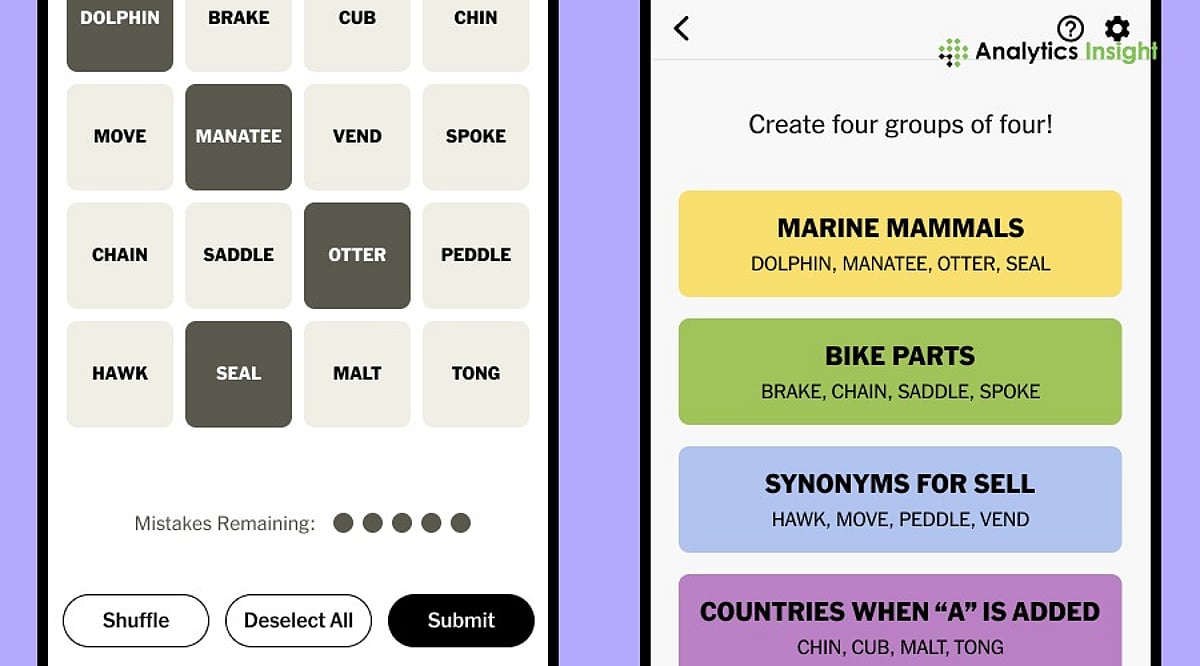
    The New York Times Connections puzzle for July 2, 2026 challenged solvers with four clever categories: imitators, old-fashioned names for modern objects, words beginning with common nicknames, and phrases that start with sports venues. While some groups became obvious after a few guesses, the final wordplay theme required careful observation.

    Today’s Connections Clues

    Here is one representative word from each category:

    • Yellow Category: MOCKINGBIRD
    • Green Category: SPECTACLES
    • Blue Category: RICH TEXT
    • Purple Category: FIELD MOUSE

    Additional clues for today’s groups:

    • Yellow Group: Think of things that imitate or mimic something else.
    • Green Group: Older names for items people still use today.
    • Blue Group: Every answer starts with a familiar nickname.
    • Purple Group: Each phrase begins with the name of a sports venue.

    Category Titles

    • Yellow Group: They Impersonate Other Things
    • Green Group: Old-Timey Names for Things We Still Use
    • Blue Group: Starting With Nicknames
    • Purple Group: Starting With Sports Venues

    Complete Answers for July 2, 2026

    Yellow: They Impersonate Other Things

    • COPYCAT
    • MIME
    • MOCKINGBIRD
    • T-1000

    Green: Old-Timey Names for Things We Still Use

    • LOOKING GLASS
    • SPECTACLES
    • TALKIE (Some players may see GRAMOPHONE instead.)
    • WATER CLOSET

    Blue: Starting With Nicknames

    • BILLY GOAT
    • DAN DAN NOODLES
    • RICH TEXT
    • TOM-TOM

    Purple: Starting With Sports Venues

    • COURT JESTER
    • DIAMOND RING
    • FIELD MOUSE
    • TRACK RECORD

    The Bottom Line

    Today’s puzzle rewarded players who looked beyond literal meanings and focused on hidden word patterns. The impersonators and old-fashioned names were relatively approachable, but the nickname-based phrases and sports venue wordplay made the final two groups significantly more challenging. It was a satisfying puzzle that balanced straightforward logic with clever linguistic twists.

    Also Read: NYT Connections Hints and Answers for July 1, 2026 (Puzzle #1116)

  • Cregis 2026 Review: Unified Crypto Infrastructure for Enterprise Operations

    Cregis 2026 Review: Unified Crypto Infrastructure for Enterprise Operations

    Digital assets are becoming part of how mainstream finance runs, and that change has exposed a structural problem. Most companies still manage wallets, fund movement, compliance, and custody on separate tools. Each one works on its own, but getting them to work together takes constant effort.

    This is the gap Cregis has spent close to a decade closing. Rather than offering a standalone wallet or payment product, it provides an enterprise infrastructure platform that brings together wallet infrastructure, fund flow orchestration, and institutional governance into a unified operational framework.

    Cregis Product Architecture Overview

    By the company’s own account, Cregis has never pivoted. It grew by answering one question over and over: How can enterprises manage digital assets more safely and efficiently? Over time, customer demand revealed three recurring infrastructure needs – wallet management, fund movement, and asset custody. Those three needs became the pillars the Cregis platform is building on: the wallet layer (WaaS), the fund flow layer (Flow), and the custody layer (Custody).

    Cregis at a Glance – Quick Overview

    There is a lot to unpack with Cregis, so before we get into the details, here is a simple overview of what it is and what it does:

    • Wallet-as-a-Service (WaaS): the control layer that lets enterprises build crypto wallets into their own products via a single API, with MPC security splitting private keys into separate pieces.
    • Flow: the movement layer that orchestrates fund movement between wallets, accounts, entities, and operational workflows, covering collection, routing, payouts, treasury movement, and settlement.
    • Custody: the governance layer, built on bank-grade Hardware Security Modules (HSMs), combining secure key management with governance policies, approval workflows, compliance validation, and audit trails.

    Cregis Wallet-as-a-Service (WaaS): The Control Layer

    For most enterprises, digital asset operations begin with wallet infrastructure. This is where Cregis’s Wallet-as-a-Service, or WaaS, sits within the broader platform architecture. Companies need crypto wallets inside their own product, and building that infrastructure securely is hard and slow. WaaS gives them that whole stack as ready infrastructure. With a single API, one can build crypto wallets into a product so they generate addresses and process transactions. The controls are built for how a company operates. Approvals can require several sign-offs, the company defines its own risk rules, and address management keeps pace as volume climbs. Underneath all of it works MPC, the security model that splits each private key into separate pieces. No one person or device ever holds the full key.

    Cregis Flow: The Movement Layer

    Flow is the fund flow orchestration layer of the platform. The capability is not a payment processor or a checkout tool. The work happens one level deeper, in how digital assets move between wallets, accounts, entities, and the operational workflows a finance team runs every day. Collection, routing, payouts, treasury movement, and settlement all run through this one layer. Funds can be pooled from accounts on many chains, routed to the appropriate internal destinations, and paid to partners on whatever schedule the business sets, with manual steps automated. That covers the full lifecycle of a company’s funds, from the point they enter to the point they leave. The Payment Engine works as a component within Flow and extends Cregis to FX brokers, cross-border payment firms, and the wider fintech infrastructure.

    Cregis Custody: The Governance Layer

    As institutional adoption of digital assets grows, secure storage is only part of the challenge. Banks and enterprises also need stronger controls over how assets are managed, approved, and moved. To support these requirements, Cregis introduced Trust Vault in 2025. Designed for institutional digital asset operations, including custody, treasury, payments, stablecoin and RWA issuance, Trust Vault serves as the trusted key management and governance foundation behind the company’s institutional infrastructure. Built on bank-grade Hardware Security Modules (HSMs), Trust Vault combines secure key management with governance policies, approval workflows, compliance validation, and audit trails in a single operational framework. Together, these capabilities form the foundation of Cregis Custody, the company’s upcoming institutional custody offering.

    TronGas Station and the Operations Hub: The Supporting Tools

    Around those three core capabilities, a couple of smaller tools deal with the practical headaches that show up once you run crypto at volume. TronGas Station cuts your gas costs for USDT transfers on the Tron network. You pay a small fixed fee in USDT per transaction and skip the usual need to buy and stake TRX, which Cregis says saves up to 60 percent. The Operations and Security Hub ties the rest of the platform together and hands you role-based permissions, approval rules, transaction analytics, and round-the-clock monitoring.

    Security and Compliance

    Before a serious buyer signs off on infrastructure like this, the security review is usually the longest part of the conversation. Cregis has a lot to work with in that review, and most of it holds up. For institutions with higher security requirements, sensitive keys can be protected inside bank-grade Hardware Security Modules (HSMs), and CertiK has audited the smart contracts. Nine years in, the company reports zero security incidents. On the compliance side, Cregis has also built the certifications that institutional procurement teams typically expect: SOC 2 Type I and SOC 2 Type II, and ISO 27001. Compliance carries through to how money moves. Cregis screens transactions through Elliptic, so the system flags high-risk addresses and tainted funds before they reach your wallets.

    Who Cregis Is For

    Cregis fits a range of businesses that handle crypto, but several specific businesses can get the best value out of it: Banks, financial market infrastructures (FMIs), and exchanges; Forex platforms; PSPs, fintechs, and financial institutions; and Web3 companies.

    Cregis vs. Competitors

    Most providers in this space operate across different parts of the digital asset infrastructure stack. Fireblocks provides institutional-grade custody and wallet infrastructure; Cobo offers wallet infrastructure alongside developer-focused tooling; Dfns provides infrastructure for embedded wallet use cases. Cregis takes a more integrated approach, combining wallet infrastructure, fund flow orchestration, and operational governance into a single platform for end-to-end enterprise fund movement.

    The Trade-offs

    Pros

    • Proven track record: Cregis has operated since 2017 with no major security incidents, more than $300 billion in cumulative transaction volume, and over 4,000 clients across 50+ countries.
    • Strong balance of capability and cost: Cregis offers a broader range of enterprise capabilities while maintaining a more accessible commercial model.
    • Compliance built into operations: Governance controls, approval workflows, AML screening, and audit trails are integrated into everyday fund operations.

    Cons

    • Enterprise-oriented onboarding: Cregis is designed primarily for institutional and enterprise clients, meaning access and evaluation typically require sales-led onboarding.
    • Enterprise deployment model: Pricing and architecture vary depending on deployment type.
    • No quick self-serve trial: full access runs through a demo and sales process, with only a limited free tier to test first.

    Final Thoughts

    Cregis is built around a simple idea: managing the full lifecycle of digital asset operations through a single platform. Rather than replacing one point solution with another, it aims to reduce the operational complexity that comes from managing multiple vendors and disconnected workflows. For teams operating at scale, especially exchanges, payment providers, brokers, and Web3 companies with complex transaction flows, this consolidation reduces fragmentation across tools and operational layers. At the same time, the platform is modular, which means smaller teams or narrower use cases can still start with specific components—such as wallet infrastructure or payment flows—and expand over time as needs evolve.


  • Bitcoin ETFs See $294M Outflow, Metaplanet Revenue Hits ¥11.4B, Avalanche Stock Plunges 73%

    Bitcoin ETFs See $294M Outflow, Metaplanet Revenue Hits ¥11.4B, Avalanche Stock Plunges 73%

    The crypto market witnessed major developments as Bitcoin spot ETFs reported $294.62 million in net outflows, while XRP whales accumulated during the price dip. Meanwhile, Metaplanet disclosed its BTC revenue and Avalanche Treasury stock fell.

    Bitcoin Saw $294 Million in Outflows

    According to SoSoValue, the Bitcoin spot ETF saw a total net outflow of $294.62 million yesterday. The Bitcoin Spot ETF with the highest net inflow yesterday was the Grayscale Bitcoin Mini Trust ETF $BTC, with a daily net inflow of $36.33 million. The second highest was Morgan Stanley’s ETF MSBT, with a daily net inflow of $29.81 million, and the total historical net inflow of MSBT currently stands at $364.01 million. The Bitcoin Spot ETF with the highest net outflow yesterday was BlackRock’s ETF IBIT, with a daily net outflow of $219.39 million, and the total historical net inflow of IBIT currently stands at $60.03 billion. The total net asset value of Bitcoin Spot ETFs is $72.46 billion, with an ETF net asset ratio of 6.01%. The historical cumulative net inflow has reached $50.86 billion.

    XRP Whales are Accumulating

    According to market analyst Xaif Crypto, XRP’s drop to $1.04 appears to have triggered fear among smaller traders, but large investors saw it as a buying opportunity. XRP has since recovered to $1.06. A key indicator is the All CEX whale spread, which has climbed to 50.9%, signaling that whales now control a significantly larger share of XRP held on centralized exchanges. Coinbase whale outflows have surged. Transfers of more than 1 million XRP jumped from 10% to 25.7% of total exchange activity in just two weeks. Large withdrawals are widely viewed as a bullish signal, suggesting investors are moving tokens into private wallets for long-term holding instead of preparing to sell.

    Metaplanet Reports Bitcoin Income Business Revenue

    Japanese listed company Metaplanet released results for its Bitcoin income business revenue in the second quarter of fiscal 2026. According to Foresight News, the business recorded operating revenue of 1.75 billion yen in the second quarter. Metaplanet said cumulative revenue for the first half of the fiscal year reached 4.72 billion yen. The company added that over the past 12 months, cumulative revenue from its Bitcoin income business totaled 11.4 billion yen.

    Ethereum Posts Historic Third Straight Losing Quarter

    The second-largest cryptocurrency has fallen victim to the prolonged bear market as the second quarter closed. This makes it the asset’s third consecutive quarterly loss. Since reaching its all-time high of nearly $5,000 in August 2025, the price of the cryptocurrency has maintained a steady downward trajectory. Data from CoinGecko reveals that the asset is now trading around $1,560, representing a 70% contraction from its peak price. Historically, the month of July does not usually favor the platform’s performance, having closed lower in six of the last ten years.

    Avalanche Treasury Stock Collapses

    Avalanche Treasury Co. shares have fallen sharply since their Nasdaq debut as lower AVAX prices have weighed on the company’s digital asset holdings. The AVAX-focused digital asset treasury firm began trading under the ticker AVAT on June 11. The stock recently traded near $0.50, down about 73% from its $1.85 close on debut. AVAX recently traded near $6.69, up 0.94% over 24 hours but down 23% over the past month. Avalanche Treasury reported a net loss of $26.78 million for the quarter ended March 31, according to its latest SEC filing. The company also reported $1.22 million in cash and a net working capital deficit of $9.06 million at quarter-end.

    FAQs

    1. How much outflow did Bitcoin spot ETFs record?
    According to SoSoValue, Bitcoin spot ETFs recorded total net outflows of $294.62 million yesterday. BlackRock’s IBIT saw the largest withdrawal at $219.39 million.

    2. Which Bitcoin ETF saw the highest inflow?
    The Grayscale Bitcoin Mini Trust ETF recorded the highest daily inflow at $36.33 million. Morgan Stanley’s MSBT followed with $29.81 million in daily inflows, taking its historical inflow to $364.01 million.

    3. Why are XRP whales accumulating?
    According to market analyst Xaif Crypto, XRP’s fall to $1.04 created fear among smaller traders but attracted larger investors. Coinbase whale transfers above 1 million XRP rose from 10% to 25.7% of exchange activity in two weeks.

    4. How much revenue did Metaplanet report from its Bitcoin income business?
    According to Foresight News, Metaplanet’s Bitcoin income business generated ¥1.75 billion in operating revenue during Q2 FY2026. The company said revenue reached ¥4.72 billion in the first half and ¥11.4 billion over the past 12 months.

    5. Why did Avalanche Treasury stock fall sharply?
    Avalanche Treasury stock has dropped around 73% from its Nasdaq debut close as weaker AVAX prices pressured its digital asset holdings. The company also reported a quarterly net loss of $26.78 million and a working capital deficit of $9.06 million.