
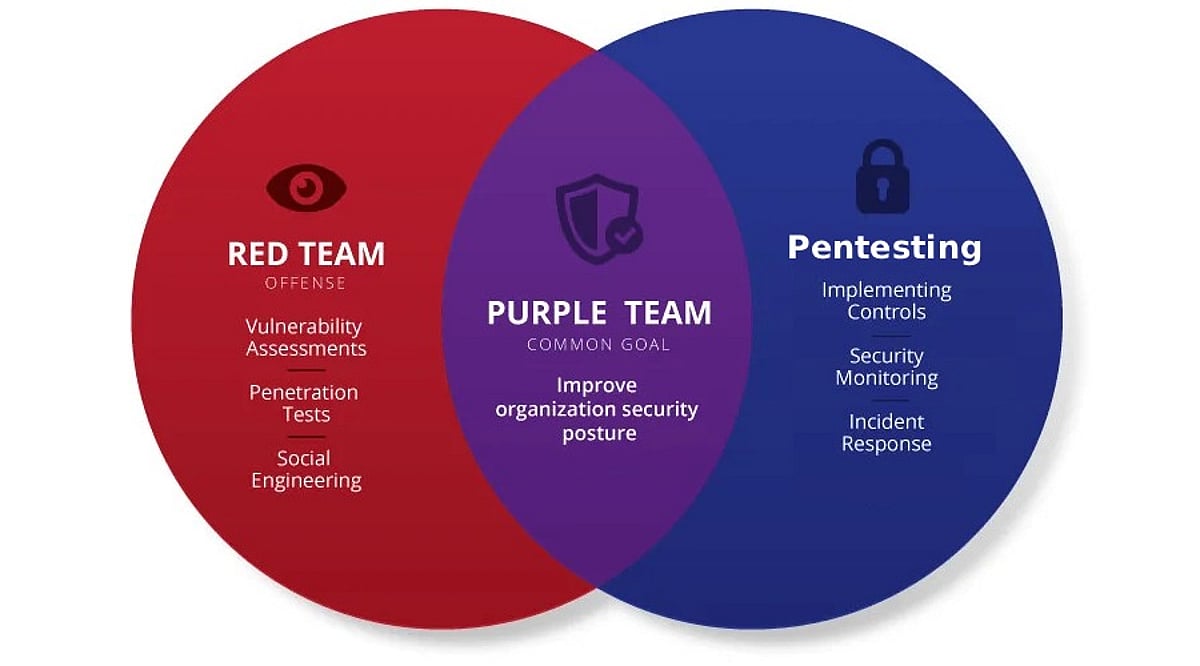
When a company asks a security firm to “see whether anything can be hacked,” the request sounds straightforward until the first meeting. Suddenly, questions arise: Which systems are most critical? Should testers stay within a fixed scope? Are employees part of the test? Does the organization want a list of flaws, proof that an attacker can reach a sensitive asset, or evidence that the security team can detect the intrusion?
These are not minor details. They determine whether the engagement becomes a penetration test, a red team operation, or a purple team exercise. While the same technical skills may be used across all three, the outcomes can look very different.
The Same Exploit Can Mean Three Different Things
Consider a weak cloud permission that gives one employee account access to files it should not see.
- Penetration testing: The tester verifies the issue, documents how it can be abused, assesses its impact, and adds it to the report. The finding matters because it exposes a concrete weakness the company can fix.
- Red teaming: The team uses the same permission quietly and moves on. The permission is just one step toward a larger objective, such as reaching customer records or gaining control of a high-value account.
- Purple teaming: The exploit may be repeated several times. The attacking side runs it, the defenders check the logs, and both teams examine what was visible. If the activity passed unnoticed, they may add telemetry, change a rule, and run the technique again.
The vulnerability did not change. The purpose of the exercise did.
Penetration Testing Produces a Map of Weaknesses
Penetration testing works best when the scope is concrete. A company might ask for an assessment of a customer portal, internal network, API, or cloud environment. Testers explore that area, look for security failures, and prove which ones can be exploited.
The report often becomes a working document for developers, system owners, and security staff. It can include authentication flaws, exposed services, unsafe application logic, excessive permissions, or outdated components. A useful finding explains where the issue exists, what access it could provide, and what should change.
Common findings include:
- Users accessing records belonging to other accounts
- Administrative interfaces exposed to the internet
- Credentials stored in application files or repositories
- Cloud roles with unnecessary permissions
- Missing controls around password resets
- Internal services running vulnerable software
Penetration testing can be noisy; several attack paths may be explored at once, and testing often stops once exploitation is proved. Production safeguards and time limits also affect how far the work goes.
A Red Team Does Not Need to Find Everything
Red teams usually receive an objective rather than a checklist of systems. For example: reach the finance platform, obtain a sensitive document, gain control of an executive account, or enter a restricted network segment without triggering a meaningful response.
Once the objective is agreed, the team looks for a workable route. One severe software vulnerability might provide that route, but several ordinary mistakes can do the same job. A phishing email leads to a valid account. That account has access to an internal tool. That tool exposes credentials for another service. The second account reaches a system no one expected it to reach.
This is where discussions of penetration testing vs. red teaming often go wrong. The difference is not that one uses basic techniques and the other uses advanced ones. Both can involve complex technical work. What changes is the reason for using those techniques.
Even one successful attack path can show that several layers of defense failed at once.
Quiet Attacks Expose Different Problems
When a red team compromises one account through a small phishing campaign, uses normal remote tools, moves during business hours, and reaches sensitive data with valid credentials, the incident raises questions that a conventional list of findings may not answer:
- Why did unusual account activity fail to trigger an investigation?
- Which logs were missing?
- Were useful alerts buried among low-value notifications?
- Could the response team reconstruct what happened?
Purple Teaming Removes the Need to Pretend
A covert operation can reveal whether defenders notice an attack on their own. But it is less efficient when the immediate goal is to improve detection. Purple teaming takes away some of the secrecy. Offensive and defensive specialists work through selected attack techniques with visibility into what both sides are doing. The red side may execute credential dumping, suspicious PowerShell activity, cloud privilege abuse, or lateral movement. The blue side watches what appears in endpoint data, identity logs, network traffic, and security alerts.
Sometimes nothing appears. Sometimes an alert fires but contains too little context to be useful. In other cases, the detection works, yet the response process stalls because ownership is unclear. The teams can make changes while the exercise is still running: a detection rule is adjusted, a missing log source is connected, an investigation guide is rewritten. Then the same action is repeated.
This repetition would look strange in a covert red team operation. In purple teaming, it is the point.
These Are Not Levels in a Maturity Ladder
Security vendors sometimes present the three approaches as a progression: first pentesting, then red teaming, then purple teaming. Real security programs are not that tidy. A mature organization may still need a focused pentest before releasing a new payment feature. A smaller company may benefit from a limited purple team session if it recently deployed new detection tools and wants to check whether they work. A red team operation can be premature when basic security problems remain unresolved.
Start With the Question
The choice becomes easier when the organization defines what it wants to know at the end: whether a system contains exploitable flaws, whether an attacker can reach a critical asset, or whether defenders can see and contain the activity. The decision should also account for practical limits. Social engineering may be unacceptable during a sensitive business period. Production systems may require strict safeguards. Internal defenders may need to know that testing is underway, even if the wider company does not. Remediation ownership matters as much as the exercise itself, because an excellent report has little value when no team is responsible for acting on it.
Penetration testing, red teaming, and purple teaming can overlap during one security program. They do not need to compete for the same budget. One finds weaknesses, another tests an attack path, and the third helps defenders see what their controls currently miss.
Leave a Reply