Tag: ADA

  • Apeing Stage 5 Presale Launches as Cardano Surges on x402 Integration

    Apeing Stage 5 Presale Launches as Cardano Surges on x402 Integration

    Apeing Stage 5 Presale Now Live

    Apeing has entered Stage 5 of its crypto presale, with the $APEING token currently priced at USD 0.00055. The project reports raising over USD 102,000 and selling more than 463 million tokens. This latest phase, called Dip Devourers, marks a continued rollout across 33 total stages, each with a progressively higher token price. The next stage will increase the price to USD 0.0006, with a future listing target of USD 0.01. Based on these figures, Apeing projects a potential 1,700% return from the current presale price to the listing level, though this depends on market conditions. Unsold tokens from each stage are burned after closure, reducing the total supply over time.

    Referral and Staking Features

    Apeing has introduced several participation incentives, including Ape Wars, the Ape Referral League, and a tiered staking system. Buyers using a referral code receive 10% additional tokens, and referrers earn a 10% reward from qualifying purchases. Purchases of USD 25 or more unlock a personal referral code. The project also offers four staking tiers with annual percentage yields of 10%, 25%, 50%, and 85%, allocating 30% of the total token supply to staking. Participants can connect compatible Ethereum wallets like MetaMask or Trust Wallet, and pay with supported cryptocurrencies or Visa/Mastercard.

    Cardano Gains on x402 Integration

    Cardano (ADA) saw a 3.62% gain in an 18-hour period and nearly 9.6% over 24 hours, driven by renewed market attention and the integration of the x402 software development kit. This SDK enables applications and AI agents to make API payments using ADA or Cardano-native tokens, connecting the network to the growing machine-to-machine payment sector. The broader crypto market also rallied, with total capitalization rising from about USD 2.74 trillion to USD 2.87 trillion, and Bitcoin moving above $84,000. Cardano’s wider ecosystem developments, including the Leios scaling upgrade and governance updates, continue to generate discussion. The x402 integration adds a practical utility layer to Cardano’s ongoing evolution.
  • Cardano (ADA) in 2026: Why This Crypto Deserves Investor Attention

    Cardano (ADA) in 2026: Why This Crypto Deserves Investor Attention

    Investing has the power to reshape lives, offering the kind of stability that goes far beyond raw numbers. For some, financial comfort might mean dining out more often; for others, it’s the freedom of earning passive income. However you define wealth, having a secure financial footing is universal.

    Cryptocurrencies continue to offer one path toward that goal. Among the many digital assets out there, Cardano’s ADA has been drawing attention from both retail and institutional investors. While it may not promise flashy features, its recent legal clarity and evolving ecosystem make it a coin worth exploring.

    Cardano’s Journey and Vision

    Cardano’s journey began when Charles Hoskinson left the Ethereum project in 2014. After a six-month sabbatical, he teamed up with Jeremy Wood to create IOHK, the company behind Cardano. Launched in 2017, Cardano was initially dubbed the “Japanese Ethereum,” and its native token ADA pays homage to Ada Lovelace, the world’s first programmer.

    Today, Cardano is widely seen as an improved version of Bitcoin, thanks to its second-generation, peer-to-peer architecture that supports more than simple financial transactions. Hoskinson has described the goal as building a social system that motivates people to go beyond expected results—an ambitious vision that could fuel ADA’s long-term growth.

    Market Signals and the Opportunity Zone

    Market signals also paint an interesting picture. Many wallets active on the network over the past year are sitting on average losses of 43%. Yet Santiment describes this as an “opportunity zone”—a time when fearful investors may be ideally positioned to act. The MVRV ratio, which measures asset valuation against historic buying prices, often trends toward zero. This suggests that the remaining ADA holders are long-term believers, weathering market volatility with remarkable resilience.

    Midnight: Privacy Meets Utility

    Another development is Midnight, a privacy-focused partner chain that has been in the works for over eight years. Midnight allows users and applications to prove compliance with regulations without exposing sensitive information like identity, age, or financial records. Its two main tokens—NIGHT and DUST—serve distinct purposes: NIGHT is public and transparent, while DUST enables metadata-shielded transactions. With Bullish and Wordplay as federated node operators, Midnight could make rapid privacy protection a reality. The project also rewards staking ADA for more than 12 months, especially as the TVL hits lows not seen since 2023.

    Should You Consider ADA?

    The goal for Cardano’s ecosystem is to minimize meaningful failure events and continue building a reliable, high-velocity decentralized economy. For investors seeking a relatively inexpensive cryptocurrency with serious potential, ADA offers a compelling case. But as always, preparation is key. The amount you start with matters less than your willingness to learn and stay committed.

    Disclaimer: Cryptocurrency investments carry significant risk. Always conduct your own research and consider your financial situation before making any investment decisions.

  • Cardano Price Tests $0.245 Resistance After 15% Weekly Rally as Funding Turns Positive

    Cardano Price Tests $0.245 Resistance After 15% Weekly Rally as Funding Turns Positive

    Cardano (ADA) traded near $0.222 on Monday after posting a 15% gain last week, with technical momentum improving and funding rates turning positive. Buyers now face resistance between $0.231 and $0.245, a zone that could determine the next leg of the recovery.

    ADA Momentum Improves as Funding Turns Positive

    ADA traded above its 50-day and 100-day exponential moving averages, supporting a stronger short-term technical structure. A move through the $0.231-$0.245 resistance zone would extend the current recovery.

    CoinGlass data shows Cardano’s long-to-short ratio at 0.94, indicating that short positions slightly outnumber longs. However, the narrow gap points to cautious positioning rather than heavy bearish conviction.

    Funding data sends a different signal. Cardano’s open interest-weighted funding rate turned positive on Saturday and reached 0.0097% on Monday, showing stronger demand for bullish leveraged exposure.

    Wyckoff Setup Keeps December Upside in Focus

    CryptoQuant’s summary data shows large whale orders in Cardano futures, while most other tracked measures remain neutral. This mix points to increased large-trader activity without a broad bullish shift.

    Trader LuckSide Crypto said Bitcoin and ADA follow a Wyckoff accumulation pattern and currently sit in Phase D. He linked Bitcoin’s setup to a possible range breakout around September 25.

    LuckSide also cited two Bitcoin metrics: long-term holders control 75% of supply, while only 17% moved during the last three months. Bitcoin dominance has also fallen below 60%.

    According to LuckSide, the same framework could support an ADA gain of roughly 50% by December if the pattern holds. He also noted that the September 25 timing does not guarantee a breakout.

    CLARITY Vote and Cardano Activity Add Market Risks

    The Senate plans a September 15 cloture vote on the CLARITY Act, according to LuckSide Crypto. The vote would open debate rather than approve the legislation.

    The measure needs 60 votes to advance. Republicans hold 53 Senate seats, while only two Democrats have publicly backed the bill so far. Anonymous traders reportedly wagered more than $1 million on failure.

    LuckSide said a failed vote would not end US crypto policy efforts because the SEC and CFTC continue separate work. Still, a delay would remove one September catalyst for the broader market.

    Cardano network data also shows a mixed picture. Chainspect recorded about 26,500 transactions on September 4 before activity fell to 19,054 on September 6.

    Over the same period, on-chain revenue rose 1.99% to $1,261. Average transaction fees fell 2.42% to $0.06619, contrasting with a separate report that claimed ADA’s DEX volume had tripled.

    Traders will also track Cardano network activity, Bitcoin’s market structure, and the September 15 CLARITY Act cloture vote.

  • Cardano Holds $0.163 Support as ADA Aims for Key $0.20 Breakout

    Cardano Holds $0.163 Support as ADA Aims for Key $0.20 Breakout

    Cardano’s ADA is trading near $0.163, holding a critical support level even as broader market weakness weighs on sentiment. The token slipped 2% in the latest session, mirroring a downturn across the crypto market as Bitcoin hovered around $64,000. Despite the price pressure, Cardano’s development roadmap—including a planned speed upgrade—continues to draw attention from analysts and investors.

    Governance and Speed Upgrade Draw Attention

    Charles Hoskinson, Cardano’s founder, highlighted the network’s governance model as a key differentiator from Bitcoin. He argued that Bitcoin’s ‘frozen in time’ governance creates a vulnerability greater than quantum computing, contrasting it with Cardano’s on-chain voting system, which could enable a coordinated shift to quantum-resistant cryptography. Meanwhile, Hoskinson reiterated that a planned network upgrade could deliver a 60-fold speed increase, strengthening Cardano’s long-term development narrative. However, these fundamentals have not yet translated into price action, as short-term momentum remains constrained by macro headwinds.

    ADA Holds the First Major Downside Target

    According to crypto analyst More Crypto Online, ADA has stabilized near $0.163, which coincides with the 78.6% Fibonacci retracement and marks the first major downside target on the chart. Holding this level offers short-term support, though a confirmed reversal is still pending. The wave structure suggests a completed A-B-C correction and a potential wave two bounce, but the larger corrective phase could still produce further losses. The key question is whether ADA can reclaim $0.20 before sellers push the token toward $0.092. A move above $0.20 would strengthen the case for a wave four bounce, potentially targeting $0.23 and $0.314.

    Key Levels Define ADA’s Next Move

    ADA faces its first major resistance at $0.20. A clear break above that level would provide the first technical sign that the recent low may hold. The next resistance points sit at $0.23 and $0.314, though reaching them would likely require broader market recovery and supportive Cardano developments. If volume remains low, ADA could continue moving between $0.16 and $0.18, maintaining a neutral short-term structure. The bearish scenario begins with a loss of $0.163, which could expose the $0.092 Fibonacci extension—nearly 40% below the current area.

    ADA remains within a multi-year downtrend that began after its 2021 peak above $3.00. The present move still forms part of that wider correction. As long as ADA stays below $0.20, the third wave may continue extending. Traders are therefore closely watching $0.163 for support and $0.20 for confirmation of a trend reversal.

    Conclusion

    ADA is holding near $0.163 as wider market weakness limits momentum despite Cardano’s governance claims and planned speed upgrade. A move above $0.20 could support targets at $0.23 and $0.314, while losing current support may expose $0.092. Market participants should closely monitor these levels before assessing ADA’s next direction.

  • Cardano’s Van Rossem Hard Fork Goes Live After Full On-Chain Governance Approval

    Cardano’s Van Rossem Hard Fork Goes Live After Full On-Chain Governance Approval

    Cardano activated its van Rossem hard fork on July 18, 2026, after final approval came through its decentralized on-chain governance system. The upgrade took effect at the boundary of epoch 644, moving the network to Protocol Version 11. It stayed within the Conway ledger era, making van Rossem an intra-era hard fork. This marked a significant milestone as one of the first major blockchain upgrades executed entirely through binding on-chain votes.

    Governance Bodies Back the Upgrade

    The hard fork received approval on July 13 from all three governance groups required under Cardano’s post-Chang framework. DReps backed the action with 77.63% support, clearing the 60% threshold. Stake pool operators also approved the upgrade, with their support reaching 52.7%, just above the 51% requirement. The Constitutional Committee completed the process with six approvals; the rule required five committee votes, and one member did not vote.

    Cardano’s Governance Model Enters a New Phase

    The activation marked a major test for Cardano’s governance structure. The system emerged through the Chang and Plomin upgrades, which gave ADA holders, stake pool operators, and the Constitutional Committee formal roles in protocol decisions. Earlier Cardano upgrades relied more heavily on founding entities or temporary governance structures. Van Rossem differed because the network authorized the change through its own on-chain process.

    Intersect, Cardano’s member-based ecosystem organization, coordinated the upgrade process. It convened a Hard Fork Working Group that included Input Output, the Cardano Foundation, EMURGO, Midnight, infrastructure providers, and other contributors.

    Testing, Technical Changes, and Market Tone

    The group focused on testing and readiness rather than final authority. Cardano ran checks across SanchoNet, Preview, and Preprod before activation. Preview moved to Protocol Version 11 on May 8. Preprod followed on June 10 after developers fixed compatibility issues affecting tools such as Ogmios and Kupo.

    Van Rossem introduces targeted changes to Plutus smart contracts, ledger consistency, and node security without changing transaction structure. It expands built-in functions across Plutus V1, V2, and V3. The upgrade also adds more efficient case expressions for basic types, arrays, optimized multi-asset value operations, modular exponentiation, and improved list handling. Additional changes cover BLS12-381 cryptographic operations and stronger uniqueness protections for stake pool verification keys. A separate Plutus cost-model update passed on June 18, which prepared pricing for the new functions before activation.

    ADA traded at $0.165 on Monday after a mild recovery in the previous week. Even so, the token remained below its 50-day, 100-day, and 200-day exponential moving averages. Price action also stalled after the early-July rebound. Sellers continued to defend lower Fibonacci retracement levels from the April-to-June decline. The RSI stayed just under 50, while MACD held only slightly above zero. Funding rates turned positive on Friday and stood at 0.0061% on Monday. However, the long-to-short ratio remained at 0.90, showing bearish positioning in derivatives markets.

    Conclusion

    Cardano activated the van Rossem hard fork through its on-chain governance system after approval from DReps, stakeholder operators, and the Constitutional Committee. The upgrade moved the network to Protocol Version 11 and added Plutus and security improvements while ADA traded with mixed market signals.

  • Cardano Whales Accumulate Ahead of Van Rossem Hard Fork as ADA Eyes Key Resistance

    Cardano Whales Accumulate Ahead of Van Rossem Hard Fork as ADA Eyes Key Resistance

    Cardano (ADA) traded near $0.161 on Thursday after a slight decline, but on-chain data and derivatives activity suggest growing investor confidence ahead of the van Rossem hard fork set for Saturday. Large holders have been accumulating, while futures open interest and funding rates have improved. However, ADA remains below key technical levels, leaving traders watching for a breakout or a retest of support.

    Whale Accumulation Grows as Network Upgrade Nears

    According to Santiment, wallets holding between 100,000 and 100 million ADA now control over 25.65 billion ADA—the highest level since February 2023. In contrast, smaller wallets (under 100 ADA) reduced holdings by about 0.7% over the past four months, highlighting a divergence between large investors and retail traders.

    Cardano’s development roadmap advanced this week after Intersect confirmed the van Rossem hard fork activation on Saturday, following governance ratification. The upgrade introduces new Plutus functionality and protocol improvements designed to enhance smart contract performance, developer tools, and network efficiency.

    Futures Data Reflects Improving Market Sentiment

    Derivatives data from CoinGlass shows Cardano futures open interest rising from $422 million on Monday to $445 million on Thursday. Rising open interest alongside stable prices often indicates new capital entering the futures market rather than position closures. Additionally, ADA’s funding rate turned positive at 0.0042%, meaning long traders are willing to pay a premium to maintain their positions.

    Technical Barriers Continue to Limit ADA

    Despite positive fundamentals, ADA remains below key moving averages: the 50-day EMA at $0.179, 100-day EMA at $0.208, and 200-day EMA at $0.276. It also trades below the 23.6% Fibonacci retracement at $0.173 and trendline resistance near $0.207.

    Momentum indicators are mixed. The RSI is near 46 (neutral), while the MACD has turned slightly positive, suggesting bearish momentum is weakening but no sustained reversal is confirmed yet.

    If buyers regain control, resistance levels are at $0.179, then the $0.207–$0.208 region, followed by $0.2135 (50% Fibonacci). On the downside, immediate support is at $0.1500, with a break below potentially exposing the June 25 swing low of $0.1382.

    What’s Next?

    Cardano is trading below major resistance despite improving market signals. The van Rossem hard fork and whale accumulation provide a bullish backdrop, but technical resistance remains a hurdle. Traders will be watching whether ADA can break above key levels or revisit support.

  • Cardano Logs 233 GitHub Commits in a Week as Governance Platform Proposal Evolves

    Cardano Logs 233 GitHub Commits in a Week as Governance Platform Proposal Evolves

    Cardano has recorded 233 GitHub commits over the past seven days, according to Token Terminal, positioning it among the most actively developed Layer-1 blockchain networks. The activity represents roughly 6.2% of the approximately 3,700 total Layer-1 commits tracked during that period.

    Meanwhile, the Cardano Foundation continues advancing its governance framework, proposing an off-chain discussion platform following the adoption of the Cardano Constitution in February 2025. Together, these developments underscore the network’s ongoing focus on both technical progress and decentralized decision-making.

    Cardano Maintains Strong Development Momentum

    Token Terminal data shows steady developer participation throughout the week. While commit counts do not directly influence token prices, many market observers track them as a proxy for network advancement. Despite a smaller market capitalization compared to several peers, Cardano consistently ranks among leading blockchain projects for open-source development activity.

    Everstake, a staking provider, recently described Cardano as “one of the strongest foundations in the cryptocurrency industry,” citing its active developer community, improving network metrics, and expanding ecosystem as key factors supporting its long-term position.

    The week’s development pattern followed a familiar cadence: commits started strong, dipped around July 4 (a low point), then rebounded on July 5 and peaked on July 6 before tapering slightly but remaining above the week’s minimum. Such batch-driven activity is common in open-source projects, and similar trends appeared across other Layer-1 blockchains.

    Cardano Foundation Advances Governance Plans

    Alongside development work, the Cardano Foundation is advancing governance tools in the wake of the Cardano Constitution’s activation. A newly proposed open off-chain discussion platform aims to improve collaboration among stakeholders. Participants would access the platform using verified identities linked to on-chain credentials. The framework would feature independent moderation, transparent governance discussions, and open communication standards.

    The proposal carves out dedicated spaces for ADA holders, Delegated Representatives, proposal authors, and committee members. Optional user profiles could display governance interests and prior voting history. Ultimately, the foundation stated that the platform itself could be subject to an on-chain community vote, allowing the ecosystem to decide which collaboration tool best serves its needs rather than relying on a central authority.

    Development and Governance Remain Active

    Cardano’s recent GitHub activity continues a multiyear trend of consistent developer contributions, even as market attention oscillates around price movements. Governance development is proceeding in parallel, with the proposed discussion platform marking the next step in decentralized decision-making. Both efforts reflect ongoing momentum across Cardano’s technical and organizational fronts.

    What could sustained development and expanding governance tools mean for Cardano’s long-term network growth? The latest data shows developers building while governance initiatives move forward under the foundation’s current proposals, offering a clearer picture of the network’s dual-track progress.

    Conclusion

    Cardano recorded 233 GitHub commits over the past week while advancing governance plans through a proposed community discussion platform. The updates highlight continued developer activity alongside efforts to improve decentralized collaboration, providing insight into the network’s ongoing technical and governance evolution.

  • BlockDAG Leads $500M AI-Driven Crypto Rally as Render and Cardano Show Signs of Strategic Recovery

    BlockDAG Leads $500M AI-Driven Crypto Rally as Render and Cardano Show Signs of Strategic Recovery

    The crypto market is undergoing a significant capital rotation, with investors shifting from traditional layer-1 networks and niche tokens toward platforms offering immediate value and scalability. This trend has brought BlockDAG (BDAG) into the spotlight as one of the top crypto gainers today, following a $500 million valuation jump tied to its new BlockDAG AI technology.

    Alongside this artificial intelligence milestone, the project revealed plans for a Fully Regulated Crypto Exchange & App, changing how users perceive utility and ecosystem access. These developments are reshaping investor sentiment and driving up daily transaction volumes.

    Render Price Shows Signs of a Potential Turnaround

    The Render price is quietly positioning for a notable comeback, with technical patterns that have analysts optimistic. Currently trading around $1.52 after a minor 24-hour dip, the token has corrected nearly 92% from its all-time high of $13.83. This correction has pushed Render into a long-term accumulation zone between $1.20 and $0.80, historically a prime entry point for investors.

    Despite Bitcoin’s sideways movement capping immediate growth, short-term forecasts point to a potential 34% rally that could push Render to $2.20. If the token breaks out of its multi-year downward channel and surpasses $2.71, experts see targets at $5.50, $13, and beyond. For this decentralized GPU platform, the quiet period appears less like a decline and more like a launchpad.

    Cardano Crypto Aims for Real-World Utility Beyond Market Rankings

    Cardano crypto is navigating a tough market, with ADA slipping to approximately $0.1441 and ranking 18th by market capitalization. The token would need a surge of over 2,000% to reclaim its previous all-time high. Despite skepticism, founder Charles Hoskinson remains confident, emphasizing that real success goes beyond recovering past price milestones.

    The project’s roadmap focuses on global blockchain adoption through tangible applications, relying on its EUTXO accounting model, decentralized governance, proof-of-stake security, and the Midnight privacy initiative. For loyal Cardano supporters, the current price drop is seen as a foundation for a secure, global infrastructure.

    BlockDAG Builds Massive Momentum as Top Crypto Gainer

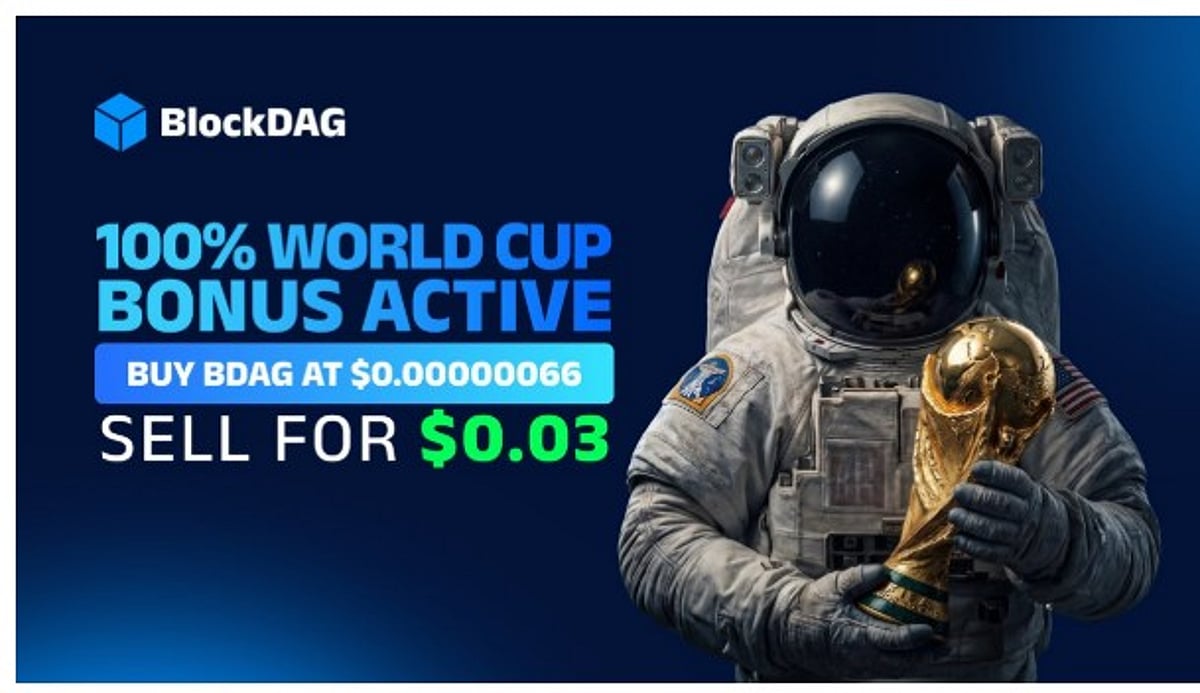
    BlockDAG is capturing market attention by locking in its position among top crypto gainers through a series of major milestones. The ecosystem saw a $500 million valuation jump from its BDAG AI launch, alongside plans for a regulated trading platform and mobile app. To celebrate, the network doubled its World Cup promotion from a 50% to a 100% bonus for new participants.

    Under this structure, buyers can purchase BDAG at $0.00000066 and receive an immediate 100% extra allocation, with coins sent directly to their wallets. The project also features a built-in $0.03 buyback mechanism, creating a clear exit strategy. Combined with an upcoming mainnet upgrade capable of 7,000 transactions per second, this has driven massive transaction volume.

    While older networks face resistance, BlockDAG’s combination of AI tools and fixed-value systems keeps it among the top crypto gainers today.

    Summary

    The crypto market is moving in different directions. While Render price appears technically ready for a cyclical bounce and Cardano builds long-term decentralized governance, BlockDAG has captured immediate attention by slashing entry barriers. By launching AI tools, growing valuation by $500M, and prepping a regulated exchange, the platform boosted its community with a World Cup Bonus raised from 50% to 100% extra BDAG. Anyone buying at $0.00000066 gets that bonus, a $0.03 buyback path, and instant coin delivery, keeping the project aligned with top crypto gainers.

    Disclaimer: This article is for informational purposes only and does not constitute investment advice. Cryptocurrencies are high-risk assets; you are responsible for your own research (DYOR) before investing.