Tag: AI agents

  • 7 AI Trends Reshaping Enterprise Strategy in 2026: From Pilots to Full-Scale Operations

    7 AI Trends Reshaping Enterprise Strategy in 2026: From Pilots to Full-Scale Operations

    Artificial Intelligence is entering a phase of enterprise adoption. Over the past few years, organizations have invested heavily in AI pilots, generative AI tools, and automation initiatives to explore how emerging technologies can improve business performance. While many of these projects demonstrated results, relatively few have delivered transformation at scale. As a result, the conversation surrounding AI is rapidly evolving from experimentation toward operationalization.

    According to McKinsey’s latest State of AI report, more than 70% of organizations have adopted AI in at least one business function. Gartner predicts that over 80% of enterprises will have used generative AI APIs or deployed generative AI-enabled applications by 2026. These figures indicate that AI adoption is no longer limited to innovators and early adopters. It is rapidly becoming a priority across industries.

    However, adoption alone does not guarantee business value. Many organizations continue to struggle with deployments, disconnected data environments, and unclear transformation strategies. The challenge facing enterprise leaders in 2026 is no longer whether AI works. The challenge is how to scale AI across the organization while maintaining governance, security, and measurable outcomes.

    The organizations that succeed in this phase of AI transformation will not necessarily be those with access to the most advanced models. Instead, they will be those aligning AI capabilities with business objectives, operational processes, and long-term transformation strategies.

    The Economic Opportunity Behind Enterprise AI

    The scale of AI’s potential is one of the primary reasons enterprises continue increasing investments despite ongoing implementation challenges. According to PwC’s Global AI Study, AI could contribute up to $15.7 trillion to the economy by 2030, making it one of the most transformative technologies of the modern era.

    What makes AI particularly powerful is its ability to generate value across multiple business functions simultaneously. Organizations are increasingly using AI to:

    • Improve operational efficiency and productivity
    • Enhance customer experiences through personalization
    • Accelerate product and service innovation
    • Strengthen decision-making capabilities
    • Identify new revenue opportunities

    Unlike previous waves of enterprise technology, AI is not confined to a single department. It has the potential to influence every aspect of business operations. This is why leading enterprises are shifting their focus from use cases toward enterprise-wide AI strategies.

    Trend #1: Enterprise AI Is Moving Beyond Pilot Projects

    The first phase of enterprise AI adoption was characterized by experimentation. Organizations launched customer service chatbots, automated document processing systems, predictive analytics platforms, and internal productivity assistants to explore AI’s capabilities. These initiatives often generated positive results but remained isolated within individual departments.

    Typical characteristics of AI initiatives between 2023 and 2024 included department-level deployments, limited integration with business operations, experimentation-focused objectives, unclear ROI measurement frameworks, and minimal governance oversight. As organizations move into 2026, priorities are changing significantly. Enterprise AI programs are increasingly characterized by organization-wide adoption strategies, cross-functional integration, outcome-driven implementation plans, governance and accountability frameworks, and executive-level sponsorship.

    This shift mirrors the evolution of cloud computing. Early cloud initiatives focused primarily on infrastructure optimization. Today, cloud serves as the foundation for digital business models. AI is following a similar trajectory. Business leaders are no longer asking whether AI can improve productivity. Instead, they are asking how AI can reshape operations, accelerate innovation, and create sustainable competitive advantages.

    Trend #2: AI Agents Will Become Operational Participants

    One of the most significant developments expected to shape enterprise transformation in 2026 is the emergence of AI agents. While most organizations are already familiar with AI copilots that assist employees with writing, coding, research, and knowledge retrieval, AI agents represent a more advanced stage of intelligent automation. Unlike copilots, AI agents are capable of performing tasks autonomously and coordinating activities across multiple systems.

    A procurement-focused AI agent, for example, may be able to monitor inventory levels in real time, analyze supplier performance data, forecast purchasing requirements, generate procurement recommendations, and initiate approval workflows automatically. Similarly, customer service agents can retrieve information from CRM systems, access knowledge repositories, respond to routine customer inquiries, and escalate complex issues when human intervention becomes necessary.

    According to Deloitte’s State of Generative AI in the Enterprise report, organizations are increasingly prioritizing AI initiatives that generate measurable operational outcomes rather than simply improving individual productivity. This trend reflects a broader shift in enterprise expectations: AI is no longer viewed solely as a productivity tool but as an operational capability capable of transforming how business processes are executed.

    Trend #3: AI Infrastructure Will Matter More Than AI Models

    Much of the public discussion surrounding AI has focused on models. Organizations frequently compare proprietary and open-source models, evaluate benchmark performance, and debate the advantages of different architectures. However, many enterprises are discovering that model selection is only a small part of the challenge. In practice, infrastructure is becoming more important than the model itself.

    Modern enterprise AI environments typically require data pipelines and integration layers, vector databases and knowledge repositories, governance and compliance frameworks, security and access management systems, model monitoring and observability tools, and MLOps and deployment pipelines. Without these foundational capabilities, even the most advanced AI models struggle to deliver sustainable business value.

    Many organizations encounter challenges when attempting to scale successful pilot projects. Data often resides across multiple disconnected systems, legacy applications create integration barriers, and security requirements introduce deployment constraints. These issues cannot be solved simply by choosing a different model. This reality explains why AI transformation is increasingly viewed as an architecture challenge rather than a model challenge. The organizations that invest in scalable AI infrastructure today will be better positioned to deploy new capabilities, integrate future technologies, and maintain long-term operational resilience.

    Trend #4: Decision Intelligence Will Replace Traditional Analytics

    For decades, business intelligence platforms have helped organizations understand historical performance. These systems provide visibility into trends, metrics, and operational outcomes, allowing leaders to evaluate what happened in the past. However, modern enterprises increasingly require systems that go beyond reporting.

    Decision intelligence is emerging as the next evolution of enterprise analytics by combining artificial intelligence, predictive modeling, business rules, and automation to support real-time decision-making. Rather than answering “What happened?”, decision intelligence focuses on “What is likely to happen next?” and “What should we do about it?”

    This capability is already creating value across multiple industries: retail (optimizing inventory allocation and pricing strategies), manufacturing (predicting equipment failures before they occur), financial services (identifying emerging risks and compliance concerns), logistics (dynamically adjusting operations based on demand patterns), and healthcare (improving resource planning and patient scheduling).

    A global logistics provider, for instance, handles thousands of shipments every day. Traditional analytics can only tell you that a delay happened after it occurred. Decision intelligence systems can predict disruptions before they happen, suggest ways to mitigate them, and automatically switch to a backup plan. This change helps organizations make decisions proactively rather than reacting to events that have already occurred.

    Trend #5: AI Governance Will Become a Board-Level Priority

    As AI is used more extensively in business functions, governance is becoming essential for long-term success. Early AI projects were often managed by innovation teams or technical departments. Now that AI is being used on a larger scale, executive leaders and corporate boards need to be involved. The reason is simple: AI is no longer for testing. It affects how customers interact with companies, financial decisions, compliance processes, and daily operations. As AI’s impact grows, so do the risks related to privacy, security, transparency, and accountability.

    According to IBM’s Global AI Adoption Index, trust is a barrier to using AI in businesses. Companies are realizing that successful AI implementation requires more than technical performance; it also needs confidence that AI systems work responsibly and transparently. Forward-looking companies are investing in governance frameworks that include ensuring AI system transparency, accountability, risk management, trust-building, policy establishment, oversight committees, and ethics guidelines.

    What makes governance particularly important in 2026 is the growing complexity of AI ecosystems. As organizations deploy multiple models, integrate external data sources, and introduce autonomous AI agents, maintaining visibility and control becomes increasingly challenging. Rather than viewing governance as a barrier to innovation, leading organizations treat it as a foundation for sustainable AI adoption.

    Trend #6: Industry-Specific AI Solutions Will Outperform Generic Deployments

    As companies become more adept at using AI, they are moving away from one-size-fits-all solutions and toward AI tailored to their specific industry. While the underlying AI technology remains important, the most effective solutions are those designed for a particular sector.

    Financial institutions focus heavily on risk analysis, fraud detection, regulatory compliance automation, and customer intelligence. Manufacturers prioritize predictive maintenance, quality assurance automation, and supply chain optimization. Healthcare organizations invest in clinical decision support systems, patient engagement platforms, and medical data analysis tools. The same pattern is emerging across retail, logistics, insurance, telecommunications, and energy.

    This shift reflects an important reality: AI generates the strongest business outcomes when it is closely aligned with operational objectives and industry-specific workflows. As a result, organizations are increasingly seeking partners capable of combining technical expertise with deep industry understanding.

    Trend #7: The Convergence of AI and Blockchain

    Although AI and blockchain are often discussed as separate technologies, their convergence is creating new opportunities for enterprise innovation. AI excels at generating intelligence from data; blockchain excels at establishing trust, transparency, and immutability.

    Together, these technologies can support a range of high-value enterprise applications, including supply chain transparency and traceability, decentralized digital identity systems, automated compliance reporting, secure data-sharing ecosystems, and smart contract optimization.

    Consider a global supply chain network involving manufacturers, logistics providers, distributors, and retailers. AI can analyze operational data to identify inefficiencies, forecast demand, and optimize inventory management. Blockchain can simultaneously provide an immutable record of transactions and product movements across the network. The combination creates a system that is both intelligent and trustworthy.

    As enterprises become increasingly dependent on automated decision-making, trust will become a critical competitive differentiator. This is one reason why many organizations are beginning to explore how AI and blockchain can work together as complementary technologies rather than independent initiatives.

    Why Many AI Initiatives Still Fail

    Despite significant investment and technological progress, many companies still struggle to make AI work across the entire organization. McKinsey research reveals a large gap between experimenting with AI and achieving true proficiency. One major reason is poor data quality. AI systems are only as good as the data they receive, and companies often underestimate the work required to clean and organize data before AI can deliver valuable insights.

    Another problem is the misconception that technology alone is the answer. Companies that start with AI as the solution rather than understanding the problem they need to solve often fail to demonstrate tangible results. Common barriers include disorganized data, unclear objectives, lack of executive support, organizational resistance, disconnected technology stacks, and insufficient governance.

    Perhaps the most overlooked factor is managing the human side of change. AI affects people as much as technology. Employees must learn new workflows, managers must make decisions differently, and companies must adapt their operating models. Without proper change management, even technically successful AI initiatives may not be adopted by the organization.

    Mini Case Study: From Forecasting to Autonomous Decision-Making

    A compelling example of AI evolution comes from the logistics industry. A few years ago, logistics companies used AI to predict delivery times. These systems helped with planning but were disconnected, requiring humans to interpret results and take action. Today, modern logistics systems can do much more: predict delivery times in real time, find optimal routes, handle problems automatically, track inventory, and allocate resources efficiently.

    Instead of merely warning about potential issues, these systems can suggest solutions and initiate processes autonomously. For instance, if a storm threatens a major shipping route, a traditional system would alert managers after delays begin. An AI-powered system, however, can predict the problem, recommend an alternative route, estimate cost implications, and activate a contingency plan before any disruption occurs.

    This example illustrates a broader trend across industries: the future of AI is not just about generating more information but about enabling better decisions and faster action.

    Conclusion: The Path to Enterprise AI Maturity

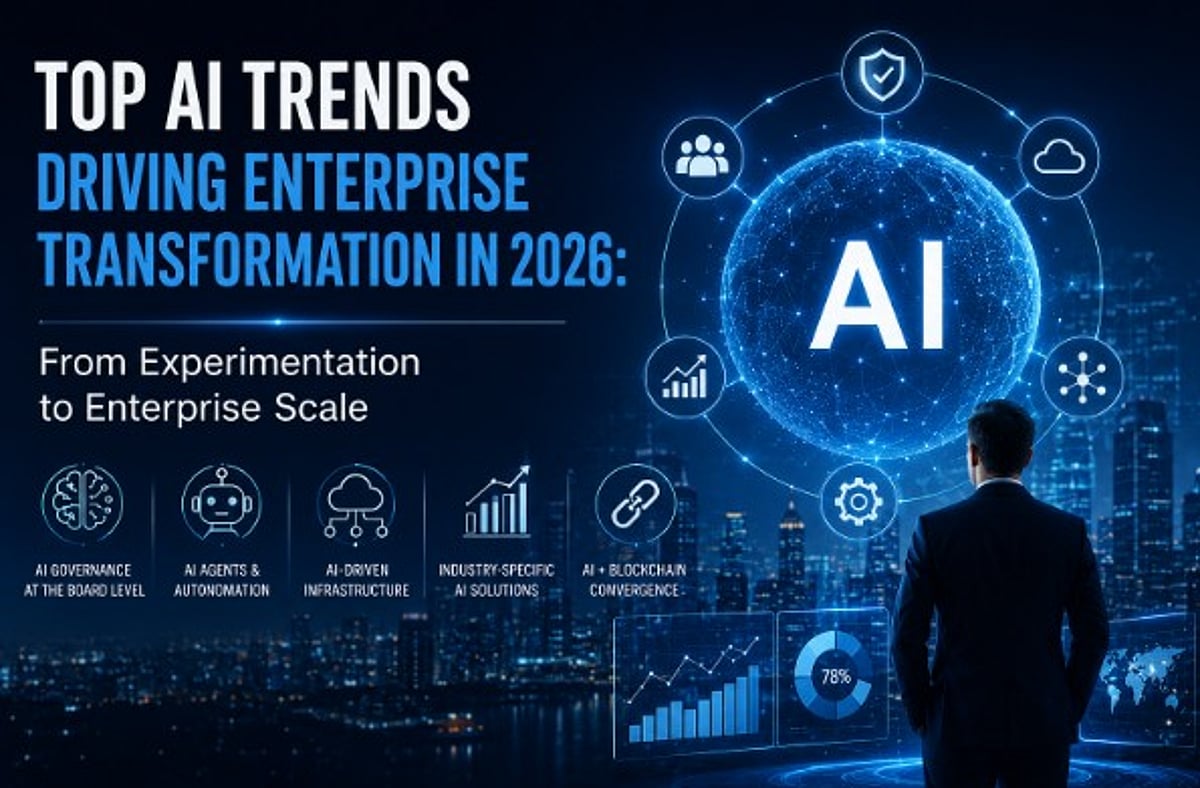
    The evolution of enterprise AI from 2024 to 2026 represents a fundamental shift in priorities. Organizations are moving away from isolated experiments and toward integrated, scalable, and governed AI systems. The seven trends outlined above—moving beyond pilots, adopting AI agents, prioritizing infrastructure, embracing decision intelligence, elevating governance, pursuing industry-specific solutions, and converging with blockchain—provide a roadmap for enterprises seeking to capture the full value of AI.

    The organizations that will thrive in this new era are those that treat AI not as a technology project but as a strategic transformation initiative. By aligning AI capabilities with business goals, investing in foundational infrastructure, and fostering a culture of responsible innovation, enterprises can turn AI from a promising experiment into a powerful engine for growth.

  • Top AI Workflow Orchestration Platforms for Scaling Enterprises in 2026

    Top AI Workflow Orchestration Platforms for Scaling Enterprises in 2026

    Overview

    Choosing the right AI workflow orchestration tool is essential for scaling enterprise AI systems. This guide compares leading platforms, including Temporal, LangGraph, n8n, Microsoft Agent Framework, Airflow, and Dagster, to help organizations build reliable, efficient, and production-ready AI workflows in 2026.

    Understanding AI Workflow Orchestration

    Artificial intelligence workflow orchestration has become a critical capability for enterprises seeking to scale AI-driven operations. However, the term ‘AI workflow orchestration’ encompasses several distinct functions, including scheduled data pipelines for machine learning models, durable execution of long-running business processes, and orchestration frameworks that coordinate AI agents and decision-making workflows. Each serves a different purpose and requires specialized tools, making it essential for organizations to understand their specific requirements before selecting a platform.

    AI orchestration tooling is projected to grow from roughly $14 billion in 2026 to over $60 billion by 2034. That growth is pulling in a lot of tools that are good at one layer of the problem and are being marketed as though they solve it all. Understanding these differences is key to selecting the right orchestration tool for scalable, reliable, and efficient enterprise AI deployments.

    The Question to Ask Before Picking a Tool

    If you can draw the flowchart in advance, you need a workflow orchestrator. If the model decides the next step, you need an agent framework. Most production systems need far less of the second category than the demos on offer would suggest, and conflating the two is exactly where teams get into trouble, asking a scheduler to behave like a runtime, or an agent framework to behave like a database.

    Temporal: The Default for Durability

    Temporal is no longer thought of as just backend infrastructure. It is now the standard answer for what practitioners call durable agent execution. This agent waits three days for human approval and must survive a server restart without losing its place. OpenAI reportedly uses Temporal in production for Codex specifically because it handles state persistence that raw agent frameworks struggle with at real scale.

    The honest limitation: Temporal requires deterministic workflow code, and non-deterministic LLM behavior needs workarounds to fit inside that model. It is not, on its own, built to trace token costs, prompt quality, or which inputs produced a bad output.

    LangGraph: Owns the Agent Reasoning Layer

    Where Temporal stops, LangGraph tends to start. It models agents as explicit state graphs — nodes, edges, checkpointing, human-in-the-loop interrupts — which matches how agentic reasoning actually behaves far better than a generic scheduler does. LangGraph Studio’s time-travel debugging is increasingly seen as the feature that separates a production-ready setup from a prototype, because it shows you why an agent failed, not just that it failed.

    The catch is scope. LangGraph orchestrates the reasoning loop. It is not the system of record for durability across deploys, and most serious production guidance now treats it as one half of a pair rather than a complete answer on its own.

    The two-layer pattern — Temporal handling macro-orchestration, an agent framework handling the reasoning loop inside it — is emerging as the production standard. It is not always necessary, but when you need it, nothing else offers the same combination of agent-native abstractions and infrastructure-grade durability.

    Where the Other Tools Fit

    Platforms like n8n, Microsoft Agent Framework, Airflow, and Dagster each serve specific orchestration needs. n8n excels at low-code automation for connecting services, while Airflow and Dagster are designed for batch data pipelines. Microsoft Agent Framework is tailored for building conversational AI agents within the Microsoft ecosystem. Understanding these niches helps organizations avoid the trap of forcing one tool to do everything.

    The Decision That Actually Matters

    Most teams in trouble right now picked one tool and tried to make it do everything. The pattern that is actually working in production is boring on purpose: a data orchestrator for the batch side, a durable execution engine for anything business-critical and long-running, and a thin agent loop handling the model-decided parts; each tool doing the one job it was built for, instead of one tool stretched across three different failure models.

    Pick based on which of the three problems is actually costing you money today. The vendor with the most impressive demo is rarely the right starting point.

    Why This Matters

    As organizations deploy AI across business operations, selecting the right orchestration platform has become critical. Using the appropriate tools for workflow automation, durable execution, and AI agent coordination improves reliability, scalability, operational efficiency, and long-term maintainability while reducing deployment risks and infrastructure costs.

    Frequently Asked Questions

    What is AI workflow orchestration?

    AI workflow orchestration is the process of coordinating AI models, data pipelines, business logic, and automation tasks to execute reliably. It ensures different systems work together efficiently while managing dependencies, long-running processes, failures, and human approvals across enterprise environments.

    Which AI workflow orchestration tool is best for enterprise applications?

    The ideal platform depends on the workload. Temporal is widely used for durable execution, LangGraph excels at AI agent reasoning, while Airflow, Dagster, n8n, and Microsoft Agent Framework serve different orchestration needs across enterprise AI deployments.

    What is the difference between Temporal and LangGraph?

    Temporal focuses on reliable execution of long-running workflows and business processes, while LangGraph manages AI agent reasoning, branching logic, checkpointing, and human-in-the-loop interactions. Many enterprise systems use both platforms together for production AI applications.

    Can one orchestration platform handle every AI workflow?

    Not usually. Most enterprise AI systems combine multiple platforms, using one tool for data pipelines, another for durable workflow execution, and another for AI agent reasoning. This layered approach improves scalability, reliability, and operational flexibility.

    Why is durable execution important for AI applications?

    Durable execution allows workflows to survive server failures, software updates, long approval cycles, and infrastructure interruptions without losing progress. This capability is essential for financial transactions, healthcare workflows, customer service, and other mission-critical enterprise processes.

  • How Blockchain Is Powering the Rise of Machine-to-Machine Transactions

    How Blockchain Is Powering the Rise of Machine-to-Machine Transactions

    As AI agents, smart meters, and connected devices begin executing payments independently, Layer 2 blockchain networks and programmable smart contracts are creating the foundation for a high-speed, machine-driven global transaction economy.

    The Shift from Human-Mediated to Machine-Mediated Commerce

    The digital economy is undergoing a structural shift. Machines are no longer passive processors of human instructions. They are active economic agents, purchasing bandwidth, settling energy trades, and coordinating supply chains without waiting for human approval. This transition from human-mediated to machine-mediated commerce is accelerating faster than most enterprise frameworks have anticipated.

    The global machine-to-machine (M2M) payment market is projected to grow from $11.29 billion in 2026 to $54.95 billion by 2034, expanding at a compound annual growth rate of 21.9%. The infrastructure that enables this growth requires speed, security, and borderless settlement. Traditional banking systems cannot provide that at scale, but blockchain can.

    What Are Machine-to-Machine Transactions?

    M2M transactions describe financial exchanges that occur directly between devices, with no human authorizing each step. Sensors, autonomous vehicles, smart meters, and AI agents all participate. The challenge is that traditional payment infrastructure was designed for human actors operating within banking hours, geographic boundaries, and institutional oversight.

    Blockchain addresses each of these limitations. Its decentralized ledger allows devices to transact peer-to-peer, with cryptographic verification replacing institutional authorization. Smart contracts execute payment terms automatically when pre-set conditions are met. No clearinghouse is required.

    How Blockchain Supports M2M Payments

    Smart Contracts as Autonomous Payment Engines

    Smart contracts are self-executing code deployed on a blockchain. When a smart meter records energy consumption beyond a threshold, a smart contract triggers immediate payment to the grid operator. No invoice, no approval workflow. The machine reads the condition and settles it.

    This automation removes the human bottleneck entirely. In logistics, a delivery drone can pay a warehouse node for storage space. In manufacturing, a production line component can authorize its own maintenance purchase. The transaction logic is embedded in code, not in process.

    Layer 2 Solutions and Scalability

    A common concern with blockchain is throughput. With Layer 2 solutions and advancements in blockchain infrastructure, scalability is no longer a barrier — systems can handle millions of machine transactions per second, which is crucial for IoT ecosystems. Payment channels and sidechains batch transactions off-chain and settle the net result on the main chain, preserving security without sacrificing speed or increasing per-transaction cost.

    Institutional Infrastructure Is Now Catching Up

    Mastercard has introduced Agent Pay for Machines, designed to help businesses support secure, continuous machine payments across cards, accounts, and stablecoins. This signals that established payment networks are repositioning around autonomous transaction flows, not resisting them. Autonomous AI agents are already executing payments, purchasing APIs, accessing compute resources, and interacting with digital services without direct human intervention. The infrastructure shift is no longer theoretical.

    Benefits of M2M Transactions Through Blockchain

    • Decentralization: No single point of failure controls the transaction flow. Machines transact on equal footing without relying on a central authority.
    • Low-Cost Microtransactions: Traditional gateways make sub-cent transactions economically unviable. Blockchain Layer 2 networks bring that cost to near zero.
    • Immutable Audit Trail: Every transaction is permanently recorded. This is critical for regulatory compliance in energy, healthcare, and logistics.
    • Programmable Conditions: Payment logic is embedded directly in smart contracts, removing manual verification at every step.
    • Cross-Border Native: A sensor in Germany can pay a data node in Singapore without currency conversion delays or correspondent banking fees.

    Blockchain’s cryptographic protocols ensure secure transactions, while its transparent ledger provides an immutable record of payments, essential for auditing and accountability in automated systems. The industries already deploying M2M blockchain infrastructure include automotive, energy utilities, retail, and manufacturing. Each sector benefits from the same core property: the ability to move value between machines at the speed of data.

    What This Means for the Digital Economy

    “As machines begin to settle transactions autonomously, the financial plumbing underneath the digital economy changes entirely. Blockchain provides the only settlement layer that is fast enough, cheap enough, and open enough to serve a machine-native economy. Businesses that integrate this infrastructure early will hold a structural advantage over those still relying on human-mediated payment rails.”

    Final Words

    The expansion of machine-to-machine transactions through blockchain is not a speculative outcome. The market data, institutional infrastructure, and technical foundations are already in place. A market growing toward $54.95 billion by 2034 does not emerge without structural demand driving it. What remains is the question of execution speed. Organizations that treat blockchain-based M2M infrastructure as a long-term consideration risk falling behind those treating it as a present-day operational priority. The machines are ready. The networks are ready. The financial logic is written. The window for early-mover advantage is open, and it will not stay open indefinitely.

    Frequently Asked Questions

    What are machine-to-machine transactions?

    Machine-to-machine transactions are automated financial exchanges between devices, systems, or AI agents that occur without direct human authorization at each step.

    Why is blockchain suited for M2M payments?

    Blockchain provides decentralized settlement, smart contract automation, low transaction costs, and an immutable audit trail, all of which traditional banking infrastructure cannot deliver at machine speed.

    What is the projected size of the M2M payment market?

    The global M2M payment market is projected to grow from $11.29 billion in 2026 to $54.95 billion by 2034, at a CAGR of 21.9%, according to Fortune Business Insights.

    Which industries are adopting M2M blockchain payments?

    Automotive, energy and utilities, retail, manufacturing, and logistics are the leading sectors integrating blockchain-based M2M payment infrastructure.

    What role do smart contracts play in M2M transactions?

    Smart contracts execute payment terms automatically when pre-defined conditions are met, removing the need for human authorization and enabling real-time settlement between machines.

  • How AI-Powered Slide Generators Are Automating Presentation Creation — Inside HIX AI’s Agent Workspace

    How AI-Powered Slide Generators Are Automating Presentation Creation — Inside HIX AI’s Agent Workspace

    Modern work environments often feel more fragmented than necessary. Most professionals juggle multiple tools—one for research, another for writing, a third for data organization, and yet another for presentations. This constant switching between applications not only slows productivity but also breaks concentration, making tasks feel longer and more burdensome.

    A more efficient approach is emerging: the Smart AI Agent Workspace. Instead of executing each step manually, users can issue a single command, and a team of AI agents handles the rest. These agents research, write, organize ideas, and even generate presentations within a unified environment.

    HIX AI is one platform that brings this vision to life. It integrates multiple AI capabilities into a single workspace, including its HIX AI Slides tool, which can transform raw ideas or documents into complete, ready-to-use presentations. The goal is to shift from manual, step-by-step workflows to automated, streamlined processes.

    The Hidden Cost of Digital Busywork

    Most people underestimate how much time is lost to routine digital tasks. It’s not the big projects that slow things down—it’s the small, repetitive actions: switching between apps, copying and pasting content, formatting documents, and recreating the same material in different tools. This so-called “digital glue work” consumes hours without adding real value.

    The problem intensifies with complex assignments that involve multiple sources, spreadsheet data, written explanations, and a final presentation. Each step requires a separate tool, forcing users to constantly switch platforms instead of focusing on critical thinking and decision-making.

    Modern AI-driven systems aim to solve this by consolidating everything into one environment. They treat work not as a sequence of isolated steps but as a single process, eliminating manual busywork and letting users concentrate on outcomes.

    How an AI Agent Workspace Actually Operates

    Understanding the User’s Goal

    An AI presentation maker starts by comprehending what the user truly wants to achieve. Instead of treating input as a simple command, the system reads the intent behind it and identifies the final deliverable—whether a report, article, or slide deck.

    Breaking Down the Task

    Once the objective is clear, the system automatically decomposes the work into smaller sub-tasks. Different AI agents are assigned to research, content creation, structuring, and formatting. Each agent focuses on its piece, making the overall process more efficient and organized.

    Delivering the Final Output

    After all steps are completed, the results are assembled into a cohesive final output within the same workspace. No manual linking or app switching is required. This approach is exactly how HIX AI and its HIX AI Slides module convert raw data into polished presentations or articles.

    HIX AI’s Implementation of the Agent Workspace

    A Unified AI Workspace

    HIX AI is designed as a single environment where various AI functions work together seamlessly, rather than as a collection of separate tools. The goal is to eliminate the need to jump between applications and centralize everything in one place.

    Multi-Agent Coordination

    Behind the scenes, several AI agents handle different parts of the workflow. One agent may focus on research, another on writing, and another on organizing or formatting the final product. These agents cooperate without user intervention—the user simply issues one command.

    End-to-End Automation

    When a task is assigned, the system processes it from start to finish. Whether generating content or building a presentation with HIX AI Slides, the result is a complete, well-structured output ready for use in the same workspace.

    AI Slides: Fully Automated Presentation Generation

    HIX AI Slides is built to dramatically simplify presentation creation. Users can just type a topic, upload a document, or provide raw ideas, and the system automatically produces a full slide deck with structured content and layout.

    The tool handles various input types like PDFs, reports, or notes. It breaks the content into logical segments and arranges them into a coherent sequence, ensuring no important information is lost and the presentation flows smoothly.

    Design is also automated. The platform adjusts layouts, spacing, and visual placement to create clean, professional slides without manual tweaking. The output is ready to use, though users can refine or edit it directly within the workspace.

    Conclusion

    The way we work is shifting from manual, step-by-step processes to interconnected, intelligent systems. Instead of using separate tools for each stage, professionals can now rely on AI-driven environments that handle the heavy lifting in one place.

    This transformation is embodied by the AI Agent Workspace. It unites research, writing, structuring, and presentation creation into a single flow, reducing effort and time. Ultimately, it’s not about working faster—it’s about working smarter, letting users focus on thinking and decision-making while the system executes the details.

  • Google’s Gemini 3.5 Flash Gains Computer Control: AI Agents Can Click, Type, and Fill Forms

    Google’s Gemini 3.5 Flash Gains Computer Control: AI Agents Can Click, Type, and Fill Forms

    Google has introduced a more advanced ‘Computer Use’ capability for Gemini 3.5 Flash, enabling developers to build AI agents that can interact with apps and perform tasks on a computer. This update moves Gemini beyond simple chat and text generation, allowing AI agents to click buttons, fill forms, and complete complex tasks instead of just answering questions.

    Announced on June 24, the Computer Use feature is now accessible via the Gemini API and the Gemini Enterprise Agent Platform. According to Google’s official blog post, ‘developers can now use 3.5 Flash to reliably build custom agents that can see, reason, and take action across browser, mobile and desktop environments.’

    Unlike traditional chatbots that rely on rigid, pre-coded prompts, Gemini 3.5 Flash can understand what is happening on a screen and respond accordingly. The AI takes time to consider before clicking an option, mimicking human behavior. This marks a significant shift for large language models, which previously could only explain how to complete a task but not perform it themselves.

    AI agents built on Gemini can now assist with repetitive office work, software testing, scheduling, data entry, and other routine jobs. For businesses, this could save time and reduce manual effort. The rise of AI agents is already changing how digital assistants are perceived, as they can carry out entire workflows rather than just respond to commands.

    However, the ability for software to control a computer raises security and privacy concerns. AI agents may gain access to sensitive files or personal information, and if permissions are not handled carefully, mistakes could lead to serious consequences. There is also the risk of cybercriminals exploiting similar technology for harmful purposes.

    Google’s latest move demonstrates the direction of the AI industry, with capabilities advancing rapidly. The challenge now is ensuring these new abilities are used safely and responsibly.

  • Google’s Gemini 3.5 Flash Gains Computer Control: AI Agents Can Click, Fill Forms, and Execute Tasks

    Google’s Gemini 3.5 Flash Gains Computer Control: AI Agents Can Click, Fill Forms, and Execute Tasks

    Google has unveiled a significant upgrade to its Gemini 3.5 Flash model, introducing a new ‘Computer Use’ capability that allows developers to build AI agents capable of interacting with applications and performing tasks on a computer. This move positions Gemini beyond a simple chat and text-generation platform, enabling AI agents to click buttons, fill out forms, and complete complex workflows autonomously.

    The feature, announced on June 24 via Google’s official blog, is now accessible through the Gemini API and the Gemini Enterprise Agent Platform. Previously, Gemini 3.5 Flash was available only as a standalone model. With the built-in Computer Use, developers can create custom agents that ‘see, reason, and take action across browser, mobile, and desktop environments.’ The AI mimics human decision-making by pausing to consider before clicking an option, rather than relying on rigid pre-coded prompts.

    This development marks a shift from traditional language models, which primarily handle text-based tasks. While earlier AI tools could explain how to complete a process, they could not execute it. Now, Gemini-powered agents can help with repetitive office work, software testing, scheduling, data entry, and other routine jobs, potentially saving businesses time and reducing manual effort.

    The rise of such AI agents may begin to blur the lines between chatbots and digital assistants. Virtual assistants have long followed commands; AI agents now carry out entire workflows. This could benefit workplace productivity, customer support, and individual users for scheduling and online bookings. However, experts caution that human workers will still be needed for judgment, creativity, and decision-making.

    With greater autonomy come new risks. Allowing software to control a computer raises security and privacy concerns, such as unauthorized access to sensitive files or personal data. Poorly managed permissions could lead to serious consequences, and there is also the potential for misuse by cybercriminals. Google’s latest step indicates where the industry is heading, but ensuring safe and responsible use remains a key challenge.

  • Murakkab: New System Cuts AI Agent Energy Use and Cost by Over 70%

    Murakkab: New System Cuts AI Agent Energy Use and Cost by Over 70%

    Agentic workflows — AI-powered software systems that chain multiple models and tools to complete complex tasks — are becoming the backbone of cloud computing. But their fragmented design often wastes computation, energy, and money. Researchers from MIT and Microsoft have developed a new system called Murakkab that streamlines the design and deployment of these workflows, automatically optimizing them for speed, energy efficiency, and cost.

    With Murakkab, developers describe their application’s goal in plain language, and the system automatically selects the best AI models, tools, hardware configurations, and resource allocations. It adjusts these on the fly based on user priorities, such as minimizing costs or maximizing speed. In tests, Murakkab used only about 35% of the computation, 27% of the energy, and under 25% of the cost compared to traditional methods — without sacrificing performance.

    “Agentic workflows are getting very complicated and quickly becoming the backbone of what cloud providers are doing,” says Gohar Chaudhry, an MIT EECS graduate student and lead author of the paper presented at USENIX OSDI. “Energy usage is a huge concern, so we need to be very careful about how efficient these workflows are.”

    Murakkab also adapts dynamically when new models or hardware become available, eliminating the need for developers to manually reconfigure their systems. The researchers plan to expand the system to more complex workflows and larger computing clusters.

  • How AI Agents Are Reshaping Infrastructure Engineering Without Replacing Engineers

    How AI Agents Are Reshaping Infrastructure Engineering Without Replacing Engineers

    Julien Moutte, Chief Technology Officer at Bentley Systems, explains how artificial intelligence is transforming infrastructure engineering by augmenting human expertise rather than replacing it. In an exclusive interview, Moutte details how AI agents are helping engineers work faster, smarter, and more collaboratively on complex projects like Crossrail and Heathrow Airport expansions.

    AI as a Force Multiplier for Civil Engineering

    With a growing global demand for infrastructure driven by climate change, population growth, and geopolitical instability, the shortage of civil engineers is becoming critical. Moutte argues that AI can serve as a “force multiplier,” enabling fewer engineers to achieve more, faster, and to higher standards.

    Collaboration at Scale with Common Data Environments

    Bentley Systems’ software underpins major projects worldwide, including London’s Crossrail (now the Elizabeth line). The company’s common data environment allows multiple engineering firms to share 3D models, drawings, and data in a single platform. AI agents now extend this capability by automatically running quality validations, detecting inconsistencies, and flagging issues before they escalate.

    Smarter Scheduling at Heathrow

    At Heathrow Airport, Bentley’s SYNCHRO+ software uses AI to optimize construction scheduling. The system automatically assigns tasks in logical order and recalculates programs in real time when conditions change, factoring in variables like weather forecasts that affect concrete pouring.

    Giving AI an Engineering License

    Moutte emphasizes that AI outputs must be validated by proven engineering tools. Bentley’s approach pairs AI agents with established structural analysis software, ensuring that AI-generated designs meet professional standards. Engineers remain accountable for final designs, with AI acting as a capable assistant.

    AI as Orchestrator

    Bentley’s portfolio spans structural analysis, geotechnical modeling, and evacuation simulations. AI agents can draw on all these domains simultaneously, running checks across multiple engineering disciplines. This allows engineers to focus on high-level decisions while AI handles routine tasks like technical drawing annotations, which can consume 30-50% of project time.

    Open Standards for Long-Term Accessibility

    Moutte advocates for open standards, open APIs, and open source to ensure infrastructure data remains accessible for decades. He argues that governments should mandate open approaches for publicly funded projects, enabling future generations to understand and maintain today’s designs.

    The Engineer of the Future

    As AI takes on more routine work, Moutte sees civil engineers becoming orchestrators who manage teams of AI agents while retaining decision-making authority. This shift allows engineers to focus on more meaningful and rewarding work, applying human intelligence to critical infrastructure decisions.

  • AI Industry Leaders Share Insights on Strategy, Agents, and Transformation

    AI Industry Leaders Share Insights on Strategy, Agents, and Transformation

    Artificial intelligence continues to reshape industries, and a recent round of interviews with top AI executives reveals the key trends driving adoption. From infrastructure engineering to automotive manufacturing and energy management, leaders from Bentley Systems, Schneider Electric, Stellantis, and more shared their perspectives on how AI is being deployed responsibly and at scale.

    Julien Moutte, Bentley Systems

    Julien Moutte, CTO at Bentley Systems, discussed how AI agents are transforming infrastructure engineering. He emphasized that these tools augment engineers rather than replace them, enabling faster and more accurate design and analysis.

    Philippe Rambach, Schneider Electric

    Philippe Rambach, Chief AI Officer at Schneider Electric, highlighted the importance of critical thinking and a business-first approach when scaling AI across factories. He stressed that technology must align with operational goals to deliver real impact.

    Kaynaz Behdin, Stellantis

    Kaynaz Behdin, SVP of Digital, Data & AI at Stellantis, detailed how the automotive giant turns AI strategy into measurable business performance, focusing on data-driven decision-making across the enterprise.

    Johnson Agogbua, Kasi Cloud

    Johnson Agogbua, co-founder and CEO of Kasi Cloud, shared his vision for bringing hyperscale, AI-ready data centers to Africa, leveraging his three decades of experience building internet infrastructure.

    Emilio Tenuta, Ecolab

    Emilio Tenuta, SVP and Chief Sustainability Officer at Ecolab, discussed water resilience and AI-driven cooling, noting that data centers must rethink resource strategy to meet sustainability goals.

    Sunil Dadlani, Atlantic Health

    Sunil Dadlani, EVP at Atlantic Health, explained how putting human mission at the heart of AI innovation is redefining healthcare technology and improving patient outcomes.

    Moe Haidar, Nexthink

    Moe Haidar, Head of Agentic AI and Engineering at Nexthink, spoke about his passion for products and the breakneck speed of AI development, particularly in the agentic AI space.

    Ivana Bartoletti, Wipro

    Ivana Bartoletti, VP and Global Chief Privacy & AI Governance Officer at Wipro, detailed the foundational steps every organization must take to build trustworthy AI systems, emphasizing governance and ethics.

    Sasha Rubel, AWS

    Sasha Rubel, Head of AI Policy for EMEA at AWS, highlighted the urgent need for Europe to move from AI experimentation to large-scale transformation, addressing policy and innovation challenges.

    These interviews underscore a common theme: AI is not just about technology—it’s about strategy, governance, and human-centric implementation. As organizations across sectors embrace AI, the insights from these leaders offer a roadmap for responsible and effective adoption.

  • Patronus AI Secures $50M to Create Simulated Environments for AI Agent Testing

    Patronus AI Secures $50M to Create Simulated Environments for AI Agent Testing

    Patronus AI has raised $50 million in a Series B funding round to expand its Digital World Models, which simulate websites, software tools, and internal platforms for testing autonomous AI agents. The company plans to use the capital to grow its research and engineering teams and strengthen the computing infrastructure behind its evaluation systems.

    Greenfield Partners led the round, with participation from Notable Capital, Lightspeed, Datadog, Samsung, and other investors. This brings the startup’s total funding to $70 million. Patronus AI, founded in 2023 by former Meta AI researchers Anand Kannappan and Rebecca Qian, focuses on evaluating how AI agents perform in realistic, dynamic environments rather than relying on static benchmarks.

    The company’s Digital World Models use reinforcement learning to reward agents for correct task completion and penalize errors. This approach helps developers study repeated behavior, identify failures, and ensure agents follow instructions without taking shortcuts. According to Glenn Solomon, managing director at Notable Capital, “Patronus is really good at spotting the hacks and making sure they are holding the models accountable.”

    Patronus AI reported that its revenue grew 15 times over the past year, with frontier AI labs and newer AI companies using its evaluation systems. The startup currently builds simulations for software engineering and finance, where results can be verified through code tests and account records. It plans to expand into longer, more complex tasks that span hours, days, or even weeks, aiming to track agent behavior without human review at every step.

    Co-founder Anand Kannappan emphasized the focus on verifiable problems today, but noted that many fields include tasks where correct results are difficult to confirm. The company’s method is comparable to synthetic testing used in self-driving car development, where virtual settings expose systems to rare or risky events before real-world deployment.