Tag: AI agents

  • Agentic AI Explained: Autonomy, Planning, and a $290 Billion Market by 2035

    Agentic AI Explained: Autonomy, Planning, and a $290 Billion Market by 2035

    What Is Agentic AI?

    Agentic AI represents a fundamental shift from traditional artificial intelligence. Instead of simply responding to a single prompt, agentic systems set their own path toward a goal, adapt to changing conditions, and complete multi-step tasks with minimal human intervention. This autonomy, combined with planning, memory, and tool use, enables them to pursue complex objectives in dynamic environments.

    The global market for agentic AI is projected to grow from USD 8.19 billion in 2025 to USD 290.62 billion by 2035, a compound annual growth rate of 42.88%. This rapid adoption reflects a real change in how enterprises view automation and intelligent systems.

    Core Concepts Behind Agentic Systems

    Agentic AI is built on several key capabilities:

    • Autonomy: Systems operate with minimal oversight once a goal is defined, though humans may still approve high-risk actions.
    • Goal-oriented behavior: Large objectives are broken into smaller tasks through task decomposition.
    • Reasoning and planning: The system compares options and settles on a workable sequence of actions.
    • Decision-making: Actions are chosen based on current context, not fixed scripts.
    • Adaptability: The system adjusts when conditions change mid-task.
    • Environmental awareness: New inputs are read and plans updated accordingly, crucial in fast-moving fields like finance or healthcare.
    • Learning from feedback: Reinforcement learning sharpens future choices through rewards and penalties.
    • Tool use: Agents can query databases, run calculations, or trigger business actions beyond their training data.
    • Memory: Agents recall earlier steps during long tasks, often enhanced by retrieval-augmented generation (RAG).

    The Basic Agentic AI Process

    Agentic systems operate on a continuous loop rather than a single exchange. A goal is defined, the system studies the situation, drafts a plan, and takes action. It then checks the results and learns from them, repeating the cycle until the objective is reached. This loop marks the clearest distinction between agentic AI and older, one-shot tools.

    The Evolution of Agentic AI

    The concept of agentic AI has roots stretching back eight decades:

    • Early Foundations (1943-1990s): Neural network theory, the Turing Test, and the Dartmouth conference (1956) set the intellectual groundwork. Shakey the Robot combined perception and planning in the early 1970s. Expert systems, backpropagation, and early reinforcement learning followed through the 1980s and 1990s.
    • Deep Learning and Reasoning (2012-2022): AlexNet (2012) demonstrated the power of deep neural networks for perception. DeepMind’s AlphaGo (2016) paired deep learning with reinforcement learning. The Transformer architecture (2017) reshaped language modeling. By 2022, research like ReAct fused reasoning with action, and ChatGPT brought large language models into everyday use.
    • The Agentic Era (2023-2026): Toolformer (2023) showed that language models could learn when to call outside tools. AutoGPT and BabyAGI popularized goal decomposition. The Model Context Protocol (2024) gave agents a common way to reach tools and data. Google’s Agent2Agent protocol (2025) allowed agents built on different platforms to communicate. Enterprises are now integrating these capabilities into orchestration, identity, and governance frameworks.

    Market Growth and Outlook

    According to Analytics Insight’s Global Agentic AI Market Report, the market is expected to surge from USD 8.19 billion in 2025 to USD 290.62 billion by 2035, at a CAGR of 42.88%. This growth reflects enterprise confidence in agentic AI’s ability to deliver real value. However, success will depend not only on model quality but also on reliability, governance, and clean integration. Organizations that master these fundamentals now will be best positioned to capture value as the technology matures.

    Frequently Asked Questions

    1. What is the main difference between agentic AI and traditional AI?
    Traditional AI generally completes one task at a time, such as answering a question or translating text. Agentic AI instead pursues a broader goal, planning steps and adapting to changing conditions on its own.

    2. What are AI agents?
    AI agents are self-contained software systems designed to gather information, make decisions, and act toward a specific objective. They serve as the individual building blocks that make up larger agentic AI systems and workflows.

    3. What core capabilities define agentic AI systems?
    Agentic AI relies on autonomy, goal-oriented behavior, reasoning, planning, decision-making, and adaptability. It also depends on memory, tool use, and learning from feedback, allowing systems to complete complex, multi-step tasks reliably over time.

    4. When did agentic AI evolution begin?
    Its roots trace back to early neural network research in 1943 and the founding of artificial intelligence in 1956. Recent progress accelerated after 2022, when reasoning models, tool use, and agent frameworks matured quickly.

    5. How large is the global agentic AI market expected to become?
    The global agentic AI market was valued at USD 8.19 billion in 2025. It is projected to reach USD 290.62 billion by 2035, growing at a CAGR near 42.88%.


  • Banks Warn AI Shopping Bots Risk Wrong Purchases and Payment Data Exposure

    Banks Warn AI Shopping Bots Risk Wrong Purchases and Payment Data Exposure

    Major banks are sounding the alarm over the rise of AI shopping assistants that can search for products and even complete purchases on behalf of consumers. The concerns range from incorrect purchases and scams to exposure of payment data and weaker consumer protections, prompting calls for clearer standards around AI-driven commerce.

    AI Agents Could Make Purchases on Your Behalf

    The technology, often described as “agentic commerce,” allows an AI system to act on a shopper’s instructions rather than simply providing recommendations. Depending on the design, an agent could search for a product, select an option, and potentially complete the transaction. A group including NatWest, Bank of America, ING, Capital One, ASB Bank, and Commonwealth Bank of Australia has raised concerns about scams, fraud, and misuse of financial data.

    The warning comes as technology companies including OpenAI, Google, Anthropic, and Meta develop AI agents capable of assisting with or carrying out shopping tasks. The banks said adoption is outpacing existing industry standards and consumer protections.

    UK retailer John Lewis reported that searches originating from AI agents rose to 2.5% this year, up from 0.3% a year earlier, signaling rapid growth in AI-driven shopping.

    Card Details and Payment Risks

    Financial information is another major concern. The banking group highlighted situations in which AI agents could request customers’ card details and enter them directly into websites. There are also concerns that an AI agent could steer a shopper toward payment methods that provide weaker fraud or purchase protections. If a transaction goes wrong, consumers may not know whether the retailer, payment provider, or AI service is responsible.

    Banks Seek Clearer AI Commerce Rules

    The participating banks plan to discuss a set of proposals with policymakers. These include requiring businesses to disclose when an AI agent is involved in a transaction and providing greater transparency about how the technology makes purchasing decisions. The group also called for stronger safeguards around customer data, along with freedom for consumers and merchants to choose which AI-powered commerce services they use. Interoperability between different AI shopping systems was another principle included in the framework.

    As AI moves from recommending products to acting on shoppers’ behalf, the debate increasingly shifts toward who controls these transactions and who takes responsibility when something goes wrong.

  • Qualcomm’s Agentic AI Vision Could Reshape Smartphones — But Raises Data Privacy Concerns

    Qualcomm’s Agentic AI Vision Could Reshape Smartphones — But Raises Data Privacy Concerns

    Qualcomm CEO Cristiano Amon recently outlined a future where smartphones evolve from simple command receivers into proactive AI agents capable of understanding user intent and completing tasks autonomously. Speaking at the Snapdragon Summit 2026 in Maui, Amon described the transition to an ‘agentic age,’ where artificial intelligence becomes the central driver of the mobile experience.

    “We are going from a phone-centric model to an agent-centric model. Going forward, agents will become the center of experience. We can finally see what an AI phone truly means,” Amon said.

    To support this vision, Qualcomm unveiled two new mobile platforms: the Snapdragon 8 Elite Gen 6 and Snapdragon 8 Elite Gen 6 Extreme. These chips are designed to handle substantial AI workloads locally, reducing the need to offload every task to the cloud. This local processing could enable faster, more private interactions — but it also requires the phone to access more personal data, such as calendars, messages, and shopping details, to anticipate user needs.

    Amon acknowledged the importance of user permission and context, stating, “The permission to use will be very important. And, so is context. Because the phone is very personal and specific to you. Agentic AI will need your phone to do a lot more than just execute tasks for you.”

    The shift could fundamentally change how users interact with their devices. Instead of manually controlling every step, users might only need to approve key actions while the phone handles the rest. Qualcomm expects this agentic model to extend beyond smartphones to PCs, smart glasses, wearables, and cars, creating a seamless ecosystem of interconnected devices.

    As AI agents take on more responsibility, the balance between convenience and privacy becomes critical. Users will need clear visibility into what their devices access and when they are allowed to act. Transparent permission controls and user oversight will be just as important as AI performance in earning trust.

  • WhatsApp Begins Testing Third-Party AI Agents on iPhone—With a Privacy Catch

    WhatsApp Begins Testing Third-Party AI Agents on iPhone—With a Privacy Catch

    WhatsApp expands AI agent testing to iPhone

    WhatsApp is taking another step toward integrating third-party artificial intelligence into its messaging app. The latest beta release for iOS — version 26.37.10.70 — lets select iPhone users in limited countries connect external AI agents directly inside chats. The rollout follows earlier testing on Android, with WABetaInfo reporting the update on September 22. WhatsApp also confirmed that the feature supports independent agents built by outside developers.

    How the new AI agent feature works

    Eligible users can create up to five third-party agents and interact with them through dedicated one-to-one conversations. Setting up an agent begins in the WhatsApp settings menu, where users assign a name and profile photo. WhatsApp then generates an API key that links the agent to its external hosting service, allowing the agent to respond in the chat.

    According to WABetaInfo, the API key connects WhatsApp with the external service running the agent. Users can reset the key if needed, and the key should be kept private. WhatsApp may adjust the five-agent limit in the future.

    What agents can and cannot access

    Third-party agents are deliberately isolated from most WhatsApp data. They can only see information shared directly with them in their designated conversation. Agents cannot access other chats, contacts, or media stored in WhatsApp, and group chats and communities are not included in the current setup.

    Privacy limits: No end-to-end encryption for agent chats

    The most important caveat is privacy. While regular personal chats remain protected by end-to-end encryption, WhatsApp explicitly says communications with third-party agents are not end-to-end encrypted.

    Messages sent to an agent travel through a Meta service that manages the conversation for the provider. That means the agent provider can receive, process, and store messages in unencrypted form. The provider is also responsible for its own data practices, including how it handles requests for access, deletion, correction, or data portability.

    What users should consider before trying AI agents

    This feature adds new functionality without extending WhatsApp’s standard encryption protections. Anyone thinking about connecting a third-party AI agent should review the provider’s privacy terms carefully before sharing sensitive information.

    WhatsApp has not announced a broader release date for the feature. The iOS rollout is still limited, so the final experience could change before it becomes widely available.

  • Baselayer Secures $35M to Create a Trust Infrastructure for Autonomous AI Agents

    Baselayer Secures $35M to Create a Trust Infrastructure for Autonomous AI Agents

    Baselayer has raised $35 million in a funding round led by M13 to build what it describes as a ‘trust layer’ for artificial intelligence agents. The investment comes as enterprises increasingly rely on AI systems that can act autonomously and make critical decisions across business workflows.

    The new capital will support Baselayer’s efforts to develop infrastructure that provides AI agents with trusted business identity data, risk intelligence, and reliable decision-making capabilities. The platform aggregates business identity, people and ownership information, digital presence, and fraud, legal, credit, and compliance risk signals.

    Baselayer also introduced its Model Context Protocol (MCP), which gives AI agents direct access to the company’s business identity and risk intelligence. This system is designed to supply agents with evidence-backed context before they execute actions, reducing the risk of decisions based on incomplete or unreliable data.

    The company’s technology targets high-stakes workflows in compliance, procurement, finance, risk, and sales — areas where agentic AI is gaining traction but still requires robust controls around reliability and accountability. Customers can use Baselayer’s intelligence to verify businesses and associated individuals, conduct due diligence, monitor risk changes, and improve supplier evaluation.

    As AI agents move from answering questions to taking autonomous actions, questions of identity, accountability, and trust become paramount. Baselayer’s latest funding aims to close the infrastructure gap and support the emerging agentic economy.

  • LangGraph vs. LangChain: Selecting the Optimal AI Agent Framework

    LangGraph vs. LangChain: Selecting the Optimal AI Agent Framework

    The debate between LangChain and LangGraph has evolved from a simple comparison of two competing tools into a strategic decision about the right level of abstraction for your AI agent project. LangChain provides a streamlined, high-level API for building standard agents, while LangGraph offers granular control over state, workflows, persistence, and human-in-the-loop oversight. Understanding when to use each—and how they complement each other—is essential for delivering scalable, production-ready AI systems.

    Key Takeaways

    • LangChain is designed for rapidly building common AI agents with a higher-level API and fewer lines of code.
    • LangGraph delivers detailed control over state transitions, multi-step workflows, data persistence, approval gates, and long-running agents.
    • The two frameworks can work together: start with LangChain and migrate to custom LangGraph workflows as complexity grows.

    LangChain: Ideal for Standard AI Agent Projects

    LangChain centers on the core agent loop: a model receives a task, invokes tools, processes results, and returns an answer. Its create_agent API gives developers a direct path to this pattern. The framework also offers model abstractions, tool integrations, middleware support, and connections across multiple providers. This structure can significantly reduce the amount of boilerplate code needed for a typical agent.

    The 1.0 release streamlined the project: LangChain reduced its package surface and moved older features into langchain-classic. The current 1.x lineage emphasizes the agent loop and middleware. Note that LangChain 1.0 requires Python 3.10 or newer. Recent releases—such as LangChain Core 1.4.6—show active development including updates to create_agent, middleware types, structured output fallbacks, provider tools, and human-in-the-loop capabilities.

    LangGraph: Richer Control for Complex Workflows

    LangGraph takes a lower-level, graph-based approach. Developers define an agent workflow as a directed graph with nodes, state, and explicit transitions. This model fits systems where an agent must follow a fixed sequence, pause for human approval, resume after a long wait, or interleave deterministic code with model-driven decisions. LangChain officially describes LangGraph as a framework and runtime for highly customized agents and long-running production systems.

    State management is central to LangGraph. Workflows can retain data across steps, use persistence for extended tasks, and incorporate human review checkpoints. This becomes critical in domains like finance, customer support, and research, where autonomous decisions must be gated. Recent releases—LangGraph 1.2.11, for example—introduced updates to trace policies, checkpoint packages, SQLite and PostgreSQL support, and related SDK improvements.

    Main Difference Comes Down to Control vs. Simplicity

    LangChain shortens the common path; LangGraph makes the full path explicit. A straightforward support agent with a model and a few tools may only need LangChain. But a system requiring multiple decision points, stored state, retries, approval steps, and conditional routing benefits from LangGraph’s structure—at the cost of additional design effort.

    Critically, the two frameworks are not competitors. LangChain 1.0 runs its agents on LangGraph. Teams can start with create_agent and later embed that agent inside a custom LangGraph workflow when more control is needed. LangChain encourages this migration path as a way to evolve from a high-level agent to a custom graph without a full framework swap.

    Production Needs Determine the Right Framework

    Production requirements often tip the scale. A short, stateless agent task fits LangChain. A long-running business process demands stronger workflow orchestration. LangGraph targets long-running agents, stateful tasks, human reviews, multi-agent scenarios, and cases where teams need fine-grained control over latency or cost. The deployment story has also matured: the LangGraph Platform (now called LangSmith Deployment) supports running and managing LangGraph applications in production.

    Practical Guidance for New Projects

    For a standard agent with a clear model-tool-response cycle, choose LangChain. It offers a higher-level API and keeps the initial architecture simple. For systems where workflow state, persistence, approvals, custom routing, or long tasks matter from day one, start with LangGraph.

    The strongest aspect of the current ecosystem is the synergy between the two frameworks. LangChain does not lock agents into a separate runtime; its agents use LangGraph underneath. This gives every project a natural upgrade path—from a simple agent to a fully controlled workflow—without requiring a complete rewrite. Ultimately, the decision is about choosing the right level of control, not about picking a winner.

    Frequently Asked Questions

    1. What is the main difference between LangChain and LangGraph?

    LangChain provides a higher-level API for building common AI agents quickly, while LangGraph focuses on explicit workflow orchestration with state, persistence, and complex agent behaviors.

    2. Is LangGraph built on LangChain?

    Not exactly. LangChain agents run on LangGraph, meaning LangChain offers a high-level agent experience while LangGraph handles the underlying runtime and workflow capabilities.

    3. When should I use LangChain?

    Use LangChain when you need a straightforward model-tool-response agent and want to minimize custom workflow code.

    4. When should I use LangGraph?

    LangGraph is ideal when your application requires persistent state, multi-step workflows, human approval, retries, custom routing, or long-running processes.

    5. Can LangChain and LangGraph be used together?

    Yes. You can build an agent with LangChain and later integrate it into a custom LangGraph workflow as your application needs greater control and orchestration.

  • 10 Real-World Machine Learning Use Cases Reshaping Industries

    10 Real-World Machine Learning Use Cases Reshaping Industries

    Machine learning (ML) has evolved from a niche technology into a core enabler across industries. From fraud alerts that block suspicious payments in seconds to medical scans that assist in early disease detection, ML identifies patterns in data and uses them to make predictions, decisions, or take actions. Today’s systems go beyond recommendation engines, embedding AI into real business processes. Here are ten practical ways machine learning is applied in the real world.

    1. Recommendations and Personalization

    Streaming services, online retailers, music apps, and social platforms use ML to predict what users may want next. By analyzing past choices and viewing history, systems leverage deep learning and embeddings to deliver personalized experiences. Personalization is now integrated into larger AI ecosystems.

    2. Fraud Detection and Financial Risk

    Banks, payment processors, and insurers deploy ML to detect unusual activity. Models examine account history, location, device data, and transaction timing. Anomalous patterns can trigger reviews or block transactions. ML also supports credit risk assessment and insurance fraud investigation.

    3. Healthcare and Medical Diagnosis

    ML models analyze medical images, patient records, and lab results. Hospitals use ML for disease risk prediction, patient triage, image analysis, drug discovery, and clinical decision support. For instance, India’s eSanjeevani platform applies AI for retinal checks and differential diagnosis, while PM-JAY uses ML for fraud detection.

    4. Predictive Maintenance in Industry

    Factory sensors capture temperature, vibration, pressure, energy use, and sound. ML learns normal operating patterns and flags potential failures before they occur. This reduces unplanned downtime in aircraft engines, vehicles, power systems, data centers, and robotics.

    5. Computer Vision and Quality Control

    Computer vision enables machines to interpret images and video. Manufacturers use ML to detect product defects on assembly lines. Healthcare systems inspect medical scans. Multimodal AI systems combine visual data with text and other inputs for richer analysis.

    6. Search, Speech, and Language

    Search engines, speech recognition, translation services, email filters, virtual assistants, and chatbots rely on ML. Models classify text, convert speech to text, rank search results, and generate summaries. Large language models now process text, images, audio, and video. Stanford’s 2026 AI Index highlights rapid gains in multimodal capabilities and real-world task performance.

    7. Forecasts and Supply Chains

    Retailers apply ML to estimate demand using historical sales, seasonality, promotions, pricing, weather, and other signals. These forecasts improve inventory management, delivery routing, energy demand planning, and pricing decisions.

    8. Cybersecurity and Threat Detection

    Cybersecurity teams face massive volumes of logs, network events, and device signals. ML identifies patterns that deviate from normal behavior, helping detect malware, phishing emails, suspicious logins, account compromises, and potential data breaches.

    9. Autonomous Systems and Robotics

    ML enables robots, drones, autonomous vehicles, and industrial systems to interpret sensor data and choose actions. Self-driving cars combine computer vision, sensor fusion, prediction, and route planning. Robots navigate large warehouses to move goods. Gartner lists physical AI as a major data and analytics trend.

    10. Software Development and AI Agents

    Software teams use ML for code generation, code review, bug fixing, testing, documentation, and issue analysis. Advanced AI agents connect models with development tools to automate multi-step workflows. Applied’s April 2026 report studied nearly 200 real-world AI use cases across 200+ companies, 25 industries, and 15 business functions—operations accounted for 38.6% and software development for 21.4%.

    The Shift from Prediction to Action

    The most significant change in ML is the move from isolated predictions to integrated actions. Modern systems link predictions with tools, data, and business processes. Gartner notes organizations are adopting AI-first business models. Deloitte reports that worker access to sanctioned AI tools rose 50% in 2025, and the number of companies with at least 40% of AI projects in production is expected to double within six months. This shift demands reliable data, clear controls, and rigorous evaluation. Successful AI initiatives may invest up to four times more in data and analytics foundations than less successful ones. ML now acts as a core layer shaping decisions, operations, software, and physical tasks across numerous industries.

  • How AI Agents Will Reshape Everyday Life: A Glimpse Into the AI-First Future

    How AI Agents Will Reshape Everyday Life: A Glimpse Into the AI-First Future

    Artificial intelligence is moving beyond chatbots and recommendation engines. In an AI-first world, intelligent systems become the default layer of daily life — helping people set goals while AI agents quietly handle tasks across apps, devices, and digital services.

    Your Personal AI Agent Could Run Your Day

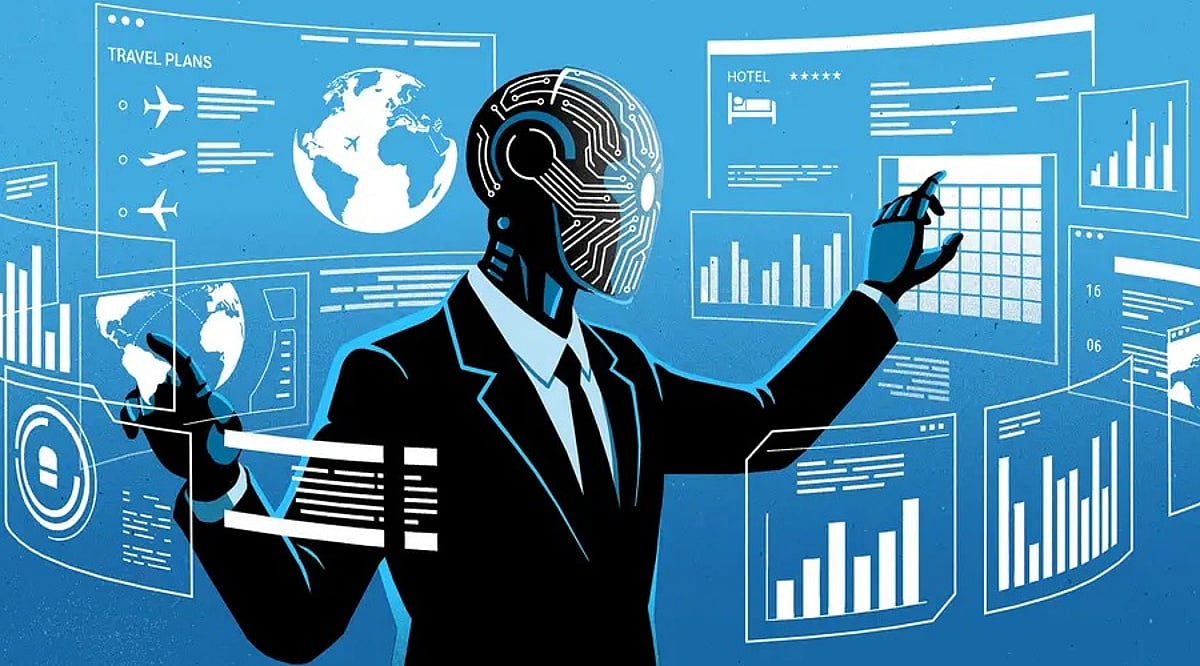
    Imagine a personal AI assistant that manages your calendar, books travel, pays bills, plans meals, tracks spending, and handles everyday errands. Instead of juggling multiple apps and reminders, you simply express an intention and your AI agent coordinates the rest.

    AI Could Become a Digital Coworker

    In the workplace, AI agents are expected to manage multi-step workflows such as research, report generation, coding, and customer support. That shift lets people focus on higher-value activities: making decisions, exercising judgment, and overseeing outcomes rather than performing routine execution.

    Learning Could Become Fully Personalized

    Education is another area poised for transformation. AI tutors could explain difficult concepts, generate practice questions, and adapt lessons to each student’s pace, level, and learning goals. This kind of personalization could make education more accessible and effective for learners of all ages.

    Healthcare Could Become More Proactive

    AI systems could combine wearable data, medical records, and broader health information to flag potential risks, track medications, and schedule follow-ups automatically. Instead of reacting to symptoms, patients and providers could work together to prevent problems before they escalate.

    Smart Homes Could Anticipate Your Needs

    Connected homes powered by AI could adjust energy use, control appliances, manage shopping lists, and optimize household routines based on daily habits and preferences. The home becomes an active participant in comfort and efficiency rather than a collection of manual devices.

    AI Could Change Jobs and Skills

    As agents take on more routine work, human roles will shift toward strategy, creativity, critical thinking, and reviewing AI-generated results. Microsoft reports that AI users in India are placing strong emphasis on human judgment and quality control — a sign that oversight skills will become increasingly valuable.

    More AI Access Also Means More Risks

    AI-first systems require access to sensitive data and digital accounts. That raises serious concerns about privacy loss, incorrect decisions, biased outputs, excessive permissions, and job disruption. Building trust will require careful governance, transparency, and safeguards.

    The most likely future is not one where AI replaces people, but one where daily life becomes human-led and AI-executed. The biggest shift will be moving from doing every task manually to setting goals, checking AI decisions, and retaining control over the choices that matter most.

  • Why AI Agents and Multi-Agent Systems Are the Must-Have GenAI Skills in 2026

    Why AI Agents and Multi-Agent Systems Are the Must-Have GenAI Skills in 2026

    Generative AI is evolving far beyond simple chatbots and prompt-based tools. In 2026, businesses are increasingly deploying AI agents that can execute multi-step tasks, interact with software tools, and collaborate across workflows. This shift is driving demand for professionals who not only use AI but also build, manage, and evaluate these complex systems.

    AI Skills Demand Surges

    The 2026 AI Index reveals a dramatic rise in job postings requiring agent-related skills in the United States. In 2025, 16,541 job postings mentioned Agentic AI, up from just 151 in 2024—a staggering 10,854% increase. Similarly, postings for AI agents grew 1,062% to 15,217, while multi-agent system mentions rose from 1,635 to 5,461. LangGraph-related postings jumped from 194 to 4,294. These numbers highlight the growing need for expertise in new AI architectures, particularly in tech and AI-specific roles.

    Multi-Agent Systems Transform Workflows

    Unlike conventional chatbots that respond to individual prompts, AI agents can perform multiple steps, use tools, and cooperate with other agents. Multi-agent systems extend this by assigning distinct tasks to separate agents. Microsoft’s 2026 Work Trend Index reports that active agents in the Microsoft 365 ecosystem grew 15× year-over-year, and 18× in large enterprises. The report identifies “Frontier Professionals” who leverage agents for multi-step workflows and build multi-agent systems. For learners, understanding agent communication, task division, information flow, and human oversight is becoming essential as companies integrate AI into complex processes.

    Beyond Prompting: Deeper GenAI Skills

    Learning generative AI in 2026 is increasingly about what happens behind the interface. Skills such as retrieval-augmented generation (RAG), orchestration, evaluation, observability, guardrails, and deployment are now critical for practical AI development. For instance, IIT Hyderabad offers an Applied AI Professional Certification Program covering RAG, orchestration, multi-agent systems, AI engineering tools, evaluation methods, observability, guardrails, and deployment strategies—all centered on building and deploying a production-style AI agent system. This reflects a broader shift: practical development skills are gaining importance alongside basic familiarity with generative AI tools.

    Human Skills Remain Vital

    Studying AI does not mean discarding traditional competencies. According to Microsoft’s research, 50% of AI users say quality control of AI output is becoming increasingly important as a human skill, while 46% cite critical thinking. Moreover, 86% view AI output as initial information. Assessing AI systems is crucial because they can produce incorrect data, misunderstand instructions, or behave unexpectedly—especially when given more autonomy. Recent news reinforces this: in September 2026, OpenAI released a framework for regularly disclosing when AI systems show unexpected or unauthorized behavior.

    What to Learn in 2026

    If you’re planning a career in AI, it’s about more than prompting. An AI roadmap should include: basics of generative AI, prompt engineering, RAG, AI agents, agent orchestration, tooling, evaluation, observability, security, and AI governance. The goal is not just to acquire new tools but to understand how to design, evaluate, and deploy these systems. As AI agent-related jobs and enterprise adoption grow, students and professionals should invest in learning these technologies to adapt to organizational changes—from experimenting with GenAI to integrating AI agents into daily workflows.

    Frequently Asked Questions

    What is Generative AI?
    Generative AI creates text, images, code, and other content using models trained on large datasets and user-provided instructions.
    What are multi-agent systems?
    Multi-agent systems involve multiple AI agents working together, with each agent handling specific tasks within a larger workflow.
    Why are AI agents becoming important in 2026?
    Businesses increasingly use AI agents for multi-step tasks, software tools, and workflows, creating demand for professionals with specialized skills.
    What skills should professionals learn alongside GenAI?
    Professionals can learn RAG, prompt engineering, orchestration, agent development, evaluation, observability, deployment, security, and AI governance.
    Are traditional human skills still important with AI?
    Yes, critical thinking and quality control remain important because AI systems can produce inaccurate information or misunderstand instructions.
  • CTO’s Roadmap for AI Agent Infrastructure: From Copilots to Autonomous Systems

    CTO’s Roadmap for AI Agent Infrastructure: From Copilots to Autonomous Systems

    Overview

    AI agents require infrastructure beyond traditional model APIs and chatbot frameworks. Identity, sandboxing, observability, data access, and tool controls become essential as autonomy grows. CTOs can scale agent deployments more safely by combining automation with strong governance.

    The Shift from Copilots to Autonomous Agents

    AI agents are moving from workplace assistants into operational systems. This shift changes what enterprises need from their technology infrastructure. A copilot usually waits for a user instruction. An autonomous agent can plan tasks, call tools, and act independently. This difference has major infrastructure implications. CTOs now need more than model access and application APIs. They need secure runtimes, reliable data, strong identity, observability, and control. The architecture must also support changing models and agent behavior.

    Start with a Clear Agent Architecture

    The first step is separating the agent into distinct layers. The model handles reasoning and generates the next action. An orchestration layer manages prompts, workflows, tools, and handoffs. Data services provide business context, retrieval, memory, and application information. The runtime executes agent tasks and manages their state. A governance layer controls permissions, policies, security, and human approvals. This structure makes systems easier to manage and upgrade. Microsoft Foundry now brings models, agents, tools, security, and governance together.

    Build a Runtime for Real Agent Work

    Agents need an environment for more than text generation. They may inspect files, run code, use APIs, and modify business data. This makes runtime isolation especially important. A poorly contained agent can turn a simple error into an operational incident. OpenAI’s Agents SDK now includes sandbox execution for controlled agent workflows. Its updated architecture supports long-running tasks across files and tools. CTOs should define resource limits before deploying autonomous systems. These limits can cover network access, execution time, spending, and tool permissions. High-risk actions should also require explicit approval to keep automation from becoming uncontrolled.

    Treat Identity and Access as Core Infrastructure

    An agent should never receive broad access by default. Its permissions should match the task it is performing. Use separate identities for agents, tools, and workloads. Apply role-based access controls and short-lived credentials where possible. Tool access deserves the same discipline. An agent should not call payment, database, or administrative systems without strict controls. Microsoft’s current agent platform supports Entra identity and role-based access control. It also supports network isolation and policy controls for enterprise deployments. This model creates clearer boundaries between an agent and corporate systems.

    Make Observability Part of the Agent Stack

    Traditional application monitoring is not enough for autonomous systems. Teams need to understand what the agent did and why. This requires tracing model calls, tool usage, latency, failures, and costs. It also requires evaluating task quality and safety over time. Microsoft Foundry supports agent tracing, evaluations, and production monitoring. Its telemetry can include tool calls, inputs, outputs, latency, and token usage. OpenAI’s Agents SDK also includes tracing and observability capabilities. CTOs should treat these signals like application performance data. Agent quality can drift after model, prompt, or tool changes.

    Design for Data, Memory, and Tool Integration

    Agents become useful when they can access relevant enterprise context, which may come from documents, databases, APIs, or business applications. Retrieval systems need strong permissions and reliable source data. Memory also needs clear rules around storage, retention, and user access. Tool integration should use stable interfaces and explicit contracts. Model Context Protocol is gaining attention for connecting agents with external tools. Infrastructure teams should avoid building every integration from scratch. Shared tool registries can simplify authentication, versioning, and governance. Microsoft’s Agent Service supports shared toolboxes and managed MCP endpoints.

    Put Governance Around Autonomous Actions

    Greater autonomy creates greater responsibility for enterprise leaders. Agents can make mistakes faster when they operate without constant human input. Guardrails should therefore cover inputs, tool calls, outputs, and sensitive actions. OpenAI recommends layered guardrails with authentication and authorization controls. Keep human intervention available for high-risk operations. Examples include large refunds, financial transfers, account changes, or destructive actions. CTOs should also define clear ownership for every deployed agent. Someone must be accountable for its performance, security, and business impact.

    Moving from Copilots to Autonomous Systems

    The infrastructure shift is gradual, not a single technology upgrade. Organizations can start with copilots and expand autonomy as controls mature. Early systems may only suggest actions. Later versions can execute approved workflows with limited supervision. Fully autonomous systems require stronger safeguards and deeper operational visibility. They also demand better testing before reaching production. For CTOs, the goal is not maximum autonomy. The goal is useful autonomy that remains observable, secure, and controllable. This principle can shape the architecture long before agents become business-critical.