Tag: artificial intelligence

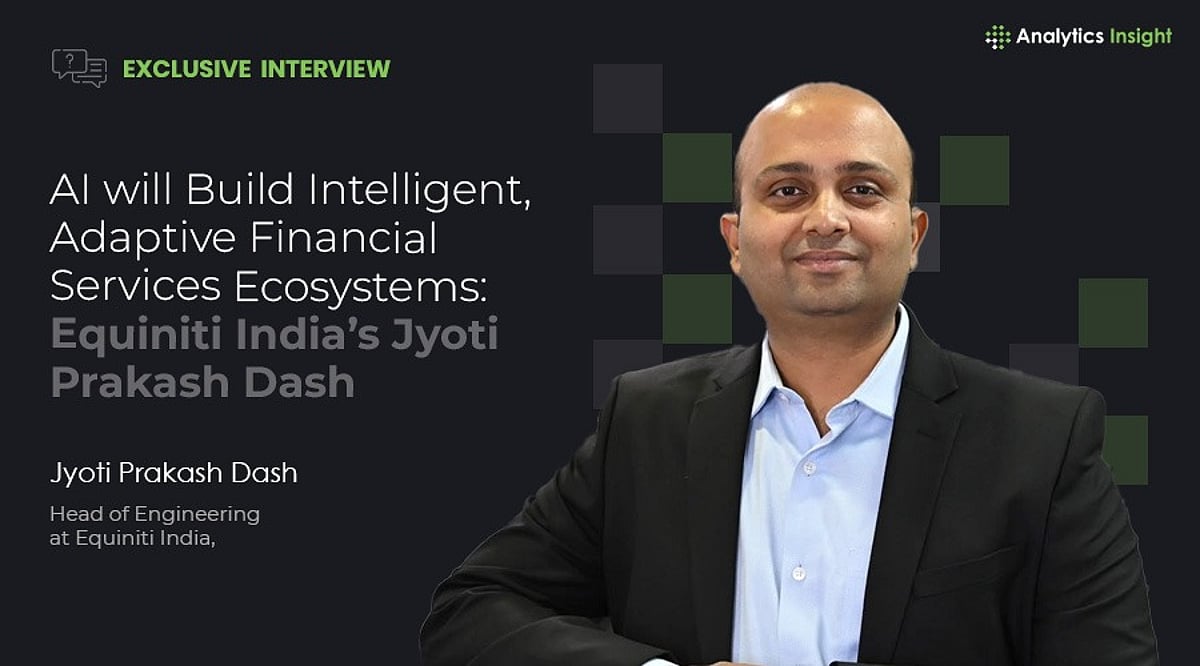
  • How AI Is Building Adaptive Financial Ecosystems: Insights from Equiniti India’s Engineering Head

    How AI Is Building Adaptive Financial Ecosystems: Insights from Equiniti India’s Engineering Head

    Artificial intelligence is rapidly transforming financial services, enabling organizations to modernize legacy operations without compromising trust, security, or regulatory compliance. Beyond improving operational efficiency, AI is helping financial institutions accelerate software development, automate complex workflows, enhance decision-making, and deliver better customer experiences.

    For companies with long-standing industry expertise, the real opportunity lies in adopting AI responsibly. Strong governance, transparency, and human oversight are becoming just as important as innovation, ensuring businesses can unlock AI’s potential while maintaining the confidence of clients and regulators.

    Jyoti Prakash Dash, Head of Engineering at Equiniti India, believes AI will go far beyond automation to reshape how financial services are designed and delivered. In an exclusive interview, he shares Equiniti India’s AI strategy, the evolving role of engineering leaders, workforce readiness in the GenAI era, and how intelligent financial ecosystems will define the industry’s future.

    Modernizing a 200-Year Legacy with AI

    Dash explains that AI enables Equiniti to modernize complex financial services operations while preserving the trust, accuracy, and regulatory compliance clients expect. The focus is on responsible AI adoption that enhances productivity, decision-making, and customer outcomes through strong governance, transparency, security, and human oversight.

    Engineering Leadership in the AI Era

    The role of engineering leadership has evolved from managing delivery to orchestrating teams with AI capabilities. Success now depends on driving AI adoption, establishing guardrails, building AI-ready talent, and accelerating innovation without compromising quality, security, or compliance.

    Where AI Is Creating Value

    Equiniti India is embedding AI across software engineering, testing, operational processes, and data-driven decision-making. The impact is already visible through improved developer productivity, faster delivery, enhanced quality, and increased automation, allowing teams to focus on higher-value innovation and customer outcomes.

    Skills Engineers Need in the AI Era

    Engineers must develop AI fluency alongside strong fundamentals in architecture, systems thinking, data, security, and governance. At Equiniti India, significant investment is being made in AI enablement, communities of practice, hands-on learning, and responsible AI adoption to prepare teams for the future.

    Long-Term Vision: Intelligent, Adaptive Ecosystems

    Dash’s vision is to move beyond automation and build intelligent, adaptive financial services ecosystems. AI will enable better decision-making, greater personalization, stronger risk management, and faster innovation, creating sustainable competitive advantage for clients and transforming how financial services are delivered.

  • How AI Video Localization Helps Brands Expand Into Global Markets in 2026

    How AI Video Localization Helps Brands Expand Into Global Markets in 2026

    AI video localization is transforming how brands reach international audiences. Instead of re-filming or hiring voice actors for every market, companies can now use artificial intelligence to translate voiceovers, sync lip movements, and adapt on-screen text automatically. This technology turns a single video into dozens of language versions, making global expansion faster, cheaper, and more accessible than ever before.

    What Is AI Video Localization and Why Does It Matter Now?

    AI video localization uses machine learning to adapt video content for different languages and cultures. Rather than manually re-producing a video for each region, the system generates a translated audio track, matches the speaker’s lip movements, and updates captions and on-screen text. This approach significantly reduces the time and cost traditionally associated with localization, opening the door for startups and mid-sized companies to compete globally.

    The Language Factor: How Much Does It Affect Reach?

    Consumer behavior clearly favors localized content. Research from CSA Research shows that around 75% of consumers prefer to buy products when information is presented in their own language, and a majority are more likely to purchase from a brand that communicates in their native tongue. With most high-performing video content still produced in English first, the fastest-growing audiences are often non-English-speaking. Localization bridges this gap, allowing brands to tap into markets they would otherwise miss.

    From Translation to Growth Strategy

    Translation answers the question “what did they say?” Localization answers a bigger one: “will this land with this audience?” This shift in perspective turns localized video into a growth lever. Producing one strong video and adapting it into ten languages multiplies the return on a single creative investment. Instead of ten separate shoots, a team gets ten market-ready assets from one, keeping costs fixed while expanding the addressable audience several times over.

    Markets Driving Demand for Localized AI Video

    The strongest demand comes from fast-growing digital regions. Asia-Pacific, led by markets such as Japan, China, and South Korea, is expanding its use of AI video at a pace well above the global average, with growth rates frequently cited above 40% annually. Europe and Latin America also contribute significant demand, each fragmented across many languages where a single English asset cannot serve the whole region. Tools like VlogMe AI, which supports multilingual voices and avatars across languages including English, Russian, Japanese, and Chinese, are built around this multi-market reality.

    How Brands Are Using AI Video Localization in Practice

    The use cases are broad because video is everywhere. Marketing teams localize product launches and ads so a single campaign runs across regions. Training and HR teams adapt onboarding and compliance videos for global staff. Educators and course creators reach students in their own language. Customer-facing teams localize explainers and support content so help feels native, not translated. The common thread is repurposing: a company records once and generates market-specific versions from that base, keeping brand voice consistent across every region.

    Risks and Challenges to Watch

    Localization at scale is powerful but not risk-free. Quality and nuance remain concerns: a literal translation can miss idiom, tone, or cultural context, so human review of high-stakes content still matters. Authenticity and disclosure are also important, as regulators and audiences increasingly expect clear labeling of AI-generated video. Finally, governance is key: when one asset becomes twenty, weak oversight multiplies mistakes just as quickly as output. Treat localization like any other data-driven process, with review steps, brand guardrails, and clear accountability.

    How to Approach AI Video Localization in 2026

    Start with the markets that matter most, not every market at once. Pick two or three high-potential languages, localize a single proven video, and measure the response before expanding. Build a repeatable workflow: one strong source video, a reliable localization tool, a human review step for tone, and clear labeling of AI-generated content. The goal is not to produce the most content but to reach the right audiences, in their language, with quality that holds up.

    The Bottom Line

    AI video localization has quietly shifted from a technical capability into a business strategy. It lets brands turn one creative investment into many market-ready assets, reach the fastest-growing regions in their own languages, and do it at a cost that no longer requires an enterprise budget. The winners in 2026 will not simply be the companies that make more video — they will be the ones that make their video understood everywhere it travels, and that publish it responsibly.

  • Leading AI Software Development Companies in the UK for 2026

    Leading AI Software Development Companies in the UK for 2026

    According to a study by the Office for National Statistics, self-reported AI adoption among UK businesses with 10+ employees reached 35% by June 2026—a new high. Yet many organizations still struggle to integrate AI effectively due to a lack of in-house expertise. Partnering with a specialized third-party AI developer can bridge that gap, offering strategic guidance, custom solutions, or team augmentation. Below are the top 10 AI software development companies in the UK for 2026, curated to help you find the right partner.

    1. Itransition

    A global IT consulting firm with a London office, Itransition delivers end-to-end AI services—from consulting to development and support. With over 5 years in AI and a dedicated AI/ML Center of Excellence, they serve Fortune 500 clients across 20+ industries, including healthcare, retail, and fintech. Key highlights include certified partnerships with Microsoft and AWS, deep UK market knowledge, and expertise in AI agents, generative AI, recommendation engines, and computer vision.

    2. Softblues

    This UK-based company specializes in intelligent automation and agentic AI, particularly with Claude. As a member of the Claude Partner, Microsoft, and Google Cloud Partner networks, Softblues offers a 90-day AI implementation process with a money-back guarantee if the proof of concept fails. Their experience spans healthcare, financial services, logistics, recruitment, and customer support.

    3. Old.St Labs

    A consultancy and development firm based in London, Old.St Labs focuses on bespoke AI-enabled solutions like mobile apps, web apps, and visual dashboards. Their partnership-driven engagement model provides real-time project visibility via a dedicated web portal. They also conduct security audits for apps built with AI coding tools.

    4. Leobit

    An international software consulting company operating in the US, EU, and UK, Leobit builds custom web, mobile, and desktop solutions including workflow automation, agentic AI, and LLM apps. They have 35+ Azure, AWS, and Anthropic AI-certified engineers and deep .NET expertise, serving sectors like healthtech, finance, logistics, and entertainment.

    5. Imobisoft

    UK-based Imobisoft delivers bespoke AI solutions such as LLMs and generative AI agents, with strong experience using Anthropic Claude and OpenAI. They develop multi-agent systems for complex tasks and have a proven track record in healthcare, utilities, energy, financial services, and the public sector.

    6. Infinum

    A global IT company with a London office, Infinum specializes in strategic consulting, cybersecurity, and enterprise-grade web and mobile apps—both AI and non-AI. They offer free AI readiness assessments and have built AI agents, computer vision systems, and deep learning models for sectors like healthcare, financial services, and automotive.

    7. TatvaSoft

    With a regional office in London, TatvaSoft provides strategic AI advisory, AI/ML development, and staff augmentation. Their bespoke AI solutions cover 10+ sectors and include LLMs, multi-agent systems, chatbots, and object recognition tools. They often combine models like Midjourney, OpenAI GPT, AWS Bedrock, and DALL-E in one project.

    8. Tapptitude

    An international mobile and web app development agency with a London office, Tapptitude offers AI consulting, model integration, and monitoring. Their team of data scientists and ML engineers can join client teams or handle full projects. Expertise spans healthcare, retail, entertainment, fintech, and proptech.

    9. 3 Sided Cube

    This UK-based agency is known for building mobile apps that address global issues like disaster warning and deforestation monitoring. They now also deliver custom LLMs and automation workflows using tools like n8n, OpenAI, Gemini, and Claude. Their AI Readiness Toolkit helps organizations launch risk-free pilot projects.

    10. Transparity

    A pure-play Microsoft partner based in the UK, Transparity provides AI strategy consulting and development using Copilot Studio, Azure OpenAI, and Azure Machine Learning. They offer free two-hour AI Readiness Assessments and primarily serve manufacturing, logistics, retail, financial services, professional services, and nonprofit sectors.

    Final Thoughts

    With UK businesses increasingly adopting AI, the right development partner can make or break a transformation initiative. This list of top AI software companies provides a starting point for finding a trusted partner to turn your AI strategy into reality.

  • How Counter-Drone Systems Stack Up: Detection, AI, and Response Tactics Compared

    How Counter-Drone Systems Stack Up: Detection, AI, and Response Tactics Compared

    Unauthorized drones pose varying risks depending on their type and behavior. A small commercial drone near a military base behaves differently from an autonomous aircraft following a pre-planned route. Some drones stay linked to an operator, while others fly without live communication. These differences shape how security teams detect, identify, and respond to threats.

    To compare counter-drone systems effectively, look beyond detection range. Evaluate the sensors, information quality, response methods, and ability to integrate with existing security tools. A robust drone defense setup helps operators understand what is flying, where it came from, and what actions are available.

    How Do Counter-Drone Systems Detect Aircraft?

    Radar detects movement in the air and covers large areas. It can find drones that do not transmit radio signals, but may need additional sensors to distinguish small drones from birds or other objects.

    Radio frequency (RF) sensors listen for communication between a drone and its controller. They identify many commercial models and provide details about the aircraft or operator. Passive RF detection works without transmitting a signal, useful when a protected unit wants to stay covert.

    Cameras provide visual confirmation after another sensor detects an object. They help operators see the drone and track its direction, but weather, distance, lighting, and buildings can affect image quality.

    Modern systems often combine these sources through one software platform, allowing operators to view radar data, radio signals, and camera images in a single interface instead of reviewing separate alerts.

    How Does Artificial Intelligence Support Detection?

    AI processes information from multiple sensors. It studies movement patterns, compares objects, and helps reduce false alerts—valuable in areas with birds, vehicles, authorized drones, and other activity. AI does not replace sensors; it organizes their data and highlights objects needing attention. The quality of results still depends on the sensor data and site conditions.

    When systems use similar sensors, their software can create a major difference. One platform may send a basic alert, while another can identify the model, track the flight path, locate the operator, and suggest the next action.

    How Do Response Methods Differ?

    Jamming interferes with communication between drone and controller. The aircraft may land, hover, return to start, or continue along a programmed route. Jamming can affect nearby communications, limiting its use in many locations.

    Physical interception can stop a drone directly, but falling parts create danger near people, vehicles, equipment, or buildings. Other systems use directed energy, though range, weather, power, and line of sight affect performance.

    Protocol-based control works through the communication used by a supported drone. It can disconnect the original controller and guide the aircraft to a chosen landing point. This avoids broad radio interference, but does not support every drone model.

    Effective drone defense often combines several response options rather than relying on one method.

    Why Does Integration Matter?

    A counter-drone system rarely operates alone. Defense teams may already use radar, cameras, command software, and other air protection tools. The new system should exchange information with them and display threats through a clear operational view. Open integration also makes it easier to add new sensors or response tools later. Drone technology changes quickly, so a closed platform can become difficult to update.

    Sentrycs, for example, uses passive detection, drone identification, operator location, and protocol-based control as part of a wider drone defense approach. Its technology connects with radar, optical sensors, and military command systems rather than replacing every existing layer.

    What Should Security Teams Test?

    A useful test should reflect the real environment: relevant drone models, local radio activity, buildings, low flights, and multiple aircraft in the air. Teams should also measure false alerts, response time, setup needs, and training requirements. The best comparison comes from testing each system against the same mission and threats. The strongest drone defense solution is not simply the one with the longest range—it is the one that gives operators accurate information, supports a suitable response, and continues working under difficult conditions.

  • OpenAI Playground Guide: Key Features, Real-World Uses, and Prompt Engineering Tips

    OpenAI Playground Guide: Key Features, Real-World Uses, and Prompt Engineering Tips

    As generative AI becomes an essential part of software development and business processes, developers need a space to experiment with prompts, test models, and fine-tune outputs. OpenAI Playground was built for exactly this purpose. It offers a web-based graphical interface where you can interact with AI models, adjust parameters, and evaluate results without writing code.

    This versatile tool is widely used for fast prototyping, prompt crafting, and API trials, making it a valuable resource for developers, researchers, and businesses building AI-powered applications.

    Key Features of OpenAI Playground

    OpenAI Playground is a web-based application that enables real-time interaction with various AI models. Users can perform text generation, programming assistance, reasoning, summarization, translation, and structured outputs. One major benefit is parameter customization: you can modify settings such as temperature, max output tokens, and other generation controls to see how they affect responses. This flexibility helps developers fine-tune prompts before integrating them into apps. The Playground also supports system instructions and multi-turn conversations, allowing users to simulate authentic chatbot interactions and AI assistants.

    Common Use Cases

    Developers frequently use the Playground to test AI applications at the prototype stage before writing production code. It enables rapid testing of prompts for customer support bots, content generation, coding help, document summarization, and workflow automation. Businesses leverage it to evaluate AI responses for internal knowledge bots, email creation, report generation, and data analysis. Researchers use it to compare prompts and study how different instructions affect model behavior. The low-friction setup allows teams to quickly try out ideas without building a full application.

    Tips for Better Results

    • Write clear, specific prompts: provide background, describe the desired output format, and state any constraints.
    • Break complex tasks into smaller prompts to improve consistency and reduce ambiguity.
    • Experiment with parameter settings to find the right balance between creativity and factual accuracy.
    • For structured tasks, request output in JSON, tables, or bullet points for easier post-processing.
    • Test multiple prompt variations to determine the most effective approach before deploying AI into production.

    Conclusion

    OpenAI Playground is an excellent testing ground for anyone developing AI-powered applications. Its interactive interface, configurable parameters, and support for advanced prompts make it useful for both beginners and seasoned developers. As organizations increasingly invest in AI, tools like the Playground help cut development time, improve prompt quality, and accelerate experimentation. Thoughtful prompt design combined with systematic testing enables more reliable, scalable, and effective AI applications.

    Frequently Asked Questions

    1. What is OpenAI Playground used for?

    OpenAI Playground is a web-based interface that lets users interact with AI models without coding. It is commonly used for prompt testing, prototyping applications, and experimenting with different model settings before deployment.

    2. Is OpenAI Playground free to use?

    OpenAI Playground typically requires an OpenAI account with available API credits or a paid plan. Usage is billed based on the selected model and the number of input and output tokens processed.

    3. How is OpenAI Playground different from ChatGPT?

    Unlike ChatGPT, OpenAI Playground provides advanced controls such as temperature, max output tokens, system instructions, and structured output settings. It is designed for developers and researchers who need greater flexibility.

    4. Can businesses use OpenAI Playground for application development?

    Yes. Businesses use OpenAI Playground to test customer support bots, automate workflows, generate content, summarize documents, and refine prompts before integrating AI models into production applications.

    5. What are the best practices for getting accurate responses in OpenAI Playground?

    Use clear and specific prompts, provide relevant context, define the desired output format, and experiment with model parameters. Testing multiple prompt variations also helps improve response quality and consistency.

  • Eyecandy AI: Building Companion Robots That Blend Emotional Intelligence with Everyday Assistance

    Eyecandy AI: Building Companion Robots That Blend Emotional Intelligence with Everyday Assistance

    Eyecandy AI is a startup on a mission to redefine human-robot interaction by developing companion robots that combine advanced artificial intelligence with emotional intelligence. The company envisions a future where robots are not just tools but empathetic companions capable of natural conversation, personalized support, and seamless smart home integration.

    Company Vision: AI Companions for Everyday Life

    Eyecandy AI focuses on creating robots that serve as daily assistants, helping users manage schedules, set reminders, and handle routines while offering genuine companionship. The goal is to reduce dependence on multiple separate devices by providing an all-in-one intelligent partner.

    Human-Like Conversations Powered by Advanced AI

    The robots leverage state-of-the-art language models to hold natural dialogues, answer questions, and engage users in meaningful interactions. This capability transforms the robot from a simple machine into a conversational companion that adapts to each user’s communication style.

    Personalized Experiences That Learn and Adapt

    Over time, the AI learns user preferences and behavior patterns, allowing it to deliver customized responses, reminders, entertainment, and assistance. This personalization ensures that the robot becomes more helpful and intuitive the longer it is used.

    Smart Home Integration for Connected Living

    Eyecandy AI’s companion robots can connect with compatible smart home devices, enabling users to control lighting, appliances, and other connected technologies through voice commands or automated routines. This integration positions the robot as a central hub for the smart home ecosystem.

    Emotional Intelligence: Recognizing and Responding to Feelings

    A key innovation is the development of AI capable of recognizing emotions through tone, facial expressions, and context. The robot responds with appropriate empathy and conversational support, making interactions feel more authentic and comforting.

    Privacy and Security as Core Principles

    The startup places a strong emphasis on secure data handling and user privacy. By building trust through transparent data practices, Eyecandy AI aims to address common concerns about always-on intelligent devices in the home.

    Looking Ahead: Expansion into Education and Healthcare

    Eyecandy AI plans to expand robot capabilities through regular software updates, enabling broader applications across homes, education, and healthcare settings. This future-proof approach ensures the robots remain relevant as AI technology evolves.

    With the global robotics market growing rapidly, Eyecandy AI is positioning itself at the intersection of artificial intelligence, emotional technology, and consumer convenience, offering a glimpse into a future where robots are part of our daily lives.

  • SAP Halts Hiring and Travel as AI Costs Surge, Prioritizes AI Investments

    SAP Halts Hiring and Travel as AI Costs Surge, Prioritizes AI Investments

    SAP has paused most hiring and internal business travel worldwide as it grapples with rising costs associated with artificial intelligence. The German software giant implemented the measures in July 2026 to control spending while channeling funds into AI products, tools, and acquisitions. According to a current SAP employee cited by 404 Media, the restrictions remain in place.

    The hiring pause does not cover every role. SAP is focusing recruitment on selected positions that support the company’s long-term AI strategy. AI-related jobs, customer travel, development trips, and essential AI training are exempt from the freeze. Internal business travel has stopped under the new spending rules, but customer meetings and trips tied to SAP’s AI development program can continue.

    “Be disciplined in how we spend,” the company told employees, as rising AI costs put more pressure on budgets. SAP noted that AI adoption has increased token usage and related costs across its operations, with more AI services running at scale across the company.

    The company also plans major spending on AI products, internal AI use, and acquisitions involving data and artificial intelligence. A SAP spokesperson said the measures will help direct money toward areas with stronger long-term value, allowing the company to invest in AI while reducing spending in less critical areas.

    The move highlights a growing challenge for technology companies investing heavily in AI. While AI can improve productivity, running large AI systems can also create significant costs. SAP’s decision underscores a clear shift in priorities: AI skills and projects remain vital, while other hiring and spending now face tighter controls.

  • How Khalil Ismail’s ‘Technical Philosopher’ Role Is Shaping the Future of Mind Computing

    How Khalil Ismail’s ‘Technical Philosopher’ Role Is Shaping the Future of Mind Computing

    By Arundhati Kumar

    At Voyage, the founder of the Maison for Mind Computing is building a technical house where engineering, taste, neuroscience, and philosophy belong in the same room.

    Most technology companies know what to do with an engineer. They know what to do with a researcher, a designer, a product manager, or a strategist. The categories are familiar, clean, and useful enough for software, hardware, and much of artificial intelligence. Khalil Ismail thinks mind computing needs a different kind of person.

    At Voyage, the Maison for Mind Computing he founded, that person is called a Technical Philosopher. The title is not decorative. It is Ismail’s answer to a problem he believes has slowed the brain-computer interface field for years: too many people are solving narrow pieces of a challenge that, by its nature, refuses to stay narrow.

    “You cannot build for the mind with only one lens,” Ismail says. “The signal matters, but so does meaning. The object matters, but so does the judgment behind it. The intelligence matters, but so does the person using it.”

    Voyage is launching publicly around a category Ismail calls Mind Computing, with a long-term focus on non-invasive neural interfaces built for real-world use. The product itself is not being publicly launched yet. They are introducing the company’s identity, philosophy, and internal structure: a technology this intimate requires a company culture built to hold science, craft, ethics, and taste at the same time.

    That is why he calls Voyage a Maison. In tech, the word may sound unusual at first. Ismail uses it to describe a technical house, one built around frontier engineering, careful form, philosophical depth, and cultural judgment. His view is that neural interfaces will not become part of ordinary life because they are hidden inside existing objects or made slightly less awkward. The field needs a different operating system before it can build a different interface.

    “The Maison is how we organize the work,” he says. “It means the cultural questions are not added after the engineering. They are inside the engineering brief.”

    That thinking comes from Ismail’s own formation. Imperial College London gave him engineering discipline. The Royal College of Art sharpened his relationship to form, craft, and material expression. Apple, Microsoft, Snap Inc., MIT Media Lab, Harvard, and Oxford each exposed a different part of the same problem: intelligent systems were advancing, but the human interface was still being treated too narrowly.

    The point, for him, is not the prestige of the path. It is the collision between those rooms. At one end were the demands of sensing, computation, product architecture, and model behavior. At the other were questions that do not fit neatly on an engineering roadmap: why would someone trust this, what does the object ask of the person wearing it, how should consent work when the interface becomes more intimate, and what kind of future does the company’s taste make possible?

    “Most fields train people to separate those questions,” Ismail says. “I became interested in what happens when you refuse to separate them.”

    That refusal has become central to Voyage’s hiring language. The Technical Philosopher is the archetype Ismail wants at the center of the company. He sees the role as a builder who can engage with equations and materials, but also with ethics, perception, autonomy, restraint, and cultural meaning.

    In a field often dominated by clinical use cases, invasive implants, laboratory constraints, and science-fiction imagery, that blend is deliberate. Ismail is not dismissive of medical neurotechnology. He believes invasive systems can be incredibly important for clinical needs. His argument is different: the consumer path for neural interfaces requires a different starting point.

    “You cannot assume society will accept intimate technology because it is powerful,” he says. “The first question is not only what the system can do. The first question is what kind of relationship it creates.”

    That question changes the engineering. Non-invasive neural interfaces have long faced skepticism because of sensor quality, noisy data, and the difficulty of building systems that generalize outside controlled settings. Ismail believes the AI era has changed the shape of that problem, especially through reinforcement learning and the possibility of models improving through richer context. But the context cannot come from a lab alone.

    For Voyage, the object has to become habitual. It has to enter real environments, real choices, and real patterns of intent. That makes the company’s attention to form and adoption part of the technical architecture rather than an aesthetic layer added near the end.

    “Data is not floating in the abstract,” Ismail says. “It comes from life. If the interface does not belong in life, you never reach the depth of understanding people keep promising.”

    This is where the Maison structure becomes strategic. Ismail sees historical houses as institutions that shaped more than objects. They shaped how new materials, techniques, and forms entered culture. He points to the idea that a house can create a world around a material before the public fully knows how to name it.

    Voyage wants to do something similar for neural interfaces. The company is trying to move the field away from dystopian imagery and toward a more deliberate model of human-computer entanglement, one where the person remains the author of the interaction. Ismail’s vision is not a future where AI becomes a louder companion with a name, a face, and a personality. He wants ambient intelligence to support intent without taking over the story.

    “The machine should not become the protagonist,” he says. “The person using it should still feel like the author.”

    The early team reflects that same sensibility. Ivan Bokarev and Hiteyjit Singh Gujral joined because they shared Ismail’s impatience with narrow thinking. Their fit was not only technical. It was temperamental. Voyage was being built for people willing to question inherited assumptions about neuroscience, consumer technology, and what a technical company is allowed to value.

    That makes internal culture more than a workplace concern. At the Maison, questions about privacy, consent, trust, form, and human agency belong at the beginning of the work. The Voyage Handbooks are used by every technical philosopher. The handbooks also give space for them to write in and challenge ideas as they work through new challenges.

    “What should a neural interface never do?” Ismail says. “That question matters as much as what it can do. If you do not ask it early, the answer gets decided by accident.”

    That gives Voyage a different posture from the typical frontier technology company. It is not trying to prove that philosophy can make technology sound refined. It is trying to prove that philosophy can change what gets built, who builds it, and how carefully the company treats the human being at the center of the interface.

    Khalil Ismail’s bet is that the next computing shift will require institutions that do not look like the last generation of labs, studios, or startups. Mind computing will need engineers who understand culture, designers who can think technically, and thinkers who are willing to build. It will need people with enough discipline to work inside the hard problems and enough imagination to ask whether the hard problems have been framed correctly.

    At Voyage, that person has a name.

    The title may sound unusual now. That is partly the point. Voyage is being built for a category that does not yet have inherited roles, inherited rituals, or inherited rules. Ismail is not waiting for that language to appear after the field matures. He is putting it into the company from the beginning.

  • Lisa Su: The Visionary CEO Transforming AMD into an AI and Semiconductor Powerhouse

    Lisa Su: The Visionary CEO Transforming AMD into an AI and Semiconductor Powerhouse

    Lisa Su is an accomplished semiconductor leader who currently serves as Chair and CEO of Advanced Micro Devices (AMD). Under her guidance, AMD has become a global force in high-performance computing, artificial intelligence, gaming, and adaptive computing. Known for her forward-thinking leadership, deep technical expertise, and innovation-driven approach, Su has revitalized AMD’s competitive standing and driven the development of cutting-edge processors and enterprise computing systems.

    Early Life and Education

    Lisa Su earned her bachelor’s, master’s, and doctorate degrees in Electrical Engineering from the Massachusetts Institute of Technology (MIT). Her research focused on semiconductor device physics and Silicon-on-Insulator technology. This strong technical foundation paved her way to influential roles in semiconductor research, development, and advanced computing innovation.

    Professional Career

    Su began her career at Texas Instruments before moving to IBM, where she managed research and development in semiconductors and technology. She later served as Chief Technical Officer and led business operations at Freescale Semiconductor. At AMD, she rose from President and CEO to her current role as Chair and CEO.

    Business Intervention in AI

    AMD harnesses high-performance computing, intelligent infrastructure, and developer tools to accelerate AI. The company consistently uses state-of-the-art CPUs, GPUs, adaptive computing, and open software to create fast, intelligent, and scalable AI solutions. AMD’s EPYC™ Server CPUs provide efficient infrastructure for generative AI, agentic AI, cloud computing, and data center innovations. The company also brings AI closer to data through energy-efficient computing for intelligent retail, 5G, cloud storage, and edge infrastructure. AMD supports AI enthusiasts with cost-effective, secure, and energy-efficient technologies, and offers developers free tools, cloud platforms, mentorship, and training. Within enterprises, AMD drives AI adoption for increased efficiency, productivity, and optimized operations, all while pioneering ethical and responsible AI through scientific research, STEM education, and international collaborations.

    Business Achievements

    Under Su’s leadership, AMD has achieved remarkable milestones with the invention of Ryzen, EPYC, and Instinct processors, building its AI computing capabilities. She forged partnerships with industry leaders such as Microsoft, Meta, and Oracle, helping AMD become a top player in high-performance computing, AI infrastructure, gaming, and adaptive computing.

    Controversies

    No controversies have ever emerged around Lisa Su. She is widely recognized for her strategic leadership, innovations in semiconductors and AI, and for transforming AMD into a key player in the chipmaker industry.

  • Wharton’s AI for Business Specialization: Master AI Strategy Without Coding

    Wharton’s AI for Business Specialization: Master AI Strategy Without Coding

    The AI for Business Specialization from the University of Pennsylvania’s Wharton School is designed for working professionals who want a practical, business-first understanding of artificial intelligence—no coding background required. Delivered through Coursera, this four-course program covers machine learning fundamentals, big data, AI ethics, and real-world applications in marketing, human resources, and operations. It’s tailored for managers and leaders who need to make informed decisions about AI adoption rather than build models themselves.

    What You’ll Learn

    • Core concepts of AI, machine learning, and big data—and how they apply to business decision-making.
    • Real-world AI applications in marketing, customer personalization, and the customer journey.
    • How to apply AI and analytics to people management and HR, including responsible algorithm use.
    • AI ethics, risk management, and governance frameworks for responsible deployment.
    • Insights from industry leaders on how AI and big data are transforming business operations.

    Flexible and Accessible

    The specialization is fully online and self-paced, making it easy to fit around a full-time job. Most learners complete all four courses in about six months with roughly two hours of study per week, though some finish sooner. Instead of a flat course fee, the program is available through a Coursera subscription, which keeps costs significantly lower than typical bootcamps or degree programs. A 7-day free trial is available, and learners can audit the lectures at no cost before committing.

    Curriculum Highlights

    • AI Fundamentals: Key concepts in AI and machine learning, plus tools that lower the barrier to enterprise adoption.
    • AI Applications in Marketing: Using data analytics and personalization to enhance the customer journey.
    • People Analytics and AI: Applying machine learning to HR while maintaining fairness and minimizing bias.
    • AI Strategy and Governance: Building responsible governance frameworks and developing organization-wide AI strategies.

    Who Should Enroll

    No prior AI, machine learning, or programming experience is required. The program is best suited for professionals working in marketing, HR, finance, or operations who want to confidently speak the language of AI. A general comfort with business concepts and data-driven decision-making is helpful, and enrollment is open through Coursera with no formal application process.

    Why It Stands Out

    This program leverages Wharton’s academic reputation and is taught by Wharton faculty, including Professors Kartik Hosanagar and Kevin Werbach, who bring research and industry advisory experience into the coursework. Unlike many technical AI courses, this specialization is built for business decision-makers, not engineers, using case studies from marketing, HR, and finance. Graduates receive a shareable University of Pennsylvania certificate that can be added to a resume or LinkedIn profile, although the credential does not carry university credit.

    Final Thoughts

    For professionals who want to understand what AI can realistically do for their organization without diving into technical details, the AI for Business Specialization is a strong choice. With Wharton’s backing and a curriculum focused on practical business use cases, it gives managers and leaders the vocabulary and judgment to guide AI strategy, collaborate with data teams, and evaluate AI initiatives with confidence.