Tag: automation

  • AI-First Service Delivery: How Enterprises Are Building Smarter Customer and Employee Experiences

    AI-First Service Delivery: How Enterprises Are Building Smarter Customer and Employee Experiences

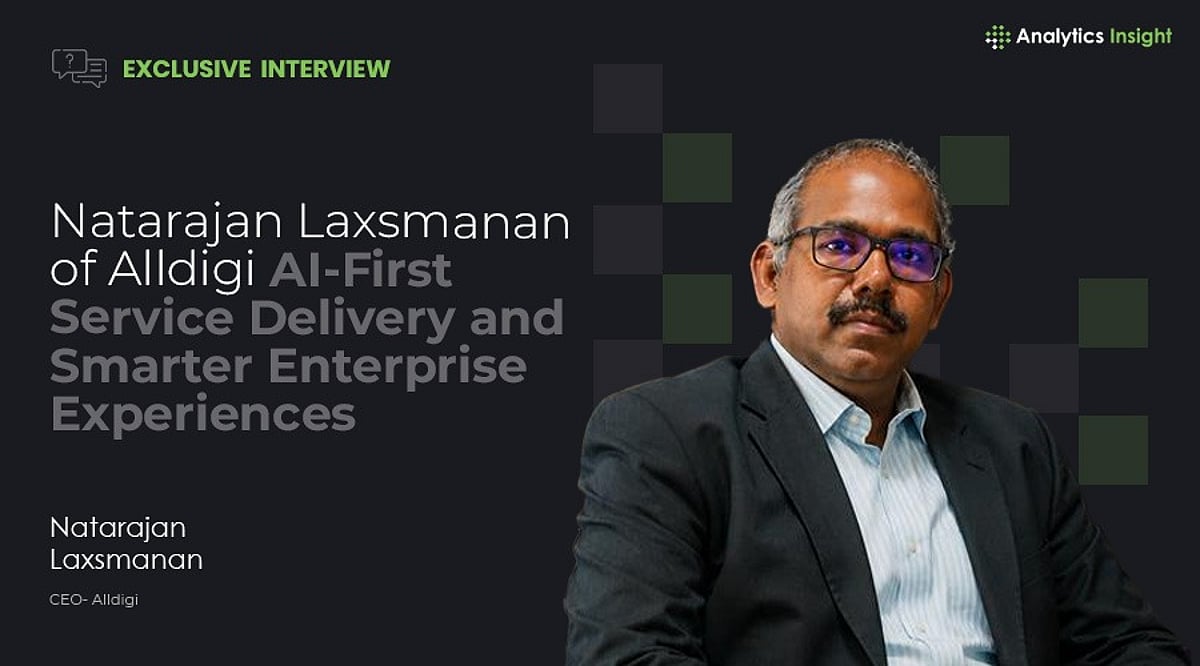
    Artificial intelligence is no longer just a support tool—it is becoming the foundation of enterprise service delivery. In a recent interview, Natarajan Laxsmanan, CEO of Alldigi, shared how AI is transforming customer and employee experiences through predictive engagement, intelligent automation, integrated workflows, and stronger governance. Here are the key insights from that conversation.

    From Reactive Support to Predictive Engagement

    AI is fundamentally changing customer experience by helping businesses move from issue resolution to issue prevention. Traditional support models are reactive: companies respond only after a customer raises a concern. AI enables organizations to anticipate needs by analyzing behavioral patterns, historical interactions, transaction data, and real-time signals.

    This intelligence allows businesses to proactively address issues, offer personalized recommendations, and create highly contextual interactions across channels. AI-powered virtual assistants, intelligent routing, sentiment analysis, and predictive service models are helping enterprises deliver faster resolutions while improving overall customer satisfaction. The result is a shift from transactional touchpoints to continuous, personalized engagement that strengthens loyalty and lifetime value.

    One practical way to operationalize this balance is to use AI-powered service platforms that bring AI agents and human teams together across channels. Connected knowledge, ticketing, messaging, voice, and reporting tools can help organizations automate routine, high-volume requests while keeping human expertise in the loop—supporting faster service without losing empathy or accountability.

    Employee Experience as a Strategic Growth Driver

    Employee experience is no longer just an HR priority; it is a business performance imperative. Organizations increasingly recognize the direct connection between employee satisfaction, productivity, innovation, retention, customer outcomes, and overall business growth.

    Modern employees expect workplace experiences that are as intuitive and responsive as the digital experiences they encounter as consumers. This requires cross-functional collaboration across HR, operations, technology, finance, and leadership teams. AI is helping organizations create more personalized employee journeys through intelligent support, workforce analytics, learning recommendations, and automated service delivery.

    Enterprises that treat employee experience as a strategic lever rather than an administrative function are better positioned to build an engaged workforce, improve operational agility, and drive sustainable growth in an increasingly competitive environment.

    Scaling AI Across the Enterprise

    The biggest challenge is not implementing AI, but identifying where it can create enterprise-wide value. Many organizations deploy AI in isolated applications, leading to fragmented insights and disconnected workflows.

    The real opportunity lies in connecting payroll, compliance, workforce management, and customer experience systems into an integrated operating ecosystem. When AI can access and analyze data across functions, it can uncover patterns, automate decisions, improve compliance oversight, optimize workforce planning, and deliver more personalized experiences for both employees and customers.

    However, success depends on strong data foundations, system interoperability, governance frameworks, security controls, and clearly defined business objectives. Organizations that get these fundamentals right can leverage AI as a strategic capability that delivers measurable improvements in efficiency, compliance, agility, and stakeholder experience.

    Balancing Automation with Human Interaction

    The goal of AI should not be to replace human interaction, but to elevate it. Automation is most effective when applied to repetitive, high-volume, and rules-based tasks, allowing employees to focus on activities that require empathy, judgment, creativity, and relationship-building.

    Whether serving customers or supporting employees, there will always be moments where human intervention is essential. Businesses must therefore design operating models where AI handles routine processes while humans manage complex and emotionally nuanced interactions.

    The organizations that achieve the best outcomes are those that view AI and human expertise as complementary strengths. This approach enables greater efficiency while preserving the trust, personalization, and authenticity that remain critical to exceptional experiences.

    Building an AI-First Operating Model

    Adopting an AI-first approach requires organizations to rethink more than technology. It demands changes across operating models, governance structures, and workforce strategies.

    First, businesses need to redesign workflows around intelligence, automation, and predictive decision-making rather than simply embedding AI into existing processes. Second, robust governance frameworks must be established to ensure transparency, accountability, security, privacy, compliance, and ethical AI usage.

    Equally important is workforce transformation. Employees need the skills and confidence to work alongside AI systems, interpret insights, and focus on higher-value responsibilities. Organizations that invest in continuous learning, digital capability building, and change management are more likely to realize the full benefits of AI.

    Ultimately, successful AI-first enterprises combine technology, governance, and people transformation to create scalable, trusted, and outcome-driven service delivery models that continuously evolve with business needs.


  • Why the Chief Robotics Officer Could Be the Next Big C-Suite Role

    Why the Chief Robotics Officer Could Be the Next Big C-Suite Role

    Robots are no longer confined to factory floors and warehouses. With advances in physical AI, they are moving into logistics, healthcare, manufacturing, agriculture, retail, and field services. That expansion raises a strategic question for business leaders: who should own the company’s robotics agenda?

    Most organizations still distribute robotics responsibilities across engineering, operations, technology, and innovation teams. A dedicated chief robotics officer (CRO) could eventually consolidate those duties into one C-suite role. While the title is not yet common, growing enterprise deployments could make it increasingly necessary.

    Robotics Is Becoming a Company-Wide Strategy

    For decades, robotics sat squarely in manufacturing. Industrial machines performed repetitive tasks in controlled environments. Physical AI changes that model. Modern robots can perceive their surroundings, learn new tasks, and adapt to unpredictable conditions.

    Capgemini found that 79% of surveyed organizations were already engaging with physical AI, and 27% had begun deploying or scaling solutions. The impact is no longer limited to manufacturing. Logistics, healthcare, agriculture, retail, and field services are all exploring robotics. As a result, robotics decisions now touch budgets, technology, safety, and workforce planning across multiple departments.

    Why Existing Executive Roles May Not Be Enough

    CTOs, CIOs, COOs, and innovation leaders each oversee pieces of the robotics puzzle. But a single deployment can require software, hardware, connectivity, maintenance, safety protocols, and workforce changes at the same time. That cross-functional complexity often leaves no one with end-to-end ownership.

    Intel’s research from August 2026 underscores the gap: 74% of surveyed leaders expect workforce planning and robotics strategy to become inseparable by 2030, while only 40% currently report having a formal human-robot workforce strategy.

    What a Chief Robotics Officer Would Actually Do

    • Set a company-wide robotics roadmap and identify the best automation opportunities
    • Evaluate vendors, robotics platforms, AI models, and infrastructure needs
    • Define measurable targets for productivity, quality, safety, service levels, and operating costs
    • Lead workforce planning and training for employees who supervise or collaborate with robots
    • Address cybersecurity, compliance, and risk management for connected robot fleets

    In practice, a CRO would act as a bridge between technology teams and operations, ensuring robotics investments deliver business value rather than existing in silos.

    Physical AI Expands the Leadership Challenge

    Physical AI is more adaptive than traditional automation. Capgemini describes the shift as a move toward context-aware robotics, with 67% of executives viewing physical AI as potentially game-changing. But flexibility brings risk. Robots operating near people require stronger safety controls, and data quality, integration, cybersecurity, and reliability remain major barriers.

    Deloitte similarly identifies these issues as constraints on broader robotics growth. A future robotics executive would therefore need business judgment and risk management skills, not just engineering expertise.

    Could Humanoid Robots Accelerate the Trend?

    Humanoid robots have captured attention in 2026. Xpeng’s CEO He Xiaopeng says he will personally lead the company’s robotics division, with mass production of the IRON humanoid targeted for late 2026. Agility Robotics has unveiled Digit 5 for commercial use and reports more than USD 300 million in multiyear orders.

    These announcements do not guarantee rapid adoption. Commercial economics, safety, reliability, and deployment timelines remain open questions. Still, more capable robots would likely increase the need for central leadership of robotics strategy.

    Will the Chief Robotics Officer Become Common?

    The title is likely to emerge gradually. Some companies may hire robotics heads or vice presidents first; others may keep robotics oversight with a CTO or COO for years. A dedicated CRO becomes more plausible when robot fleets are large, business-critical, and spread across multiple functions.

    The broader trend is already clear: organizations are moving from isolated automation projects toward integrated human-robot operations. Whether the title becomes a standard C-suite role remains uncertain, but the underlying responsibility is becoming harder to ignore.

  • AI-Driven Threats Force Companies to Overhaul Their Network Defense Strategies

    AI-Driven Threats Force Companies to Overhaul Their Network Defense Strategies

    Artificial intelligence is transforming cybersecurity from both sides. Organizations now leverage AI to monitor activity, automate repetitive security tasks, and uncover patterns that are nearly impossible for humans to detect manually. At the same time, attackers harness the same technology to operate faster and at a larger scale. This dual impact is reshaping what businesses must defend, how quickly they need to react, and what skills their security teams require. Merely adding AI tools to an existing security framework is no longer enough; the entire strategy itself needs a fundamental redesign.

    Security Operations Must Keep Pace with Automated Threats

    As attacks become more rapid and automated, organizations need security operations that can identify unusual behavior without relying solely on manual review. Many companies now turn to managed cybersecurity services to provide continuous monitoring, threat detection, and incident response expertise that internal teams may struggle to maintain around the clock. This external support becomes especially valuable when internal IT departments are already stretched thin managing cloud systems, user accounts, software, devices, and daily technical issues. The ultimate objective is to establish enough visibility and response capability so that suspicious activity never sits unnoticed in a queue.

    AI heightens the need for this capacity because attackers can use automation to conduct reconnaissance, test stolen credentials, generate persuasive phishing messages, and adjust their tactics in real time. No longer does an attacker have to manually execute every step of an intrusion to affect thousands of targets. Defenders must deploy systems that can process vast volumes of activity and help analysts prioritize what truly requires immediate action. Human judgment remains indispensable, but people increasingly depend on technology to filter and highlight the most critical signals.

    Phishing Is Becoming Harder to Spot by Appearance Alone

    For years, employees were taught to detect phishing by looking for awkward grammar, spelling mistakes, odd formatting, or phrasing that seemed off. Generative AI erodes many of those clues because attackers can now craft polished, professional emails tailored to a specific audience in seconds. They can also customize messages to target a particular role, industry, or situation using data gathered from public sources. A suspicious email may now look every bit as legitimate as a routine corporate communication.

    This shift means organizations must move beyond training workers to recognize poorly written scams. Employees should learn to evaluate requests based on context, urgency, unusual payment instructions, unexpected credential demands, and changes to established procedures. Companies can also reduce reliance on human recognition by enforcing stronger authentication and verification steps for sensitive actions. An employee should never have to decide alone whether a convincing message from an executive requesting a major financial transfer is genuine.

    Identity Is Becoming More Central Than the Traditional Network Perimeter

    Companies have long concentrated on securing the boundary between their internal network and the outside world. That boundary has become increasingly blurred as employees use cloud applications, remote devices, mobile technology, third-party platforms, and systems that never reside inside a conventional corporate network. Attackers recognize that compromising a legitimate user account may be far easier than breaking through a technical barrier. Consequently, identity has emerged as one of the most valuable targets in modern cybersecurity.

    AI amplifies identity-based attacks by helping cybercriminals generate convincing social-engineering messages or process stolen data at scale. Defensive strategies therefore now emphasize multifactor authentication, privileged-access controls, device trust, unusual-login detection, and limiting what each account can access. Companies should also routinely audit whether users still hold permissions they no longer need as roles evolve. A compromised account becomes far less damaging if it cannot reach systems that are not essential to its normal function.

    Security Teams Need Help Distinguishing Signals from Noise

    Modern organizations generate an overwhelming volume of security data. Firewalls, cloud platforms, identity systems, applications, endpoints, email servers, and countless other tools each produce alerts. The challenge is no longer about collecting more information; it is about understanding which combinations of activities indicate something genuinely suspicious.

    AI can assist by correlating events and highlighting patterns that might be overlooked when each alert is examined in isolation. A login from an unfamiliar location may not be alarming on its own, and a large file download could have a plausible explanation. But when those events occur together on a privileged account shortly after a suspicious authentication attempt, the situation warrants immediate investigation. Context transforms individual datapoints into actionable insight.

    However, organizations should remain cautious about assuming AI can eliminate false positives or make security decisions without human oversight. Automated systems can misinterpret legitimate behavior, and attackers may deliberately try to evade or manipulate detection mechanisms. The most effective approach combines AI-driven analysis with skilled human judgment to create a resilient and adaptive defense.

  • Why Keeping Humans in the Loop Is Critical for AI-Driven Financial Crime Compliance

    Why Keeping Humans in the Loop Is Critical for AI-Driven Financial Crime Compliance

    The debate over artificial intelligence in financial crime compliance is often framed as a choice between automation and human judgment. Sriramakrishna Vadlamudi, a veteran in enterprise financial services technology, argues that this framing is fundamentally flawed. Instead of turning a dial between the two, the best systems redesign where and how humans engage.

    Vadlamudi, who has spent nearly a decade working on anti-money-laundering compliance automation, points out a common pitfall: institutions conflate automating data validation, case routing, and narrative drafting with automating the decision itself. This conflation quietly erodes oversight while maintaining the appearance of procedural compliance.

    He designed a system that automates data validation and routing, cutting manual processing errors by roughly 40 percent. The tool reduces rework and delays, but it deliberately does not dispose of cases. Structured checkpoints remain where a person must review and approve before a case closes. This design decision preserves meaningful human judgment.

    Vadlamudi warns that automating too little fails to deliver efficiency, but automating too much turns human review into a rubber stamp. The latter is worse than no review, because it creates a record of oversight that never actually occurred. He notes that institutions getting this wrong often treat a model’s recommendation as sufficient justification, quietly eroding the oversight regulators rely on.

    One of his most impactful insights is that explainability is not merely a data-science requirement; it is a compliance control. A model that cannot produce a defensible explanation for an individual decision represents an audit gap, not just a technical shortcoming. He built a feature-attribution approach that surfaces the specific factors driving a model’s score in a form that compliance investigators can evaluate, rather than a number to accept or reject blindly.

    Looking ahead, Vadlamudi sees agentic AI taking on multi-step investigative and drafting work. He argues that each intermediate step an agent takes must be auditable, just as an analyst’s actions would be. An agent that reaches a defensible conclusion through unreconstructable steps has been trusted, not overseen.

    His recommendation to institutions is straightforward: human checkpoints should be first-class design requirements from the start, not compliance overlays retrofitted after a model works. Retrofitting is more expensive and less convincing to examiners. The institutions that manage this well will not necessarily have the most capable models; they will be the ones that can still answer the fundamental question: who decided, on what basis, and can they show it?

  • 7 Essential Skills Beyond Generative AI to Future-Proof Your Career

    7 Essential Skills Beyond Generative AI to Future-Proof Your Career

    Generative AI has transformed how millions work—from brainstorming with ChatGPT to summarizing documents and drafting emails. But as AI tools become more intuitive, the real career advantage lies not in writing prompts but in building AI-powered workflows, verifying outputs, and solving meaningful business problems. Here are seven skills that will define the next wave of AI-driven careers.

    1. Understand How AI Agents Work

    AI is moving beyond single-answer responses. AI agents can handle sequences of tasks, use external tools, and complete workflows with minimal human intervention. Learning how agents operate—how to grant them access to tools and where human oversight is critical—will set you apart from casual AI users.

    2. Master Retrieval-Augmented Generation (RAG)

    RAG enables AI to pull information from documents, databases, or company knowledge before generating answers. This is vital for businesses that want AI to work with proprietary data rather than relying solely on pre-trained knowledge. Start with concepts like embeddings, vector databases, and retrieval methods—no need to become a machine learning expert overnight.

    3. Build AI Automation Skills

    Move from using AI to integrating it into daily workflows. Learning basic Python, APIs, databases, and automation tools helps connect AI models with other applications. Even modest technical know-how allows you to automate repetitive tasks and build simple AI-powered solutions.

    4. Develop AI Evaluation Skills

    AI can sound confident even when wrong. Being able to evaluate outputs for accuracy, hallucinations, and consistency is increasingly valuable—especially in fields like finance, healthcare, and legal work. Learn to test model performance and compare responses systematically.

    5. Learn AI Security and Governance

    As companies give AI access to sensitive data and business systems, privacy, security, and responsible use become critical. Understanding data protection, access controls, compliance, and AI risk management opens doors to roles at the intersection of technology and business.

    6. Strengthen Data and Machine Learning Fundamentals

    Generative AI may make technical depth seem unnecessary, but a basic grasp of statistics, data analysis, and how models are trained reveals both strengths and limitations. You don’t need to be a researcher—just knowing why an AI behaves a certain way makes you a smarter user and decision-maker.

    7. Never Forget Human Skills

    The World Economic Forum’s Future of Jobs Report 2025 highlights that analytical thinking, creativity, resilience, and collaboration remain essential. Combining these human abilities with AI proficiency creates the highest career value. The most sought-after professionals will be those who know when to use AI, how to make it work, and when not to trust it.

    By investing in these skills—AI agents, automation, RAG, evaluation, governance, data basics, and human judgment—you position yourself for the next phase of AI, where the real question isn’t “Can you use ChatGPT?” but “Can you use AI to solve a real problem?”

  • Workflow Automation Comparison: Zapier vs Make vs n8n vs Pipedream – Which Tool Is Right for You?

    Workflow Automation Comparison: Zapier vs Make vs n8n vs Pipedream – Which Tool Is Right for You?

    Choosing the right workflow automation tool has become more complex as platforms evolve beyond simple task automation. Zapier, Make, n8n, and Pipedream now offer distinct strengths in AI, API access, code support, and pricing. This guide breaks down each platform to help you decide based on your team’s technical level, workflow complexity, and scale.

    Key Takeaways

    • Zapier: Best for non-technical teams needing simple automation and extensive SaaS integrations.
    • Make: Ideal for complex visual workflows with branching, conditions, and granular control.
    • n8n: Leads for technical and AI automation, offering self-hosting and execution-based pricing.
    • Pipedream: Excels for developer-focused API and code workflows with compute-time billing.

    Zapier: Ease of Use and Ecosystem

    Zapier remains the go-to for teams that want fast setup and a large app ecosystem. Its strength lies in simple business automation across sales, marketing, operations, and support. Recent updates embed AI by Zapier directly into the Zap editor, combining normal actions, AI decisions, tool calls, filters, and branches in one flow.

    Pricing starts at free (100 tasks/month), then $19.99/month (Professional) and $69/month (Team). Tables, Interfaces, and Zapier MCP are now included in these plans. However, costs can rise at higher volumes, and AI actions may consume tasks at 1x, 3x, or 5x multipliers.

    Make: Visual Control for Complex Workflows

    Make shines when workflows require multiple paths, conditions, and data transformations. Its Scenario Builder provides a clear visual map of connections. With over 3,000 apps and a credit-based pricing model, it suits automation specialists and operations teams.

    Free plan: 1,000 credits/month. Core: $12/month for 10,000 credits. Pro: $21/month for 10,000 credits. Teams: $38/month for 10,000 credits. Enterprise custom. Make also places AI agents inside the Scenario Builder, with visibility into decisions and tool calls. Maia offers conversational workflow creation, and agent memory, AI web search, and human approval are supported.

    n8n: Technical and AI-Focused Automation

    n8n has transformed into an automation engineering platform. Its strengths include code, APIs, databases, AI agents, workflow control, and self-hosting via the Community Edition. Cloud pricing uses workflow executions: EUR 20/month for 2,500 executions, offering value for multi-step workflows.

    A major update on September 9, 2026, introduced n8n Assistant, which creates workflows from natural-language instructions, requests credentials, runs workflows, and finds errors. This reduces n8n’s learning curve significantly.

    Pipedream: Developer-First Integration Layer

    Pipedream focuses on APIs, webhooks, code, and events. JavaScript and Python support custom logic, and Pipedream Connect helps SaaS products embed integrations. Pricing is based on compute time and memory: at 256 MB, one credit covers 30 seconds. Higher memory uses credits faster. Best for software engineers and product teams needing direct API control.

    Which Platform Should You Choose?

    • Non-technical business teams: Zapier – safe, simple, broad SaaS coverage.
    • Complex visual automation: Make – superior branching and visual design.
    • Technical and AI-heavy workflows: n8n – strongest mix of AI, code, self-hosting, and execution pricing.
    • API-first development: Pipedream – ideal for custom code, webhooks, and integration layers.

    No single tool wins across all scenarios. The best choice depends on your workflow type: simple SaaS tasks favor Zapier, complex visual flows favor Make, technical/AI workflows favor n8n, and API-heavy products favor Pipedream.

    Frequently Asked Questions

    Which automation tool is easiest to use?

    Zapier is generally the easiest, especially for non-technical teams.

    Is Make better than Zapier for complex workflows?

    Yes, Make excels at workflows with multiple paths, conditions, and advanced visual logic.

    Is n8n good for AI automation?

    Yes. n8n combines AI agents with APIs, code, databases, and self-hosting, making it strong for technical AI workflows.

    Should developers choose Pipedream or n8n?

    Pipedream is better for API-first development and custom code; n8n offers broader workflow orchestration and self-hosting.

    Which automation platform is best overall?

    There is no universal winner, but n8n leads for technical/AI automation, while Make and Zapier excel in visual control and simplicity respectively.

  • PayU Unveils AI Agent Store to Help Indian SMBs Automate Commerce and Payments

    PayU Unveils AI Agent Store to Help Indian SMBs Automate Commerce and Payments

    PayU has launched Agent HQ, a dedicated AI agent store designed specifically for small and medium-sized businesses (SMBs) in India. The platform enables merchants to deploy specialized AI agents across various stages of commerce, from improving product discoverability on AI shopping platforms to simplifying payment operations and creating conversational AI experiences.

    According to PayU, the platform helps SMBs adapt to shifting consumer behavior, noting that nearly 50% of search traffic is moving to AI agents. Shoppers referred by AI can also achieve conversion rates up to three times higher than traditional channels.

    What Agent HQ Offers

    Agent HQ is built on over a decade of PayU’s commerce intelligence, covering more than 450,000 merchants, over 700 million shopper journeys, and Rs. 7,800 billion in processed transactions.

    Through the platform, merchants can make their products and services discoverable and transactable on AI platforms such as Claude and ChatGPT, as well as messaging channels including WhatsApp. Businesses can also create custom conversational AI assistants for their websites, apps, and customer journeys. These assistants provide real-time shopper support and handle post-purchase queries.

    AI Agents for Payments and Operations

    Agent HQ includes AI agents designed to automate operational tasks such as transaction follow-ups, chargeback reconciliations, refund escalations, and settlements. The agents use merchant transaction data—including success and failure patterns, chargeback histories, and shopper behavior—to suggest targeted sales and marketing campaigns while helping merchants reduce fraud, disputes, and operational effort.

    Integration with PayU Merchant Dashboard

    Agent HQ is integrated directly into the PayU merchant dashboard. Merchants can hire an AI agent in a few clicks, choose its frequency, monitor its activity, and receive outputs through email and WhatsApp. PayU emphasizes that all agents operate strictly within boundaries defined by merchants.

    Manas Mishra, Chief Product Officer at PayU & Wibmo, said Agent HQ expands PayU’s value-added offerings by providing merchants with a personalized team of AI agents to improve discoverability, drive growth, and manage payment operations.

    Merchants including Policybazaar, Daily Objects, and Pinq Polka are already using Agent HQ to enhance their commerce workflows.

  • AI vs. Human Intelligence: Key Strengths of Each and Why Collaboration Wins

    AI vs. Human Intelligence: Key Strengths of Each and Why Collaboration Wins

    Artificial intelligence continues to reshape the way we live and work, but comparing human abilities with machine capabilities shows that neither side is universally superior. People and AI excel in different areas, and the strongest outcomes usually come from combining the two.

    Where Humans Excel

    • Creativity and original thinking: Humans create original ideas by blending emotions, experiences, imagination, and personal perspective — qualities AI cannot genuinely replicate.
    • Emotional intelligence: People can read body language, tone, and personal context, which makes human judgment essential in sensitive or emotionally charged conversations.
    • Ethical reasoning: Humans can weigh values, social impact, personal responsibility, and real-world consequences when making difficult decisions.
    • Adaptability: Humans use common sense and past experiences to respond to sudden changes or incomplete information.

    Where AI Excels

    • Speed and scale: AI can process enormous amounts of information in seconds and complete repetitive tasks far faster than humans.
    • Data analysis: AI scans massive datasets, spots patterns, compares information, and surfaces useful insights without getting tired or distracted.
    • Consistency in repetitive work: AI can perform the same task thousands of times with steady performance, making it ideal for routine digital and office work.
    • 24/7 operation: AI systems do not need sleep and can handle requests, monitor systems, and process information around the clock.

    Why the Best Results Combine Both

    Neither humans nor AI can fully replace the other. The most effective outcomes come when human creativity, judgment, and empathy work alongside AI’s speed, scalability, and data-processing power.

  • Top 10 IP Address Management Tools for Streamlined Network Operations in 2026

    Top 10 IP Address Management Tools for Streamlined Network Operations in 2026

    Tracking IP addresses can become surprisingly complicated as businesses add more devices, cloud services, applications, and remote networks. Managing everything through spreadsheets or manual records quickly turns into a headache. That is where IP Address Management (IPAM) tools come in. These platforms help IT and network teams keep track of IP addresses, organize subnets, identify conflicts, and maintain better visibility across their networks. Many also offer automation, DNS and DHCP integration, IPv6 support, and APIs. Here are 10 leading IPAM tools to consider in 2026.

    1. NetBox

    NetBox is a favorable open-source option for managing network infrastructure. It acts as a single source of truth for IP addresses, prefixes, devices, VLANs, and interfaces. Its robust API support makes it highly customizable.

    2. phpIPAM

    phpIPAM is a simple, self-hostable IPAM solution. It manages IPv4 and IPv6 subnets and VLANs, allocates IP addresses, and offers a REST API for integration.

    3. Infoblox IPAM

    Infoblox is built for enterprises with complex, extensive networks. It tightly integrates DNS and DHCP, providing a single pane of glass for core network services.

    4. SolarWinds IP Address Manager

    SolarWinds IP Address Manager gives administrators a complete overview of the IP network. It excels at address discovery, subnet management, and conflict detection, while seamlessly working with existing DNS and DHCP environments.

    5. EfficientIP SOLIDserver

    EfficientIP SOLIDserver is an integrated platform combining IPAM, DNS, and DHCP. It supports both IPv4 and IPv6, includes network discovery and automation, and is well suited for large-scale networks.

    6. BlueCat Integrity

    BlueCat Integrity provides a DDI (DNS, DHCP, IPAM) solution for centralized monitoring and management of distributed systems. Its automation features help reduce redundant administrative tasks.

    7. ManageEngine OpUtils

    ManageEngine OpUtils combines IP address management with broader network management functions. It helps with IP discovery, network monitoring, and other tasks, making it useful for small to medium-sized IT teams.

    8. Micetro

    Micetro is designed for organizations using a mix of DNS, DHCP, and IPAM platforms. It enables centralized management across diverse infrastructures and automates common networking chores.

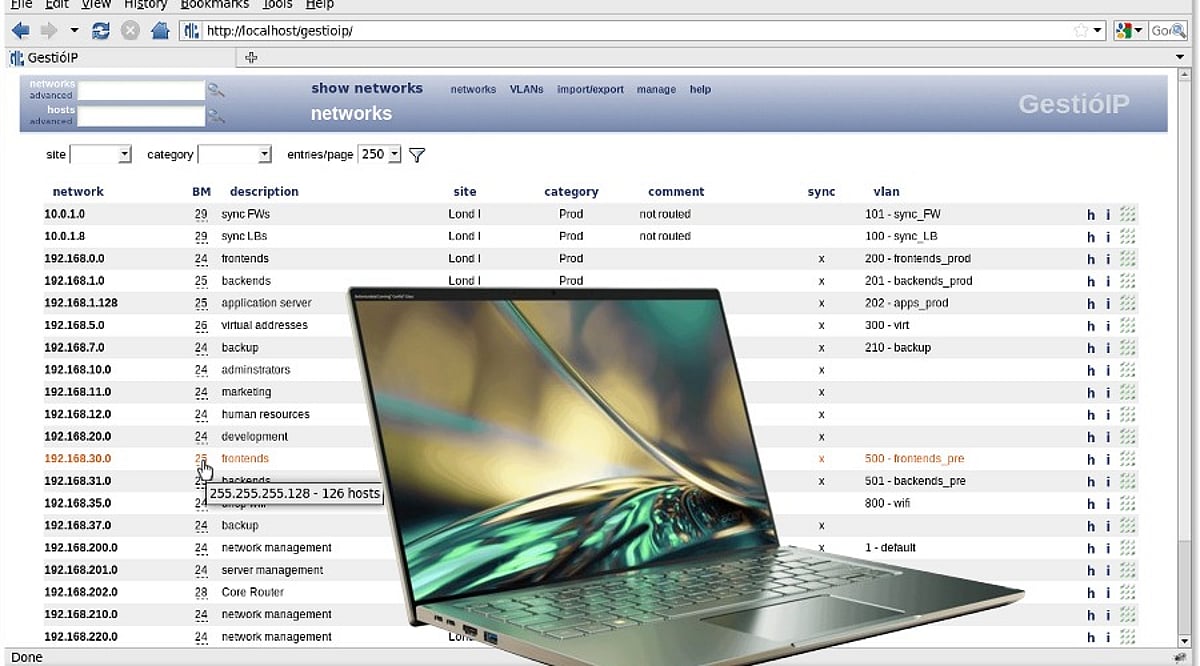
    9. GestióIP

    GestióIP is an open-source IPAM system that supports IPv4 and IPv6, subnet management, and network discovery. It is ideal for teams that prefer self-hosted solutions.

    10. Microsoft IPAM

    Microsoft IPAM is a natural choice for businesses already invested in Microsoft technology. It comes with Windows Server and provides centralized management of IP addresses and network infrastructure.

    Choosing the Right IPAM Tool

    Selecting an IPAM tool is not simply about picking the platform with the longest feature list. The right option depends on network size, existing infrastructure, and required automation. Open-source tools like NetBox, phpIPAM, and GestióIP appeal to teams seeking flexibility, while Infoblox, BlueCat, and EfficientIP are better suited for large enterprises. Tools such as SolarWinds IP Address Manager and ManageEngine OpUtils offer broader network management capabilities. Before deciding, evaluate IPv4 and IPv6 support, DNS and DHCP integration, network discovery, automation, API availability, scalability, and security features. A good IPAM platform should simplify network management, not add complexity.

  • Agentic AI in Action: Real-World Use Cases and Industry Lessons

    Agentic AI in Action: Real-World Use Cases and Industry Lessons

    Agentic AI goes far beyond simple chat responses: it plans, acts, and executes tasks across systems, marking a shift from generative content creation to operational authority. While adoption is accelerating, most enterprise projects still fail to scale—not because the technology is weak, but because success hinges on setting clear boundaries for autonomous action.

    Gartner projects that 40% of enterprise applications will incorporate task-specific AI agents by the end of 2026, up from under 5% in 2025. Yet McKinsey reports fewer than 10% of companies have scaled agents to deliver real value. Gartner also warns that over 40% of agentic AI projects will be canceled by 2027. The critical question for businesses is: where should AI be allowed to act without human intervention?

    Where Agents Move Fastest

    Customer service illustrates both the promise and the pitfalls. Klarna’s OpenAI-powered assistant handled 2.3 million conversations in its first month, cutting average resolution time from 11 minutes to under two and matching the output of roughly 700 full-time agents. However, by 2025, Klarna’s leadership acknowledged that automation had gone too far on service quality and began rehiring staff for escalated cases. This reversal underscores a key lesson: the boundary of what an agent should handle alone shifts as organizations learn where trust breaks down.

    Software engineering is another area where agents are thriving. Tools like Claude Code, GitHub Copilot’s agent mode, and Cursor now read codebases, write fixes across files, run tests, and open pull requests with minimal manual input. Developers increasingly review diffs rather than writing every line themselves. This sector leads in scaled agent use because the humans supervising the output can quickly catch mistakes.

    Where Risk Slows the Rollout

    Finance and healthcare move more deliberately. Banks use agents to trace fraud patterns and draft suspicious-activity reports, but any action touching customer funds requires direct human approval. Healthcare systems employ ambient tools like Abridge and Nuance’s DAX Copilot to draft clinical notes and flag coding gaps, while leaving diagnosis and treatment fully in human hands. Insurance follows the same pattern: claims intake, document checks, and fraud screening run through agents, but settlement decisions sit behind an approval gate.

    Manufacturing and Retail Emerging Patterns

    In manufacturing, a vision system spots a recurring defect, and an agent traces it back to a specific supplier’s batch, then opens a corrective-action ticket automatically—a chain that once took a quality engineer days to reconstruct. Retailers use agents to track demand, generate purchase orders, and set delivery windows, stepping in only when a variance crosses a set threshold. What makes these scenarios truly agentic is the orchestration across systems, not just a single automated task.

    The Real Determining Factor

    Across industries, one pattern holds: adoption speed moves inversely to the cost of a wrong autonomous action. Customer service and coding advance quickly because mistakes are cheap to catch. Finance, insurance, and healthcare are cautious because a wrong action carries financial, legal, or clinical weight. These sectors are not rejecting agentic AI—they are gating it. Successful deployments share three habits:

    • Give the agent a scoped job, not an open mandate.
    • Map its permissions to the actual risk of each action, not a blanket setting.
    • Define in advance exactly when a human takes over.

    Projects that skip these steps tend to be canceled quietly. The ones that succeed are not the boldest deployments—they are the best governed ones.

    Final Thought

    The next phase of enterprise AI will not be measured by how many agents a company switches on. It will be measured by how precisely each one knows the edge of its own authority—and how quickly a business notices when that edge has been crossed.