Tag: Compliance

  • SharePoint Server 2016 and 2019 End of Support: Security and Compliance Risks for Enterprises

    SharePoint Server 2016 and 2019 End of Support: Security and Compliance Risks for Enterprises

    SharePoint Server 2016 and 2019 End of Support: What Enterprises Must Know

    Microsoft has announced that SharePoint Server 2016 and 2019 will reach their end of extended support on July 14, 2026. After this date, these platforms will no longer receive security updates, patches, or technical support from Microsoft. This marks a critical juncture for enterprises that rely on these systems for document management, collaboration, and data governance. The absence of updates exposes organizations to escalating security vulnerabilities and compliance challenges, making proactive migration essential.

    Understanding the Support Timeline

    SharePoint Server 2016 reached end of mainstream support on July 13, 2021, while SharePoint Server 2019 followed on January 9, 2024. The upcoming end of extended support on July 14, 2026, means that all forms of standard support will cease. Systems will continue to function, but they will operate without protection against newly discovered vulnerabilities. While some organizations may explore custom support agreements or compensating controls, these measures are often limited and do not offer the same security assurance as a fully supported platform.

    Security Risks Escalate After Support Ends

    Unsupported SharePoint environments become prime targets for cybercriminals who actively scan for outdated systems with known, unpatched vulnerabilities. These weaknesses can lead to unauthorized access, privilege escalation, and data exfiltration. Once attackers gain a foothold, they can move laterally across the network, especially where legacy authentication or identity services are in use. Internal risks also increase as monitoring tools lose compatibility and security policies become outdated, creating a compounding effect that may go unnoticed until a breach occurs.

    Compliance and Regulatory Pressure

    Organizations operating under regulations such as HIPAA, GDPR, SOX, or FINRA must ensure their systems meet current security expectations. Unsupported software rarely satisfies these requirements. Auditors will scrutinize whether systems receive ongoing updates and vendor support, and a platform past its support window can trigger audit findings, increased scrutiny, or even failed audits. This can result in financial penalties, reputational damage, and forced remediation timelines, especially in heavily regulated sectors.

    Operational Strain on IT Teams

    Maintaining unsupported SharePoint versions places a heavy burden on internal IT departments. Without vendor patches, teams must manually create workarounds, monitor emerging threats independently, and troubleshoot issues without official support channels. This increases workload, reduces efficiency, and diverts resources from strategic initiatives. Downtime risks also rise, as resolving failures takes longer without vendor-backed fixes or documentation updates, ultimately affecting productivity across departments that depend on SharePoint.

    Why Delaying Action Is Risky

    Budget constraints or perceived migration challenges often lead organizations to postpone upgrades. However, delay widens the gap between current technology and security requirements. Over time, compatibility problems increase as third-party tools fail and integrations become more difficult. Data integrity issues may arise with backups and indexing. The longer an organization waits, the more complex and costly the eventual migration becomes.

    Modern Alternatives and Migration Paths

    Enterprises have two primary paths forward: SharePoint Server Subscription Edition for those who prefer on-premises deployment, or SharePoint Online for a cloud-based solution. SharePoint Server Subscription Edition is Microsoft’s supported on-premises option, but organizations must maintain active Software Assurance to access new versions and features. Each path requires careful evaluation of data volume, customizations, workflows, and integration dependencies. A structured approach, supported by professional SharePoint migration services, helps map current systems, identify risks, and execute a controlled transition with minimal downtime.

    Leveraging Automation for Modernization

    Legacy SharePoint systems often rely on manual processes that slow operations and introduce inconsistencies. Moving to a supported platform presents an opportunity to automate workflows using tools like Power Automate. Automation replaces manual approvals, document routing, and data handling with efficient, consistent processes. It also strengthens compliance by generating consistent audit trails, logging actions, and simplifying reporting. This transforms SharePoint from a static repository into an active, operational system.

    Strategic Planning and Expert Guidance

    Successful migration goes beyond technical execution. Strategic planning defines how systems will function long term. SharePoint consulting services help organizations evaluate architecture, governance models, and security frameworks, identifying gaps before they become problems. Consultants also guide decisions on customization, connectivity, and user access structures. A clear roadmap reduces uncertainty and prevents costly missteps, ensuring that migration is treated as a strategic initiative rather than a simple upgrade.

    Ensuring Post-Migration Stability

    Post-migration stability is critical. Systems must remain secure, efficient, and aligned with evolving business needs. Ongoing managed support services provide monitoring, updates, and issue resolution, reducing internal workload and keeping systems current. These services also offer visibility into system health, allowing teams to identify trends and address issues before they impact operations. A well-supported environment prevents the cycle of falling behind again.

    User Experience and Adoption

    The benefits of migration are realized only when users embrace the new system. Training and communication are essential to ensure productivity during the transition. Employees need to learn new interfaces and features, which often bring improved usability, faster search, and enhanced collaboration. Proper education ensures that users can leverage these capabilities, leading to increased efficiency and satisfaction.

    Data Governance and Control in Modern Environments

    Upgraded SharePoint systems offer stronger governance tools, including more precise permission management, data classification, retention policies, and audit tracking. These features help reduce unauthorized access risks and support compliance requirements while maintaining operational flexibility. Organizations gain clearer visibility into data access and sharing, strengthening both security and accountability. Modern governance capabilities address challenges that older platforms struggle to manage.

    Cost Considerations Beyond Immediate Budgets

    While migration costs may seem daunting, staying on unsupported systems carries hidden costs. These include potential breach expenses, compliance penalties, downtime losses, and productivity inefficiencies. Investing in updated infrastructure mitigates these risks and opens opportunities for improved collaboration and streamlined operations. A forward-looking perspective reveals that delaying action often becomes more expensive over time.

    Preparing for the Inevitable Shift

    The end-of-support deadline is a call to action. Early action gives enterprises control over the migration process, while procrastination leaves them with limited options and increased risk. A well-planned approach enables organizations to thrive in a constantly evolving technological landscape. By viewing this change as an opportunity rather than a disruption, businesses can modernize their systems, boost efficiency, and better protect their data. Planning ahead is essential for future stability and eliminating unnecessary risks.


  • Balancing Crypto Privacy and Compliance: How Zero-Knowledge Proofs and Global Regulation Are Reshaping Digital Asset Privacy

    Balancing Crypto Privacy and Compliance: How Zero-Knowledge Proofs and Global Regulation Are Reshaping Digital Asset Privacy

    Cryptocurrency creates an unusual privacy challenge. Public blockchains can permanently expose transaction histories, while regulators increasingly require exchanges and other crypto businesses to identify customers and detect illicit activity. The long-term challenge is preserving legitimate financial privacy without making transactions completely untraceable.

    Public Blockchains Are Not Automatically Anonymous

    Bitcoin and Ethereum are not anonymous; they are pseudonymous. Addresses are anonymized, but transactions, counterparties and histories are not. If an address is connected to a person, blockchain analytics can follow up on the activity in relation to that person.

    Privacy technologies try to minimize this exposure in the following ways: confidential transactions, privacy-oriented cryptocurrencies, mixers, and zero-knowledge proofs. The privacy guidance from Ethereum, updated in August 2026, outlines selective disclosure and zero-knowledge technology as a method for verifying information without disclosing users’ personal information.

    Regulation Is Expanding

    The Financial Action Task Force’s July 2026 review found further progress in global virtual-asset regulation. According to FATF, 83% of surveyed jurisdictions had enacted legislation implementing the Travel Rule, up from 73% in 2025. Another 11 jurisdictions reported implementation was underway.

    However, major gaps remain. FATF identified stablecoins, offshore service providers, peer-to-peer transfers through unhosted wallets and decentralized finance as continuing risk areas. A separate March report said more than 250 stablecoins were circulating by mid-2025, with combined market capitalization exceeding USD 300 billion.

    DeFi presents another challenge. FATF reported in July that 132 of 143 surveyed jurisdictions, nearly 93%, had not implemented its standards for qualifying DeFi arrangements. Only two of 142 jurisdictions had licensed or registered a DeFi arrangement in practice.

    Can Zero-Knowledge Proofs Bridge the Gap?

    Zero-knowledge proofs can help achieve a perfect balance by allowing someone to validate a statement without revealing the details. By using zero-knowledge proofs, it is possible to demonstrate identity validation or eligibility without making other triggers of violation public.

    This method allows for selective disclosure rather than setting a choice between total transparency and anonymity. Still, regulators need to be assured that privacy methods will not be used to avoid practicing AML and sanctions. Custodial wallets become extraordinarily complex as users are able to make transactions directly without any intermediary who would perform KYC.

    Why This Matters

    Crypto regulation does not necessarily require eliminating privacy. The challenge is building systems that protect legitimate financial information while allowing regulated businesses to verify identity, sanctions compliance and anti-money-laundering requirements when legally required, without exposing unnecessary user data.

    Final Thoughts

    Crypto’s future may combine privacy-preserving cryptography, selective disclosure, regulated gateways and blockchain analytics. FATF’s 2026 findings show regulation is expanding, but implementation remains uneven. The balance will depend on whether privacy technologies can protect users while still supporting enforceable, risk-based compliance.

    Frequently Asked Questions

    1. Are Bitcoin and Ethereum transactions anonymous? No. Bitcoin and Ethereum are generally pseudonymous rather than anonymous. Blockchain addresses do not automatically reveal legal identities, but transactions and balances are public and can potentially be traced once an address is linked to someone.
    2. What is the FATF Travel Rule for cryptocurrency? The Travel Rule requires qualifying virtual-asset service providers to obtain and transmit specified information about transaction originators and beneficiaries. FATF reported that 83% of surveyed jurisdictions had enacted Travel Rule legislation in 2026.
    3. How can zero-knowledge proofs improve crypto privacy? Zero-knowledge proofs allow users to demonstrate that certain conditions are satisfied without revealing all the underlying information. They could potentially support identity, eligibility or compliance verification while keeping unrelated personal and financial information private.
    4. Why is DeFi difficult for regulators to oversee? DeFi can enable blockchain transactions without conventional centralized intermediaries responsible for KYC and transaction monitoring. FATF reported that 132 of 143 surveyed jurisdictions had not implemented its standards for qualifying DeFi arrangements.
    5. Can crypto remain private under stronger regulation? Potentially, but privacy may increasingly rely on selective disclosure rather than complete anonymity. Zero-knowledge technology, privacy-preserving cryptography, regulated gateways and blockchain analytics could coexist as jurisdictions develop their digital-asset compliance frameworks.
  • India’s 2027 E-Commerce Rules: Compliance Burden Looms for Small Sellers and MSMEs

    India’s 2027 E-Commerce Rules: Compliance Burden Looms for Small Sellers and MSMEs

    India’s amended e-commerce rules, set to take effect on January 1, 2027, are raising compliance concerns among small sellers and micro, small, and medium enterprises (MSMEs) that rely on online marketplaces. The Consumer Protection (E-Commerce) (Amendment) Rules, 2026, introduced by the Department of Consumer Affairs, will replace the 2020 regulations and introduce new requirements on pricing, product rankings, sponsored listings, dark patterns, and consumer grievance support.

    Ranking and Pricing Rules Add to Compliance Work

    Under the updated framework, e-commerce platforms must disclose the factors determining product rankings and clearly label sponsored listings. While the goal of improving transparency is widely welcomed, a senior industry executive noted that smaller sellers may struggle with the complexity. “Requirements around disclosure of ranking parameters, particularly the relative importance of different parameters, could be difficult for small and unorganised sellers to navigate,” the executive said.

    Pricing rules also tighten: discount claims must now reference the lowest price offered in the previous 30 days (the “prior price” requirement). Industry representatives warn that this could force small businesses without dedicated compliance staff to maintain detailed price records to ensure accuracy.

    Dark Pattern Audits and Consumer Helpline Integration

    The amended rules link marketplaces to the government’s 2023 guidelines on dark patterns—practices that mislead or pressure consumers. Businesses must conduct an annual self-audit on dark patterns. Industry executives support stronger accountability but seek clarity on how certification will work for sellers using large platforms. “An annual self-audit is a reasonable way of doing that,” the executive said, while questioning whether some duties might shift from platforms to individual merchants.

    Additionally, platforms must partner with the National Consumer Helpline to streamline complaint handling and improve coordination with government-backed grievance systems.

    Flipkart Welcomes the Move

    Flipkart publicly endorsed the government’s focus on consumer protection and transparency. A company spokesperson stated, “We welcome the Government’s focus on strengthening consumer protection and transparency in e-commerce.” The company said it will study the detailed rules and continue discussions with the government, emphasizing its commitment to supporting small businesses, MSMEs, and farmers.

    As the January 2027 deadline approaches, sellers and platforms must prepare for new disclosure, pricing, audit, and consumer-support requirements. Industry representatives have urged policymakers to ensure the compliance system remains manageable for businesses of all sizes.

  • Streamlining High-Volume Onboarding: How KYC Automation Accelerates Identity Verification

    Streamlining High-Volume Onboarding: How KYC Automation Accelerates Identity Verification

    Digital onboarding can become difficult to manage when application numbers climb. Every new customer may need to provide information and prove their identity before gaining access to an account or service. When too much of that work depends on manual processing, higher demand can quickly create longer queues.

    KYC automation changes how businesses handle those repeatable checks. It can process information, support identity verification, and direct unusual cases for further attention. This helps businesses manage larger onboarding volumes while keeping necessary checks within the customer journey.

    Manual KYC Creates Friction as Application Volumes Rise

    Manual KYC processes require people to handle tasks that occur again and again during onboarding. Staff may need to inspect submitted information, review identity documents, or investigate inconsistencies. That workload can be manageable with a limited number of applications, but the pressure changes when hundreds or thousands arrive within a short period.

    The operational bottleneck becomes clearer as those applications accumulate. Businesses can track the percentage of applications sent to manual review, average handling time, and queue length to see where capacity is being stretched. If applications are entering manual review faster than employees can process them, waiting times increase even when each individual check takes only a few minutes.

    Those delays can also have a direct financial impact. Customers who encounter a lengthy verification process may abandon an application before opening an account or accessing the service. Tracking onboarding drop-off alongside processing times can help businesses identify where verification delays are contributing to lost conversions.

    Hiring more reviewers can increase capacity, although staffing alone doesn’t remove repetitive work from the process. KYC automation approaches the problem differently. Routine steps can be processed digitally, allowing businesses to increase onboarding capacity without requiring every additional application to produce the same amount of manual work.

    Automating Identity Checks: Removing a Major Onboarding Bottleneck

    KYC slows down when identity checks sit in separate steps. A document may be reviewed in one place, a selfie match in another, liveness results somewhere else, and fraud signals passed to a manual team before a decision can move forward. Even when each check works, the workflow itself can create delays.

    Automation helps by bringing those checks into a connected sequence. Organizations can reduce that friction by connecting document checks, facial matching, biometric liveness, and fraud signals inside one onboarding workflow. That does not remove human review. It makes the review process more selective by separating routine applications from cases that need closer attention.

    A well-structured workflow may include:

    • Document validation to assess identity documents and the information they contain,
    • Facial matching to compare the applicant with the portrait on the submitted document,
    • Biometric liveness to establish that a real person is present during verification,
    • Fraud detection to identify suspicious or manipulated identity signals.

    Incode identity verification is one example of this workflow-led approach. Incode is an enterprise AI-powered identity verification platform built to enable instant digital trust through unified biometric verification, fraud prevention, and regulatory compliance. It features built-in KYC and AML workflows that automate compliance checks. This helps regulated businesses keep onboarding moving at volume without removing the review controls needed for uncertain or higher-risk applications.

    Risk-Based Workflows Keep Manual Review Focused

    Some KYC cases are straightforward, while others need closer examination. Treating both in exactly the same way can make onboarding inefficient. If every application waits for the same level of manual attention, employees spend time reviewing routine cases while more complicated ones compete for the same resources.

    Automated workflows can help separate cases according to established criteria before every application reaches a manual queue. An application that completes required checks without producing an issue may continue through the process. Certain issues can trigger escalation to manual review. These include a low-confidence document check, failed liveness verification, a data mismatch, or suspected fraud.

    This approach makes human involvement more targeted. Review teams can concentrate on situations where context, investigation, or judgement is needed instead of repeatedly performing predictable tasks that can be automated. Human oversight therefore remains part of the process without becoming a mandatory stopping point for every applicant.

    That distinction matters when volumes suddenly rise. A business may experience a surge following a product launch or expansion into a new market. If routine applications can continue moving while reviewers concentrate on exceptions, increased demand is less likely to produce an equally large increase in manual queues.

    Faster Onboarding Still Depends on Effective Controls

    Speed alone isn’t a useful measure of an effective KYC process. An onboarding journey that moves quickly because important checks have been removed creates a different problem. Automation works best when it reduces unnecessary waiting and repetitive handling while supporting the controls the business has determined are necessary.

    Accuracy matters just as much when automated processes are making assessments at scale. Businesses can monitor metrics such as false rejection rate, manual-review rate, approval rate, and fraud catch rate to judge whether faster processing is producing the intended results. A high false rejection or manual-review rate, for example, may indicate that legitimate applicants are encountering unnecessary friction.

    Privacy deserves similar attention. Digital KYC can involve identity documents, personal details and, in some processes, biometric information. Organisations need to consider how that information is collected, processed and protected throughout the onboarding journey. Faster processing doesn’t remove those responsibilities.

    The practical goal is to make the process efficient without treating every second saved as an improvement. Automation can reduce repetitive work and shorten unnecessary queues, while appropriate controls and escalation routes ensure that cases requiring closer attention still receive it.

    Scaling Onboarding Without Scaling Every Manual Step

    High-volume digital onboarding creates a simple operational challenge: more applicants mean more checks. When every check requires individual employee involvement, processing capacity can struggle to keep pace with customer demand. Automation changes that relationship by allowing repeatable parts of KYC to move through digital workflows.

    The result can be a more scalable onboarding process where human attention is concentrated where it adds the most value. Routine identity and data checks can move more efficiently, while uncertain cases still receive additional scrutiny. For businesses handling large application volumes, that balance can shorten customer waiting times without making speed the only priority.

  • France’s E-Invoicing Mandate: Is Your Business Ready for the 2026 Deadline?

    France’s E-Invoicing Mandate: Is Your Business Ready for the 2026 Deadline?

    The digitalization of tax administration is accelerating globally, and Europe is at the forefront. France’s Ministry of Economy, Finance, and Digital Sovereignty is implementing a groundbreaking digital tax reform that will fundamentally change how businesses handle invoicing and reporting. If your company operates in France, trades with French companies, or is subject to French VAT, understanding these new obligations is critical.

    The reform has two main components: mandatory electronic invoicing for domestic B2B transactions and mandatory e-reporting for cross-border, B2C, and overseas activities. Companies must adapt their ERP and accounting processes well before the implementation deadlines.

    Understanding the Core Architecture of France’s E-Invoicing Reform

    The French mandate rests on two pillars: mandatory electronic invoicing and dynamic e-reporting. The French tax administration (Direction Générale des Finances Publiques – DGFiP) aims to deter VAT fraud, reduce administrative burdens, and gain real-time access to economic activity.

    Unlike traditional paper or unstructured PDF invoices sent via email, e-invoicing under the new framework requires structured digital formats that enable automated machine processing. Invoices will no longer be sent directly from supplier to buyer; they must pass through validated digital channels that extract key tax data and transmit it to a national central hub.

    1. Electronic Invoicing (E-Invoicing)

    Mandatory e-invoicing targets all domestic Business-to-Business (B2B) transactions between companies established in France. Every tax-registered company must be capable of receiving structured electronic invoices, and sellers must issue them in standardized formats such as UBL 2.1, CII (Cross Industry Invoice), or Factur-X (a hybrid format combining a human-readable PDF with embedded XML data).

    2. Electronic Reporting (E-Reporting)

    Transactions outside domestic B2B scope are governed by e-reporting rules. This includes:

    • Business-to-Consumer (B2C) Transactions: Domestic and international sales to end consumers.
    • Cross-Border B2B Transactions: Intra-EU acquisitions, cross-border sales, and international import/export activities.
    • Payment Status Data: For services, payment date status must be reported to enable accurate VAT collection on an accrual or cash-received basis.

    The Regulatory Timeline: Phased Implementation Schedule

    The French government has established a phased implementation roadmap to allow businesses to progressively integrate necessary software and test data flows. While mandatory issuance is tiered by company size, every business in France must be equipped to receive structured e-invoices starting in September 2026. Waiting until 2027 is risky even for smaller enterprises, as receipt capability demands functional integration, system updates, and employee training today.

    Technical Infrastructure: PDP, PPF, and OD

    The operational framework relies on a Y-shaped architectural ecosystem designed by the French tax authority:

    • Public Billing Portal (Portail Public de Facturation – PPF): The state-run central repository that aggregates transaction data for tax oversight, provides basic free invoicing services, and routes data directly to the tax authority.
    • Partner Dematerialization Platforms (Plateformes de Dématérialisation Partenaire – PDP): Third-party certified service providers that convert non-compliant formats, validate invoice integrity, exchange invoices between platforms, and automatically route tax data to the PPF.
    • Dematerialization Operators (Opérateurs de Dématérialisation – OD): Uncertified technology vendors that can generate or process electronic invoices but cannot connect directly to the PPF or other PDPs without relying on an accredited PDP or manual intervention.

    Key Compliance Takeaway: For multinational businesses with complex ERP ecosystems like SAP, Microsoft Dynamics, or Oracle, partner integration with an accredited PDP is essential to automate high-volume invoice routing, schema transformation, and status tracking without breaking existing business logic.

    Operational Challenges and How to Prepare Your Business

    Transitioning to full compliance requires more than installing a simple software plugin. It impacts core finance, procurement, tax governance, and IT infrastructure. Organizations should undertake a systematic implementation strategy focused on:

    1. Data Governance and Master Data Cleanup

    E-invoicing validation engines rigorously inspect mandatory fields. Errors in SIREN, SIRET, or intra-community VAT numbers, customer addresses, or incorrect tax classification codes will cause instant invoice rejection. Establishing robust master data governance is step one.

    2. ERP and Financial System Alignment

    Assess your current ERP stack. Does your billing system support structured formats such as Factur-X or UBL? Does it track mandatory invoice lifecycle statuses (e.g., Deposited, Approved, Refused, Received, Payment Complete)? ERP systems must be configured to process real-time status feedback loops.

    3. Cross-Border Tax Strategy

    Ensure your tax technology stack can differentiate between domestic B2B flows (requiring e-invoicing) and cross-border or B2C flows (requiring structured e-reporting). Misclassifying transactions will result in compliance gaps and potential tax penalties.

    Future-Proofing Compliance with Integrated Solutions

    Given the shift toward real-time transaction management, maintaining separate systems for each country is unsustainable. Enterprises need scalable solutions that integrate easily with existing ERP environments. SNI Technology offers comprehensive, fully automated solutions for SAP-based compliance, helping businesses meet French e-invoicing and e-reporting requirements through automation of invoice creation, format transformation, validation, and routing via certified PDP channels.

  • Why Data-Driven Businesses Miss Regulatory Risks: Key Insights from Armin Ordodary

    Why Data-Driven Businesses Miss Regulatory Risks: Key Insights from Armin Ordodary

    Some of the most analytically mature businesses measure almost everything: conversion, churn, lifetime value, model performance, infrastructure latency, acquisition efficiency, and unit economics. Yet many of those same organizations have no comparable mechanism for tracking whether the assumptions behind a product, data architecture, or algorithm remain defensible as regulation changes. Armin Ordodary argues that this is not a failure of intelligence, but a failure of input design.

    Why Regulatory Risk Doesn’t Show Up in Dashboards

    Most analytics systems are built around signals that are observable, repeatable, and comparable over time. Revenue can be segmented. Churn can be measured by cohort. Model drift can be monitored. Regulatory risk behaves differently because it is often categorical rather than continuous: an activity may fall within a licensing perimeter or it may not; a particular use of personal data may be permissible in one jurisdiction and restricted in another.

    That makes regulatory exposure difficult to express as a conventional KPI. There may be no gradual decline in performance before the underlying assumption becomes problematic. A business can operate for months with apparently stable metrics while accumulating exposure created by the way it collects data, makes automated decisions, or enters new markets. The absence of a visible negative signal is therefore weak evidence that the underlying position is sound.

    There is also a modeling problem. Analytics teams are trained to improve decisions by increasing the quality of available data. Regulatory intelligence often requires a different discipline: identifying when the decision space itself changes. A rule affecting data retention, explainability, consent, or product classification does not merely add another variable to a model—it can alter which options should be considered viable in the first place. This distinction sits at the center of Ordodary’s framework: regulation is not simply another risk metric but part of the structure within which business decisions are made.

    Three Business Moments Where Regulatory Blind Spots Become Measurable

    Geographic expansion. A company sees strong demand signals in a new market, forecasts customer acquisition, models expected revenue, and prioritizes the launch accordingly. The analytical case can be entirely coherent while still being incomplete. If the new jurisdiction treats the product, data flow, or customer relationship differently, the forecast is built on an operating model that may not transfer. The cost becomes measurable when implementation begins: additional consent requirements may alter the funnel, a licensing issue may change the launch timetable, and restrictions on data use may weaken a key feature.

    Data architecture. Engineering teams routinely make decisions about storage, retention, identity resolution, and data movement for good reasons—performance, reliability, observability, and cost. Problems arise when those decisions are treated as technically neutral. Where data is stored, how long it is retained, which teams can access it, and whether datasets can be combined may have regulatory significance. By the time that significance becomes visible, architecture has usually hardened. A change that would have been cheap during system design can require substantial re-engineering after pipelines, models, and downstream dependencies have formed.

    Algorithmic systems. A lending, hiring, or pricing model can be statistically strong and commercially valuable while still creating difficult questions about explainability, discrimination, documentation, or accountability. Accuracy and defensibility are related but not interchangeable properties. A mature organization asks more than whether a model performs well against its objective function—it asks whether the variables, decision logic, monitoring process, and governance can withstand scrutiny from someone who does not share the optimization goal. The regulatory question must enter before deployment, when the business still has meaningful design choices.

    What Regulatory Intelligence Looks Like as an Input to Decision-Making

    Regulatory intelligence is not the same as legal compliance. Compliance asks whether a business is meeting defined obligations. Regulatory intelligence asks how rules, supervisory priorities, and jurisdictional differences should influence a decision before the company commits capital, architecture, or organizational resources.

    For a data-literate leadership team, the useful analogy is not a checklist but a constraint layer. A market model may suggest that five jurisdictions are commercially attractive. Regulatory intelligence may show that two require materially different product structures. A machine-learning team may identify the most predictive feature set. Regulatory analysis may show that some variables create governance or explainability problems that change the cost-benefit calculation.

    Strategically mature businesses make those constraints visible early. They do not attempt to convert every regulatory issue into a synthetic score. Instead, they identify which assumptions are jurisdiction-dependent, which decisions are difficult to reverse, and which regulatory developments could invalidate the model being used to allocate resources. The objective is not numerical neatness—it is decision quality.

    The Key Question for Data-Driven Leadership Teams

    Armin Ordodary’s most useful diagnostic is simple: Which assumption in this decision would become false if the regulatory environment changed?

    The strength of the question is that it shifts attention away from abstract “regulatory risk” and toward the logic of the decision itself. If expansion economics depend on using customer data in a particular way, that dependence should be explicit. If an algorithm depends on variables that may become harder to justify, that assumption belongs in the decision model. If a product only works commercially under one classification, leadership should know how much of the strategy rests on that classification remaining intact.

    Some regulatory changes are inconvenient but reversible. Others can invalidate months of engineering, change the economics of a market, or force a redesign of the customer journey. Good regulatory intelligence distinguishes between them before capital and technical effort make the distinction expensive.

    Data-driven management works because disciplined organizations refuse to rely solely on instinct where evidence can improve a decision. Regulatory intelligence extends the same principle into an area where the evidence is less tidy. The most dangerous variable is not always the one a company has measured incorrectly. Sometimes it is the variable that never entered the model at all.

  • iDenfy Launches Standalone Selfie-Based Age Estimation Tool for Faster Onboarding

    iDenfy Launches Standalone Selfie-Based Age Estimation Tool for Faster Onboarding

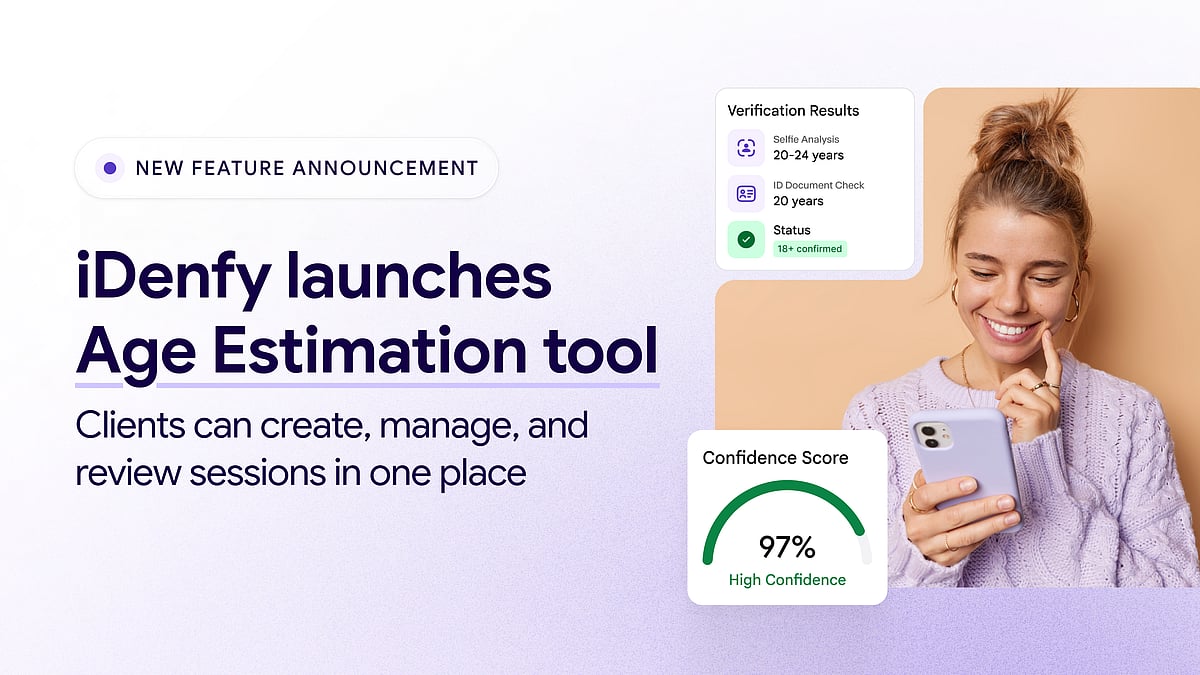
    iDenfy, a global RegTech platform specializing in identity verification and fraud prevention, has announced a significant upgrade to its age verification platform with the introduction of a new Age Estimation tool. This feature allows businesses to estimate a user’s age using a real-time selfie, eliminating the need for an ID document upload in many cases.

    How the Age Estimation Tool Works

    Traditionally, iDenfy’s age verification required users to upload a government-issued ID. With the new Age Estimation add-on, users can simply capture a selfie, and the system analyzes facial features to estimate age within a three-year accuracy gap. Businesses can set a configurable age limit and buffer zone. Users clearly above the threshold pass instantly; those near the limit are automatically routed to a certified ID document check within the same session for final verification.

    Standalone Product with Dedicated Infrastructure

    Unlike a bundled feature, iDenfy has built Age Estimation as a standalone product with its own permission structure, billing model, and API endpoints. This means partners who only need age estimation checks can access it without adopting the full identity verification stack. The dedicated dashboard provides a centralized view of sessions, token generation, and detailed session pages, supported by custom settings and verification URLs.

    Benefits for Businesses and Compliance

    Validated age data reduces the risk of underage access to restricted products while minimizing personal data collection. Because most users pass with just a selfie, companies avoid requiring government IDs from their entire user base. This supports compliance with regulations such as the UK Online Safety Act, EU Digital Services Act, GDPR, and emerging state-level laws in the US and Australia’s under-16 social media restrictions.

    Domantas Ciulde, CEO of iDenfy, commented: “Age estimation only works if the people using it can actually see what’s happening inside each session. We improved our product against disguises such as makeup or a moustache to precisely estimate people’s age and brought it into the dashboard with its own sessions list and detailed view.”

    He added: “Centralizing session creation and results in one dashboard view might sound like a small operational detail, but for partners that run age checks at scale, it removes a lot of manual tracking that used to happen outside our platform.”

    Availability

    The Age Estimation dashboard module is now available to iDenfy partners, who can integrate via API or Dashboard with 24/7 support. For more information, visit iDenfy’s age verification service page.

  • Crypto Privacy Tools Can Bolster Both Security and Compliance, New Report Reveals

    Crypto Privacy Tools Can Bolster Both Security and Compliance, New Report Reveals

    For years, mainstream crypto design prioritized absolute on-chain transparency, treating financial privacy as a liability rather than a necessity. A new joint report by digital asset management and crypto loan provider CoinRabbit and crypto super app ChangeNOW challenges that assumption, concluding that public ledgers create dangerous privacy leaks for businesses and physical safety risks for individual holders.

    Presented by Decrypt, Financial Privacy in the Digital Age synthesizes data from TRM Labs, Chainalysis, CertiK, and Statista to make a pragmatic case: Web3 privacy tools are essential infrastructure for basic security, while law enforcement leverage actually sits at regulated fiat gateways, not upstream transaction histories.

    Key Highlights

    • $124.1M lost to physical attacks. Public wallet addresses act as unintended net-worth registries, exposing investors to targeted extortion and social engineering.
    • Corporate vulnerabilities & $4.44M breach costs. Transparent ledgers allow competitors to reconstruct vendor contracts, payroll, and treasury balances, impacting the 36% of board members who consider internal data exposure their top operational threat.
    • Enforcement targets gateways, not on-chain history. Authorities combat illicit flows at centralized fiat off-ramps, exchange KYC databases, and stablecoin issuer freezes rather than through continuous public surveillance.
    • Privacy tools already operating within compliance. The report highlights CoinRabbit’s custodial model and ChangeNOW’s private crypto transfers as benchmarks for privacy-preserving infrastructure.

    The Corporate and Personal Risks of Open Ledgers

    While permanent ledger visibility makes protocol audits efficient, it presents severe liabilities for mainstream business adoption. Unlike traditional bank accounts, public blockchain addresses broadcast complete cash flows and account balances to anyone with an internet connection. Competitors can easily monitor corporate wallets to deduce profit margins, supplier pricing, and internal payroll cadence. With Statista estimating average data breach costs at $4.44 million, broad ledger exposure creates a structural weakness for corporate treasuries moving on-chain.

    For private investors, that visibility carries physical consequences. “Public blockchain transparency lets anyone audit your net worth in real time, turning private wealth into public information,” said Walter Barrett, Chief Strategy & Growth Officer at CoinRabbit.

    The security data back up that warning. CertiK recorded 52 verified physical extortion (“wrench”) attacks in the first half of 2026. In France, which accounted for 33 of those incidents, breaches at public agencies allowed criminal networks to cross-reference residential addresses with suspected crypto holdings. In response, 30% of surveyed high-net-worth holders now hire data-broker removal services to break the link between their identities and wallet addresses.

    How Investigators Track Illicit Capital

    Skeptics often frame financial privacy as an enclave for illicit finance, pointing to TRM Labs data that places 2025 illicit crypto inflows at $158 billion, with Chinese-language laundering networks accounting for over $100 billion. However, investigative data shows that raw ledger transparency is rarely the decisive factor in asset recovery or criminal attribution. Instead, law enforcement leverage is concentrated at centralized touchpoints: exchange KYC registries, court subpoenas, stablecoin blacklist functions, and fiat off-ramps.

    “Successful blockchain investigations rely on the combination of on-chain analysis, behavioral patterns, KYC information, exchange cooperation, stablecoin issuer interventions, and traditional investigative methods. In practice, attribution is achieved by connecting multiple sources of evidence rather than relying on blockchain transparency alone,” noted Albert Quehenberger, founder of AQ Forensics.

    Because enforcement operates primarily at these regulated checkpoints, the authors argue that base-layer privacy tools can protect legitimate user data without disabling the mechanisms authorities use to police market abuse.

    Rethinking Financial Transparency in Web3

    The report calls for a fundamental redesign of Web3 architecture, urging developers to replace mandatory public broadcasting with permissioned, selective disclosure. “The privacy debate starts from the wrong assumption that ordinary users must prove they have nothing to hide by exposing everything,” said Pauline Shangett, Chief Strategy Officer at ChangeNOW. “That is not how any mature financial system works.”

    Yet as crypto pushes for institutional adoption, this tension between default visibility and basic confidentiality remains one of Web3’s thorniest policy battlegrounds. While developers press for selective disclosure tools to protect commercial secrets, global regulators continue to push for tighter oversight of self-custodial flows. How the industry resolves that pushback will determine whether digital assets can offer a viable financial infrastructure for traditional finance, or whether privacy and compliance remain locked in an ongoing tug-of-war.

    Disclaimer: This article is for informational purposes only and does not constitute financial or investment advice. Cryptocurrencies are risky assets; always conduct your own research before investing.

  • Solana Block Building Gets Compliance Layer via Flowra-Honeypot Partnership

    Solana Block Building Gets Compliance Layer via Flowra-Honeypot Partnership

    Flowra, a Solana-focused platform for open orderflow auctions and validator infrastructure, has announced a partnership with compliance provider Honeypot to integrate sanctions and risk screening directly into the block-building process. The collaboration gives validators new tools to define compliance policies before transactions are finalized on-chain.

    Bringing Compliance into Block Construction

    The integration combines Honeypot’s compliance intelligence with Flowra’s Programmable Block Policy (PBP), enabling institutional validators to set configurable rules for which transactions and bundles can be included during block construction. Rather than applying a single compliance framework across the network, the system lets each validator independently decide how those policies are implemented.

    The initial rollout supports screening against sanctions-related criteria, including wallet addresses linked to sanctioned entities, along with network-level indicators such as VPNs, proxy services, and Tor exit nodes. Flowra says the framework is designed to accommodate additional enterprise compliance providers over time, allowing validators to adapt as operational and regulatory requirements evolve.

    Why Institutional Validators Need More Control

    As institutional participation in blockchain networks grows, validators are increasingly expected to operate within compliance frameworks originally built for exchanges, custodians, and wallet providers. While those businesses routinely screen users before transactions reach the blockchain, validators have historically had limited options for applying configurable compliance controls during block construction.

    Flowra’s Programmable Block Policy extends compliance into validator infrastructure without imposing mandatory network-wide enforcement. Participating validators retain full authority over how transaction selection policies are configured. They can choose whether to implement screening, which providers to integrate, and when to update those policies — preserving autonomy while expanding compliance capabilities for regulated infrastructure providers.

    “Public blockchains have become increasingly attractive to institutional participants, but the infrastructure hasn’t evolved to give validators the compliance controls many regulated operators expect,” said Harry Hwang, CEO of Flowra. “We’re working with Honeypot to bring compliance into the block-building process itself, allowing validators to define and enforce their own policies before transactions are included on-chain. The goal isn’t to make the network less open, it’s to give individual validators the flexibility to operate in a way that reflects their own requirements.”

    Looking Ahead

    Initially, the collaboration focuses on sanctions screening, wallet screening, and auditability for regulated institutions. Future updates are expected to expand the framework to support additional enterprise compliance providers while introducing new capabilities that give validators greater flexibility over how compliance policies are implemented within their own infrastructure.

    Flowra develops validator infrastructure, delegation programs, and orderflow technologies aimed at improving transparency, incentive alignment, and value distribution across the Solana ecosystem. Honeypot provides compliance intelligence that helps exchanges, DeFi protocols, and financial institutions identify VPNs, proxy services, Tor exit nodes, and other location-obfuscation methods in support of sanctions compliance and regulatory audit requirements.

  • Flowra and Honeypot Integrate Sanctions Screening Directly into Solana Block Building

    Flowra and Honeypot Integrate Sanctions Screening Directly into Solana Block Building

    SEOUL, South Korea — Flowra, the open orderflow auction and validator infrastructure platform for Solana, has announced a collaboration with compliance infrastructure provider Honeypot to embed sanctions and risk screening directly into the block-building process.

    The integration combines Honeypot’s compliance intelligence with Flowra’s Programmable Block Policy (PBP), enabling institutional validators to define compliance rules that govern which transactions and bundles can be included during block construction.

    The framework supports screening against sanctions-related criteria, including wallet addresses associated with sanctioned entities, as well as network-level indicators such as VPNs, proxy services, and Tor exit nodes. These methods account for an estimated 31–61% of traffic arriving through network obfuscation. The system is also designed to accommodate additional enterprise compliance providers over time.

    Each validator will define its own policy, preserving validator autonomy while offering operators greater flexibility over block-building decisions.

    “Public blockchains have become increasingly attractive to institutional participants, but the infrastructure hasn’t evolved to give validators the compliance controls many regulated operators expect,” said Harry Hwang, CEO of Flowra. “We’re working with Honeypot to bring compliance into the block-building process itself, allowing validators to define and enforce their own policies before transactions are included on-chain. The goal isn’t to make the network less open, it’s to give individual validators the flexibility to operate in a way that reflects their own requirements.”

    The collaboration will initially focus on sanctions screening, wallet screening, and auditability for regulated institutions, with additional technical details to be shared as implementation progresses.

    About Flowra

    Flowra is a blockchain infrastructure company building validator and order flow solutions for the Solana ecosystem. The company develops technology designed to improve transaction transparency, value distribution, and incentive alignment across validators, users, and builders. Through its validator infrastructure, delegation programs, and MEV-related technologies, Flowra aims to create a more open, efficient, and scalable foundation for the next generation of blockchain networks.

    About Honeypot

    Honeypot provides compliance intelligence for platforms operating under sanctions and geo-restriction requirements. By detecting VPNs, proxies, Tor exit nodes, and other forms of location obfuscation, Honeypot helps exchanges, DeFi protocols, and financial institutions strengthen compliance controls and support regulatory audit requirements.