Tag: cryptocurrency

  • How AI-Powered Apps Are Revolutionizing Cryptocurrency Trading

    How AI-Powered Apps Are Revolutionizing Cryptocurrency Trading

    Artificial intelligence is rapidly becoming a cornerstone of cryptocurrency trading infrastructure. AI-powered applications can process price action, derivatives data, blockchain activity, news, and sentiment far faster than any individual trader. While some systems only generate signals, newer agentic tools can connect directly to exchanges or wallets and execute transactions autonomously. However, these systems produce probabilistic decisions, not guaranteed forecasts.

    AI Combines Multiple Data Sources

    Conventional technical analysis typically relies on price, volume, and indicators. AI, on the other hand, analyzes vast datasets including Bitcoin momentum, order-book depth, funding rates, open interest, liquidations, exchange flows, and volatility. Machine learning identifies historical relationships associated with specific market events, while natural language processing (NLP) incorporates financial news, regulatory announcements, and social media discussions. The result: systems can classify market conditions as bullish, bearish, or neutral, assign probabilities to potential movements, or rank possible trading sequences.

    From Signals to Autonomous Execution

    AI analysis is increasingly extending beyond recommendations. Applications connected to exchange APIs can convert trading signals into orders, adjust position sizes, and monitor positions continuously. This trend became more visible in 2026: Kraken launched its CLI in March with 134 commands supporting spot trading, futures, staking, transfers, and WebSocket streaming. Kraken said the system was designed for developers and AI agents to access crypto markets directly. Coinbase introduced Agentic Wallets in February 2026, providing infrastructure that lets AI agents autonomously spend, earn, and trade while using built-in security guardrails.

    Historical Performance Can Be Misleading

    Machine learning models depend heavily on training data. A strategy optimized during a Bitcoin bull market may identify relationships that weaken during sideways or declining markets. Overfitting is another risk: a model can perform exceptionally well against historical observations but deteriorate once deployed with live capital. Trading costs—exchange fees, bid-ask spreads, slippage, and execution latency—can reduce or eliminate profits suggested by backtests. The CFTC warns that AI cannot predict sudden market changes and urges skepticism toward bots or signal services promising guaranteed or unusually high returns.

    Risk Controls Remain Essential

    Automated execution makes risk management particularly important, as errors can be repeated quickly. Position limits, stop-loss rules, exposure controls, model monitoring, and independent validation help constrain losses. The CFTC’s Innovation Task Force, announced in 2026, specifically includes artificial intelligence and autonomous systems among the technologies for which it is developing regulatory frameworks.

    Why This Matters

    The crypto market operates 24/7 and generates vast real-time data. While AI can process and respond rapidly, the need for reliable models, transparent strategies, and robust risk management increases proportionally.

    Final Thoughts

    AI can play a significant role in monitoring the cryptocurrency market, identifying trends, and executing trades, but it cannot eliminate trading uncertainty. Performance still depends on data quality, model design, changing market conditions, transaction costs, and disciplined risk controls.

    Frequently Asked Questions

    1. How does AI analyze cryptocurrency markets?
    AI systems process price movements, volume, order books, funding rates, open interest, liquidations, and blockchain activity simultaneously. NLP also incorporates financial news, regulatory developments, and social media sentiment.

    2. How do AI-powered apps generate crypto trading signals?
    Machine learning models search historical and real-time datasets for patterns associated with particular market conditions. They classify conditions as bullish, bearish, or neutral, calculate probabilities, or rank potential trading opportunities.

    3. Can AI automatically execute cryptocurrency trades?
    Yes. AI applications connected to exchange APIs or compatible wallets can convert signals into orders, determine position sizes, and monitor positions. Newer agentic infrastructure makes autonomous execution increasingly accessible.

    4. Can AI accurately predict Bitcoin and cryptocurrency prices?
    AI identifies patterns and estimates probabilities but cannot reliably predict future prices. Unexpected events, changing variable relationships, poor training data, and overfitting can cause previously successful models to fail.

    5. What are the major risks of using AI for crypto trading?
    Key risks include overfitting, inaccurate signals, sudden market changes, automation errors, slippage, and transaction costs. Position limits, stop-loss rules, exposure controls, and continuous model monitoring remain critical when automated systems trade.

  • Bitcoin Breaks $85,000 Barrier, FTT Soars 33%: Key Crypto Market Developments Today

    Bitcoin Breaks $85,000 Barrier, FTT Soars 33%: Key Crypto Market Developments Today

    Bitcoin Surpasses $85,000

    Bitcoin surged above $85,000 as a wave of short liquidations accelerated the cryptocurrency’s strongest advance since January. Over the past 24 hours, BTC gained more than 5%, reaching $85,190 before easing to $84,545 at press time. According to CoinGlass data, approximately $750.5 million in leveraged crypto positions were liquidated, with shorts accounting for about 86% of the total ($648 million). Bitcoin alone represented roughly $360 million of the liquidations, while Ethereum contributed nearly $171 million.

    FTX Token Jumps 33%

    FTX Token (FTT) surged 33.43% in the last 24 hours, driven by renewed altcoin rotation and speculative liquidity that pushed the token toward $0.30. The rally aligns with a broader rebound across the altcoin market, though it lacks a token-specific fundamental catalyst. Spot trading volume for FTT skyrocketed 2,187% to $26.6 million, signaling strong trader interest.

    Hyperliquid Launches Manual Borrowing

    On September 18, 2026, Hyperliquid introduced a manual borrowing feature that allows users to pledge HYPE or Bitcoin as collateral to borrow stablecoins USDC or USDT. On the first day, users borrowed $269 million in stablecoins, demonstrating rapid adoption. Borrowing terms vary by collateral: HYPE holders can borrow up to 65% of token value, with liquidation at 82.5% loan-to-value (LTV); Bitcoin collateral caps at 50%, with liquidation at 75% LTV. The HYPE token reached a record high above $90 following the launch.

    Bank of Russia Proposes 1% Crypto Risk Limit

    The Bank of Russia has proposed capping banks’ total risk from cryptocurrencies and foreign digital instruments at 1% of their capital. The draft regulation introduces two maximum risk ratios—N31 for individual institutions and N32 for banking groups—both limited to 1% of own funds. The rules cover loans, derivatives, bonds, repo transactions, guarantees, credit lines, and other instruments tied to crypto or foreign digital assets. Banks must comply on every operating day.

    Strategy Acquires 950 BTC

    According to an 8-K filing with the U.S. SEC, Strategy purchased 950 Bitcoins at an average price of approximately $79,670 between September 14 and 20, 2026, totaling roughly $75.7 million. The company did not sell any shares through its ATM program during this period and repurchased 1.7712 million shares of STRC preferred stock for $174 million. As of September 20, Strategy holds 846,000 BTC, with a cumulative cost basis of about $63.8 billion (average $75,416 per Bitcoin).

    FAQs

    1. Why did Bitcoin rise above $85,000? Bitcoin gained more than 5% as short liquidations accelerated its rally, with $648 million of the total $750.5 million in liquidations coming from short positions.
    2. Why did FTX Token surge more than 33%? FTT benefited from speculative demand and broader altcoin momentum rather than a clear token-specific catalyst. Its spot trading volume surged 2,187% to $26.6 million.
    3. What is Hyperliquid’s new manual borrowing feature? Hyperliquid allows users to pledge HYPE or Bitcoin as collateral to borrow USDC or USDT. Users borrowed $269 million in stablecoins on the first day.
    4. What crypto limit did the Bank of Russia propose for banks? The Bank of Russia proposed limiting banks’ aggregate exposure to cryptocurrencies and qualifying foreign digital instruments to 1% of their own capital via the N31 and N32 risk ratios.
    5. How much Bitcoin does Strategy hold after its latest purchase? Strategy acquired 950 BTC between September 14 and 20, 2026, bringing its total holdings to 846,000 BTC as of September 20.
  • Coinbase Surges 11.7% as Bitcoin Reclaims $80K; CEO Armstrong Reaffirms $400K Target for 2030

    Coinbase Surges 11.7% as Bitcoin Reclaims $80K; CEO Armstrong Reaffirms $400K Target for 2030

    Coinbase shares closed at USD 194.00 on September 18, 2026, surging 11.7% during the NASDAQ session. The rally followed renewed strength in Bitcoin, which reclaimed USD 80,000 and briefly moved above USD 81,000. Yahoo Finance placed Coinbase among the S&P 500’s strongest percentage gainers that day, while TradingKey recorded an 11.66% advance.

    Coinbase Global Inc. (ISIN US19260Q1076) far outperformed the broader market. TradingKey noted the NASDAQ Composite gained only about 0.40% on September 18. Crypto-related stocks, by contrast, formed one of the session’s strongest groups and posted several double-digit gains. The performance came as investors returned to digital-asset exposure, with Bitcoin’s rebound above USD 80,000 supporting interest in companies tied closely to crypto trading and digital-asset demand.

    Armstrong Renews USD 400,000 Bitcoin Target for 2030

    Coinbase CEO Brian Armstrong also renewed a long-term Bitcoin projection. In a podcast shared on September 21, he said Bitcoin could reach USD 400,000 by 2030. Armstrong linked the forecast to expanding institutional adoption, clearer regulation, Bitcoin’s halving cycle, scarcity, and macroeconomic debasement. He stated that spot Bitcoin ETFs are purchasing Bitcoin at a rate 20 times higher than daily mining output, driving further demand.

    Regulation and New Coinbase Products Stay in Focus

    Armstrong said regulatory progress could continue even if the CLARITY Act fails to secure approval, expecting the CFTC and SEC to shape crypto rules. Coinbase also submitted a rulebook update with the SEC on September 18 regarding proposed single-stock perpetual contracts, adding a product-development angle for traders to watch.

    Market attention on September 21 centers on whether Bitcoin can hold above the USD 80,000 area after its latest recovery. COIN’s recent jump, Armstrong’s bullish outlook, and the derivatives filing now shape the immediate news flow around the company.

  • NEAR Intents Aims to Unite Fragmented DeFi Liquidity Across Blockchains

    NEAR Intents Aims to Unite Fragmented DeFi Liquidity Across Blockchains

    NEAR Protocol has unveiled NEAR Intents, a concept designed to create a unified liquidity layer for decentralized finance. The initiative aims to simplify cross-chain activity by connecting liquidity across blockchain networks and reduce the steps users face when moving assets between separate ecosystems. The launch comes as cross-chain transactions gain traction and liquidity remains spread across many platforms. NEAR Intents also extends its reach through ZCash transactions available via services such as Cash App and PayPal.

    NEAR Intents Targets Fragmented Cross-Chain Liquidity

    DeFi liquidity remains divided across blockchain networks, decentralized exchanges, bridges, and applications. This structure can create fragmented markets and inefficient routing. NEAR Intents aims to connect these separate pools through a shared execution layer. As a result, applications can access cross-chain liquidity without building separate systems for every network.

    The system uses an intent-based architecture. Users define the outcome they want, such as exchanging one asset for another across different chains. Independent market participants, called solvers, then compete to complete that request. This model reduces the need for users to manage bridges, routes, or several transaction steps themselves. NEAR says the approach can improve price discovery while making cross-chain activity easier to manage.

    Chain Abstraction Expands Access Across Networks

    Chain abstraction forms another central part of NEAR Intents. The infrastructure allows users to interact with assets across networks such as Bitcoin, Ethereum, and Solana. It reduces the need to manage separate blockchain workflows for each transaction. This design supports NEAR’s broader effort to make cross-chain activity more unified.

    NEAR describes Intents as infrastructure that lets users define high-level financial actions without managing each smart-contract interaction. Applications can focus on the requested outcome rather than every technical step. The ZCash integration extends that usability into payments. NEAR Intents allows ZCash users to transact through Cash App and PayPal, expanding available payment options while linking cross-chain infrastructure with widely used platforms.

    NEAR Extends Intents Beyond Token Swaps

    NEAR is positioning the infrastructure for more than conventional token swaps. The protocol says Intents can support yield products, payments, decentralized applications, and autonomous AI agents. These uses rely on moving value across blockchain networks without requiring separate infrastructure for each chain.

    For developers, the model focuses on simplifying access to cross-chain liquidity while keeping transactions onchain. Instead of treating each blockchain as an isolated liquidity environment, NEAR Intents seeks to connect them through one shared layer. Developers can then build applications around wider liquidity access and cross-chain transaction capabilities.

    The initiative arrives while the wider cryptocurrency market shows mixed signals across altcoins. Cross-chain activity continues to attract attention as blockchain ecosystems expand. Traders are closely monitoring how NEAR Intents affects liquidity and engagement within the broader NEAR ecosystem. The system’s development will depend on its ability to attract liquidity and support transactions across connected platforms.

  • Altcoin Momentum Builds as Glassnode Index Reaches 75, but Full Season Remains Uncertain

    Altcoin Momentum Builds as Glassnode Index Reaches 75, but Full Season Remains Uncertain

    Glassnode’s latest data reveals a notable uptick in altcoin momentum as of September 2026, with the firm’s Altcoin Cycle Signal climbing to 75. However, broader market indicators present a more cautious picture, suggesting that while conditions are favoring altcoins, a sustained “altcoin season” is not yet confirmed.

    Glassnode’s Altcoin Cycle Signal

    Glassnode’s Altcoin Cycle Signal, which tracks the performance of the top 250 altcoins excluding stablecoins, rose to 75 in late August. The signal indicates that market conditions have shifted toward an altcoin-favoring phase. Yet, Glassnode’s September 15 Market Compass report cautioned that the rally that drove this reading subsequently faded, warning that simultaneous gains across assets can occur during riskier market phases.

    Mixed Signals from Broader Indicators

    Another widely followed measure, BlockchainCenter’s Altcoin Season Index, stood at just 53 on September 22, well below the 75 threshold typically used to define an altcoin season. This index measures how many of the top 50 cryptocurrencies have outperformed Bitcoin over the previous 90 days. The divergence between the two indices highlights an important dynamic: altcoins can rise in dollar terms without necessarily outperforming Bitcoin. Glassnode acknowledged this in its September research, noting that while altcoin market capitalization increased, altcoins had not yet taken meaningful market share from Bitcoin.

    Bitcoin Remains a Key Driver

    Bitcoin’s performance remains crucial for any broader rotation. Glassnode’s recent analysis shows Bitcoin consolidating after a period of gains, with capital flows and derivatives activity continuing to influence market direction. For a more established altcoin rotation, market participants will likely watch Bitcoin dominance, relative altcoin performance, and trading breadth. A sustained improvement across these indicators would provide stronger evidence of a broad-based shift.

    Outlook for a 2026 Altcoin Season

    The market appears to be in a transition phase. Whether this develops into a sustained altcoin season in 2026 will depend on whether altcoins can continue outperforming Bitcoin over a longer period. Until then, investors should approach the current momentum with caution, as the signals remain mixed.

  • India Retains 30% Crypto Tax and Enforces Stricter VDA Reporting Rules

    India Retains 30% Crypto Tax and Enforces Stricter VDA Reporting Rules

    India has reaffirmed its 30% tax on income from virtual digital assets (VDAs) and the 1% tax deducted at source (TDS) on qualifying transfers. At the same time, the government has expanded transaction reporting requirements for prescribed crypto entities, effective from April 1, 2026.

    The Income Tax Department’s new VDA explainer consolidates the tax, TDS, and reporting provisions into a single document. It also clarifies which digital assets are covered and outlines penalties for non-compliance by reporting entities.

    India Keeps 30% VDA Tax and 1% TDS

    According to the Income Tax Department, income from transferring a VDA remains taxable at a flat 30% rate, plus applicable surcharge and cess. The new reporting framework does not alter this rate or the method for calculating taxable income.

    Under Section 115BBH, taxpayers may only deduct the cost of acquiring the asset. Other expenses are not allowed, and VDA losses cannot be offset against other income or carried forward to a later financial year.

    Section 194S continues to mandate 1% TDS on payments made to Indian residents for VDA transfers. For specified individuals and Hindu Undivided Families, the annual threshold is Rs. 50,000; for others, it stands at Rs. 10,000.

    VDA Definition Includes Crypto Assets and Certain NFTs

    The VDA definition covers cryptocurrencies, certain non-fungible tokens (NFTs), and other notified digital assets. It also includes digital representations of value that use a cryptographically secured distributed ledger or similar technology to validate transactions.

    However, Indian currency, foreign currency, and India’s central bank digital currency (CBDC) are not classified as VDAs. The government may exclude additional digital assets through official notifications.

    Exclusions include gift cards, vouchers, reward points, loyalty cards, and subscriptions to websites or digital platforms. Some NFTs are also excluded when their transfer legally passes ownership of an underlying physical asset.

    Crypto Reporting Rules Take Effect

    Section 285BAA introduced a separate reporting duty for prescribed entities handling crypto-asset transactions. These entities must provide transaction information to the Income Tax Department in the required form, within the specified period, and through the designated filing process.

    The Income-tax Act, 2025, which took effect on April 1, 2026, now carries the reporting requirement under Section 509. Thus, Section 285BAA refers to the earlier framework, while Section 509 contains the corresponding rule under the current act.

    The reporting duty does not replace individual tax filings. Crypto investors must continue reporting their transfers through Schedule VDA in their income tax returns and maintain records of acquisition costs, sale values, swaps, and other transfers.

    Penalties for Delayed or Inaccurate Reports

    A prescribed entity that misses the reporting deadline may face a penalty of Rs. 200 for each day the failure continues. Authorities may also impose a Rs. 50,000 penalty if an entity submits inaccurate information, fails to correct an identified error, or does not complete required checks.

    When authorities identify a defective statement, they may direct the reporting entity to correct it. Entities must also amend information when they discover errors after filing. These requirements place the reporting responsibility primarily on exchanges, service providers, and other prescribed intermediaries.

    The new framework increases transaction information available to the tax department but does not create a new tax for investors. The 30% VDA tax, 1% TDS, deduction limits, and loss-offsetting restrictions remain unchanged.

  • 21Shares Expands European Crypto ETP Lineup with ether.fi and Zcash Products

    21Shares Expands European Crypto ETP Lineup with ether.fi and Zcash Products

    21Shares has launched two new physically backed exchange-traded products across Europe, giving investors access to ether.fi and Zcash through traditional brokerage platforms. The 21Shares ether.fi ETP (ticker: ETHFI) and the 21Shares Zcash ETP (ticker: ZCASH) track their respective underlying cryptoassets without requiring direct ownership of ETHFI or ZEC.

    Investors can buy these ETPs through European brokerage and financial institutions, bypassing the need for crypto exchange accounts, private key management, or personal token custody. Established third-party custodians hold the underlying assets.

    ether.fi ETP Expands Access to ETHFI

    The ether.fi ETP provides direct exposure to ETHFI, the native governance and utility token of the ether.fi ecosystem. Initially focused on liquid restaking, ether.fi has grown into a broader crypto financial services platform encompassing earning, borrowing, payments, and spending. Users have deposited billions of dollars across ether.fi products, according to 21Shares.

    Ether.fi also operates Liquid, a product that allocates deposited assets across decentralized finance strategies, rebalancing positions and compounding rewards. Jasmin Muelhaupt, Director of Financial Product Development at 21Shares, noted that European investors want easier access to projects building practical technology. “Ether.fi is a great example of an ecosystem moving beyond basic staking into real-world use cases like cards and borrowing,” she said.

    Zcash ETP Adds Privacy-Focused Crypto Exposure

    The Zcash ETP offers direct market exposure to ZEC. Zcash has a fixed maximum supply of 21 million coins, similar to Bitcoin, but adds optional privacy through shielded transactions. Users can choose whether transaction details remain transparent or use cryptographic tools to conceal certain information.

    The product aligns with Zcash’s focus on cryptographic security, including ongoing development for network upgrades such as the proposed NU6.3 upgrade featuring Ironwood Quantum Recoverability. While the upgrade has not yet been activated, it highlights the network’s long-term roadmap.

    Ether.fi and Zcash serve distinct purposes: ether.fi focuses on decentralized financial services, while Zcash centers on optional transaction privacy. This diversity allows 21Shares to expand its product range across two different areas of the digital asset market.

    Physically Backed Structure Removes Direct Custody Burden

    Both ETPs use a physically backed structure, meaning each ETP is linked to holdings of its corresponding cryptoasset rather than relying only on derivatives. Third-party custodians manage the cryptoassets, letting investors gain price exposure through brokerage accounts without handling wallets or private keys.

    Muelhaupt emphasized that the exchange-traded format makes both assets easier to add through traditional investment channels, similar to purchasing a standard stock or fund. 21Shares has offered physically backed crypto ETPs since 2018 and continues to expand its European lineup. The latest additions—ether.fi and Zcash—are now available through European brokerage platforms and financial institutions.

  • Solana Memecoins BONK and WIF Surge After Upbit Delisting, but Resistance Looms

    Solana Memecoins BONK and WIF Surge After Upbit Delisting, but Resistance Looms

    On September 22, Solana-based memecoins BONK and WIF rallied sharply, supported by robust trading volume, even as the market digested BONK’s removal from Upbit’s KRW and USDT markets earlier in the month. BONK climbed 17.92% to $0.0000036, while WIF gained 21.7% to $0.2483, outperforming broader meme tokens like DOGE, PEPE, and SHIB.

    Technical indicators show BONK breaking above its 20-day ($0.00000337) and 50-day ($0.00000316) moving averages, as well as the Ichimoku Kijun level at $0.00000331. Momentum signals such as MACD, ADX, and the Awesome Oscillator turned bullish, and RSI reached 66.6. However, Stoch RSI and CCI entered overbought territory, suggesting a potential short-term pullback. Crucially, BONK remains below its 200-day moving average at $0.00000462, a key resistance level.

    The rally came despite BONK being delisted from Upbit’s KRW and USDT markets on September 7 due to an unresolved review. Upbit continues to support withdrawals until October 7, giving holders time to transfer assets. This delisting still poses liquidity challenges for BONK.

    Data from CoinGecko and BSCNews showed strong volume: BONK at $106.7 million and WIF at $152.8 million (nearly 61% of its market cap). The price action varied slightly across snapshots, highlighting the volatile nature of memecoins during high-volume sessions.

    Indian crypto traders can monitor BONK and WIF on major global exchanges as both tokens maintain outperformance relative to the broader market. The next price moves will likely depend on volume sustainability and BONK’s ability to overcome the MA-200 resistance.

  • Absa Rolls Out Institutional Digital Asset Custody in South Africa Using Ripple

    Absa Rolls Out Institutional Digital Asset Custody in South Africa Using Ripple

    Absa Corporate and Investment Banking (CIB) has launched an institutional digital asset custody service in South Africa, built on Ripple’s custody technology. The new offering gives corporate and institutional clients a bank-operated environment for storing cryptocurrencies and other tokenized assets.

    What Absa Digital Asset Custody Offers

    Absa Digital Asset Custody is designed for custody rather than trading. Clients can store digital assets without relying on retail exchanges or managing private keys through their own systems. The platform includes private-key management tools, approval workflows, transaction controls, and audit trails. These features help institutions meet security, governance, and regulatory requirements when holding digital assets.

    Ripple Provides the Underlying Technology

    Ripple’s custody technology powers the platform, allowing financial institutions to control private keys, define approval policies, and manage digital assets within their existing operating structures. Absa remains responsible for its service and customer relationships.

    “By leveraging Ripple’s custody technology, Absa is setting a new benchmark for secure, compliant, and bank-grade digital asset management on the continent,” said Reece Merrick, Ripple’s managing director for the Middle East and Africa.

    Absa and Ripple first announced their partnership on October 15, 2025, with Ripple identifying Absa as its first major custody partner in Africa.

    Built for Corporate and Institutional Clients

    The service is aimed at corporate and institutional clients, not retail users. It enables organizations to set stronger approval controls, defined access rules, and clear records while keeping custody within a bank-led service.

    Absa has not disclosed which cryptocurrencies or tokenized assets are supported, nor has it published fees or named early customers. Prospective clients must contact Absa’s sales team for eligibility and service terms.

    What’s Next for Absa and Ripple

    Absa plans to expand the platform as institutional demand evolves, while monitoring South Africa’s regulatory framework. Future additions will depend on customer needs, compliance requirements, and operating conditions.

    Ripple continues to grow its institutional custody business. In February 2026, it added Securosys hardware security modules and Figment staking capabilities, giving financial institutions more options for protecting private keys and managing proof-of-stake assets.

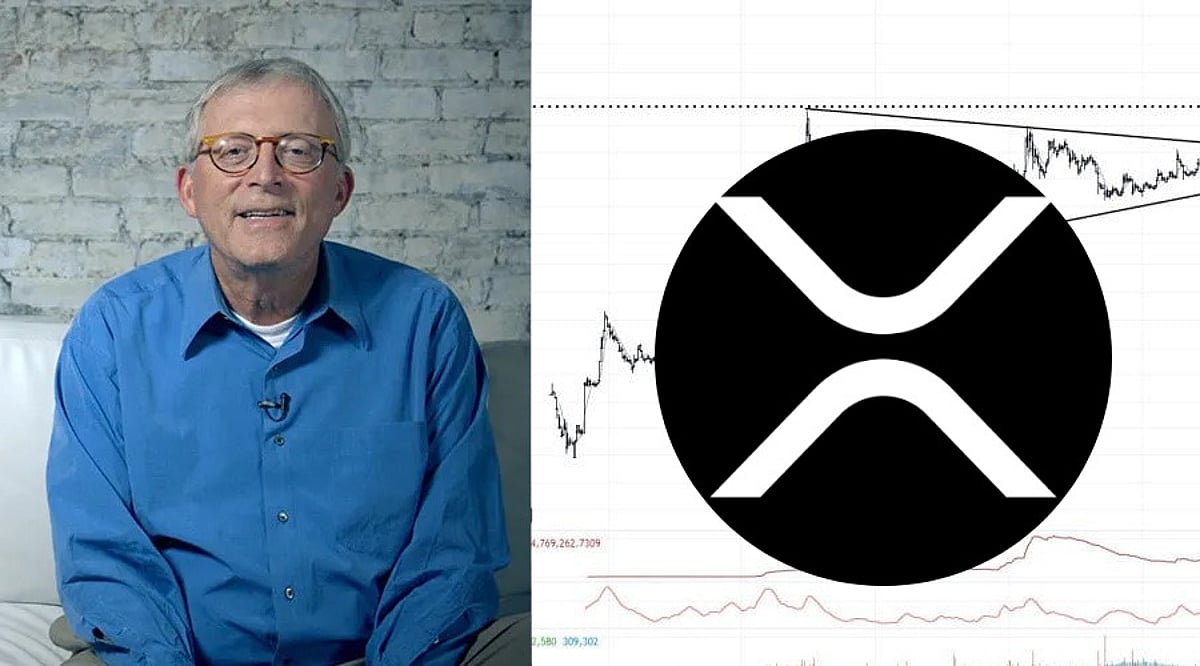
  • Peter Brandt Highlights $5.40 XRP Price Target as 2026 Correction Reshapes Long-Term Outlook

    Peter Brandt Highlights $5.40 XRP Price Target as 2026 Correction Reshapes Long-Term Outlook

    Veteran trader Peter Brandt has pointed to $5.40 as a potential long-term target for XRP in a monthly chart shared on September 21. The projection is based on a technical structure that has formed over nearly a decade, although Brandt did not specify a timeline for the move.

    What the Monthly Chart Shows

    Brandt’s XRP/USD chart tracks roughly ten years of price action and highlights both a rising support line and a descending resistance line. The resistance line begins at the 2018 cycle peak, while support has been drawn from lows recorded in 2020 and subsequent pullbacks.

    Between those two boundaries, XRP spent several years compressing in a broad range. The 2021 rally produced a high below the 2018 peak, keeping the downward-sloping resistance intact. That pattern eventually led to a breakout in 2024–2025, with monthly candles climbing toward the $3.00–$3.50 zone — the highest sustained area since 2018.

    Current Price Position

    After the sharp advance, XRP entered a correction in 2026. The latest part of the chart shows a pullback unfolding in a smaller descending channel or wedge. In September 2026, XRP was trading near $1.4901, roughly 20.6% below its 18-month moving average of about $1.877. A faster moving average sits closer to price, but the longer-term trend measure remains above the token.

    Interpreting the $5.40 Objective

    Brandt described $5.40 as an eventual technical objective rather than an active trade. The figure is not drawn as a horizontal line directly on the chart, and the trader did not provide a completion date.

    From the chart’s displayed price near $1.49, XRP would need to gain approximately 262% to reach $5.40. Based on the slightly higher market price near $1.54, the required advance would be about 251%, placing the target at roughly 3.5 times the reference price.

    XRP was reported near $1.54 after gaining around 8.7% in 24 hours as Brandt’s chart drew attention. Even so, the token remains far below the projected level. The key tension in the setup is that XRP is still under its 18-month moving average and trading inside a declining structure from the 2025 highs, even as the broader multi-year formation supports a much higher long-term target.

    Brandt’s use of the word “eventual” leaves the timing open. For traders watching the trend, the main question is whether the current descending structure resolves before the next major monthly advance begins.