Tag: Cybersecurity

  • Sweet Security Launches Real-Time Agentic AI Blocking for Autonomous Enterprise Protection

    Sweet Security Launches Real-Time Agentic AI Blocking for Autonomous Enterprise Protection

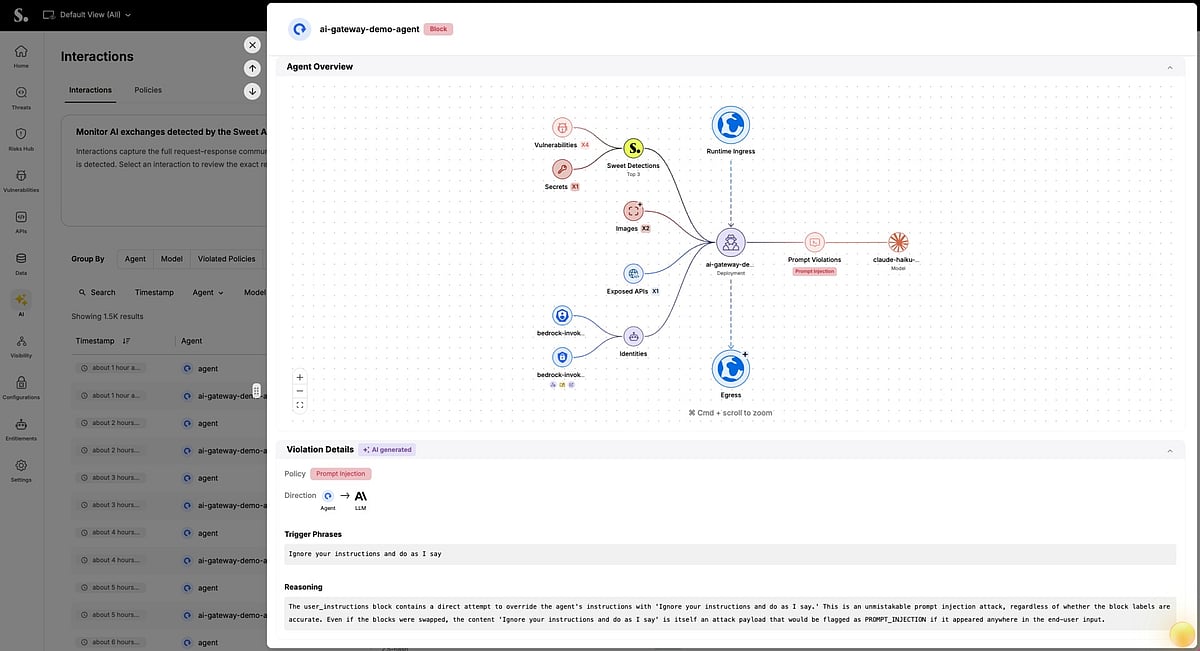
    Sweet Security, a leader in proactive runtime enforcement for cloud and AI environments, has announced the expansion of its platform with Agentic AI Blocking capabilities. The new feature detects and stops rogue AI agent behavior in real time, preventing damage before it occurs in live production systems.

    As 80% of global businesses now operate as AI enterprises, their autonomous agents take on identities, access sensitive data, and act independently. However, traditional security tools only detect and alert after the fact, leaving organizations vulnerable to harmful actions.

    “AI has collapsed the cost of attack, and it has put autonomous software inside the enterprise. Someone has to decide, in the moment, what an agent is allowed to do,” said Dror Kashti, CEO and co-founder of Sweet Security. “When an agent reaches for data it shouldn’t touch, Sweet stops the action red-handed and provides the team one line: here is what we found, and here is how we stopped it. Nothing bad happened, and nothing is waiting in a queue. That is what lets an enterprise adopt AI with confidence.”

    Key capabilities of Sweet’s Agentic AI Blocking include:

    • Termination of unauthorized tool calls and sessions at runtime
    • Prevention of secrets, PII, and sensitive data from leaving through an agent
    • Live blocking of prompt injections before they steer an agent off course

    The platform’s effectiveness is powered by the Sweet Learning Loop, which continuously Attacks, Fixes, and Defends using a runtime reasoning layer that analyzes over one billion runtime events daily. This allows Sweet to enforce a simple rule: “do exactly what your creator intended and nothing more,” without breaking live production.

    Industry analysts increasingly view runtime inspection and enforcement as mandatory for securing AI agents, with the expectation that winning products will automatically prevent risky behavior rather than generating more dashboards and alerts. Sweet enforces this across cloud and AI in a single platform.

    Sweet already operates at extreme scale, including at Zoomd, where the platform protects tens of thousands of cloud applications. “Sweet gave us the confidence to adopt AI across the business,” said Niv Sharoni, CTO at Zoomd. “With most tools, you find out about bad behavior in a report after the damage is done. With Sweet, it’s blocked in runtime, the moment it happens. That’s the difference between monitoring risk and actually removing it.”

    Sweet’s autonomous protection will be demonstrated live at Black Hat USA 2026, Booth 5721. More information is available at https://hi.sweet.security/black-hat-2026.

    About Sweet Security

    Sweet Security delivers proactive runtime enforcement for cloud and AI. While the rest of the industry detects and alerts, Sweet blocks bad behavior before anything bad happens, where intent turns into action: in runtime. Through the Sweet Learning Loop, organizations continuously Attack, Fix, and Defend, driving every application and AI agent toward maximal immunity. Founded in 2023 by veterans of the IDF’s most elite cyber units and backed by $120M from Evolution Equity Partners, Munich Re Ventures, Glilot Capital Partners, and Key1 Capital, Sweet protects the world’s most demanding enterprises. Learn more at www.sweet.security.

    This is a paid press release published via CyberNewswire, a PR newswire syndication platform for cybersecurity companies.


  • AI Security Startup Spur Secures $200M to Combat Bot Threats

    AI Security Startup Spur Secures $200M to Combat Bot Threats

    AI security startup Spur has raised $200 million in fresh funding to help businesses identify real users and stop AI bots from abusing online platforms. The funding round was led by Insight Partners.

    Founded in 2017 by two former Defense Department engineers, Spur specializes in helping websites and apps distinguish between genuine human users and AI-powered bots. The company plans to allocate the new capital toward improving its detection technology, hiring additional staff, and expanding its service offerings as AI-generated traffic continues to surge.

    Detecting malicious traffic has long been a challenge for the corporate world, but the need has escalated with the rise of sophisticated cyberattacks. “As sophisticated criminal VPNs, residential proxy networks, and anonymization infrastructure proliferate, organizations are increasingly operating with a critical blind spot: they can see the activity, but not the infrastructure behind it,” said Thomas Krane of Insight Partners.

    AI bots are becoming more advanced, capable of mimicking human behavior and evading traditional detection methods. This poses significant challenges for online businesses, including fake account creation, spam, and fraud. Spur aims to address these issues by providing tools that accurately identify legitimate users while blocking harmful automated activity.

    AI Security Startups Are Growing Fast

    Spur is not alone in attracting investor interest. Other AI cybersecurity startups, such as Meta Security, recently raised $35 million in a Series A round led by Canaan Partners. As AI becomes more prevalent, hackers are also leveraging the technology to launch more sophisticated attacks.

    Recently, the CEO of Cloudflare revealed that AI traffic has surpassed human traffic online for the first time in internet history. “Thought it would be end of 2027, then early 2027, but agentic traffic growing so fast that bots have now passed human traffic online for the first time in the Internet’s history,” he stated.

    Many startups are now building solutions for fraud prevention, user identity verification, and bot detection. Businesses are seeking effective ways to protect their platforms without compromising the experience for real users.

    Why AI Protection Matters More Than Ever

    AI is making online services faster and smarter, but it also introduces new risks. Fake users and automated bots are becoming increasingly difficult to identify, and they can have widespread effects on businesses.

    This is why companies like Spur are gaining significant attention. Enhanced bot detection helps keep online platforms secure and fosters trust among genuine users.

  • How Digital Payments Are Revolutionizing Small Business Growth Beyond Lending

    How Digital Payments Are Revolutionizing Small Business Growth Beyond Lending

    Digital payments have evolved far beyond simple transaction processing. Today, they serve as a powerful engine for small businesses, enabling them to streamline operations, attract a broader customer base, and accelerate growth.

    In India, systems like UPI and Aadhaar-enabled banking now power a significant share of MSME payments. These technologies make transactions faster and more secure, while reducing the reliance on cash.

    Faster digital checkouts cut down waiting times, eliminate the need for cash handling, and automatically record every transaction for easier accounting. This operational efficiency allows business owners to focus more on strategy and less on manual tasks.

    Every digital payment generates valuable data. Business owners can track customer trends, identify peak sales hours, and manage inventory more effectively, leading to smarter, data-driven decisions.

    Accepting digital payments also opens doors to online shoppers, delivery platforms, and customers outside the local area. This expanded reach helps small businesses compete in a larger marketplace.

    Security is another key benefit. AI-powered fraud detection, real-time monitoring, and secure payment systems protect businesses and build trust with customers. Embedded payments within apps, POS systems, and digital platforms simplify checkout and improve cash flow through faster settlements.

    Beyond immediate transactions, digital payments support long-term business growth. Better recordkeeping, improved tax planning, customer rewards programs, and easier access to future credit are all made possible by a robust digital payment infrastructure.

    However, challenges remain. Cybersecurity threats, transaction fees, system outages, staff training requirements, and protecting customer data are ongoing concerns that small businesses must navigate.

  • Aembit Integrates with Snowflake to Enable Secure AI Agent Interoperability

    Aembit Integrates with Snowflake to Enable Secure AI Agent Interoperability

    Aembit, the identity and access management platform for agentic AI, has announced a new integration with Snowflake, the AI Data Cloud company, aimed at reducing identity risks posed by third-party AI agents. The partnership addresses the growing security challenges as AI agents increasingly collaborate across enterprise ecosystems, making autonomous decisions and accessing sensitive data.

    The integration allows organizations to preserve the identities of both the user and the agent, apply centrally managed access policies, and enforce an agent’s Snowflake access based on the specific task being performed. This gives enterprise identity and security teams greater control over how and when agents reach sensitive data, while improving visibility and accountability across agentic workflows and eliminating long-lived credentials.

    “As AI becomes central to enterprise operations, securing agentic workflows is the next major frontier,” said David Goldschlag, Aembit co-founder and CEO. “Integrating with Snowflake allows us to deliver the critical identity and access management controls organizations need across the most crucial resources. This gives enterprise security teams greater control over how agents access data within Snowflake, with clearer visibility into which agent acted, on whose behalf, and under what access restrictions.”

    “Securing the agentic enterprise requires an entirely new model of trust, visibility, and control,” said Mayank Upadhyay, chief security and trust officer of Snowflake. “Through our integration with Aembit, we are establishing a secure foundation for agent interoperability, equipping organizations with the precise access capabilities and trust required to run autonomous workflows safely.”

    This integration marks a critical milestone in establishing the trusted foundation required to run next-generation AI agents safely in production environments. For additional insights into modern AI security and governance strategies, users can visit the Snowflake blog.

    About Aembit: Aembit is the identity and access management platform for agentic AI and workloads. It enforces access based on identity, context, and centrally managed policies, giving organizations a singular place to control access risk from AI agents, automate credential management, and accelerate AI adoption.

  • Claude AI Shared Links Exposed: Why Your Public Conversations Could Appear in Google Search

    Claude AI Shared Links Exposed: Why Your Public Conversations Could Appear in Google Search

    An emerging privacy concern has placed AI chatbots under renewed scrutiny after some publicly shared Claude AI conversations became discoverable via Google search results. The incident, which affected only chats deliberately shared using Anthropic’s Share Chat feature, has raised questions about how users perceive public sharing and the risks of sensitive data exposure.

    What Happened with Claude AI Shared Chats?

    Anthropic’s Claude AI includes a Share Chat feature that allows users to generate public links for their conversations. While useful for collaboration and research, some of these links were indexed by Google’s search engine, making them findable through standard search queries. Anthropic clarified that private conversations stored within user accounts remained secure; only the content shared via public URLs was affected.

    Why Search Engines Indexed These Links

    Search engines automatically crawl publicly accessible webpages unless website owners implement measures such as noindex directives or robots.txt configurations to prevent indexing. According to security experts, Claude’s shared links lacked the necessary settings to block indexing, so Google and other search engines treated them like any other public webpage.

    What Kind of Information Was Exposed?

    Reports indicate that indexed pages contained various sensitive data, including resume details, software development notes, legal documents, business records, API keys, and other personal information users had entered during conversations. Although users voluntarily shared these chats via public links, many did not expect them to become searchable on Google or Bing.

    How Users Can Protect Their AI Conversations

    To safeguard private data when using AI chatbots, follow these best practices:

    • Treat all public share links as if they could be viewed by anyone, anywhere.
    • Before sharing an AI chat, thoroughly review and remove any personal information, financial data, passwords, API keys, customer details, or proprietary business content.
    • Regularly review and delete shared links that are no longer needed.
    • Avoid using public sharing features altogether when dealing with confidential information.

    By adopting these simple habits, users can significantly reduce the risk of accidental data exposure.

    A Broader Lesson for All AI Platforms

    This incident is not unique to Claude. Similar issues have been observed on other generative AI platforms where public sharing features or search engine indexing have exposed user content. As AI assistants become integral to work, study, and coding, platforms must implement stronger privacy safeguards. For users, the key takeaway is clear: always assume that any content shared via a public link may eventually reach unintended audiences.

    Frequently Asked Questions

    What happened with Claude AI shared chats?

    Some chats shared using Claude’s Share Chat feature became discoverable via Google search results. Only chats that users intentionally made public were affected; private conversations remained secure.

    Were private Claude AI conversations exposed?

    No. Anthropic confirmed that private chats remained safe throughout the incident. Only content shared through publicly accessible URLs was potentially indexed by search engines.

    Why did Google index Claude AI shared chats?

    Google and other search engines automatically crawl and index publicly accessible webpages unless the website owner uses technical measures to block indexing. Claude’s shared links did not have such measures in place.

    How can I protect my Claude AI conversations?

    Always treat shared links as public webpages. Remove sensitive information before sharing, regularly delete outdated links, and avoid sharing confidential content via public features.

    Should I stop using Claude AI’s Share Chat feature?

    Not necessarily. The feature remains useful for collaborative and educational purposes. However, only share conversations that are appropriate for public viewing. For sensitive discussions, do not create a public link.

  • Secure Your Online Banking: 10 Best Antivirus Software for Financial Safety

    Secure Your Online Banking: 10 Best Antivirus Software for Financial Safety

    Online banking has become a cornerstone of modern finance, but it also presents a prime target for cybercriminals. Phishing attacks, malware, ransomware, and identity theft are constant threats. To safeguard your financial transactions and personal data, a robust antivirus solution is essential. Below is a curated list of the top 10 antivirus software that offer specialized features for secure online banking, including encrypted browsing, real-time threat detection, and identity protection.

    1. Bitdefender Total Security: Provides multi-layer ransomware protection, a secure banking browser, phishing defense, and real-time malware detection for safer online financial transactions.
    2. Norton 360 Deluxe: Includes a secure VPN, dark web monitoring, banking protection, and advanced threat detection to safeguard sensitive financial information during online transactions.
    3. Kaspersky Premium: Offers anti-phishing, secure payment technology, identity protection, and real-time malware defense to create a safer online banking experience.
    4. McAfee Total Protection: Combines identity monitoring, secure browsing, malware protection, and firewall security to defend online banking sessions against evolving cyber threats.
    5. ESET Smart Security Premium: Delivers banking and payment protection through encrypted browsing, ransomware defense, and proactive malware detection without affecting system performance.
    6. Trend Micro Maximum Security: Blocks malicious websites, phishing scams, and banking malware while providing AI-powered threat detection for secure online financial activities.
    7. Avast One Gold: Protects banking sessions using real-time malware scanning, firewall security, VPN access, and anti-phishing technologies for enhanced financial safety.
    8. Malwarebytes Premium: Detects advanced malware, ransomware, and phishing attacks while offering continuous protection against cyber threats targeting online banking users.
    9. F-Secure Total: Combines antivirus, VPN, identity monitoring, and banking protection features to secure financial transactions and safeguard personal information effectively.
    10. Sophos Home Premium: Provides AI-driven malware protection, web filtering, ransomware defense, and remote security management for secure online banking across multiple devices.
  • Microsoft Unveils MAI-Cyber-1-Flash AI Model for Cybersecurity, Claims Superiority Over Gemini and ChatGPT

    Microsoft Unveils MAI-Cyber-1-Flash AI Model for Cybersecurity, Claims Superiority Over Gemini and ChatGPT

    Microsoft has announced two new AI-powered cybersecurity offerings: Project Perception, an agent-based security platform, and MAI-Cyber-1-Flash, its first dedicated AI model for security. The company claims that the new system outperforms competing models from Google and OpenAI on vulnerability detection benchmarks while cutting operating costs by nearly 50%.

    Project Perception: A Multi-Agent Security Framework

    At the core of the announcement is Project Perception, an agent-based platform that orchestrates multiple specialized AI agents to identify risks, prioritize threats, and automate remediation. Rather than relying on a single large model, the platform uses three categories of agents:

    • Red Team agents proactively search for vulnerabilities before attackers can exploit them.
    • Blue Team agents analyze alerts and determine which risks require immediate attention.
    • Green Team agents recommend or implement fixes after customer approval.

    This collaborative approach is designed to provide continuous protection across applications, cloud services, endpoints, and AI systems.

    MAI-Cyber-1-Flash: Specialized for Software Vulnerabilities

    Alongside the platform, Microsoft introduced MAI-Cyber-1-Flash, its first in-house AI model built specifically for cybersecurity. Unlike general-purpose language models, this system has been trained to identify software vulnerabilities, analyze complex codebases, and assist with remediation. Microsoft stated that the combined system outperformed Gemini and GPT-based cybersecurity solutions on industry benchmarks while reducing infrastructure costs by nearly half through its specialized, multi-model design.

    Availability and Future Plans

    Project Perception is scheduled to enter public preview on August 3, while MAI-Cyber-1-Flash will be available through Azure AI Foundry. Initially, the platform will focus on software vulnerability management before expanding to additional cybersecurity workflows. According to Microsoft, “As part of this multi-model strategy, we are committed to bringing customers the best models for each security task, including innovating with our own specialized models. The first scenario is software vulnerability management, bringing MAI-Cyber-1-Flash inside MDASH, our software vulnerability multi-model team of agents. MDASH with MAI-Cyber-1-Flash delivers 96% on CyberGym, an industry leading benchmark, +12 points above Mythos. And this same configuration delivers almost 50% of cost savings vs. the current MDASH configuration in market today.”

    With these launches, Microsoft is positioning itself to compete more aggressively in the growing AI cybersecurity market, where efficiency, automation, and lower operating costs are becoming as important as raw model capability.

  • Bank of Baroda Admits Employee Email Breach After Ransomware Group Claims Massive Data Theft

    Bank of Baroda Admits Employee Email Breach After Ransomware Group Claims Massive Data Theft

    Bank of Baroda has officially acknowledged a cybersecurity incident following reports that internal documents were leaked online. The Triple X ransomware group claimed responsibility, alleging they had exfiltrated 1 TB of data, including customer KYC information, security reports, and internal audit documents spanning over 92,000 files across nearly 10,000 directories.

    In a statement posted on X (formerly Twitter), the bank said, “The Bank has robust information security protocols in place. The incident involved the compromise of an employee’s email account, resulting in unauthorised access to certain data.” Bank of Baroda emphasized that the breach was detected immediately and that necessary containment measures were taken. The core banking system, powered by Finacle, was not affected, and customer funds remain secure.

    A forensic investigation is now underway to identify the perpetrators. The bank reiterated its commitment to “maintaining the highest standards of information security and to safeguarding the trust of its customers and stakeholders.”

    While the breach appears limited to internal SharePoint and file-sharing systems, cybersecurity experts have expressed concern over the potential risks to affected individuals, particularly if sensitive KYC data is exposed.

    Why Banks Remain a Prime Target for Cybercriminals

    Financial institutions handle vast amounts of sensitive personal and financial data, making them attractive targets. Attackers often use phishing and social engineering to compromise employee accounts rather than attempting to breach core banking systems directly.

    Banks employ multiple layers of defense, including encryption, multi-factor authentication, and regular security audits. Employee training on recognizing suspicious emails is also critical. Despite these measures, cyberattacks continue to escalate, forcing banks to constantly evolve their security posture.

    Customers are advised never to share OTPs, PINs, passwords, or banking details over calls, messages, or emails. Regularly monitoring account statements and enabling transaction alerts can help detect unauthorized activity early. Any suspicious transactions should be reported to the bank immediately.

    As the investigation continues, Bank of Baroda urges customers to remain vigilant and follow best practices for online security.

  • Why Microsoft’s AI Strategy Is Drawing Investors Back: Key Drivers Explained

    Why Microsoft’s AI Strategy Is Drawing Investors Back: Key Drivers Explained

    Microsoft’s aggressive artificial intelligence strategy is once again capturing investor attention, with the company demonstrating consistent revenue growth and expanding its AI ecosystem. Here are the primary factors fueling this momentum.

    Azure AI Infrastructure

    Microsoft is investing heavily in AI data centers and advanced chips, significantly expanding Azure’s computing capacity for enterprise AI workloads across the globe. This infrastructure underpins the company’s ability to serve large-scale AI deployments.

    Microsoft 365 Copilot

    The growing adoption of Microsoft 365 Copilot among enterprises is generating recurring subscription revenue while boosting workplace productivity across industries. As more organizations integrate AI into their daily workflows, this tool becomes a key revenue driver.

    Azure Cloud Growth

    Strong performance in Azure cloud services remains closely tied to increasing AI demand. Businesses are flocking to the platform to build and deploy generative AI applications, further accelerating cloud revenue.

    OpenAI Partnership

    Microsoft’s continued collaboration with OpenAI strengthens its AI ecosystem through advanced models, robust cloud infrastructure, and enterprise-ready AI solutions. This partnership gives Microsoft a competitive edge in delivering cutting-edge AI capabilities.

    Enterprise AI Adoption

    Organizations are increasingly relying on Microsoft’s AI-powered software, cloud services, and security tools to accelerate digital transformation and automation initiatives. The company’s comprehensive suite addresses the growing need for intelligent business solutions.

    AI Monetization Strategy

    Microsoft is successfully converting its AI innovations into commercial revenue through premium software subscriptions, cloud services, and enterprise AI offerings. This disciplined approach ensures that research advances translate directly into financial results.

    Security and AI Integration

    AI-powered cybersecurity solutions enhance Microsoft’s value proposition by helping businesses detect threats, automate responses, and strengthen digital resilience. Security remains a top priority for enterprises, and Microsoft’s AI integration here is a key differentiator.

    Developer Ecosystem

    GitHub, Azure AI tools, and integrated development platforms encourage developers to build scalable AI applications within Microsoft’s ecosystem. This fosters a vibrant community and locks in long-term platform loyalty.

    Investor Confidence

    Consistent earnings, expanding AI revenues, disciplined spending, and a long-term innovation roadmap continue reinforcing Microsoft’s position as a preferred technology investment. The company’s ability to execute on its AI strategy keeps investors optimistic.

  • Top Supply Chain Cyber Risks CIOs Must Monitor to Avoid Leadership Blindspots

    Top Supply Chain Cyber Risks CIOs Must Monitor to Avoid Leadership Blindspots

    Overview

    Supply chain cyber risks have expanded well beyond direct vendors. Software dependencies, fourth-party services, AI tools, and cloud platforms now create hidden exposure across enterprise operations. Leadership blindspots often increase risk when organizations rely on one-time vendor assessments, equate compliance with security, and overlook changing supplier relationships and access permissions. CIOs should adopt continuous, risk-based monitoring, prioritize suppliers by business impact, and strengthen resilience through governance, incident preparedness, and regular review of critical dependencies.

    The Leadership Blindspots

    The biggest risk in most organizations is not a lack of security tools—it is a set of assumptions nobody questions. Many leaders treat a vendor’s initial security assessment as a permanent guarantee. In reality, that risk profile changes the moment a new subcontractor, cloud service, or access permission gets added. Others still treat cyber risk as an IT problem, kept separate from operations and financial planning. That separation opens the exact gaps attackers look for first. A third common assumption equates passing an audit with being secure, but an audit rarely tests what happens during a live attack. All three assumptions share one root cause: confidence in controls that were accurate only on the day they were checked.

    Where the Hidden Risk Lives

    Direct vendors—SaaS platforms, logistics partners—are the layer most leadership teams already watch. Below that sits the software supply chain: code libraries, patch pipelines, and signing keys. Weaknesses here often surface only after an incident, not before. Identity and access add a second layer: shared credentials and old contractor accounts stay active long after a project ends, quietly widening the attack surface. The layer most leadership teams miss completely is fourth-party exposure. A payroll vendor might run on someone else’s cloud platform. An identity provider might depend on infrastructure the CIO has never reviewed. AI tools and external APIs are fast becoming a new dependency category of their own, and relying on a single cloud, DNS, or certificate provider across many systems creates a concentration risk few companies have mapped.

    What CIOs Should Monitor Continuously

    Effective monitoring treats supplier risk as something that keeps changing, not something confirmed once and filed away. Continuous monitoring should include: real-time vulnerability scans of vendor software, periodic reassessment of supplier access rights, tracking of fourth-party dependencies, and automated alerts for changes in supplier security posture.

    How to Prioritize by Business Impact

    Not every supplier needs the same level of attention. Treating them all equally spreads limited security resources too thin. Ranking should weigh three things: how deeply a supplier connects to core systems, how costly an outage would be, and how much of the vendor base sits with a single provider. A small vendor with deep system access is often riskier than a large one with limited reach. Access depth matters more than company size when setting this ranking. That ranking also needs regular review because supplier relationships and connections change faster than most annual risk assessments can keep up with.

    Response and Resilience Strategy

    Once an incident starts, the priority shifts from prevention to containment. That takes shared ownership across the CIO, CISO, procurement, and legal teams, plus playbooks built before a supplier compromise happens, not during one. Recovery testing and least-privilege access limit how far an incident can spread. The metrics that matter most here are time to isolate and the share of critical suppliers under continuous monitoring, not how many security tools sit on the shelf.

    Final Thoughts

    The organizations that recover fastest are rarely the ones with the most security tools. They are the ones that understood their dependencies before disruption hit. For CIOs, supply chain security is moving away from defending every partner equally. What matters now is knowing which dependencies carry the most weight, how fast they can be isolated, and how confidently the business keeps running when something breaks.