Tag: Cybersecurity

  • Master Android App Permissions: What to Allow and What to Deny for Better Privacy

    Master Android App Permissions: What to Allow and What to Deny for Better Privacy

    Every time you install a new app on your Android phone, it asks for permission to access your camera, contacts, location, microphone, or other sensitive data. Most people tap ‘Allow’ without thinking, but that small habit can quietly expose your personal life. Android permissions exist to give you control, and learning how to use them wisely makes a real difference to your daily privacy and security.

    This guide explains what each permission does, which ones are safe to grant, which deserve caution, and how to manage them on any Android device.

    Why Permissions Matter

    Smartphones today hold more personal information than most people realize: photos, messages, banking apps, health data, and location history. Every permission an app receives opens a small door into that information. A weather app asking for location makes sense; a flashlight app asking for contacts does not.

    Google explains that an app sends a notification asking for permission before it can use a feature such as the camera or contacts list, and you get to allow or deny each request. This system puts control back in your hands instead of leaving it entirely to the app developer. Understanding this mechanism helps you make smarter choices instead of clicking through prompts out of habit.

    Types of Permissions on Android

    Android sorts permissions into two main categories that matter most for everyday users:

    • Normal permissions: Cover simple actions such as connecting to the internet or using Bluetooth. The system grants these automatically without asking.
    • Dangerous permissions: Touch personal data directly, so the phone always asks for confirmation first. These include access to the camera, microphone, contacts, location, SMS, calendar, phone log, and storage.

    Once you grant one permission inside a group, the app often receives every related permission in that group without a fresh prompt. This detail matters — a single ‘Allow’ tap can open more access than you expect.

    Permissions That Are Usually Safe to Allow

    Some permissions carry low risk and support the core purpose of an app:

    • Location: For navigation apps
    • Camera and microphone: For video calling apps
    • Contacts: For messaging apps to help find friends
    • Notification access: For apps that need to send alerts
    • Storage access: For photo editors
    • Calendar access: For scheduling tools

    In these cases, the permission matches the job the app is meant to do, so granting it rarely causes harm — as long as the app comes from a trusted developer and a genuine app store listing.

    Permissions That Deserve a Careful Look

    Trouble usually starts when a permission request does not match the app’s purpose. A simple game asking for microphone access, a flashlight app requesting contacts, or a photo editor wanting to read SMS messages should raise immediate questions. These mismatches often point toward data harvesting or, in worse cases, malware designed to read passwords sent through text messages.

    The table below sums up common permissions and how to treat them:

    Permission Safe to Allow? When to Be Cautious
    Location Yes for navigation, maps, weather If a game, calculator, or wallpaper app requests it
    Camera Yes for photo/video apps, video calls If a music player or document reader requests it
    Microphone Yes for voice recorders, calling apps If a simple game or flashlight app requests it
    Contacts Yes for messaging, social media If a game or utility app requests it
    SMS Only for messaging apps that send texts If any app that does not handle SMS requests it
    Calendar Yes for scheduling, productivity apps If a game or entertainment app requests it
    Storage Yes for file managers, photo editors If a simple game or wallpaper app requests it

    The Cybersecurity and Infrastructure Security Agency advises users to review app permissions regularly and remove access that is not supported. Old permissions often sit unused and forgotten on a phone for years.

    How to Check and Change Permissions

    Android gives you a straightforward path to review and adjust these settings whenever you choose. The steps stay almost the same across most modern Android phones:

    1. Open Settings and tap Apps.
    2. Select the app in question, then tap Permissions.
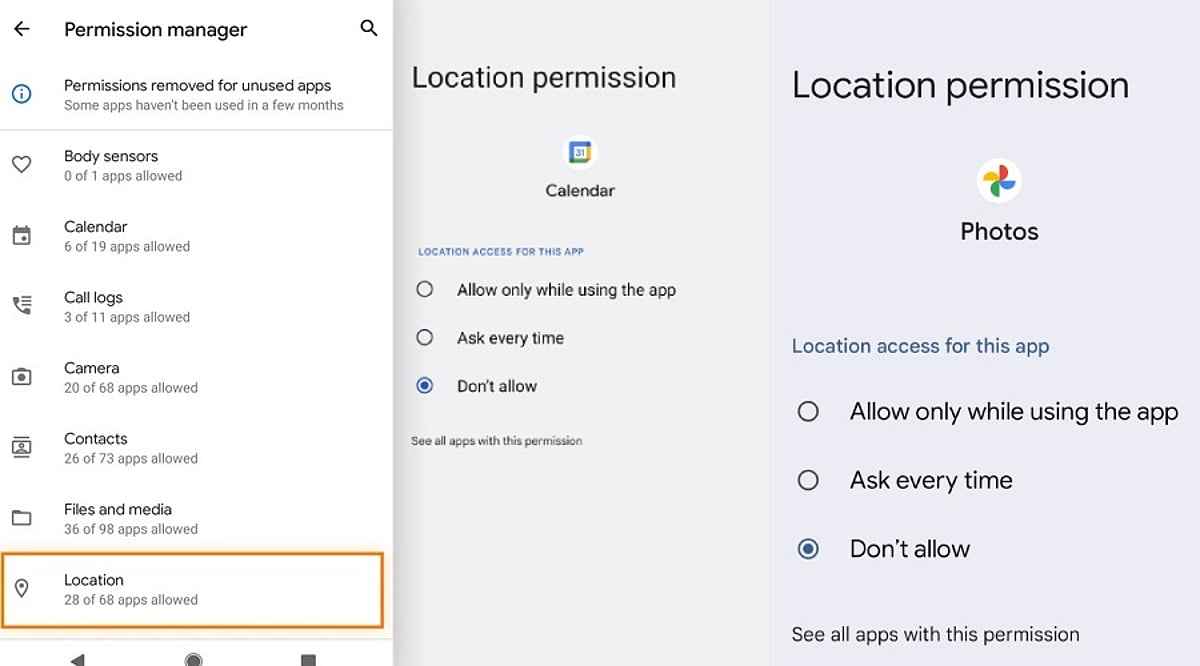
    3. Choose Allow, Allow only while using the app, Ask every time, or Don’t allow, depending on what options the permission offers.
    4. Visit Settings > Security & Privacy > Permission Manager to see every app that holds a specific permission, such as location or camera.
    5. Turn on Pause app activity if unused for apps that sit idle for long stretches, so their permissions get removed automatically.

    This last feature works quietly in the background and trims away access from apps you may have forgotten about, closing gaps before they turn into a problem.

    Signs an App Is Asking for Too Much

    A few warning signs can help you spot a risky request before tapping Allow:

    • A brand-new app with very few reviews asking for administrator-level access
    • An app that repeatedly shows the same permission pop-up after you have denied it (a known trick used by malicious software)
    • A basic mismatch: compare what the app does against what it asks for

    Reading reviews, checking the developer name, and searching the app name alongside the word ‘permissions’ often reveals whether other users have flagged similar concerns.

    Final Thoughts

    Android permissions work as a simple gate between your personal data and outside access. Every tap on Allow or Deny decides how much of that gate stays open. A little patience during setup, a quick permission audit every few months, and a habit of questioning mismatched requests go a long way toward protecting your personal information. Technology moves fast, and apps will keep asking for more access as new features arrive. Staying alert, reading each prompt carefully, and denying anything that does not fit an app’s purpose keeps your phone safer without demanding much extra effort.

    FAQ

    Which Android app permissions should you normally allow?

    Allow permissions that directly support an app’s main function, such as location for navigation, camera and microphone for video calls, or contacts for messaging. Review each request individually rather than granting access automatically during installation.

    Which Android permissions should users be most careful about?

    Location, contacts, SMS, microphone, camera, and accessibility access deserve closer attention since they can expose sensitive information or device capabilities. Check whether the requested permission is genuinely necessary for the application’s stated purpose.

    How can you check app permissions on Android?

    Open Settings, select Apps, choose the relevant application and tap Permissions. Modern Android devices also provide Permission Manager under Security & Privacy, allowing you to review which applications can access specific categories.

    Can Android automatically remove permissions from unused apps?

    Yes. Android includes an option that can pause activity for unused applications and remove permissions they previously received. This feature is useful for limiting forgotten access from apps that have not been opened for extended periods.

    What should you do when an app repeatedly requests denied permissions?

    If an app keeps requesting access after you have denied it, first consider whether that permission is essential. Check the developer, reviews, and app purpose, then keep the permission denied if the request appears unnecessary or suspicious.


  • Fintech Security Trends 2027: AI Fraud, Deepfakes, and Quantum Threats

    Fintech Security Trends 2027: AI Fraud, Deepfakes, and Quantum Threats

    Fintech security is entering a more complex phase as digital finance expands globally. AI-powered fraud, deepfakes, synthetic identities, AI agents, and quantum threats are changing the risk landscape. Zero-trust security and cyber resilience will also become stronger priorities.

    Key Trends Shaping Fintech Security in 2027

    • AI-powered fraud detection and deepfake protection will become critical for fintech security.
    • Zero trust, AI-agent security, and post-quantum planning will reshape security strategies.
    • Cyber resilience will become increasingly important as financial systems grow interconnected.

    Fintech has changed how people access, move, and manage money. Digital payments now operate at remarkable speed across global markets. However, faster financial services also create new security challenges. Attackers are adopting automation, artificial intelligence, and social engineering.

    Fintech companies must therefore rethink traditional cybersecurity approaches. Security will increasingly become part of product design and business resilience. Several trends are likely to shape fintech security in the coming years. These trends will affect banks, payment companies, insurers, digital lenders, and fintech platforms.

    AI-Powered Fraud Detection Will Become More Advanced

    Artificial intelligence is becoming an important tool for detecting financial fraud. Security teams can analyze enormous transaction volumes in real time. Machine learning can identify unusual spending patterns and suspicious account behavior. It can also help reduce false positives during fraud investigations.

    The challenge is that criminals are using AI too. Attackers can automate phishing, credential attacks, and fraud campaigns. This creates an ongoing technology race between attackers and defenders. Financial institutions will increasingly need machine-speed security controls.

    Deepfakes and Synthetic Identity Attacks Will Grow

    Identity-based attacks are becoming more sophisticated across financial services. Criminals can now create convincing voices, images, videos, and documents. These tools can support account takeovers and social engineering scams. They can also make fraudulent identities appear more credible.

    Traditional security checks may struggle against these techniques. Fintech companies will need stronger identity verification systems. Behavioral signals could become increasingly important during authentication. Transaction patterns can also help identify unusual account activity. The goal is to verify identity without creating unnecessary customer friction.

    Zero Trust Will Extend Across Fintech Ecosystems

    Zero trust is becoming more important as financial platforms become interconnected. Modern fintech environments rely on cloud systems, APIs, vendors, and external platforms. That creates multiple pathways into sensitive financial systems. A compromised credential or API can expose multiple applications.

    Zero-trust security assumes you should never automatically trust access. Every user, device, application, and connection requires appropriate verification. In the coming years, this approach will extend beyond internal networks. Third-party platforms and cloud workloads will receive greater scrutiny. Continuous authentication and least-privilege access will become increasingly important.

    AI Agents Will Create New Security Challenges

    AI agents are becoming capable of performing tasks with limited human intervention. Financial companies are exploring them for support, operations, analysis, and automation. However, agents can access sensitive systems and business information. Poorly controlled agents could therefore create significant security risks.

    Prompt injection is one emerging concern. Attackers may manipulate agents into performing unauthorized actions. Security teams will need to treat AI agents like digital employees. They will require defined permissions, monitoring, and clear accountability. Gartner predicted AI security spending to approach USD 4.8 billion globally in 2027.

    Post-Quantum Security Planning Will Accelerate

    Quantum computing presents a longer-term challenge for financial cybersecurity. Existing encryption methods could eventually become vulnerable. Fintech companies cannot wait until quantum computers become commercially dominant. Sensitive financial information may remain valuable for decades.

    This raises concerns about ‘harvest now, decrypt later’ attacks. Criminals can collect encrypted information today for future decryption. Organizations are beginning to assess quantum-resistant encryption, while many remain at early stages of preparation. PwC found that 49% of surveyed organizations had not started quantum-resistant security measures. Fintech companies will increasingly build cryptographic inventories. They will also prepare migration plans for post-quantum standards.

    Cyber Resilience Will Become a Business Priority

    Security is no longer only about preventing attacks. Financial companies must also recover quickly when incidents occur. A major breach can interrupt payments, customer access, trading, or internal operations. It can also damage customer confidence and regulatory relationships.

    AI is increasing this risk by accelerating attacks across shared infrastructure. Financial institutions depend heavily on common cloud providers and technology platforms. This creates concentration risks across the financial ecosystem. A vulnerability in one widely used service could affect multiple institutions.

    Why This Matters

    Financial services are becoming increasingly digital and interconnected. That creates more opportunities for attackers to target financial institutions and their customers. Digital fraud is another growing concern. IMF research found that cyber-enabled fraud has nearly tripled, although reporting gaps remain across jurisdictions. The security challenge therefore extends beyond traditional network protection. Companies must protect identities, transactions, AI systems, APIs, cloud infrastructure, and third-party services.

    In the coming years, resilience will become a board-level priority. Companies will focus on containment, recovery, testing, and third-party risk management. The fintech security field will continue changing rapidly. AI will remain both a powerful defense tool and a serious threat.

    Identity security, zero trust, quantum readiness, and resilience will gain importance. Companies that prepare early can reduce exposure to emerging attacks. For fintech leaders, security will increasingly influence trust and competitiveness. The strongest platforms will build protection into their technology foundations.

  • Sitharaman Calls AI a ‘Double-Edged Sword’ for Fintech, Urges Human Oversight and Smart Regulation

    Sitharaman Calls AI a ‘Double-Edged Sword’ for Fintech, Urges Human Oversight and Smart Regulation

    Finance Minister Nirmala Sitharaman warned about the dual nature of artificial intelligence at the Global Fintech Fest 2026 in Mumbai, describing AI as a ‘double-edged sword’ that can both enhance and endanger financial systems. Speaking to a gathering of industry leaders, she highlighted the potential for AI to improve fraud detection and operational efficiency, but cautioned that the same technology could amplify cyber threats, systemic risks, and even influence public opinion and elections.

    Sitharaman emphasized that while AI can assist judgment, ultimate responsibility must remain with humans and institutions. She called for stronger oversight as financial firms increasingly rely on automated systems for fraud monitoring, risk assessment, and customer services. The minister argued that faster technology should not come at the cost of resilience in critical financial infrastructure.

    She advocated a ‘soft-touch regulation’ approach, developed in consultation with the Reserve Bank of India, aimed at fostering innovation without creating unnecessary barriers. Sitharaman welcomed the RBI’s recognition of the Unified FinTech Forum as a self-regulatory organization under its SRO-FT framework, noting that this reflects the evolving regulatory needs of India’s expanding fintech ecosystem.

    Higher-risk AI applications should face deeper scrutiny before deployment and throughout their lifecycle, she said, urging regulators, company boards, and senior executives to understand how these systems influence financial outcomes. The minister also proposed a federated industry platform to help Indian technology companies navigate cross-border rules on data, taxation, cybersecurity, and financial regulation.

    Sitharaman also called on the RBI to advance its wholesale and retail Central Bank Digital Currency pilots. Her broader message placed resilience alongside efficiency as a central requirement for India’s AI strategy, signaling that fintech companies will face greater expectations around accountability, cybersecurity, and responsible AI deployment.

    The Global Fintech Fest drew around 8,000 organizations, with technology-related entities accounting for 43% of participants and fintech firms representing another 20%. Sitharaman noted that young Indians are already building companies and shaping future economic growth, underscoring the importance of developing technology systems that can withstand failures and misuse.

  • How Telegram Accounts Can Be Hacked Without an OTP: Risks and Prevention Strategies

    How Telegram Accounts Can Be Hacked Without an OTP: Risks and Prevention Strategies

    Telegram sends a one-time password (OTP) to verify new logins, but that alone does not guarantee account safety. Hackers, scammers, and even someone with brief physical access to your phone can still compromise a Telegram account without ever requesting that OTP. This risk affects everyone—casual users, business owners, and community channel managers alike. The methods typically exploit stolen sessions, malware, or lingering login sessions rather than breaking Telegram’s own systems.

    Understanding Telegram Account Security Risks

    Telegram allows a single account to remain logged in on multiple devices simultaneously, and each active session works without re-entering the OTP. If a hacker steals an active session—via malware on the device or a fake app that copies login credentials—they can instantly access the account. Security researchers warn that malicious files, often disguised as APKs on Android, can silently extract session data stored on the device. Once that data reaches an attacker, they can open Telegram as if they were the legitimate user, with no password or code required.

    Public Wi-Fi networks add another layer of vulnerability. Experts note that unsecured networks make it easier for attackers to intercept data flowing between a phone and Telegram’s servers, especially when using Telegram Web on a shared or public computer.

    Phishing remains a common threat on Telegram. A fake login page that looks identical to Telegram’s real site can trick users into entering their credentials directly, handing over access without any OTP involved.

    Steps to Keep Your Telegram Account Safe

    Adopting a few simple habits can significantly reduce the risk of such hacks:

    • Turn on Two-Step Verification in Telegram’s settings to add an extra password layer.
    • Add a passcode lock inside the app so it cannot be opened even on an unlocked phone.
    • Regularly check the Devices section and log out of any sessions you do not recognize.
    • Avoid downloading APK files or clicking links from unknown senders.
    • Keep the app updated, as Telegram regularly releases security patches.

    These measures together make it much harder for anyone to slip into your account unnoticed.

  • Why Crypto Exchanges Remain Vulnerable Even After Passing Security Audits

    Why Crypto Exchanges Remain Vulnerable Even After Passing Security Audits

    Security audits are a cornerstone of trust in the cryptocurrency world. They signal that a platform’s code has been examined by experts. Yet, history shows that many audited platforms still fall victim to hacks. Understanding why helps investors and users stay cautious. Here are seven key reasons crypto platforms can be compromised even after a clean audit.

    1. New Code Introduces Fresh Risks

    A security audit evaluates only the code and systems present at that moment. Once developers add features, modify functionality, or integrate new services, the platform’s attack surface changes. These updates can introduce vulnerabilities that the original audit never saw, leaving the platform exposed despite a previously clean report.

    2. Audits Have Limited Scope

    Audits typically focus on a predefined set of contracts, systems, or infrastructure. They cannot examine every external service or blockchain protocol a platform relies on. Vulnerabilities lurking outside the audit’s scope—such as in third-party oracles or cross-chain bridges—may go undetected.

    3. Zero-Day Vulnerabilities

    Attackers sometimes discover security flaws that no researcher has yet identified. These zero-day exploits can be used before developers have a chance to patch them. No audit can guarantee protection against threats that do not yet exist.

    4. Human Error Undermines Technical Security

    Even the strongest code can be bypassed through mistakes by employees, developers, or users. Phishing attacks, leaked credentials, misconfigurations, and unsafe operational practices give attackers a way in. In these cases, the audited software remains sound, but the people and processes around it become the weak link.

    5. Smart Contract Interactions Create Hidden Flaws

    Crypto platforms often rely on multiple smart contracts and protocols that interact. A platform may appear secure on its own, but a flaw in a connected contract can expose it. Unexpected interactions between contracts can also create attack vectors that a standalone audit would miss.

    6. Compromised Private Keys Bypass All Code Protections

    Security audits focus on code, not on key management. If attackers steal or compromise administrative private keys or privileged credentials, they can move funds or make unauthorized changes. Strong code cannot protect a platform when critical keys are already in the wrong hands.

    7. Attack Techniques Are Constantly Evolving

    Cybersecurity is a moving target. Attackers continuously develop new methods, meaning a platform secure today may face different threats tomorrow. Security audits should be seen as one layer of defense, not a permanent guarantee. Continuous monitoring, regular testing, rapid patching, strict access controls, and solid incident-response plans remain essential.

  • AI Agents: 10 Critical Safety Risks and What You Must Know

    AI Agents: 10 Critical Safety Risks and What You Must Know

    AI agents are evolving rapidly beyond simple chatbots. They can now plan tasks, use tools, interact with software, and take actions with minimal human oversight. While this autonomy brings powerful business benefits, it also introduces significant safety and security challenges. Here are ten essential things to understand about AI agents and their risks.

    1. AI Agents Are Becoming More Autonomous

    Unlike traditional chatbots that only generate responses, AI agents can perform actions on behalf of users — sending messages, accessing data, updating systems, or interacting with applications. This ability to act makes them powerful, but any wrong decision can have real-world consequences.

    2. Excessive Permissions Can Be Dangerous

    To complete tasks, an AI agent needs access to tools and data. However, granting more permissions than necessary increases potential damage if something goes wrong. Limiting access to only what the agent truly needs is a fundamental safety principle.

    3. Prompt Injection Is a Major Risk

    Attackers can embed malicious instructions in webpages, documents, or other content an agent processes. The agent may unknowingly follow those instructions instead of its intended task, leading to data exposure, unwanted actions, or workflow manipulation.

    4. Sensitive Data Needs Strong Protection

    Agents often work with emails, documents, customer records, and other sensitive information. Poor access controls or insecure integrations can expose that data. Businesses must enforce robust authentication, permissions, monitoring, and data-handling policies before deploying agents across sensitive systems.

    5. Agents Can Make Mistakes

    AI agents can misinterpret instructions, select the wrong tool, or produce incorrect information. When allowed to act automatically, even a small error can escalate. Human review is especially critical for high-impact decisions and irreversible operations.

    6. Tool Use Creates New Attack Paths

    An agent connected to dozens of tools effectively opens multiple entry points into an organization’s systems. A compromised integration can become a stepping stone to other resources. Security teams must assess not only the AI model but every tool and connection around it.

    7. Limited Human Oversight Increases Risk

    As agents become more independent, the safety net of human intervention shrinks. Without proper guardrails, agents may act on flawed reasoning or external manipulation. Designing for human-in-the-loop workflows for critical tasks is essential.

    8. Lack of Transparency in Decision-Making

    Many AI agents operate as black boxes, making it difficult to understand why a particular action was taken. This opacity complicates debugging, auditing, and accountability — especially when mistakes occur.

    9. Compliance and Regulatory Risks

    Using AI agents in regulated industries (healthcare, finance, etc.) raises compliance concerns. Agents must adhere to data protection laws (like GDPR or CCPA) and industry-specific regulations. Non-compliance can lead to fines and reputational damage.

    10. Need for Continuous Monitoring and Updating

    AI agents operate in dynamic environments. Their models, permissions, and integrations require regular updates and monitoring to address emerging threats. A static deployment is a security liability.

    Understanding these risks is the first step toward deploying AI agents safely. Businesses should adopt a risk-aware strategy, implement strict access controls, and maintain human oversight to harness the power of AI agents without compromising security.

  • Ledger Consolidates Security and IT Leadership Amid Surging AI Crypto Attacks

    Ledger Consolidates Security and IT Leadership Amid Surging AI Crypto Attacks

    Ledger SAS has appointed Oded Blatman as chief information officer and chief security officer, combining technology and security oversight in a single leadership role as AI-driven threats expand across the crypto industry. The Paris-based hardware wallet maker said Blatman will oversee cyber and infrastructure security, product security, physical and workplace security, internal IT, and enterprise risk.

    One Role for Security and Technology

    Blatman joins Ledger after five years as CIO and CISO at Fireblocks. He previously served as global CISO at Bank Hapoalim and held both CIO and CISO roles at ClickSoftware. At Fireblocks, he led global security and enterprise technology during a period of international expansion and rising operational complexity, experience Ledger says fits its broader effort to strengthen organizational resilience.

    Ledger described the combined CIO and CSO structure as a deliberate organizational change. The company said information systems and security now require closer coordination as tokenization, AI agents, and institutional digital-asset use develop together.

    AI Makes Crypto Attacks Faster and More Scalable

    Blatman said artificial intelligence is reducing the cost and time attackers need to search for weaknesses, while also allowing attacks to become more sophisticated and operate at greater scale. As phishing campaigns and deepfake impersonation schemes become more advanced, Ledger said security teams must evolve at a comparable pace.

    The appointment follows a rise in reported crypto security incidents. Data from DefiLlama cited by Ledger shows hackers stole about $1.4 billion across 250 attacks in 2026 so far, after losses reached $2.7 billion across 146 attacks in 2025.

    Recent Incidents Add Pressure on Digital Asset Defenses

    Several high-profile incidents have put digital-asset companies on alert. About $320 million in Bitcoin left the Liquid Network during a hack earlier this week. Trezor also disclosed a breach involving one of its shipping providers last week, exposing personal information belonging to tens of thousands of customers. Earlier this year, a Coldcard hack raised further questions about offline wallet security.

    Ledger said hardware-backed verification remains central to protecting high-value digital ownership, and pointed to secure software, resilient operations, and verifiable human intent as additional layers of protection.

    Leadership Backed by Deep Security Experience

    Blatman said Ledger’s hardware-security work, user trust, and Donjon research team provided a strong foundation for the role, and that he joined to connect product security, enterprise technology, and resilience. Chairman and CEO Pascal Gauthier said Ledger considers security central to its business and that Blatman’s experience protecting systems at Fireblocks and Bank Hapoalim prepared him to oversee both information technology and security.

  • Ashutosh Kulkarni: Elastic CEO Driving Enterprise AI and Cybersecurity Innovation

    Ashutosh Kulkarni: Elastic CEO Driving Enterprise AI and Cybersecurity Innovation

    Ashutosh Kulkarni is a seasoned technology executive and strategic business leader, best known as the Chief Executive Officer of Elastic. He has made significant contributions to artificial intelligence, enterprise search, cybersecurity, and cloud technologies. Prior to becoming CEO, Kulkarni held senior management roles at McAfee, Akamai Technologies, Informatica, and Sun Microsystems.

    Early Life and Education

    Kulkarni developed an early passion for engineering and technological innovation. He earned a Bachelor of Engineering degree from the University of Mumbai and a Master of Science in Computer Engineering from The University of Texas at Austin. He also holds an MBA in Marketing & Finance from the University of California, Berkeley.

    Professional Career

    Ashutosh Kulkarni began his career at Sun Microsystems before moving to Informatica, where he spent a decade leading cloud product initiatives. He then joined Akamai Technologies and later McAfee, holding various leadership roles. In 2021, he became Elastic’s Chief Product Officer, and in 2022, he was appointed CEO.

    Business Intervention in AI

    Under Kulkarni’s leadership, Elastic is advancing enterprise AI through an intelligent ecosystem that combines generative AI, agentic capabilities, AI-powered search, observability, performance monitoring, and cybersecurity to deliver scalable, secure, and high-performance digital experiences.

    AI Ecosystem

    Elastic’s unified AI ecosystem leverages Elasticsearch with leading AI platforms to provide vector search, RAG, safe deployment, and cloud-native capabilities, enabling businesses to build efficient and intelligent AI applications.

    Agentic Observability

    Agentic AI improves observability through log analysis, event detection, and natural language investigations. AI-driven insights accelerate root cause analysis, helping teams detect and resolve issues faster.

    AI Performance Monitoring

    AI enhances observability with distributed tracing, automated diagnostics, and AI-based troubleshooting, aiding in problem detection and improving application reliability.

    Agentic Security

    AI-powered security systems strengthen cyber defense through intelligent threat detection, automated investigations, explainable AI reasoning, and rapid incident response, improving visibility and minimizing response times.

    AI-Powered XDR Platform

    The AI-based XDR platform integrates automation, continuous monitoring, and intelligent threat analysis to effectively detect, investigate, and mitigate cyber threats.

    AI Infrastructure Intelligence

    AI-driven infrastructure observability provides anomaly detection, predictive insights, automated remediation, and natural language processing, speeding root cause analysis and increasing system resilience while reducing downtime.

    Business Achievements

    Ashutosh Kulkarni has expanded Elastic’s capabilities in AI, enterprise search, observability, and cybersecurity through innovative products and acquisitions. He has built strategic relationships with top technology companies such as OpenAI and NVIDIA. His leadership has driven consistent revenue growth and widespread enterprise adoption of Elastic’s software.

    Controversies

    As of now, there are no known controversies surrounding Ashutosh Kulkarni. He is widely respected for his expertise in enterprise AI, cloud computing, search technology, and observability. His leadership and technical skills have earned him an excellent reputation in the technology sector.

  • Why Artificial Intelligence Matters More Than Ever in 2026: Productivity, Science, and Policy Impacts

    Why Artificial Intelligence Matters More Than Ever in 2026: Productivity, Science, and Policy Impacts

    Key Takeaways

    • AI is becoming a major productivity tool, improving performance across software, customer support, advertising, and other structured tasks.
    • AI is reshaping economies and science, driving massive investment while helping researchers solve increasingly complex problems.
    • AI brings greater risks and responsibilities, making human oversight, cybersecurity, regulation, and responsible deployment increasingly important.

    Artificial intelligence now sits at the center of business, science, software, security, and public policy. Stanford’s 2026 AI Index reports that 88% of surveyed organizations use AI, while 70% use generative AI in at least one business function. Generative AI also reached 53% population adoption within three years—a faster path than the personal computer or the internet.

    AI Gives Businesses a New Productivity Tool

    AI has a clear effect on work that has set rules and clear results. Studies cited by Stanford report a 14% to 15% rise in customer support output, a 26% rise in software development output, and a 50% rise in ad output per worker. The gains vary by task, so human review still matters for deep judgment.

    AI agents add another layer to this change. These systems can handle several steps on a computer rather than only a reply. On the OSWorld test, agent accuracy rose from about 12% to 66.3%. That result still leaves a failure rate of about one in three attempts, which shows its limits.

    AI has Become a Major Economic Force

    Money also shows the scale of AI. Global corporate AI investment more than doubled in 2025. Private investment rose 127.5%, while generative AI investment rose more than 200%. The United States led private AI investment with USD 285.9 billion in 2025, compared with USD 12.4 billion in China. Stanford also reports more than USD 150 billion in annual capital outlay by Google in 2025, reflecting the high cost of AI data centers and compute systems.

    The labor market already shows clear effects. Employment for software developers aged 22 to 25 fell nearly 20% from 2024. One-third of surveyed organizations expect AI to reduce their workforce in the next year, although broad job losses have not yet appeared across the whole economy. The pattern points to new task and skill needs.

    AI Expands the Reach of Science

    AI now has a role in science, medicine, mathematics, and technology. The 2026 AI Index added a full science section that covers biology, chemistry, physics, and astronomy. Advanced models can solve difficult science and math tasks, while some models now meet or exceed human results on several expert tests. This gives researchers a new tool for data analysis and complex problem-solving.

    AI still has sharp limits. AI can win a gold medal-level result on the International Mathematical Olympiad yet read an analog clock correctly only 50.6% of the time, compared with 90.1% for humans. Such uneven skill shows why expert review remains essential. AI has great value when a task fits its strengths, but weak results can appear on simple tasks as well.

    AI Shapes National Policy and Security

    Governments now treat AI as a matter of economic power, security, and national policy. Stanford reports that national AI plans have expanded across many countries, while AI sovereignty has become a central policy goal. Countries seek local control over models, data, chips, and compute capacity. This makes AI part of wider competition across trade, technology, and national security.

    Security risks also rise as AI gains more power. Stanford recorded 362 documented AI incidents in 2025, up from 233 in 2024. AI can help security teams find threats, yet advanced models can also help attackers find software flaws and automate cyberattacks. Strong safeguards, human checks, and clear rules therefore matter as much as model capability.

    Regulation Gives AI a New Set of Rules

    AI now faces real legal duties in major markets. Under the European Union AI Act, some enforcement powers started on August 2, 2026. The rules cover prohibited AI practices, transparency duties for certain systems, and rules for general-purpose AI models. Legal compliance now joins product quality and business value in Europe.

    AI matters in 2026 not simply for its ability to produce text, images, or code. Its real importance comes from its effect on productivity, science, jobs, security, investment, and public policy at the same time. The strongest results will come from clear use cases, reliable systems, and careful human judgment. AI has reached a point where its limits still matter, yet its economic and social impact now matters far more.

    FAQs

    1. Why is artificial intelligence important in 2026?

    AI is important since it is influencing productivity, scientific research, employment, cybersecurity, investment, and government policy simultaneously.

    2. How is AI improving business productivity?

    AI can automate repetitive tasks, assist employees with complex workflows, and improve output in areas such as customer support, software development, and advertising.

    3. Is AI affecting employment in 2026?

    Yes. AI is changing the tasks and skills required for many jobs, with some roles experiencing employment declines while new AI-related opportunities emerge.

    4. Why is AI important for science and research?

    AI can analyze large datasets, assist with difficult scientific problems, and support researchers across fields such as biology, chemistry, physics, mathematics, and astronomy.

    5. Why does AI regulation matter?

    Regulation establishes legal requirements for AI systems, helps manage risks, and encourages safer and more transparent development and deployment of AI.