
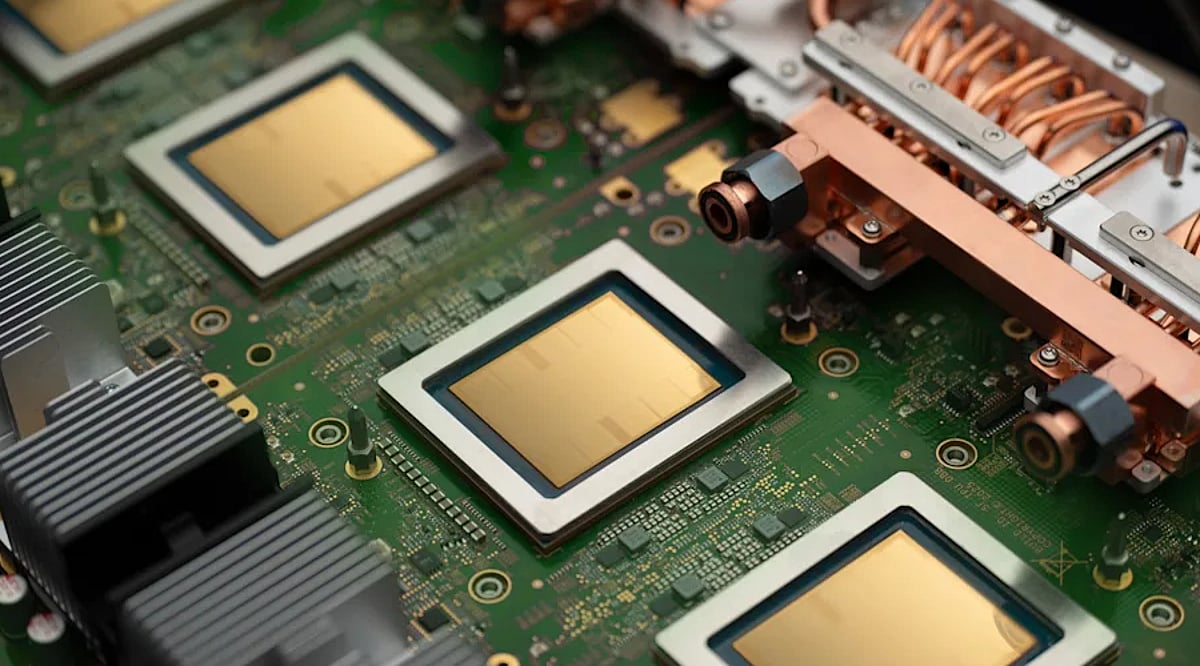
Tag: Google TPU

  • Why Tech Giants Are Developing Custom AI Chips to Cut Costs and Boost Performance

    Why Tech Giants Are Developing Custom AI Chips to Cut Costs and Boost Performance

    Nvidia’s AI GPUs have become a cornerstone of the AI infrastructure boom, but their high cost is driving major technology companies to develop custom chips. Purpose-built AI silicon can be tailored for specific workloads, helping companies control expenses and improve performance at scale.

    Google, Amazon, Microsoft, and Meta are all creating their own AI accelerators to reduce reliance on merchant GPUs. Google uses TPUs, Amazon has Trainium, Microsoft develops Maia, and Meta has MTIA. These chips are designed around each company’s unique AI workloads and data center requirements.

    The primary benefit is lower inference cost. Custom ASICs can be optimized for specific AI tasks rather than supporting every possible workload. Amazon reports that its Trainium chips can enhance price-performance, while its latest Trainium3 systems target reduced operating costs for large AI workloads.

    Building custom AI chips also diversifies the supply chain. Broadcom and Marvell help turn hyperscaler chip designs into production-ready ASICs, while Arm provides CPU architecture and licensing. This process connects chip design with advanced manufacturing and packaging.

    Memory and networking are equally critical. AI accelerators require high-bandwidth memory and fast inter-chip connections. Companies such as Micron, Astera Labs, Credo, and Arista operate across memory, connectivity, Ethernet, and data-center networking needed for large AI systems.

    Manufacturing and advanced packaging remain essential parts of the AI chip ecosystem. TSMC is a major foundry for advanced AI chips, while CoWoS packaging supports high-performance accelerator systems. Samsung also provides semiconductor manufacturing capacity. The supply chain extends from wafers to HBM and packaging.

    The AI chip race does not end with the processor. Higher-density AI racks require advanced networking, optical connections, power systems, and cooling. Companies across these areas support the growing infrastructure. Custom AI silicon is therefore becoming a full ecosystem spanning chips, memory, factories, networking, power, and cooling.

  • Beyond GPUs: Emerging Technologies Reshaping the AI Infrastructure Race

    Beyond GPUs: Emerging Technologies Reshaping the AI Infrastructure Race

    The era of GPU-only AI infrastructure is being challenged by a growing wave of specialized hardware and computing paradigms. As large-scale AI models continue to demand more performance and efficiency, companies are exploring alternatives that promise faster training, lower power consumption, and greater flexibility. Here is a closer look at the key technologies entering the AI infrastructure race.

    Google TPU

    Google’s Tensor Processing Units are built specifically for AI workloads, with specialized matrix processing that provides a strong alternative to general-purpose GPU acceleration for large-scale models.

    AWS Trainium

    Amazon’s Trainium accelerators are designed to handle machine-learning training workloads, helping cloud customers reduce their dependence on GPUs while optimizing both performance and infrastructure costs.

    Cerebras Wafer-Scale Engine

    Cerebras has developed enormous wafer-scale processors containing thousands of processing cores. This specialized architecture is built to address demanding AI model training workloads.

    Groq LPU

    Groq’s Language Processing Units focus on fast inference, using a specialized hardware architecture to deliver predictable performance for large language model workloads.

    Photonic Computing

    Photonic processors use light to perform computations, potentially delivering high bandwidth and energy efficiency for increasingly demanding artificial intelligence workloads.

    Processing-In-Memory

    Processing-in-memory architectures bring computation closer to stored data, reducing memory movement and potentially improving efficiency across large-scale AI workloads.

    Neuromorphic Chips

    Neuromorphic processors mimic aspects of biological neural systems, targeting highly efficient AI computation through event-driven processing and specialized hardware architectures.

    Quantum Computing

    Quantum processors could eventually address specialized optimization and scientific workloads, offering a fundamentally different computing paradigm beyond conventional GPU-based AI infrastructure.

    ASIC Accelerators

    Application-specific integrated circuits are designed for particular AI workloads, enabling companies to optimize performance, power consumption, and infrastructure for targeted applications.

    As the demand for advanced AI continues to grow, the infrastructure race is no longer limited to GPUs. These emerging technologies are shaping a more diversified ecosystem of compute options, each with unique strengths for the next stage of AI development.