Tag: identity verification

  • LinkedIn Combats Fake Profiles with AI Detection and Identity Verification

    LinkedIn Combats Fake Profiles with AI Detection and Identity Verification

    LinkedIn is deploying a multi-layered strategy combining artificial intelligence, identity verification, and contextual signals to counter the rising threat of fake professional profiles. Between July and December 2024, the platform blocked over 80.6 million fake accounts at registration, yet the challenge persists with AI-generated headshots, cloned executives, and fake recruiters.

    Automated Detection Screens Suspicious Accounts Early

    LinkedIn’s first line of defense is AI-driven detection. In October 2022, the company introduced a deep learning model that analyzes profile photo uploads for signs of AI generation. It detects subtle artifacts without using facial recognition or biometric data.

    A 2023 study with Professor Hany Farid found the model detected 99.6% of StyleGAN-generated faces with only a 1% false-positive rate on real photos. A 2024 update expanded the training set to include StyleGAN 1–3, Stable Diffusion 1 & 2, and DALL·E 2, achieving 98% recall at a 0.5% false-positive target. However, on unseen generators, recall dropped to 84.5%, highlighting the need for continuous model updates.

    Text-based fake profiles remain tricky. A July 2025 arXiv study showed that existing detectors allowed 42% to 52% of GPT-4-Turbo-generated LinkedIn-style profiles to pass. Adversarial training improved this to a 1% to 7% range.

    Verification Provides Evidence for Specific Claims

    LinkedIn offers free identity, workplace, and education verification. Workplace verification uses a company email or Microsoft Entra Verified ID; education checks use a school email. ID verification is handled by CLEAR (U.S., Canada, Mexico), Persona (other listed countries), or DigiLocker (India).

    By December 2025, over 100 million members had added at least one verification. LinkedIn states that Persona collects ID images and selfies, but only shares specified information after member consent—no biometric data, ID numbers, or expiry dates are received by LinkedIn.

    Contextual Signals Help Members Judge Trustworthiness

    A verification badge confirms a single claim, not overall credibility. LinkedIn provides additional context through the About this profile panel, which shows account creation date and whether a phone number or work email is verified. Members are also encouraged to review post history, message content, and account age.

    Job posts can display verified company and recruiter details. In September 2025, LinkedIn said it would require workplace verification when members add or update certain leadership or recruiter-related roles. The Verified Recruiter label appears in InMails and on profiles.

    Where the Limits Lie

    Detection models can flag suspicious photos but cannot confirm a real person behind a clean profile. Unverified members are not automatically fake. For Persona, members must be in a supported country and provide a valid NFC-enabled passport.

    TechCrunch reported that about 60% of verified members confirmed a workplace, while only 27% verified a government ID—two badges with very different weights. LinkedIn also notes that a verification badge on a job post does not increase hiring likelihood.

    The Future: Portable Verification

    Through Verified on LinkedIn, partners like Adobe, G2, UserTesting, TrustRadius, and Zoom can display member verifications on their own platforms. A self-serve API extends this to any organization. A verification earned on LinkedIn can function as a professional trust signal beyond the platform itself.

  • Streamlining High-Volume Onboarding: How KYC Automation Accelerates Identity Verification

    Streamlining High-Volume Onboarding: How KYC Automation Accelerates Identity Verification

    Digital onboarding can become difficult to manage when application numbers climb. Every new customer may need to provide information and prove their identity before gaining access to an account or service. When too much of that work depends on manual processing, higher demand can quickly create longer queues.

    KYC automation changes how businesses handle those repeatable checks. It can process information, support identity verification, and direct unusual cases for further attention. This helps businesses manage larger onboarding volumes while keeping necessary checks within the customer journey.

    Manual KYC Creates Friction as Application Volumes Rise

    Manual KYC processes require people to handle tasks that occur again and again during onboarding. Staff may need to inspect submitted information, review identity documents, or investigate inconsistencies. That workload can be manageable with a limited number of applications, but the pressure changes when hundreds or thousands arrive within a short period.

    The operational bottleneck becomes clearer as those applications accumulate. Businesses can track the percentage of applications sent to manual review, average handling time, and queue length to see where capacity is being stretched. If applications are entering manual review faster than employees can process them, waiting times increase even when each individual check takes only a few minutes.

    Those delays can also have a direct financial impact. Customers who encounter a lengthy verification process may abandon an application before opening an account or accessing the service. Tracking onboarding drop-off alongside processing times can help businesses identify where verification delays are contributing to lost conversions.

    Hiring more reviewers can increase capacity, although staffing alone doesn’t remove repetitive work from the process. KYC automation approaches the problem differently. Routine steps can be processed digitally, allowing businesses to increase onboarding capacity without requiring every additional application to produce the same amount of manual work.

    Automating Identity Checks: Removing a Major Onboarding Bottleneck

    KYC slows down when identity checks sit in separate steps. A document may be reviewed in one place, a selfie match in another, liveness results somewhere else, and fraud signals passed to a manual team before a decision can move forward. Even when each check works, the workflow itself can create delays.

    Automation helps by bringing those checks into a connected sequence. Organizations can reduce that friction by connecting document checks, facial matching, biometric liveness, and fraud signals inside one onboarding workflow. That does not remove human review. It makes the review process more selective by separating routine applications from cases that need closer attention.

    A well-structured workflow may include:

    • Document validation to assess identity documents and the information they contain,
    • Facial matching to compare the applicant with the portrait on the submitted document,
    • Biometric liveness to establish that a real person is present during verification,
    • Fraud detection to identify suspicious or manipulated identity signals.

    Incode identity verification is one example of this workflow-led approach. Incode is an enterprise AI-powered identity verification platform built to enable instant digital trust through unified biometric verification, fraud prevention, and regulatory compliance. It features built-in KYC and AML workflows that automate compliance checks. This helps regulated businesses keep onboarding moving at volume without removing the review controls needed for uncertain or higher-risk applications.

    Risk-Based Workflows Keep Manual Review Focused

    Some KYC cases are straightforward, while others need closer examination. Treating both in exactly the same way can make onboarding inefficient. If every application waits for the same level of manual attention, employees spend time reviewing routine cases while more complicated ones compete for the same resources.

    Automated workflows can help separate cases according to established criteria before every application reaches a manual queue. An application that completes required checks without producing an issue may continue through the process. Certain issues can trigger escalation to manual review. These include a low-confidence document check, failed liveness verification, a data mismatch, or suspected fraud.

    This approach makes human involvement more targeted. Review teams can concentrate on situations where context, investigation, or judgement is needed instead of repeatedly performing predictable tasks that can be automated. Human oversight therefore remains part of the process without becoming a mandatory stopping point for every applicant.

    That distinction matters when volumes suddenly rise. A business may experience a surge following a product launch or expansion into a new market. If routine applications can continue moving while reviewers concentrate on exceptions, increased demand is less likely to produce an equally large increase in manual queues.

    Faster Onboarding Still Depends on Effective Controls

    Speed alone isn’t a useful measure of an effective KYC process. An onboarding journey that moves quickly because important checks have been removed creates a different problem. Automation works best when it reduces unnecessary waiting and repetitive handling while supporting the controls the business has determined are necessary.

    Accuracy matters just as much when automated processes are making assessments at scale. Businesses can monitor metrics such as false rejection rate, manual-review rate, approval rate, and fraud catch rate to judge whether faster processing is producing the intended results. A high false rejection or manual-review rate, for example, may indicate that legitimate applicants are encountering unnecessary friction.

    Privacy deserves similar attention. Digital KYC can involve identity documents, personal details and, in some processes, biometric information. Organisations need to consider how that information is collected, processed and protected throughout the onboarding journey. Faster processing doesn’t remove those responsibilities.

    The practical goal is to make the process efficient without treating every second saved as an improvement. Automation can reduce repetitive work and shorten unnecessary queues, while appropriate controls and escalation routes ensure that cases requiring closer attention still receive it.

    Scaling Onboarding Without Scaling Every Manual Step

    High-volume digital onboarding creates a simple operational challenge: more applicants mean more checks. When every check requires individual employee involvement, processing capacity can struggle to keep pace with customer demand. Automation changes that relationship by allowing repeatable parts of KYC to move through digital workflows.

    The result can be a more scalable onboarding process where human attention is concentrated where it adds the most value. Routine identity and data checks can move more efficiently, while uncertain cases still receive additional scrutiny. For businesses handling large application volumes, that balance can shorten customer waiting times without making speed the only priority.


  • iDenfy Launches Standalone Selfie-Based Age Estimation Tool for Faster Onboarding

    iDenfy Launches Standalone Selfie-Based Age Estimation Tool for Faster Onboarding

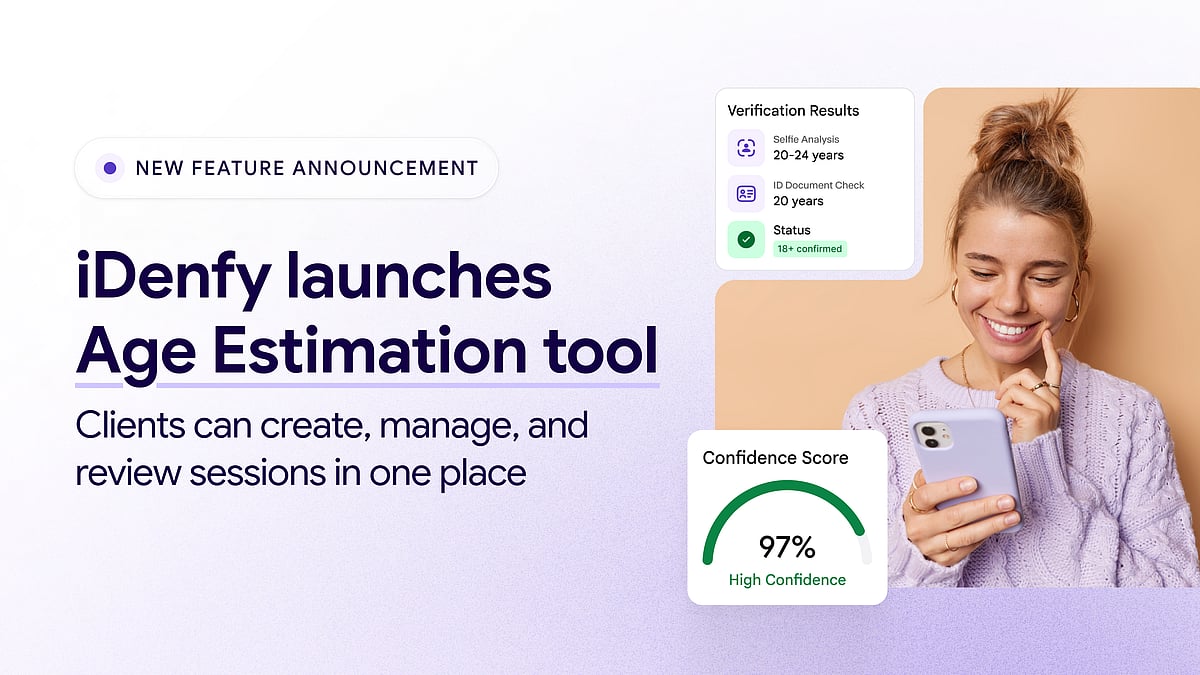
    iDenfy, a global RegTech platform specializing in identity verification and fraud prevention, has announced a significant upgrade to its age verification platform with the introduction of a new Age Estimation tool. This feature allows businesses to estimate a user’s age using a real-time selfie, eliminating the need for an ID document upload in many cases.

    How the Age Estimation Tool Works

    Traditionally, iDenfy’s age verification required users to upload a government-issued ID. With the new Age Estimation add-on, users can simply capture a selfie, and the system analyzes facial features to estimate age within a three-year accuracy gap. Businesses can set a configurable age limit and buffer zone. Users clearly above the threshold pass instantly; those near the limit are automatically routed to a certified ID document check within the same session for final verification.

    Standalone Product with Dedicated Infrastructure

    Unlike a bundled feature, iDenfy has built Age Estimation as a standalone product with its own permission structure, billing model, and API endpoints. This means partners who only need age estimation checks can access it without adopting the full identity verification stack. The dedicated dashboard provides a centralized view of sessions, token generation, and detailed session pages, supported by custom settings and verification URLs.

    Benefits for Businesses and Compliance

    Validated age data reduces the risk of underage access to restricted products while minimizing personal data collection. Because most users pass with just a selfie, companies avoid requiring government IDs from their entire user base. This supports compliance with regulations such as the UK Online Safety Act, EU Digital Services Act, GDPR, and emerging state-level laws in the US and Australia’s under-16 social media restrictions.

    Domantas Ciulde, CEO of iDenfy, commented: “Age estimation only works if the people using it can actually see what’s happening inside each session. We improved our product against disguises such as makeup or a moustache to precisely estimate people’s age and brought it into the dashboard with its own sessions list and detailed view.”

    He added: “Centralizing session creation and results in one dashboard view might sound like a small operational detail, but for partners that run age checks at scale, it removes a lot of manual tracking that used to happen outside our platform.”

    Availability

    The Age Estimation dashboard module is now available to iDenfy partners, who can integrate via API or Dashboard with 24/7 support. For more information, visit iDenfy’s age verification service page.

  • How AI-Driven Matrimony Scams Exploit Trust and Defraud Victims

    How AI-Driven Matrimony Scams Exploit Trust and Defraud Victims

    Finding a partner through a matrimonial platform has long been built on trust. However, that trust is increasingly being exploited by cybercriminals using artificial intelligence to create convincing fake identities that are difficult to detect.

    How AI Makes Scams Harder to Detect

    Cybersecurity experts report that fraudsters are no longer relying solely on stolen photographs or fabricated profiles. AI tools now enable them to generate realistic faces, manipulate voice and video interactions, forge identity documents, and maintain natural conversations for weeks, making fake profiles appear authentic.

    Victims often realize they have been deceived only after being persuaded to transfer money or invest in fraudulent schemes. According to identity verification firm Bureau, India ranks third globally for new romance scam profiles, accounting for 12% of such profiles worldwide.

    Investigations by police in different states suggest that matrimonial platforms are increasingly used to identify financially stable targets before scammers introduce fake investment opportunities or requests for financial assistance.

    Trust Becomes the Biggest Weapon

    Unlike traditional online fraud, these scams are rarely rushed. Fraudsters invest time in building relationships, speaking regularly, sharing stories about work and family, and creating an emotional connection before discussing money. By the time an investment opportunity or emergency request surfaces, many victims have already lowered their guard.

    Experts note that generative AI has significantly reduced the effort required to run such operations. A single network can create multiple believable identities, personalize conversations, and even simulate video interactions, allowing scammers to target several people simultaneously.

    Verification Is the Strongest Defense

    Cybersecurity experts have found that the increasing use of artificial identities has questioned the validity of traditional verification methods. Relying on photos, identity documents, and even video calls to validate a person’s identity is no longer enough.

    Individuals are advised to independently verify information, involve family members before making any decision, and proceed with caution if the other party quickly moves the discussion to a private chat application or talks about investments. Financial requests or demands for gifts and monetary assistance are strong indicators of fraud.

    Experts further suggest that matrimonial sites should use AI for identity verification—employing liveness detection, behavioral analytics, and device intelligence—to help curb the problem.

  • Zero Trust Security in 2026: Why Enterprises Are Ditching Passwords for Continuous Identity Verification

    Zero Trust Security in 2026: Why Enterprises Are Ditching Passwords for Continuous Identity Verification

    Zero Trust Security has become a core cybersecurity model in 2026 as companies move away from traditional password-based systems. The model follows a simple rule: never trust any user or device by default, even inside the network perimeter.

    Organizations now rely on continuous identity verification instead of one-time password authentication to reduce security risks. Multi-factor authentication has evolved into passwordless systems using biometrics like fingerprints, face recognition, and device-based trust signals.

    AI-driven security tools now monitor user behavior in real time to detect unusual access patterns and potential breaches. Cloud adoption has accelerated Zero Trust implementation, especially in hybrid and remote work environments.

    Companies are using micro-segmentation to limit access, ensuring users only reach the systems they are authorized to use. Cyber threats are becoming more advanced, pushing enterprises to adopt adaptive security systems that respond instantly.

    Experts say Zero Trust is no longer optional, as data breaches and identity attacks continue to rise globally.