

Tag: Instamart

  • Swiggy Stock Surges 6% as Domestic Ownership Crosses 50% Mark

    Swiggy Stock Surges 6% as Domestic Ownership Crosses 50% Mark

    Swiggy’s share price jumped nearly 6% on Tuesday after the company disclosed that foreign investment had fallen below 50%, pushing domestic ownership above that critical threshold. The news boosted investor confidence and sent the stock to an intraday high of around ₹267 before closing at ₹264 on the BSE. Despite the rally, the stock remains well below its 52-week high of ₹473, and its 52-week low of ₹235.85, recorded in June 2026.

    Shareholding Structure Shift

    In a stock exchange filing dated July 7, 2026, Swiggy reported that total foreign investment—including foreign direct investment, foreign portfolio investment, and other indirect holdings—stood at 49.76% as of July 6. Consequently, domestic ownership rose to 50.24%. The update follows a failed attempt by the company to amend its Articles of Association, a move that required 75% shareholder approval but received only 72.36%. Despite that setback, Swiggy reiterated that achieving Indian Owned and Controlled Company (IOCC) status remains a key long-term objective.

    Why This Matters

    Domestic ownership exceeding 50% is a significant milestone for Swiggy. It brings the company closer to qualifying as an IOCC under Indian regulations, which could grant Instamart—Swiggy’s quick-commerce arm—greater flexibility to operate an inventory-based model. This shift may improve operational efficiency and support better profit margins over time. The company clarified that the latest disclosure does not alter its ownership structure, management, voting rights, share capital, or daily operations; it merely informs investors of the updated foreign investment level.

    Market Reaction and Outlook

    The market welcomed the development, though the stock still faces headwinds. Swiggy’s share price has gained about 5% over the past month but declined 27% in the last six months and remains roughly 20% lower year-over-year. Investors are now watching for further updates on the IOCC process, which requires additional legal and regulatory steps. The company’s long-term stock performance will ultimately depend on business growth, improved earnings, and stronger results from both its food-delivery and Instamart segments.
  • Amazon and Flipkart Launch Major Discount Campaigns as Blinkit and Instamart Prioritize Profit Over Price Cuts

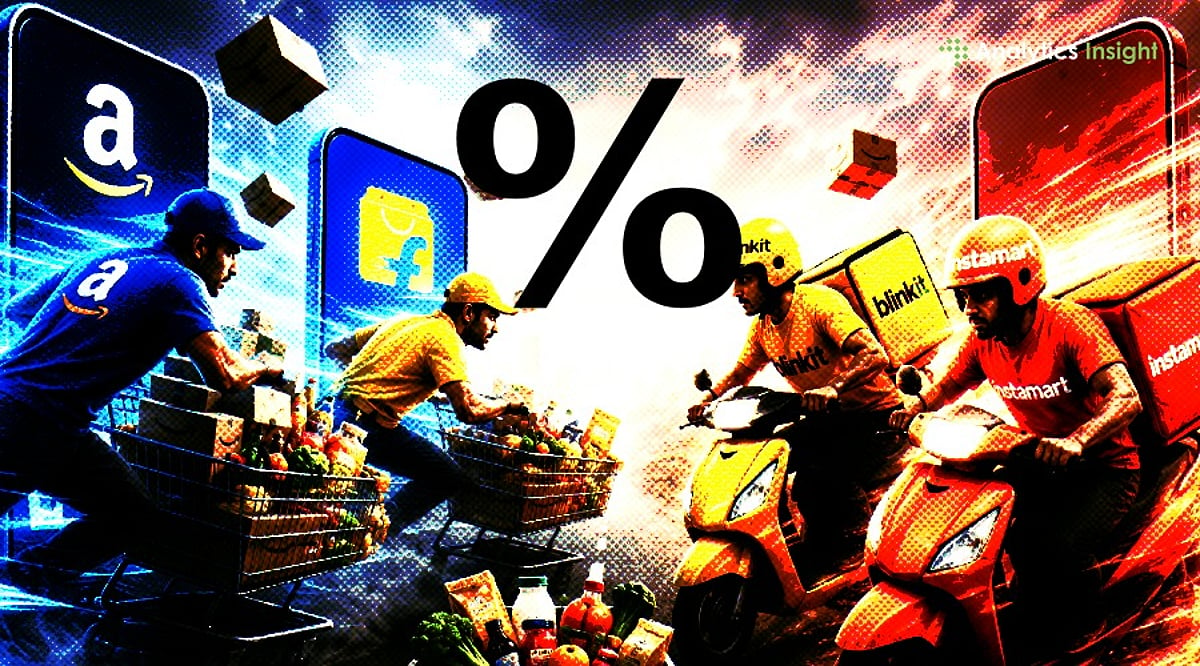
    Amazon and Flipkart Launch Major Discount Campaigns as Blinkit and Instamart Prioritize Profit Over Price Cuts

    India’s quick-commerce market is heating up as Amazon and Flipkart roll out aggressive discounts and cashback offers to capture market share, while Blinkit and Instamart take a more cautious path, prioritizing profitability over slashing prices.

    Amazon has introduced cashback ranging from Rs. 50 to Rs. 200 on various order values and plans to expand its quick-commerce service to 300 cities with 500 dark stores. Flipkart Minutes is selling select fresh fruits and vegetables for as low as Rs. 1. The company already operates roughly 1,000 dark stores and aims to reach 1,500, with a strong push into tier-2 and tier-3 cities where demand for rapid delivery is surging.

    In contrast, Blinkit—which recently reported an operating profit—is keeping discounts minimal to protect its margins. Instamart is following a similar strategy, focusing on reaching contribution margin breakeven by using delivery fees and minimum order values rather than heavy price cuts. Zepto has also intensified competition by offering selected non-grocery items for just Rs. 9 as it seeks to broaden its customer base.

    While price wars quickly attract shoppers, they also inflate losses. Industry estimates suggest the quick-commerce sector is losing between Rs. 1,300 crore and Rs. 1,500 crore each month. The challenge for all players is to grow rapidly while keeping costs under control. Analysts note that companies that balance customer acquisition with sustainable financial performance will have a long-term advantage.

    Meanwhile, the Indian government has asked platforms to avoid advertising ‘10-minute delivery’ services to emphasize rider safety and responsible practices. Speed remains important, but sustainable business models are likely to determine the next market leaders.