Tag: liquidity

  • Why a $10 Million Market Cap Is a Critical Milestone for Meme Coins

    Why a $10 Million Market Cap Is a Critical Milestone for Meme Coins

    A meme coin reaching a $10 million market capitalization may seem insignificant compared to the trillions of dollars traded in the broader crypto market. However, within the meme coin sector, this milestone carries substantial weight. It signals that a project has moved beyond the high-risk, early-stage phase and is beginning to establish real market presence.

    Survival in a Brutally Competitive Market

    The meme coin landscape is notoriously cutthroat. According to recent research, 97% of meme coins eventually fail due to weak demand, low community support, or poor liquidity. Only 0.23% manage to sustain a market cap above $1 million over the long term. Reaching $10 million, therefore, means a coin has outlasted thousands of competitors and proven its resilience.

    Community Engagement Drives Real Value

    Meme coins thrive on community support. Unlike traditional cryptocurrencies, their growth is often fueled by online discussions and social media buzz. A $10 million market cap typically indicates a large, active community across platforms like X (formerly Twitter), Reddit, Telegram, and Discord. In crypto markets, attention directly translates into demand, making community strength a key driver of future price growth.

    Improved Liquidity Builds Investor Trust

    Liquidity—how easily a coin can be bought or sold—is a major concern for small meme coins. Low liquidity can cause drastic price swings from a single large trade, scaring away potential investors. A $10 million market cap usually brings healthier trading volumes and more stable price action. This creates a safer environment for larger investors who typically avoid highly volatile, low-liquidity assets.

    The Meme Coin Market Is Rebounding

    Market data from 2026 shows a strong resurgence in the meme coin sector. The total market capitalization of meme coins currently stands at approximately $33.94 billion, with 24-hour trading volume recently exceeding $8.22 billion—an 87% spike in activity. This renewed interest signals that capital is flowing back into high-risk assets, and smaller meme coins are becoming prime targets.

    Historical Precedents: From Jokes to Giants

    Dogecoin and Shiba Inu both began as internet jokes and later evolved into major crypto projects. Dogecoin remains one of the most recognized meme coins, while Shiba Inu expanded into a full ecosystem with additional utility. These examples demonstrate that early milestones like a $10 million market cap can be the first step toward significant growth.

    Attracting Institutional Attention

    Large investors typically avoid early-stage meme coins due to extreme risk. However, a $10 million market cap changes the perception. It shows stronger market support, active trading, and improved stability. In 2026, financial analysts have even begun discussing the possibility of meme coin ETFs in the United States, indicating that traditional finance is starting to take the sector seriously.

    Why This Milestone Matters

    A $10 million market cap is more than just a number. It proves a project has survived a market where most fail. It demonstrates strong community backing, healthy liquidity, and growing investor confidence. Most importantly, it often marks the beginning of a much larger journey. In today’s digital economy, internet culture wields real financial power—and a meme coin crossing $10 million shows that online communities can create value that traditional finance can no longer ignore.

    Frequently Asked Questions

    1. Why is a $10 million market cap important for meme coins? It indicates the project has moved beyond the high-risk early stage and gained real market traction.
    2. Do most meme coins survive long term? No. The vast majority fail due to weak demand, poor liquidity, or lack of community support.
    3. How does community affect meme coin growth? Active communities generate online attention, which in crypto markets often drives demand and price.
    4. Can small meme coins become major projects later? Yes. Dogecoin and Shiba Inu both started small and later became major crypto assets.
    5. Why do large investors care after a meme coin reaches a $10 million market cap? Stronger liquidity, active trading, and market stability make the project appear more credible and safer to enter.
  • How Zero-Fee Trading Models Are Reshaping Bitcoin and Ethereum Profitability

    How Zero-Fee Trading Models Are Reshaping Bitcoin and Ethereum Profitability

    The structure of crypto trading is shifting toward lower explicit costs, tighter exchange competition, and more aggressive liquidity capture. Zero-fee models sit at the center of this transition, influencing not only how trades are priced but also how participants adapt to changing cost signals and execution conditions.

    Rather than acting as a simple pricing incentive, zero-fee regimes reshape the hierarchy of constraints that guide trading decisions. Cost is no longer a visible filter at the point of entry. Instead, it is embedded in execution mechanics, liquidity response, and order book interaction quality.

    Liquidity remains heavily concentrated in major digital assets rather than dispersed across the broader market. Bitcoin and Ethereum continue to function as the primary execution layer for global crypto exposure, meaning most meaningful cost dynamics and efficiency gains are expressed through these two instruments.

    Bitcoin trades in the high $59,000 range, while Ethereum holds near the mid $1,500 range. Both assets operate in a phase where directional conviction is inconsistent across time horizons. In this setting, returns depend less on directional accuracy and more on execution efficiency across entry, adjustment, and exit.

    Zero fees are therefore relevant not as a headline incentive, but as a structural change in how net returns are formed from gross market movement.

    What Zero Fees Actually Change

    Zero trading fees remove the explicit commission layer embedded in spot and derivatives execution, including maker and taker fees. On the surface, this compresses observable trading costs and appears to improve profitability uniformly.

    However, trading costs are not eliminated. They are redistributed into execution layers that behave dynamically rather than remaining fixed per trade. The cost structure shifts toward spread capture, slippage variability, and timing sensitivity. This creates a variable-cost regime where outcomes depend on liquidity depth, volatility, and order aggressiveness rather than predictable deductions.

    In highly liquid assets such as BTC and ETH, spreads remain tight and order books absorb moderate flow efficiently. Here, removing fees translates more directly into net performance gains because fewer structural inefficiencies offset the benefit. In thinner markets, execution friction dominates. Wider spreads and inconsistent liquidity reduce the marginal benefit, as market impact replaces commissions as the primary cost driver.

    The key shift is not cost removal itself, but the integration of execution quality into decision-making alongside price direction.

    Market Backdrop and Execution Sensitivity

    Crypto market structure continues to reflect selective liquidity concentration, where participation clusters around a limited set of large-cap assets rather than dispersing evenly across the ecosystem. Within this structure, BTC and ETH function as both tradable assets and liquidity infrastructure, acting as pricing references and absorption layers for broader market flow. This dual role increases sensitivity to cost structure changes, as execution efficiency improvements propagate through concentrated capital channels.

    When momentum weakens, price behavior becomes more fragmented. Movement shifts toward shorter cycles driven by liquidity gaps, positioning adjustments, and reactive order flow. Activity increases not because conviction strengthens, but because portfolios are adjusted more frequently. This creates a structural effect where execution frequency rises even without changes in exposure. Zero fees therefore matter through cumulative interaction rather than isolated trades.

    Why Zero Fees Do Not Automatically Improve Performance

    Zero fees do not improve trading edge. They improve the efficiency of edge realization. Research in market microstructure, including Barber and Odean’s Trading Is Hazardous to Your Wealth, shows that higher trading frequency is associated with lower net returns among retail participants. The driver is not only cost accumulation but also declining decision quality under increased activity.

    When friction exists, it filters marginal trades. When removed, that filter weakens, increasing the probability of lower-conviction execution. In crypto markets, this effect is amplified by continuous access and instant execution. Reduced friction increases both financial and behavioral trading frequency. Importantly, this does not necessarily reduce individual trade quality. It increases variation in decision quality over time, which reduces consistency in aggregate performance.

    How Zero Fees Affect Profit Mechanics

    The impact is best understood through trade-level economics. Consider a BTC position entered at $60,000 and exited after a 1% move. Gross profit is $600 per BTC. Under a typical 0.20% round-trip fee structure, about $120 is deducted, reducing net profit to $480 before slippage and spread effects. With zero fees, this deduction disappears. Market outcome remains unchanged, but gross-to-net conversion improves structurally.

    Zero fees do not change expectancy, volatility distribution, or directional probability. They improve retention of returns generated by existing strategy design. ETH and other liquid assets follow the same logic, though realized impact depends on liquidity stability and execution timing.

    Liquidity Concentration and Structural Advantages

    Liquidity remains concentrated in a small group of large-cap assets rather than evenly distributed across the ecosystem. This reflects where capital can enter and exit with minimal friction. Bitcoin and Ethereum sit at the center of this structure, functioning as both investment assets and liquidity hubs for retail, institutional, and algorithmic flow. This produces deeper order books and more stable execution compared to smaller assets.

    Two advantages follow: spreads remain tighter, reducing deviation between theoretical and executable pricing, and order books absorb volatility more efficiently, limiting extreme dislocations during rapid moves. Under zero-fee conditions, these factors determine how much of the cost reduction translates into real performance. In BTC and ETH, fee removal compounds efficiency because execution impact is already controlled. In thinner markets, slippage dominates and reduces the benefit.

    Portfolio Behavior and Rebalancing Dynamics

    Zero fees reshape portfolio construction by changing the cost of capital rotation. Active traders frequently adjust exposure between BTC, ETH, stablecoins, and selected altcoins based on volatility shifts, macro signals, or relative strength. Each adjustment normally carries a cost that influences rebalancing frequency. When fees are removed, this constraint disappears. Adjustments become easier and faster to reverse, increasing responsiveness to market shifts.

    Rebalancing becomes more continuous rather than episodic. Instead of waiting for large thresholds, traders can adjust exposure in smaller increments. This allows positioning across BTC and ETH, or majors and altcoins, to be recalibrated more fluidly as leadership rotates. Decisions become more real-time rather than delayed. The trade-off is clear: responsiveness improves, but discipline becomes more important in filtering signal from noise.

    Execution Quality Becomes the Primary Constraint

    Once explicit fees are removed, execution quality becomes the dominant performance variable. Execution quality includes entry precision, slippage behavior, order type efficiency, and liquidity depth at execution time. These replace fees as the main source of cost variation. Skill shifts from cost management to execution precision under changing liquidity conditions. Lower friction also increases trading velocity, raising the importance of pre-planned decision-making before entry.

    Leverage amplifies this dynamic. Fee savings do not affect liquidation thresholds or volatility exposure. When combined with higher frequency, portfolio risk can expand independently of execution gains.

    The Hidden Risks

    The most immediate risk is overtrading. When costs disappear, marginal setups become easier to justify, which can increase trading activity without any real improvement in strategy quality or edge. A second risk is underestimating spreads. Even in zero-fee models, bid-ask spreads and market impact can, in some cases, exceed traditional trading fees, particularly in less liquid conditions or during volatility spikes when order books thin out.

    A third risk is implicit leverage expansion. Lower friction can encourage larger position sizes or more frequent trades, while actual risk exposure per trade remains unchanged. Over time, this can quietly increase overall portfolio risk without being clearly recognized. A fourth risk is performance misinterpretation. Cleaner net P&L figures may mask inefficiencies in execution quality, timing, or order selection, leading traders to overestimate their true skill level. Over time, these factors can contribute to strategy drift, where increased activity is mistaken for improved performance or a stronger edge.

    How to Use Zero Fees on Toobit

    A practical approach starts with liquid pairs. BTC and ETH provide the clearest environment for translating fee savings into measurable gains due to deeper liquidity and tighter spreads. Monitor Toobit VIP rates and execution conditions, then evaluate whether expected movement justifies total cost, including spread and slippage. Order type selection becomes more important. Limit orders improve price control, while market orders provide speed when necessary. Lower friction increases execution frequency, so planning before entry becomes essential. Selective participation remains critical. Even without fees, not every move is worth trading. Liquidity, volatility, and structure still determine opportunity quality.

    Final Thoughts

    Zero trading fees improve crypto trading economics by removing explicit cost layers, but their real impact depends on execution behavior. The strongest benefits appear in BTC and ETH due to liquidity depth and stable execution. However, these same conditions require greater discipline because trading becomes easier and more frequent. The main limitation is behavioral, not structural. Reduced friction weakens natural constraints on unnecessary activity, increasing the importance of selectivity and execution control. Ultimately, performance depends less on cost reduction and more on disciplined capital deployment. Liquidity, timing, spread quality, and position sizing remain the core drivers of outcomes. Zero fees improve efficiency but do not replace judgment or structure.


  • Best Crypto Exchanges for High-Net-Worth Traders in 2026: Security, Liquidity, and OTC Desks Compared

    Best Crypto Exchanges for High-Net-Worth Traders in 2026: Security, Liquidity, and OTC Desks Compared

    High-net-worth crypto traders require platforms that offer robust security, deep liquidity, low fees, and advanced trading tools. In 2026, Binance, Coinbase, Kraken, OKX, and Crypto.com emerge as the top choices for wealthy investors. This article evaluates each exchange based on key criteria such as liquidity, security, regulatory compliance, and specialized services like over-the-counter (OTC) desks.

    Key Considerations for Wealthy Crypto Investors

    • Deep Liquidity: Essential for executing large transactions without significant price slippage.
    • Security and Compliance: Critical for protecting substantial portfolios and meeting regulatory standards.
    • Advanced Products: Exchanges now offer ETFs, futures, staking, and tokenized assets to cater to sophisticated investors.

    Binance: Dominant Liquidity and Expanding Services

    Binance remains the largest crypto exchange by trading volume, handling billions of dollars daily. Its deep liquidity allows high-net-worth traders to execute large orders with minimal market impact. The platform also features a robust OTC desk for private transactions and offers advanced futures products with reduced fees for VIP clients. In June 2026, Binance expanded beyond crypto by introducing direct access to U.S. stocks and ETFs, positioning itself as a competitor to traditional financial platforms.

    Coinbase: Trust Through Regulation

    Coinbase prioritizes regulatory compliance, making it a safe choice for investors seeking transparency and long-term security. Its premium service, Coinbase Prime, provides institutional clients with secure custody, advanced tools, and dedicated support. In June 2026, Coinbase restored Indian rupee support, enabling direct deposits and withdrawals, and launched index-based perpetual futures tied to AI, defense, and Nasdaq-linked sectors, broadening opportunities for advanced traders.

    Kraken: Unmatched Security

    Kraken is renowned for its strong security record, appealing to high-net-worth investors concerned about cyber threats. The exchange offers professional-grade trading infrastructure with rapid execution, deep spot liquidity, futures markets, and reliable API support. Its private OTC desk facilitates large trades without affecting public order books. Independent analysts consistently rank Kraken among the most secure platforms, with transparent reserve accounting and controlled asset management.

    OKX: Innovation for Institutional Clients

    OKX has rapidly grown into a leading exchange for wealthy traders, focusing on derivatives, automated trading, and structured products. A major milestone was its partnership with Intercontinental Exchange (owner of the NYSE) to form OKXICE, a joint venture targeting tokenized securities and blockchain-based financial products. This move bridges crypto and traditional finance, positioning OKX as a strong long-term platform.

    Crypto.com: Expanding Beyond Retail

    Originally popular with retail users, Crypto.com now attracts larger investors with over 450 supported cryptocurrencies, lending services, staking rewards, and asset management tools. In 2026, it ranks among the top platforms for crypto staking, offering both capital growth and passive income. Its growing institutional infrastructure signals a shift beyond small retail traders.

    What Wealthy Traders Should Focus On

    Large investors need more than basic trading access. Liquidity is paramount to avoid price slippage on million-dollar orders. Private OTC desks enable discreet execution of large transactions. Security measures like cold storage, insured custody, and reserve transparency reduce risk. Regulatory compliance is increasingly important as global regulations tighten. Additionally, exchanges are expanding into stocks, ETFs, tokenized securities, and lending services, creating integrated ecosystems.

    Final Outlook

    The crypto exchange industry now demands institutional-grade infrastructure for wealthy investors. Binance leads in liquidity and volume, Coinbase in trust and regulation, Kraken in security, OKX in innovation, and Crypto.com in diversification and passive income. As institutional money flows into digital assets, choosing the right exchange becomes a critical decision for serious investors.

    Frequently Asked Questions

    1. Which crypto exchange is best for high-net-worth traders? Binance offers the best combination of high liquidity, low fees, and advanced tools.
    2. Why do wealthy traders prefer OTC trading? OTC trading allows large transactions without affecting public market prices.
    3. Is Coinbase safe for large investments? Yes, due to strong regulatory compliance and secure custody systems.
    4. Which exchange offers the best security in 2026? Kraken is consistently ranked among the safest for its reserve transparency and security systems.
    5. What matters most when choosing a crypto exchange? Liquidity, security, legal compliance, custody protection, and advanced trading products are key factors.
  • Top Crypto Exchanges with the Deepest Liquidity in 2026

    Top Crypto Exchanges with the Deepest Liquidity in 2026

    Liquidity is one of the most important factors when choosing a crypto exchange. High liquidity means traders can buy or sell assets quickly without causing major price changes. Deep order books, tight bid-ask spreads, and strong trading volume help reduce slippage and improve execution quality.

    Binance remains the global leader in crypto liquidity in 2026. With some of the highest trading volumes across spot and derivatives markets, the exchange offers deep order books, low spreads, and strong liquidity for major assets like Bitcoin and Ethereum, making it ideal for large trades.

    Coinbase is a top choice for traders seeking deep USD-based liquidity and regulatory confidence. The platform is widely trusted by institutions and large investors, offering strong execution quality on major crypto pairs while maintaining a strong compliance and security framework.

    OKX has established itself as one of the strongest liquidity venues for both spot and futures trading. The exchange provides advanced trading tools, competitive fees, and deep market depth across major cryptocurrencies, making it popular among professional and institutional traders.

    Kraken continues to attract traders with its reliable infrastructure, transparent reserves, and strong fiat-to-crypto liquidity. Its deep order books for major assets and reputation for security make it a preferred platform for traders who prioritize stability and regulatory compliance.

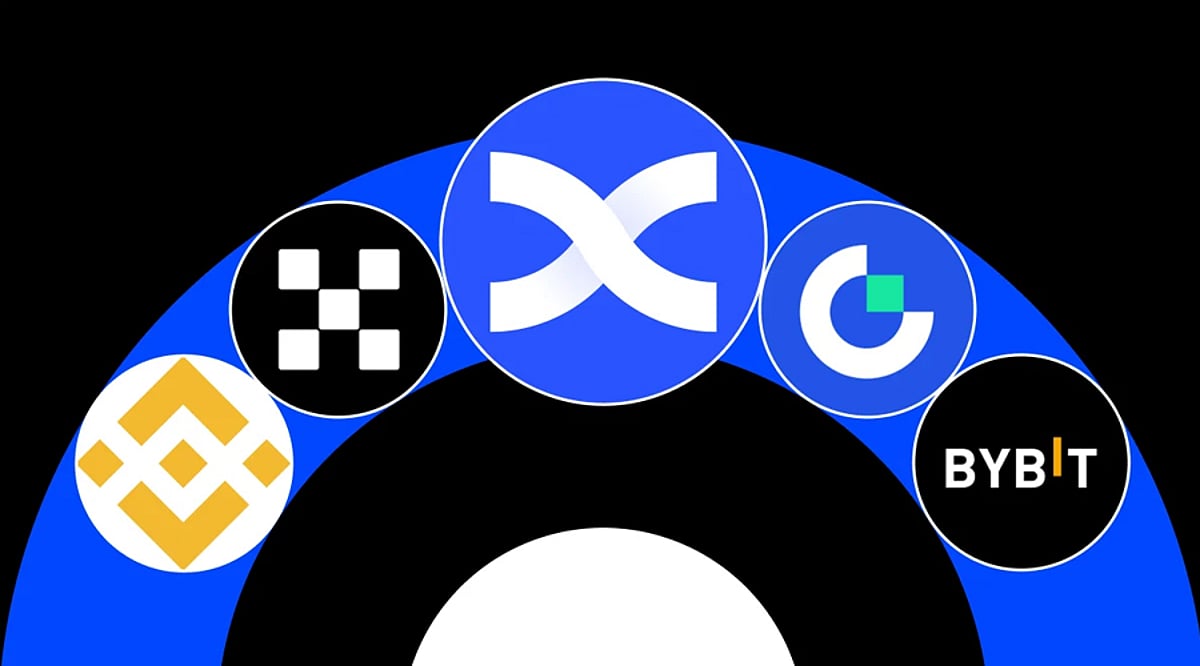
    For derivatives traders, Bybit and Bitget have become major liquidity hubs in 2026. Both platforms offer strong perpetual futures liquidity, fast execution speeds, and active trading communities. Their growing market depth helps traders manage large positions with minimal market impact.

    Before placing large trades, always check real-time order book depth, spreads, and potential slippage instead of relying only on headline trading volume. For spot trading, Binance, Coinbase, and Kraken are often top choices, while Binance, Bybit, and Bitget stand out for futures and perpetual markets.