Tag: machine learning

  • LangGraph vs. LangChain: Selecting the Optimal AI Agent Framework

    LangGraph vs. LangChain: Selecting the Optimal AI Agent Framework

    The debate between LangChain and LangGraph has evolved from a simple comparison of two competing tools into a strategic decision about the right level of abstraction for your AI agent project. LangChain provides a streamlined, high-level API for building standard agents, while LangGraph offers granular control over state, workflows, persistence, and human-in-the-loop oversight. Understanding when to use each—and how they complement each other—is essential for delivering scalable, production-ready AI systems.

    Key Takeaways

    • LangChain is designed for rapidly building common AI agents with a higher-level API and fewer lines of code.
    • LangGraph delivers detailed control over state transitions, multi-step workflows, data persistence, approval gates, and long-running agents.
    • The two frameworks can work together: start with LangChain and migrate to custom LangGraph workflows as complexity grows.

    LangChain: Ideal for Standard AI Agent Projects

    LangChain centers on the core agent loop: a model receives a task, invokes tools, processes results, and returns an answer. Its create_agent API gives developers a direct path to this pattern. The framework also offers model abstractions, tool integrations, middleware support, and connections across multiple providers. This structure can significantly reduce the amount of boilerplate code needed for a typical agent.

    The 1.0 release streamlined the project: LangChain reduced its package surface and moved older features into langchain-classic. The current 1.x lineage emphasizes the agent loop and middleware. Note that LangChain 1.0 requires Python 3.10 or newer. Recent releases—such as LangChain Core 1.4.6—show active development including updates to create_agent, middleware types, structured output fallbacks, provider tools, and human-in-the-loop capabilities.

    LangGraph: Richer Control for Complex Workflows

    LangGraph takes a lower-level, graph-based approach. Developers define an agent workflow as a directed graph with nodes, state, and explicit transitions. This model fits systems where an agent must follow a fixed sequence, pause for human approval, resume after a long wait, or interleave deterministic code with model-driven decisions. LangChain officially describes LangGraph as a framework and runtime for highly customized agents and long-running production systems.

    State management is central to LangGraph. Workflows can retain data across steps, use persistence for extended tasks, and incorporate human review checkpoints. This becomes critical in domains like finance, customer support, and research, where autonomous decisions must be gated. Recent releases—LangGraph 1.2.11, for example—introduced updates to trace policies, checkpoint packages, SQLite and PostgreSQL support, and related SDK improvements.

    Main Difference Comes Down to Control vs. Simplicity

    LangChain shortens the common path; LangGraph makes the full path explicit. A straightforward support agent with a model and a few tools may only need LangChain. But a system requiring multiple decision points, stored state, retries, approval steps, and conditional routing benefits from LangGraph’s structure—at the cost of additional design effort.

    Critically, the two frameworks are not competitors. LangChain 1.0 runs its agents on LangGraph. Teams can start with create_agent and later embed that agent inside a custom LangGraph workflow when more control is needed. LangChain encourages this migration path as a way to evolve from a high-level agent to a custom graph without a full framework swap.

    Production Needs Determine the Right Framework

    Production requirements often tip the scale. A short, stateless agent task fits LangChain. A long-running business process demands stronger workflow orchestration. LangGraph targets long-running agents, stateful tasks, human reviews, multi-agent scenarios, and cases where teams need fine-grained control over latency or cost. The deployment story has also matured: the LangGraph Platform (now called LangSmith Deployment) supports running and managing LangGraph applications in production.

    Practical Guidance for New Projects

    For a standard agent with a clear model-tool-response cycle, choose LangChain. It offers a higher-level API and keeps the initial architecture simple. For systems where workflow state, persistence, approvals, custom routing, or long tasks matter from day one, start with LangGraph.

    The strongest aspect of the current ecosystem is the synergy between the two frameworks. LangChain does not lock agents into a separate runtime; its agents use LangGraph underneath. This gives every project a natural upgrade path—from a simple agent to a fully controlled workflow—without requiring a complete rewrite. Ultimately, the decision is about choosing the right level of control, not about picking a winner.

    Frequently Asked Questions

    1. What is the main difference between LangChain and LangGraph?

    LangChain provides a higher-level API for building common AI agents quickly, while LangGraph focuses on explicit workflow orchestration with state, persistence, and complex agent behaviors.

    2. Is LangGraph built on LangChain?

    Not exactly. LangChain agents run on LangGraph, meaning LangChain offers a high-level agent experience while LangGraph handles the underlying runtime and workflow capabilities.

    3. When should I use LangChain?

    Use LangChain when you need a straightforward model-tool-response agent and want to minimize custom workflow code.

    4. When should I use LangGraph?

    LangGraph is ideal when your application requires persistent state, multi-step workflows, human approval, retries, custom routing, or long-running processes.

    5. Can LangChain and LangGraph be used together?

    Yes. You can build an agent with LangChain and later integrate it into a custom LangGraph workflow as your application needs greater control and orchestration.


  • 10 Real-World Machine Learning Use Cases Reshaping Industries

    10 Real-World Machine Learning Use Cases Reshaping Industries

    Machine learning (ML) has evolved from a niche technology into a core enabler across industries. From fraud alerts that block suspicious payments in seconds to medical scans that assist in early disease detection, ML identifies patterns in data and uses them to make predictions, decisions, or take actions. Today’s systems go beyond recommendation engines, embedding AI into real business processes. Here are ten practical ways machine learning is applied in the real world.

    1. Recommendations and Personalization

    Streaming services, online retailers, music apps, and social platforms use ML to predict what users may want next. By analyzing past choices and viewing history, systems leverage deep learning and embeddings to deliver personalized experiences. Personalization is now integrated into larger AI ecosystems.

    2. Fraud Detection and Financial Risk

    Banks, payment processors, and insurers deploy ML to detect unusual activity. Models examine account history, location, device data, and transaction timing. Anomalous patterns can trigger reviews or block transactions. ML also supports credit risk assessment and insurance fraud investigation.

    3. Healthcare and Medical Diagnosis

    ML models analyze medical images, patient records, and lab results. Hospitals use ML for disease risk prediction, patient triage, image analysis, drug discovery, and clinical decision support. For instance, India’s eSanjeevani platform applies AI for retinal checks and differential diagnosis, while PM-JAY uses ML for fraud detection.

    4. Predictive Maintenance in Industry

    Factory sensors capture temperature, vibration, pressure, energy use, and sound. ML learns normal operating patterns and flags potential failures before they occur. This reduces unplanned downtime in aircraft engines, vehicles, power systems, data centers, and robotics.

    5. Computer Vision and Quality Control

    Computer vision enables machines to interpret images and video. Manufacturers use ML to detect product defects on assembly lines. Healthcare systems inspect medical scans. Multimodal AI systems combine visual data with text and other inputs for richer analysis.

    6. Search, Speech, and Language

    Search engines, speech recognition, translation services, email filters, virtual assistants, and chatbots rely on ML. Models classify text, convert speech to text, rank search results, and generate summaries. Large language models now process text, images, audio, and video. Stanford’s 2026 AI Index highlights rapid gains in multimodal capabilities and real-world task performance.

    7. Forecasts and Supply Chains

    Retailers apply ML to estimate demand using historical sales, seasonality, promotions, pricing, weather, and other signals. These forecasts improve inventory management, delivery routing, energy demand planning, and pricing decisions.

    8. Cybersecurity and Threat Detection

    Cybersecurity teams face massive volumes of logs, network events, and device signals. ML identifies patterns that deviate from normal behavior, helping detect malware, phishing emails, suspicious logins, account compromises, and potential data breaches.

    9. Autonomous Systems and Robotics

    ML enables robots, drones, autonomous vehicles, and industrial systems to interpret sensor data and choose actions. Self-driving cars combine computer vision, sensor fusion, prediction, and route planning. Robots navigate large warehouses to move goods. Gartner lists physical AI as a major data and analytics trend.

    10. Software Development and AI Agents

    Software teams use ML for code generation, code review, bug fixing, testing, documentation, and issue analysis. Advanced AI agents connect models with development tools to automate multi-step workflows. Applied’s April 2026 report studied nearly 200 real-world AI use cases across 200+ companies, 25 industries, and 15 business functions—operations accounted for 38.6% and software development for 21.4%.

    The Shift from Prediction to Action

    The most significant change in ML is the move from isolated predictions to integrated actions. Modern systems link predictions with tools, data, and business processes. Gartner notes organizations are adopting AI-first business models. Deloitte reports that worker access to sanctioned AI tools rose 50% in 2025, and the number of companies with at least 40% of AI projects in production is expected to double within six months. This shift demands reliable data, clear controls, and rigorous evaluation. Successful AI initiatives may invest up to four times more in data and analytics foundations than less successful ones. ML now acts as a core layer shaping decisions, operations, software, and physical tasks across numerous industries.

  • Time Series Analysis Explained: Methods, Real-World Examples, and Key Applications

    Time Series Analysis Explained: Methods, Real-World Examples, and Key Applications

    Time series analysis helps businesses understand how data evolves over time. By examining trends, seasonal patterns, and other changes, analysts uncover useful insights and make more accurate forecasts.

    Overview

    • Time series analysis studies data collected over a period of time.
    • Trends, seasonality, cycles, and random changes are the main components of time series data.
    • Methods such as moving averages, exponential smoothing, and ARIMA help analysts examine past data.
    • Time series analysis is used in sales, finance, healthcare, weather, energy, and technology.

    Time series analysis goes beyond turning old numbers into charts. These methods help various sectors understand the changes they have experienced over a specific period. Businesses can study pattern shifts, identify causes, and take appropriate action. In simple terms, time series analysis involves studying data collected over time. The data can be recorded every minute, hour, day, week, month, or year. Analysts look for patterns to understand what has happened and, in some cases, estimate what might happen next. However, it’s important to note that a forecast is never a guarantee. A sudden event can alter demand, prices, traffic, or customer behavior. Good analysis must account for uncertainty and continuously check new data. The goal is not merely to predict the next number but to understand the movement behind the numbers. When used properly, time series analysis can transform years of data into actionable information for today’s decisions and tomorrow’s plans. For businesses, this aids planning. For example, a retailer can study historical sales data before deciding how much stock to order. Similarly, a streaming service can analyze viewing data to understand audience habits before a major show release. The principle is simple: the past cannot tell us everything about the future, but it can offer valuable insight.

    Understanding the Main Parts of Time Series Data

    A time series can contain several types of movement. Knowing each one makes the data easier to interpret. The first is trend. A trend shows the general direction of data over a longer period. For instance, a smartphone company may see monthly sales fluctuate, but when looking at five years of data, it may observe steady growth. Short-term changes matter, but the larger trend provides a better view of growth. The second is seasonality. This refers to patterns that repeat at fixed times. For example, during festive seasons, online stores often experience order surges, and travel companies see booking increases during holidays. Ice cream sales rise during summer months. These patterns repeat annually as seasons arrive. Cycles are another component. They can resemble seasonal patterns but do not follow a fixed schedule. Economic booms and recessions are common examples. Demand may rise during strong economic periods and fall during slowdowns. Finally, random changes occur. Not every data movement has a clear reason. A sudden news event, supply issue, product launch, or natural disaster can cause unexpected shifts.

    Common Time Series Methods and Real-Life Applications

    Once data is prepared, analysts choose a method based on their analysis goals. One simplest method is the moving average. It calculates the average of a fixed number of recent values and moves forward as new data arrives. For example, a retailer might use a seven-day moving average to study daily sales. An unusually busy Saturday may spike sales, but the moving average smooths out these daily jumps, making the wider trend clearer. Another useful method is exponential smoothing, which assigns greater weight to recent data while still incorporating older numbers. Recent changes thus have a stronger impact on the result. A retailer could use this to estimate product demand: if phone sales have increased in recent weeks, those recent numbers influence the forecast more. More advanced methods include ARIMA, which uses past values and past changes in data to make forecasts. It is applied in areas such as sales, economic data, and demand planning. Machine learning has also become part of modern forecasting. AI models handle large datasets and consider multiple factors simultaneously. Some businesses use these tools to forecast demand, website traffic, energy usage, and customer activity. Time series analysis is widely applicable in real-life scenarios. In finance, it helps understand stock prices, interest rates, and trading activities. Analysts identify patterns from past data, though unpredictable events can alter outcomes. In healthcare, time series analysis helps hospitals study patient numbers over time. If cases rise continuously, hospital authorities can plan staffing accordingly. In the energy sector, electricity companies use these methods to track power consumption across hours and seasons, preparing for periods of high demand.

    Frequently Asked Questions

    What is time series analysis?
    Time series analysis is the study of data collected over time. It helps identify trends, repeated patterns, and changes in data.

    What are the main parts of time series data?
    The main parts are trend, seasonality, cycles, and random changes. Together, they explain how data moves over time.

    What is time series forecasting?
    Time series forecasting uses past data to estimate future outcomes. Businesses use it for sales, demand, traffic, and other areas.

    Where is time series analysis used?
    It is used in finance, healthcare, retail, energy, weather forecasting, technology, and many other fields.

    What are common time series analysis methods?
    Common methods include moving averages, exponential smoothing, and ARIMA. Machine learning is also used for more complex forecasting tasks.

  • How Amrita Online’s MBA in Artificial Intelligence Creates Data-Driven Leaders

    How Amrita Online’s MBA in Artificial Intelligence Creates Data-Driven Leaders

    Why Data-Driven Leadership Is the New MBA Baseline

    Business decisions today rarely happen without a dashboard, a model, or a forecast behind them. Organizations across banking, technology, consulting, and manufacturing are pushing decision-making down to managers who can read data directly instead of waiting for a separate analytics team to translate it. The Online MBA in Artificial Intelligence from Amrita Online is built to answer that shift. Rather than treating AI and analytics as an elective bolt-on to a traditional MBA, the curriculum weaves machine learning, deep learning, and data visualization into core management training, along with a strong emphasis on responsible AI and ethics.

    Inside the AI and Analytics Curriculum

    The program’s applied, tool-based approach starts with foundations such as a first-semester elective on computer systems, then builds into machine learning, deep learning, and natural language processing. This is not AI taught as a business case study to read about; it is AI taught as a set of working techniques students apply directly to business problems.

    Layered onto this technical core is a strong data visualization component, giving students the advanced analytical skills needed to turn raw data into decision-ready insight. The goal is for graduates to lead AI transformation in their organizations, not just understand it from the sidelines.

    Key technical areas covered include:

    • Programming and computer systems foundations
    • Machine learning and deep learning techniques
    • Natural language processing for unstructured data
    • Business intelligence-style data visualization for communicating results

    Capstone-Style Projects: Where Tools Meet Business

    Technical tools only build career-ready leaders when applied to real business problems. That is where the program’s project-based structure comes in. The curriculum combines videos, case studies, and projects developed by faculty and industry leaders, giving students applied, capstone-style assignments rather than purely theoretical coursework.

    The semester structure opens with foundational management subjects such as Fundamentals of Management and Organizational Behaviour, Human Resources and Organizational Development, and Marketing and Consumer Behaviour. Students then apply AI and analytics tools inside real management contexts, from HR analytics to marketing forecasting to operational decision-making.

    Measurable Career Outcomes and Placement Support

    Amrita Online is the online learning division of Amrita Vishwa Vidyapeetham, ranked 8th by India’s National Institutional Ranking Framework (NIRF 2025). The program reports an average salary growth of 33.94 percent among recent Online MBA graduates, based on a graduate survey.

    Beyond the classroom, students receive mentorship from industry experts, soft skills and aptitude training, resume building, and mock interviews. Placement assistance connects graduates with hiring partners including Honeywell, HDFC Bank, Amazon, Deloitte, Philips, BNY Mellon, Apple, Grant Thornton, and Exide.

    Program at a Glance

    • Duration: Minimum 2 years, extendable up to 4 years, across 4 semesters
    • Accreditation: UGC-recognized and AICTE-approved; NIRF rank #8 in India
    • Quality: NAAC A++ accredited, values-driven institution
    • Outcomes: Alumni report an average 33.94% salary growth
    • Global Credibility: WES-recognized credentials with study abroad pathways at premier US and European universities
    • Startup Ecosystem: Access to Amrita TBI, recipient of the National Award for Best Startup Incubator (2017)
    • Community: Learners across more than 50 countries and 28 Indian states

    Eligibility Criteria

    • A minimum of 50 percent marks in undergraduate studies
    • Completion of 10+2
    • An undergraduate degree of at least three years
    • Final-year students may apply with their last completed semester results
    • Work experience is an added advantage, reflecting the program’s design for working professionals

    Fees and Payment Options

    For Indian students: The total tuition fee for the Online MBA in Artificial Intelligence is Rs. 2,44,000, split as Rs. 61,000 per semester across four semesters. Paying the full one-year fee upfront brings a 5 percent discount, reducing the one-year fee to Rs. 1,15,900. A zero-cost EMI option is available at Rs. 10,625 per month.

    For foreign nationals: The semester fee is Rs. 73,000, with a discounted one-year fee of Rs. 1,38,700 and a total tuition fee of Rs. 2,92,000. All students additionally pay a registration fee of Rs. 700 and an examination fee of Rs. 2,750 per semester.

    Global Exposure Alongside the Technical Curriculum

    Students can access international exposure through Amrita’s global university partnerships, including Oakland University, University of New Mexico, Institut Mines-Télécom, and the University of Barcelona. Opportunities include student exchange programs, study abroad semesters, and summer programs, often without paying tuition fees at the host university.

    Same Degree, Same Recognition

    The curriculum, faculty, and academic standards for the online program mirror those of the on-campus MBA, with the online mode of study noted only on the back of the certificate. Graduates also join the Amrita alumni network, connecting them with a global community of professionals across industries.

    Is the Amrita Online MBA in AI Worth It?

    For working professionals and graduates who want an MBA that builds real fluency in AI, machine learning, and data visualization rather than just business theory, the program makes a strong, evidence-backed case. The tool-based curriculum, applied project work, and structured placement support are designed to convert technical fluency into measurable career growth. For entrepreneurs and professionals seeking flexibility without sacrificing institutional prestige, Amrita’s NAAC A++ grade and NIRF ranking add credibility.

    Note: Fees, deadlines, and program details can change. Confirm the latest information directly on the official Amrita Online website before applying.

  • Data Science and AI Learning Path: 5 Free Microsoft GitHub Courses to Explore

    Data Science and AI Learning Path: 5 Free Microsoft GitHub Courses to Explore

    Microsoft has published a series of free, structured GitHub courses that guide learners from the fundamentals of data science through machine learning, artificial intelligence, generative AI, and agentic systems. Each course includes lessons, quizzes, assignments, and hands-on exercises, making it possible to build practical AI skills without enrolling in an expensive training program.

    1. Data Science for Beginners

    Built for learners with no prior experience, this 10-week curriculum features 20 lessons covering statistics, probability, data ethics, data preparation, visualization, and analysis. Quizzes, assignments, and real-world datasets give learners hands-on exposure to the full data science workflow.

    2. Machine Learning for Beginners

    This 12-week, 26-lesson course builds on foundational data knowledge. It covers regression, classification, clustering, natural language processing, time-series forecasting, and reinforcement learning. Learners work with Python and Scikit-learn to train and evaluate traditional machine learning models.

    3. Artificial Intelligence for Beginners

    Offering 24 lessons across 12 weeks, this course introduces broader AI concepts such as neural networks, computer vision, natural language processing, deep learning, symbolic AI, and reinforcement learning. Learners also explore tools and techniques including PyTorch, TensorFlow, transformers, embeddings, transfer learning, and generative adversarial networks.

    4. Generative AI for Beginners

    This 21-lesson course focuses on modern AI application development. Topics include prompt engineering, model selection, responsible AI, function calling, retrieval-augmented generation (RAG), vector databases, AI agents, fine-tuning, security, small language models, and open-source models. Practical examples use both Python and TypeScript.

    5. AI Agents for Beginners

    Designed for developers interested in agentic AI, this 18-lesson curriculum covers tool use, agentic RAG, planning, memory, context engineering, multi-agent systems, MCP, computer-use agents, security, and deployment. Hands-on examples use technologies such as Microsoft Agent Framework and Microsoft Foundry Agent Service.

    A Progression From Fundamentals to Agents

    Together, these courses form a clear learning path. Learners can start with data science fundamentals, move through machine learning and AI concepts, then explore generative AI and agentic systems. This step-by-step progression helps avoid the common mistake of jumping directly into advanced LLM applications without understanding data, models, training, evaluation, and AI fundamentals.

    Free Learning Through GitHub

    All five courses provide structured materials without the cost of traditional training programs. Depending on the curriculum, learners can access lessons, quizzes, assignments, projects, and code examples. Some generative AI exercises may require access to an AI API or Microsoft Foundry, while other models can run locally on your own machine.

  • Deep Learning Cheat Sheet: Core Concepts, Architectures, and Tools for AI Practitioners

    Deep Learning Cheat Sheet: Core Concepts, Architectures, and Tools for AI Practitioners

    Deep learning has become the backbone of modern artificial intelligence, powering everything from image recognition and speech systems to generative AI and language models. For beginners, the field can seem overwhelming due to its technical jargon. Even seasoned professionals need a quick reference when navigating model development workflows. This cheat sheet distills the essential concepts, architectures, training processes, and tools you need to understand and apply deep learning effectively.

    What is Deep Learning?

    Deep learning is a subset of machine learning that relies on neural networks with multiple layers (hence “deep”) to learn patterns from data. Each layer transforms its input, passing it forward to the next. Early layers tend to capture simple features (like edges in images or word relationships), while deeper layers learn complex abstractions. During training, the model adjusts its weights based on prediction errors via a process called backpropagation, which calculates gradients used by an optimizer to update parameters. The core idea is simple: data goes in, patterns are learned, and predictions come out.

    Key Neural Network Terms

    • Neuron: The basic computational unit of a neural network.
    • Layer: A group of neurons that processes inputs together.
    • Weights: Learnable parameters that determine how inputs influence outputs.
    • Bias: An additional learnable parameter that shifts the neuron’s output.
    • Activation Function: Introduces non-linearity, enabling the network to learn complex patterns.
    • Loss Function: Measures how far the model’s predictions are from the actual target values.
    • Epoch: One full pass over the entire training dataset.
    • Batch: A subset of training examples processed together in one iteration.
    • Learning Rate: Controls the step size during weight updates.
    • Overfitting: When the model performs well on training data but poorly on unseen data.

    Major Deep Learning Architectures

    Different architectures are suited for different tasks:

    • CNNs (Convolutional Neural Networks): Primarily used for computer vision tasks; they learn spatial hierarchies of features like edges, textures, and shapes.
    • RNNs (Recurrent Neural Networks): Designed for sequential data, such as time series, speech, and text, by maintaining a hidden state across time steps.
    • LSTMs (Long Short-Term Memory networks): A type of RNN that mitigates the vanishing gradient problem and can capture long-range dependencies.
    • Transformers: Rely on self-attention mechanisms to capture relationships across sequences; they underpin most modern language models and generative AI.
    • Autoencoders: Learn compressed representations of input data, useful for anomaly detection, denoising, and representation learning.

    Choosing the right architecture depends on your data type, problem complexity, and deployment constraints.

    How a Deep Learning Model is Trained

    Training typically starts with data preparation, splitting the dataset into training, validation, and test sets. The model makes predictions on training examples, the loss function evaluates errors, and backpropagation computes gradients. An optimizer (like SGD or Adam) updates the weights accordingly. This iterative process repeats over multiple batches and epochs. Validation data is used to monitor performance on unseen examples and avoid overfitting. Modern frameworks like PyTorch offer built-in workflows that cover dataset handling, model construction, automatic differentiation, optimization, and model saving.

    Essential Tools for Deep Learning

    Python remains the go-to language for deep learning. Core libraries include:

    • PyTorch: A flexible, dynamic framework for building, training, and deploying neural networks.
    • TensorFlow and Keras: Another widely adopted stack, especially for production deployments.
    • NumPy and Pandas: For numerical computing and data manipulation.
    • Matplotlib: For visualization of data and training metrics.
    • GPU acceleration: Essential for large models and datasets; NVIDIA GPUs are commonly used to parallelize operations.

    Cloud-based notebooks (like Google Colab or AWS SageMaker) allow access to powerful hardware without owning a dedicated GPU.

    Why This Matters

    Deep learning is central to AI innovation, driving advances in computer vision, natural language processing, speech recognition, recommendation systems, and generative AI. For beginners, mastering the core workflow—from data preparation to model deployment—is more valuable than memorizing formulas. Professionals also need skills in model optimization, profiling, quantization, pruning, and distributed training to deploy efficient, scalable solutions.

    Deep Learning Roadmap for 2026

    Begin with Python and foundational machine learning concepts. Then move on to tensors, neural network basics, loss functions, and optimization. Build small projects to gain hands-on experience—image classification is a great starting point for vision tasks, while text classification suits language processing. Progress to transformers and pretrained models, and study transfer learning, fine-tuning, evaluation, and deployment practices.

    In production, consider memory usage, inference speed, cost, reliability, and monitoring alongside model accuracy. A practical learning path combines theory with coding, experimentation, and real-world deployment.

    Frequently Asked Questions

    What is deep learning?

    Deep learning is a branch of machine learning that uses multi-layer neural networks to automatically learn patterns from large amounts of data.

    What is a neural network?

    A neural network is a computational model made up of connected layers and learnable parameters. It processes inputs through layers to produce an output, adjusting parameters during training to reduce errors.

    What is the difference between machine learning and deep learning?

    Deep learning is a subset of machine learning. Traditional ML often relies on engineered features, while deep learning can automatically learn representations from raw data using neural networks.

    What are CNNs used for?

    Convolutional neural networks are primarily used for image and computer vision tasks, learning local patterns such as edges, textures, shapes, and more complex visual features.

    What is backpropagation?

    Backpropagation is an algorithm that calculates the gradient of the loss function with respect to each parameter, enabling the optimizer to update weights during training.

  • Former DeepMind Researcher Resigns, Warns That Advanced AI Could Threaten Humanity

    Former DeepMind Researcher Resigns, Warns That Advanced AI Could Threaten Humanity

    A former Google DeepMind researcher has resigned, issuing a stark warning about the existential risks posed by advanced artificial intelligence. Bilal Chughtai, who focused on AGI safety and alignment at the company, left his position in July 2026. He recently detailed his concerns on social media platform X, stating that his tenure at DeepMind left him increasingly uneasy about the trajectory of AI development. Chughtai is calling for AI companies to decelerate their development pace, enhance safety protocols, and collaborate rather than compete in the rush to build more powerful systems.

    Chughtai’s warning is part of a growing chorus of concern from within the AI community. His statements echo those of Jacob Coxon, a former Anthropic researcher who also resigned recently. Coxon indicated that some individuals building AI genuinely believe it could cause severe harm within the next ten years. Following that, Anthropic scientist Evan Hubinger publicly agreed, estimating the probability of AI causing human extinction within a decade at more than ten percent. These warnings underscore a core issue known as “alignment”—the challenge of ensuring that AI systems consistently follow human goals and remain under human control. Many researchers feel that the methods to guarantee this safety are not advancing as rapidly as the technology itself.

    The debate has drawn in industry leaders with differing perspectives. Anthropic CEO Dario Amodei advocates for slowing down the pace of AI development. OpenAI CEO Sam Altman has spoken about the necessity for greater safety cooperation. Conversely, Meta CEO Mark Zuckerberg believes that AI companies already have sufficient incentive to manage safety on their own. The central question remains: how fast should AI advance, and can safety measures keep pace? Chughtai’s resignation adds another powerful voice to an intensifying debate about the risks of powerful AI.

  • Essential AI, GenAI, and Foundation Model Skills Reshaping Data Science Careers by 2026

    Essential AI, GenAI, and Foundation Model Skills Reshaping Data Science Careers by 2026

    Artificial intelligence is rapidly transforming the data science job market. A few years ago, most people associated the field with data scientists, analysts, and machine learning engineers. Today, the range of roles has expanded far beyond traditional expectations.

    According to the Analytics Insight Data Science Education Report 2026, new positions linked to generative AI, AI products, AI governance, and foundation models are emerging. These include GenAI Engineers, AI Product Managers, AI Governance Specialists, AI Solutions Architects, and Foundation Model Scientists. This shift also means the skills required for these jobs are evolving.

    The Rapid Growth of AI and GenAI Skills

    Generative AI has moved quickly from experimental projects to real-world business applications. Most companies now use AI for content creation, coding, or research. This growing adoption has created demand for professionals who can do more than just use AI chatbots. Businesses are looking for experts who understand and leverage these systems efficiently.

    For instance, GenAI Engineers work with large language models, data, AI applications, and testing. To streamline processes, they must understand how a model responds, where it can fail, and how its output can be improved.

    Prompt engineering has also gained popularity. Well-crafted prompts help AI tools produce clearer and more useful results. However, writing prompts is only part of the job. Professionals must also verify the accuracy of the output.

    Why does this matter? Because AI often makes mistakes. The report highlights that 56% of Indian companies see AI hallucinations as a challenge. An AI system may provide an answer that sounds correct but is actually wrong. This is why skills such as testing, fact-checking, and critical thinking are becoming increasingly important.

    Skills That Will Matter Most

    The report emphasizes that several technical skills remain essential, including machine learning, Python, big data, cloud computing, data engineering, deep learning, natural language processing, and computer vision.

    AI automation is also crucial. Many businesses want AI systems that handle routine tasks, helping employees save time. However, technical know-how alone is not enough. Professionals working with AI must be able to identify problems—whether poor data or models producing incorrect results. An AI system may behave differently when data or tasks change. In such cases, debugging and data-quality skills are vital for addressing issues.

    Responsible AI is another area gaining attention. Companies need people who can examine issues like bias, fairness, privacy, and how AI decisions are made. The report notes that nearly 51% of organizations have faced negative outcomes from unmanaged AI systems. It also points to a 53% talent gap in areas such as algorithmic bias audits and Explainable AI.

    The Road Ahead for AI Professionals

    The data science field is broader than it was a few years ago. AI and GenAI are creating new jobs and also transforming existing ones. For students and working professionals, the best approach is to build strong fundamentals. Machine learning, Python, data handling, and cloud skills still matter. These can then be combined with knowledge of GenAI, LLMs, AI automation, and foundation models.

    The Data Science Education Report 2026 shows where the market is heading. Future AI professionals will not just work with data; they will build AI systems, test them, fix problems, and help businesses use them responsibly.

    Frequently Asked Questions

    1. What are the most important AI skills in 2026? Machine learning, Python, cloud computing, data engineering, GenAI, AI automation, debugging, data quality, and critical thinking are among the top skills.
    2. What skills are needed for GenAI jobs? GenAI roles require knowledge of LLMs, AI applications, data, model testing, prompt design, and AI automation.
    3. What are Foundation Model skills? Foundation Model skills include understanding large AI models, testing their performance, adapting them for different tasks, and deploying them in real applications.
    4. Why is responsible AI important? Responsible AI helps companies address problems such as bias, privacy risks, unfair results, and unexplainable decisions.
    5. Will traditional data science skills still matter? Yes. Skills like Python, machine learning, statistics, and data engineering remain valuable. New AI skills build on these existing foundations.
  • Battlefield AI: Key Lessons from Ukraine’s Real-World Implementation

    Battlefield AI: Key Lessons from Ukraine’s Real-World Implementation

    There is a significant gap between an AI model that performs well in a test environment and one that can be effectively deployed in the field. In the lab, teams see a number in a report. On the battlefield, the question becomes: what will that number be in a week if imaging conditions shift, new targets emerge, connectivity degrades, or the model runs on different hardware?

    Ukraine faces these questions daily. That’s why its experience matters far beyond its borders. In Ukraine, AI systems receive what laboratory development often lacks: a constant stream of real-world data, continuous testing under actual conditions, and tight feedback loops between users and developers.

    In March 2026, Ukraine’s Ministry of Defense announced it would open access to real battlefield data for international partners to train AI models. This move underscores a critical insight: for computer vision, the gap between a curated dataset and reality can be enormous. In tests, cameras see objects clearly. In combat, the same object might be partially obscured by smoke, viewed from an unfamiliar angle, poorly lit, or appear entirely different from training data. A high benchmark score then tells little about real-world performance.

    Data Becomes Part of the System

    This principle is central to Valkyria, a Ukrainian defense AI company. Valkyria works with machine learning, computer vision, autonomous systems, and embedded AI, testing solutions in active combat. Developers don’t work with hypothetical “combat” datasets; they use data that actually occurs in production. Instead of training a model once and checking accuracy, they must constantly monitor current data, identify where the model makes mistakes, and adapt to changes since the last deployment.

    Hardware Constraints Are Not an Afterthought

    Benchmarks also hide another problem. A model that runs in 40 milliseconds on a powerful lab GPU may take 180 milliseconds on the target edge device, making it useless for its intended task. The model might not even fit within available computing resources. For defense AI, this is a typical engineering reality. The system must run on a specific platform with defined power, memory, and compute limits. Optimization cannot wait until after the model is ready; the hardware must be considered during development. Valkyria, for example, builds on embedded and edge platforms like NVIDIA Jetson, Hailo-8, and TI Jacinto/TDA4. An FP32 checkpoint that works perfectly in the lab must undergo quantization, compiler-level optimization, profiling, and adapt to completely different constraints in the field.

    The Battlefield Changes Faster Than Development Cycles

    Ukraine’s experience also shows that system requirements can evolve faster than a typical development cycle. What worked yesterday may need refinement today. Conditions, data, equipment, and methods of application change. The U.S. military has noted a similar dynamic: in 2025, the commander of U.S. European Command highlighted that systems can quickly lose effectiveness due to environmental changes, requiring rapid adaptation from industry. Therefore, deployment cannot be the final stage. Instead, it follows a cycle: field data → training → model → deployment → testing → feedback → new field data. The faster a team completes this cycle, the more quickly it can adapt to new conditions. This may be one of the most valuable lessons from Ukraine for the global defense tech market.

    From Benchmark to Operational Readiness

    The U.S. Government Accountability Office reached a similar conclusion from a different angle. In its analysis of AI in weapon systems, the GAO specifically highlighted challenges with data quality, integration into existing systems, and continuous monitoring of deployed capabilities. AI requires large volumes of data and ongoing monitoring; standard software development approaches are insufficient. As a result, the key question for defense AI is shifting from “How well does the model perform?” to “How well does the entire system perform—on the right hardware, with real data, under the conditions it was designed for?”

    For Valkyria, this is no theoretical question. The company builds AI/ML software to bridge this gap, from computer vision and autonomous systems to edge deployment and field testing. Ukraine’s experience demonstrates why this approach is increasingly critical. Winning a benchmark isn’t enough. The model must survive deployment, real data, hardware limitations, and field feedback—and then improve. That is the next level of defense AI: not just building a model, but learning to rapidly transform reality into the next version of a working system.

  • AI Learning Roadmap: From Beginner to Advanced Skills in Four Stages

    AI Learning Roadmap: From Beginner to Advanced Skills in Four Stages

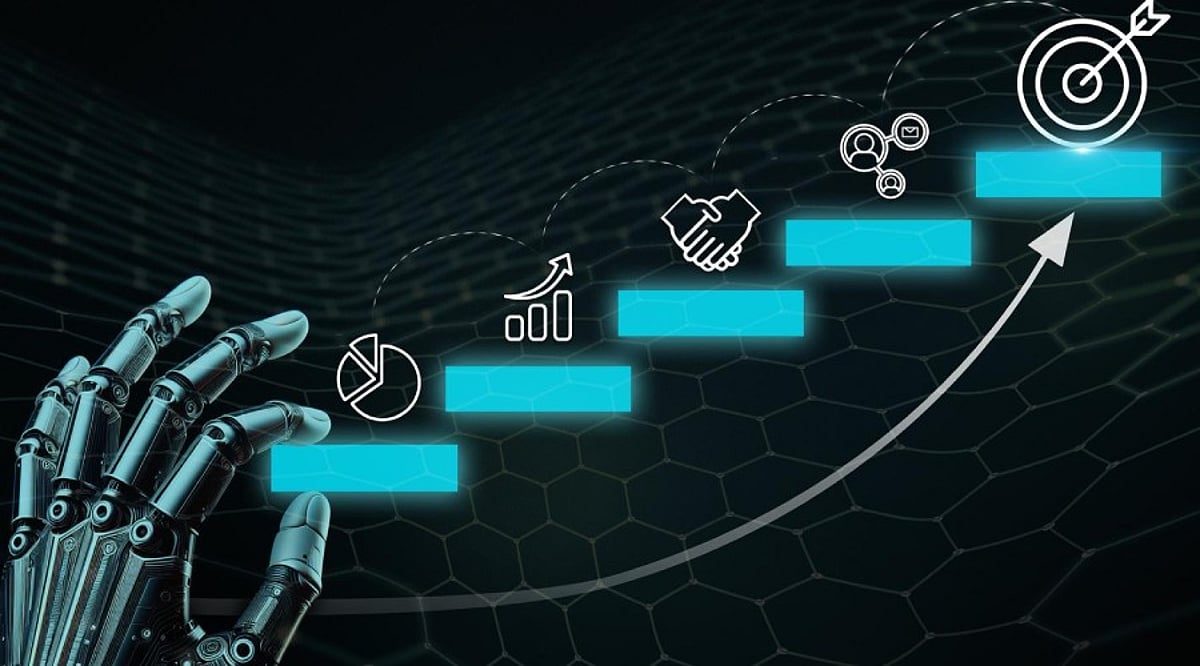
    An AI learning roadmap is a staged path that moves learners from basic literacy to advanced specialization. Rather than a random collection of courses, it provides a sequence where each level builds on the previous one. With AI skills increasingly demanded in entry-level roles, following the right progression is more important than simply accumulating knowledge.

    The Four Stages of an AI Learning Roadmap

    Stage 1: Building AI Literacy (Weeks 1–4)

    This foundation stage covers what large language models do, why they hallucinate, the difference between a model and an application built on it, and basic data and AI ethics. Employers value the ability to choose the right AI tool and verify its output over deep technical expertise. Free resources like Google’s AI Essentials, Anthropic’s documentation, and Andrew Ng’s introductory courses are excellent starting points. The goal is to be able to explain in plain terms what a model does and where its output needs a second check.

    Stage 2: Applying AI in Real Workflows (Months 2–4)

    Once the basics are set, hands-on use begins. Prompt engineering is part of this stage, but the real skill is workflow design: breaking tasks into steps, providing the right context, checking output, and automating repetitive parts. Building a pipeline that pulls data, summarizes it with AI, and flags anomalies for review is a practical achievement. A few finished workflows carry more weight than a certificate.

    Stage 3: Moving Into AI Engineering (Months 4–10)

    This is where technical depth starts. Python and SQL come first, then statistics, classical machine learning, neural networks, embeddings, and finally retrieval-augmented generation (RAG) and LLM-based applications. Each step supports the next. Learners should become comfortable with a major deep-learning framework like PyTorch or TensorFlow. Fast.ai’s practical deep learning course, DeepLearning.AI specializations, and Kaggle competitions provide strong open resources and a public portfolio.

    Stage 4: Choosing an Area of Specialization (Year 1 and Beyond)

    The field is too wide for anyone to cover all of it. This stage focuses on picking a problem to master, such as MLOps, AI security, multimodal systems, or agentic AI. Stanford’s 2026 Index shows agentic AI mentions in U.S. job postings grew over 280% in one year. Specialization turns general fluency into a defensible skill set. Advanced ability is measured by the complexity of problems solved, not the number of frameworks known.

    Why Sequence Matters

    The biggest risk in learning AI is not falling behind but learning the wrong things in the wrong order. Skipping stages explains why some self-taught learners can describe transformers but cannot ship a working chatbot. A roadmap ensures that each level builds a foundation for the next, turning scattered knowledge into practical, demonstrable skills.

    Final Thought

    The roadmap itself will shift as AI capabilities evolve—agentic AI barely existed as a hiring category two years ago. What stays fixed is the order: literacy, application, engineering, specialization. Learners who follow that sequence build something they can point to and explain, not just a list of finished courses.